The world said goodbye to Vivien Leigh in 1967 with thousands of fans lining London’s streets, weeping for Scarlett O’Hara. Inside the church, camera flashes lit up the elite of the theater world as they mourned their queen. But in the shadows stood the most tragic figure in the room, a woman no one noticed.
She was 33 years old, carrying her mother’s eyes but none of her fame. She did not cry for the cameras. She stood in eerie silence, a daughter who had been little more than a footnote in her mother’s life. Her name was Suzanne, the only child of Vivien Leigh, and that was the price she paid for her mother’s immortality.
Her disappearance from the spotlight began long before the funeral. It began before the Oscars, before the madness, before the world knew the name Vivien Leigh. The tragedy truly started in a London nursery in the early 1930s, where a small child learned her first and most painful lesson: she was a porcelain doll in a glass house, and her mother was a hurricane looking for an open window.
The story does not begin with a birth, but with a deep boredom that felt like physical pain. In 1932, Vivien Hartley, who had not yet become Vivien Leigh, was 19 years old. She was a creature of terrifying beauty and wild ambition, trapped in the constraints of conservative British middle-class life. She did what was expected of girls of her class. She married a suitable man.
Leigh Holman was a lawyer 13 years her senior, a man of kindness, intelligence, and a temperament as stable as an old clock. He offered her security, a flat in Mayfair, and a life of formal dinner parties. But Vivien hated it. She felt suffocated by the heavy curtains and the heavier expectations. She wanted to be an actress. She wanted everyone to see her.
Nature, indifferent to ambition, intervened. Months after the wedding, Vivien became pregnant. For most women of that era, pregnancy was destiny fulfilled. For Vivien Hartley, it was a prison sentence. Her diaries from that period overflow not with the joy of impending motherhood, but with frantic, erratic despair. She wrote of feeling bound hand and foot. She resented the changes in her body, the swelling that ruined her figure, the fatigue that kept her from the theater.
Suzanne arrived on October 10, 1933, in an autumn-fogged London. She was born a month premature, small and fragile, as if she too was hesitant to enter the life of the woman who would shape her fate. The birth was difficult. Vivien was exhausted, frightened, and immediately emotionally detached. When the nurse handed her the baby, she felt no cinematic rush of maternal love. There was relief that the ordeal was over, and a cold, critical curiosity. She looked at the infant Suzanne and saw a responsibility she was not ready for.
From the moment she took her first breath, Suzanne was handed to a nanny. This was, of course, the custom of their social class at the time. Children were raised in the nursery, brought down for tea at four, then returned before they became a nuisance. But in the Holman household, this separation took on a colder, different quality. The nursery at 37 Ennismore Gardens became Suzanne’s entire world. It was a world of hushed tones, starched aprons, and the steady, comforting presence of Nanny Ock.
Vivien was the visitor. And what a visitor she was. To the infant Suzanne, her mother seemed less like a mother and more like a dazzling, terrifying event. Vivien would burst into the nursery in a cloud of expensive Joy perfume, dressed in silk and fur, vibrating with an energy that made the air crackle. She would coo over Suzanne, marvel at her perfection, and treat her like a wonderful new accessory. She would play with Suzanne. She would dress her up. There are heartbreakingly beautiful photographs from that era. Vivien, impossibly young and lovely, holding baby Suzanne in layers of lace and ribbon. But look closely at the photos. Vivien is always posing. She is presenting the child to the camera. Suzanne often looks away or gazes at her mother with a mixture of awe and confusion.
That dynamic was established early. Suzanne was the audience. Vivien was the star. If Suzanne was obedient, if she smiled, if she looked pretty, if she didn’t stain the silk, she received love. She was the darling. But if she cried, threw a tantrum, or showed any of the noisy, messy needs of a child, the lights dimmed. Vivien’s face would pinch. A flash of impatience and irritability would cross her eyes, the first hint of the bipolar disorder that would define her. “Take her, Nanny,” she would say in a sharp, cold voice. “She’s boring.”
Just like that, the sun would set. Vivien would leave the room, the door clicking shut, leaving Suzanne in the aftermath of the performance. It is a deep psychological wound for a child. The realization that love is conditional, that it must be earned through perfection. Suzanne learned to be quiet. She learned to be still. She learned that to be safe, she had to be like a porcelain doll. Beautiful to look at, but silent.
As Suzanne began to grow, the atmosphere in the house began to change. The boredom Vivien had suffered during her pregnancy turned into a dangerous restlessness. She began getting small roles in films. She tasted the drug of fame and wanted more. Married life with Leigh Holman, the kind and boring husband, became unbearable. Then the lightning struck. In 1935, Vivien, now calling herself Vivien Leigh, saw Laurence Olivier on stage. She turned to a friend and said with terrifying, prophetic certainty: “That is the man I am going to marry.”
It did not matter that she was married. It did not matter that he was married. It did not matter that she had a two-year-old daughter waiting in the nursery. Vivien Leigh had decided her fate, and Suzanne was not in the script. The romance of Vivien Leigh and Laurence Olivier is often romanticized as the greatest love story of the 20th century. It was passion of operatic intensity. But for those left in the blast zone, it was a disaster. For Suzanne, the change was tangible in the atmosphere. The house became a place of slammed doors and muffled arguments.
In 1936, the crack became a complete break. Vivien and Laurence co-starred in the film Fire Over England. Their chemistry was nuclear. They could no longer pretend to continue their old lives. Vivien made a decision that would define her legacy as much as her talent. She left. She packed her bags. She left the flat in Mayfair. She left Leigh Holman. And she left Suzanne.
In the social context of 1936, a mother abandoning her child was a grave sin. It was considered unnatural. When marriages ended, the child always went with the mother. But Vivien was not a natural mother. She had the brutally self-aware realization that she could not raise a child and be Vivien Leigh at the same time. So she chose to be Vivien Leigh. The lawyers arranged custody. But reality dictated it. Leigh Holman, though heartbroken, was realistic and knew Vivien was incapable of providing a stable home. It was decided that Suzanne would stay with her father. She was three years old.
The nature of the visits changed. Vivien came as a guest. She would arrive on weekends, sometimes with Larry, sometimes alone. These visits were confusing and exhausting for a small child. Vivien would arrive with extravagant gifts, huge teddy bears, expensive dolls, things too beautiful to play with. She would try to compensate for her guilt with material things. She would hug Suzanne too tightly, laugh too loudly, and demand affection. “Do you love Mummy?” she would ask, her eyes searching Suzanne’s face with desperate intensity. “Tell Mummy how much you love her.” Suzanne, stunned by the perfume, the fur, and the overwhelming force of her mother’s presence, would nod shyly. She loved her mother, yes, but she also feared her. She feared the sudden mood swings, how Vivien’s laughter could turn to tears in an instant.
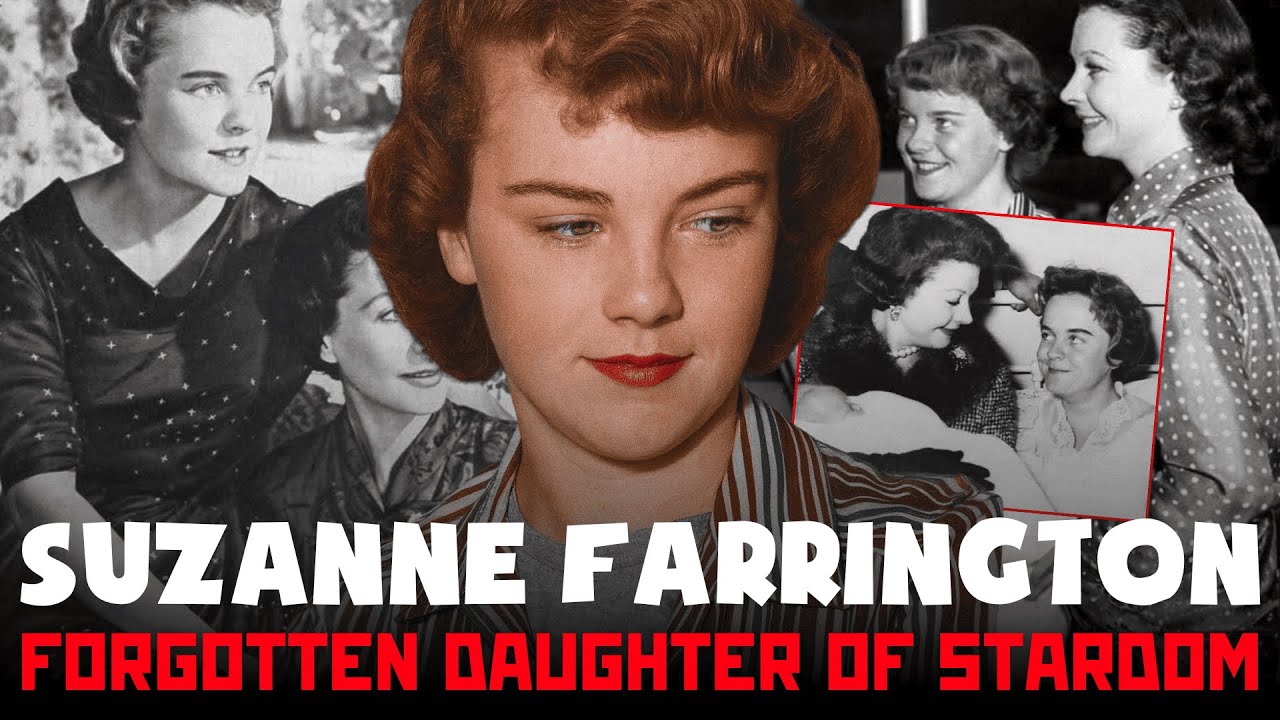
The contrast between her parents could not have been starker. Her father, Leigh, was stability and ground. He was kind, steady, and boring in the best possible way. He read her bedtime stories. He took her to the park. He never spoke ill of Vivien. He protected Suzanne from the truth of the abandonment. But a child knows the truth. A child feels the absence of a mother like a missing limb.
As 1938 approached, the world was darkening. Hitler was marching across Europe. And in Hollywood, the search was on for an actress to play Scarlett O’Hara. Vivien Leigh, possessed by a ferocious will, decided the role was hers alone. She followed Larry to America. This was the final separation. It was no longer a taxi ride to the West End. It was an entire ocean. Suzanne was five years old when her mother left for America. She did not understand geography, but she understood the silence.
Letters began to arrive. Blue airmail envelopes covered in Vivien’s erratic, looping handwriting. They were beautiful letters, full of descriptions of California sunshine and movie stars. But they were letters from an admirer, not a mother. They were performance letters. “Darling, darling Suzanne,” they would begin. “I miss you more than words can say.” But the words felt hollow against the reality of the distance. While Vivien fought for the role of Scarlett, dazzled David Selznick, and lived in a dream of forbidden romance with Olivier in Beverly Hills, Suzanne was in London learning the alphabet and waiting for the postman.
When Gone with the Wind premiered in 1939, Vivien Leigh became the most famous woman on Earth. Her face was on every magazine and every newsreel. Suzanne would see her mother’s face staring back at her from newsstands. Huge, beautiful, iconic. Imagine the confusion. To the world, she was Scarlett O’Hara, the symbol of passion and survival. To Suzanne, she was just the woman who was not there.
The war changed everything. As the bombs began to fall on London, Leigh Holman made the decision to send Suzanne away for safety. She was sent to live with her grandmother, Gertrude Holman, in the countryside, and later, there was talk of sending her further, to Canada. The separation became absolute. For long stretches of the war, Suzanne did not see her at all. She became a war orphan with a living mother. She was raised by her grandmother and the nuns at the convent school she eventually attended.
The nuns were kind, but the convent was a world of strict discipline and silence. It was the complete opposite of Hollywood. Here, Suzanne found a strange kind of solace. In the convent, no one cared about the movies. No one cared about glamour. God did not care if your mother was Scarlett O’Hara. In those quiet corridors, Suzanne began to build her armor. She learned to deflect questions about her mother. “Is it true?” the other girls would whisper. “Is your mother really that woman?” “Yes,” Suzanne would say, her face a mask of polite indifference. “But I live with my grandmother.”
She pushed the reality of Vivien away. She stopped waiting for visits. She stopped hoping the beautiful lady would come and take her home. She realized with the heartbreaking wisdom of a seven-year-old that she was not the heroine of her mother’s story. She was a prop left backstage. But even inside the convent, the shadow followed. One afternoon, the Mother Superior called Suzanne into her office. There was a newspaper on the desk. It showed a picture of Vivien Leigh and Laurence Olivier. They had finally married in California. Suzanne looked at the picture. Her mother looked radiant and triumphant. The nun said gently: “Your mother has remarried.” Suzanne stared at the photo. It was a confirmation of her status. The cuckoo had been formally evicted from the nest. Her mother had a new husband, a new life, a new continent. Suzanne had her prayers, her embroidery, and the cold, safe warmth of the convent walls. She did not cry. She simply nodded, turned, and went back to class.
By 1940, the dynamic that would define the rest of Suzanne Farrington’s life was set. She was a satellite orbiting a star that burned with an untouchable glow. She learned that getting close to Vivien meant risking being burned, but staying away meant freezing. She was seven years old and had already lived a lifetime of abandonment.
In 1940, as the bombing turned London into a scene of fire and rubble, the decision was made to evacuate Suzanne. It was a choice born of love and terror. Her father wanted her safe. Accompanied by her grandmother, Gertrude, she boarded a ship sailing through submarine-infested waters to seek refuge in Vancouver, Canada. For the next several years, Suzanne lived in a suspended reality. She was safe, yes. She had food. She was educated at a convent school in Vancouver run by nuns. But she was, in essence, an orphan of circumstance. While Suzanne learned French verbs and prayed for the soldiers, her mother was becoming a legend. Across the border in America, Vivien Leigh and Laurence Olivier were the golden couple of the Western world.
In the convent, the nuns protected the girls from the vulgarity of celebrity culture, but you cannot block out the sun. Sometimes, a newsreel would play before a film on a rare outing, or a magazine would be smuggled into the dormitory. Suzanne would see her mother’s face, imperious, commanding, impossibly beautiful. The other girls would whisper: “That’s her mother. Can you believe it?” They would look at Suzanne, the quiet girl in the simple uniform, and try to find the resemblance. The resemblance was there in the fine bones and the arch of the eyebrows, but the spirit was different. Vivien was fire. Suzanne was water. Vivien was a storm. Suzanne was the calm after it passed.
Suzanne learned to armor herself against the questions. She developed a manner of polite detachment. She would smile and nod and change the subject. She refused to trade on her mother’s fame. She did not brag about it. In fact, she seemed embarrassed by it, as if having a mother who belonged to the world meant she was not worthy of having a mother of her own. Vivien’s letters continued to arrive sporadically. They were emotional, dramatic, full of words like “darling” and “my angel.” Vivien wrote about parties, exhausting tours, and the people she met, but she rarely asked the questions a mother should ask. Are you happy? Are you lonely? Do you need new shoes?
The war dragged on. Suzanne grew from a child into a teenager in the shadow of the Rocky Mountains, thousands of miles from the bombing and light-years from Hollywood. Then in 1945, the guns fell silent. The earth sighed. It was time to go home. The reunion on the dock in England should have been a scene from a movie. The mother, crossing oceans and wars, rushing to embrace her child. The music swelling, the tears flowing. But reality is not scripted by David O. Selznick. When Suzanne stepped off the boat, she was 12 years old. She was no longer the porcelain doll Vivien remembered. She was a teenager, shy, awkward, and Canadian-influenced. She had an accent. She had opinions. She was a person in her own right.
Vivien was there to meet her, looking as beautiful as ever. But the embrace was stiff. There was a terrifying moment of recognition. Not the joy of rediscovery, but the shock of unfamiliarity. Vivien looked at this tall, quiet stranger and realized she did not know her. Suzanne looked at the radiant woman in the mink coat and realized she was frightening. Vivien took her to the car. She talked nervously. She criticized Suzanne’s clothes. She fussed over her hair. She was trying to mold her back into the perfect child she had left behind, but the clay had dried.
Suzanne did not return to her father immediately. For a time, she entered the orbit of Larry and Viv. And here the real isolation began. The Oliviers had bought Notley Abbey, a medieval property in Buckinghamshire. It was a place of breathtaking beauty and gothic romance. A 12th-century abbey turned into a home for the royalty of the stage. It had great halls, stone fireplaces, and grounds stretching down to the Thames. It was a stage set designed for their lives. Suzanne spent her school holidays at Notley. To an outsider, it might have seemed like paradise. The most famous people in the world were regular visitors. You might walk into the drawing-room to find Orson Welles reciting Shakespeare or Noël Coward at the piano or Katharine Hepburn arguing about politics. Champagne flowed like water. The laughter was loud, witty, and constant.
But for a teenage girl who just wanted a mother, Notley Abbey was a fortress of loneliness. Suzanne was the cuckoo in the nest. That phrase was often whispered by staff and friends. She did not fit. The Oliviers were a closed circle of passion and ego. They were obsessed with each other, with their work, and with their myth. There was no oxygen left in the room for a child. Laurence Olivier’s role in this dynamic was complex and cold. He was a genius, certainly, but he was also a profoundly self-absorbed man. He saw Vivien as his creation, his muse, his possession. He was jealous of anything that distracted her from him. He treated Suzanne with polite, dry coldness. He was not cruel in the sense of shouting or hitting. He was cruel in the way a cat is cruel to a mouse it has lost interest in. He simply ignored her. He made it clear through his body language and his silence that she was an intruder in their sacred space. He was Larry, not a stepfather, and certainly not a father.
Vivien, caught between her obsession with Larry and her guilt over Suzanne, became fixated on trying to compensate. She would go through intense bouts of maternal focus. She would take Suzanne to expensive dressmakers and force her into elaborate dresses Suzanne hated. She would try to teach her how to walk, how to talk, how to be charming. “Stand up straight, darling,” Vivien would scold. “Don’t mumble. Project your voice.” She was directing her daughter, not raising her. She wanted Suzanne to be a mini-Vivien, a promising starlet who would reflect well on her. But Suzanne was stubborn. She resisted the molding. She did not want to be an actress. She did not want to project. She just wanted to ride her bike. She wanted to read in her room. She wanted to be normal. This resistance infuriated Vivien.

The bipolar disorder, which had been lurking in the shadows for years, began to bare its teeth. In 1945, while filming Caesar and Cleopatra, tragedy struck. Vivien, who was pregnant with Olivier’s child, a baby they both desperately wanted, slipped on the polished studio floor. She miscarried. The loss devastated her. It triggered a spiraling depression that was terrifying to witness. At Notley, the laughter stopped. Vivien would lock herself in her room for days, crying until she was hoarse, or worse, she would enter a manic phase. She would stay awake for three days straight, polishing the silver at four in the morning, rearranging the furniture, screaming at the servants. Suzanne watched all of this from the doorway. She saw the beautiful lady fall apart. She saw the makeup running down that iconic face. She saw Larry shouting, slamming doors, and retreating to his study to escape the madness.
No one explained anything to Suzanne. Mental illness was not discussed in polite society in the 1940s. It was called “nerves.” It was called “exhaustion.” It was called “over-sensitivity.” Suzanne was left to interpret the chaos on her own. She concluded that her mother was broken, and that she, Suzanne, was somehow powerless to fix it. One terrifying incident at Notley became etched in Suzanne’s memory. During a dinner party, in the throes of a manic episode, Vivien suddenly turned on Suzanne. She began screaming at her, criticizing her appearance, her silence, her very existence. It was a verbal assault of shocking cruelty. The guests stared at their plates. Larry poured himself another drink. No one intervened. Suzanne sat there, her face burning, tears stinging her eyes. She did not run. She had learned the convent lesson. Endure. She sat until the storm passed, until Vivien collapsed into sobs and apologies.
Her father, Leigh Holman, remained her safe harbor. During holidays, she split her time. The transition was jarring. She would leave the charged drama of Notley to travel to her father’s quiet home. There, life was slow. There was tea and toast. There were dogs. There was sanity. Leigh Holman never remarried. He devoted his life to his work and his daughter. He was the only person who seemed to see Suzanne clearly. He did not want her to be an actress. He just wanted her to be happy. “Your mother is not well,” he would say gently when Suzanne arrived from Notley looking shell-shocked. “She loves you, you know, in her own way.” It was a kind gesture, a lie told to protect a child’s heart.
As Suzanne approached 18, the pressure to enter society began. Vivien was determined that Suzanne should have a social season. She wanted her to be a debutante, attending parties and finding a wealthy husband. It was the path Vivien had rejected, but she insisted on it for her daughter. Suzanne played the part. She wore the white dresses. She curtsied to the Queen. She danced with nervous young aristocrats, but she hated it. She felt like a fraud. Everyone knew who she was. “That’s Vivien Leigh’s daughter,” they would whisper. They looked for the sparkle, the fire. And when they did not find it, they drifted away. Suzanne did not want a wealthy husband or a title. She wanted a way out. She looked at her mother’s life, the pills on the bedside table, the crying jags, the desperate craving for applause, and she wanted the exact opposite.
She enrolled at RADA, the Royal Academy of Dramatic Art, but not to act. In a move that was both practical and quietly rebellious, she chose the stage management course. She learned about contracts, stage management, and the machinery that keeps the illusion alive. It was her way of demystifying the monster that had devoured her childhood. If she could understand how the theater worked, perhaps she would not be so afraid of it. But even RADA was too close to the flame. She left. She got a job at a beauty salon in Knightsbridge. It was a humble, service-oriented job. Vivien was horrified. My daughter, a shop girl? But Suzanne was happier than she had been in years. She was earning her own money. She was anonymous. She was building a self that had nothing to do with Scarlett O’Hara.
Then she met the man who would offer her the final escape. His name was Robin Farrington. He was not an actor, not a writer, not a genius. He was an insurance broker. He was tall, sturdy, reliable, and kind-hearted. He was, in every important way, a younger version of Leigh Holman. When Suzanne brought him to Notley to meet the king and queen of the theater, the contrast was comical. Vivien, shimmering in chiffon, tried to dazzle him. Larry, bored by insurance, barely spoke to him. But Robin Farrington did not care about their fame. He cared about the quiet girl with the sad eyes sitting on the edge of the sofa. He looked at Suzanne and saw her for who she was. Not as a daughter. Not as a disappointment. Just Suzanne. He offered her a key to a different world. A world of Sunday roasts, garden parties, and children raised by their parents. He offered her the one thing Vivien Leigh could never give her: peace. Suzanne grasped that key with both hands.
By the mid-1950s, the stage was set for Suzanne’s exit. She had survived the war, the convent, and the surreal gothic horror of Notley Abbey. She had watched her mother ascend to the heights of global fame and begin the terrifying slide down the other side. She knew, with a survivor’s instinct, that the ship was sinking. Vivien’s behavior was becoming more erratic, her affairs more public, her illness more pronounced. The golden couple was losing its luster. Suzanne stood on the threshold of her adult life, looking at the glittering wreckage of her childhood. She had a choice. She could stay and play the nurse, the flame-keeper, the eternal victim of her mother’s tragedy. Or she could walk out the door and never look back. She chose the door.
The greatest act of rebellion a child of chaos can commit is to be boring. For the children of artists, rebellion looks like a spreadsheet. For Suzanne Holman, the daughter of the most dramatic woman of the 20th century, rebellion came in the form of an insurance broker named Robin Farrington. It was 1957. The place was Holy Trinity Church in Brompton, a London church known for high-society weddings. But this was not just any wedding. It was a collision of two worlds. On one side, the groom’s family, solid, military, and steeped in quiet upper-middle-class British tradition. On the other side, the bride’s mother.
Vivien Leigh arrived at her daughter’s wedding not as the mother of the bride, but as a celestial event. She was 44, at the height of her fragile beauty, dressed in a formally appropriate outfit that was, in essence, a spotlight-stealer. The press was in a frenzy. They mobbed the car. They shouted for Vivien. They shouted for Larry. Suzanne, the bride, stepped out of the car in a traditional white dress. She looked beautiful, composed, and utterly terrified. But the cameras were pointed behind her. Even on her wedding day, she was the supporting actress. A lesser woman might have been crushed by this final insult. But look closely at the photos from that day, and you will see something else in Suzanne’s eyes. You will see relief. She did not want the cameras. She did not want the attention. She was happy to let her mother absorb the light. Because while the photographers were blinded by Vivien’s brilliance, Suzanne was slipping out the back door of the circus. She was marrying Robin Farrington.
Robin was a practical man. He had served with distinction in the army but never spoke of it. He worked in insurance. He loved sailing. He loved quiet. He was the complete antithesis of Laurence Olivier. He did not need to be the center of attention. In fact, he preferred the sidelines. In Robin, Suzanne found the safe harbor she had been searching for since she was a small child in her nursery. He offered her a predictable life. And for a girl raised on the rollercoaster of manic depression, predictability was the most romantic thing in the world.
The early years of Suzanne’s marriage were a deliberate construction of a fortress. She and Robin moved far from the theater district of London. They established a home that was aggressively, intentionally ordinary. There were no impromptu Shakespeare readings at three in the morning, no vases being thrown. There was tea. There was the Sunday Times. There was gardening. Suzanne embraced domesticity with a ferocity that baffled her mother. Vivien Leigh, who viewed domestic life as a prison to be escaped, could not understand why her daughter would willingly walk into the cell. “But darling,” Vivien would say during her visits, looking around Suzanne’s quiet living room with a mixture of pity and horror. “What do you do all day?” “I live,” Suzanne would reply. And she did.
She had children. Three sons: Neville, Jonathan, and Robert. And here, the cycle was finally broken. Suzanne did not hand her children to nannies. She did not leave them to go on artistic tours of America. She was present. She was the mother she never had. However, the arrival of grandchildren triggered a crisis in Vivien. In 1958, when Suzanne’s first son was born, Vivien was only 45. She was still playing romantic leads. She was still the symbol of seduction in the Empire. The idea of becoming a grandmother was abhorrent to her. It was a reminder of aging, of mortality, of the one thing she could not charm her way out of: time. She forbade the children from calling her Granny. She insisted on being called “Vivien” or “Grand-mère” in French. She treated the children with the same distant, terrified fascination she had shown Suzanne. She would hold them for a photo op, look fabulous, and then hand them back the moment they cried. Suzanne protected her sons fiercely. She limited their exposure to “Grand-mère.” She did not want them to be props in Vivien’s drama. She did not want them to see the cracks in that porcelain mask.
And the cracks were widening into chasms. While Suzanne was building her safe harbor, Vivien’s world was crumbling. By 1960, the great romance of the century, Larry and Viv, was over. The collapse of the Oliviers’ marriage was a slow-motion car crash that everyone in their circle saw coming, except perhaps Vivien. Laurence Olivier, exhausted by years of managing Vivien’s hysteria, her affairs, and her suffocating need for attention, found solace elsewhere. He fell in love with Joan Plowright, a young, stable actress who gave him peace. When Larry asked for a divorce, Vivien shattered. It did not just break her heart; it broke her entire reality. She had built her whole identity on being Mrs. Olivier. Without him, she did not know who she was.
The fallout was nuclear. Vivien entered a terrifying manic phase. She threatened suicide. She gave rambling, incoherent interviews. She was a woman on fire, burning down her own life. And who was left to pick up the pieces? Not the fair-weather friends who had drunk champagne at Notley Abbey. They all scattered, afraid of the chaos. Not Larry, who was fleeing toward his new life. It was Suzanne, the abandoned daughter, the cuckoo in the nest. The girl who had been pushed to the margins now stood at the center. But she did not step in as a daughter seeking approval. She stepped in as an adult managing a crisis. The dynamic had shifted. The power balance had reversed. For the first time in their lives, Suzanne was the strong one.
She visited Vivien in her flat at Eaton Square. She found her mother half-dressed amidst the wreckage, hallucinating and weeping. Suzanne did not flinch. She did not judge. She simply got to work. She arranged doctor’s appointments. She dealt with the press. She sat by the bedside and held the hand that had once pushed her away. It was an unglamorous, thankless task. Vivien, in her illness, was vicious. She would attack Suzanne, criticize her boring life and her dull husband, projecting her own self-hatred onto the one person who stayed. “You’re so dull, Suzanne,” she would spit. “So terribly dull.” Suzanne absorbed the insults like a sponge, knowing it was the disease talking, not the mother. Or perhaps knowing that both were talking and no longer caring. She had her own life, her own love, her own home. Vivien’s words could no longer hurt her because Vivien was no longer her goddess. She was just a patient in her care.
There is a particularly harrowing chapter from this period involving electroconvulsive therapy. In the 1960s, ECT was a blunt instrument for treating depression and mania. It was brutal. Vivien underwent several courses of treatment. Suzanne witnessed the aftermath. She saw the most beautiful woman in the world come out of the treatment room, confused, her memory shattered, her famous sparkle gone. She saw the burn marks on her temples. It was a horrifying sight. Seeing her mother in this pitiful state changed something in Suzanne’s anger. It is hard to hate a victim. The resentment she had carried for the abandonment, the years in the convent, the coldness of Notley, began to dissolve into a deep, painful pity. She realized that Vivien was not evil. She was a prisoner. A prisoner of her own brain chemistry, a prisoner of her fame, a prisoner of the impossible expectations placed upon her. And Suzanne, with her quiet life and her insurance broker husband, was the one who was free.

In the final years, a fragile truce developed between the two women. Vivien bought a country house, Tickerage Mill, not far from where Suzanne lived. It was smaller than Notley, less grand, more appropriate. Vivien would come to Suzanne’s house for Sunday lunch. Those afternoons were surreal. The great star Vivien Leigh sitting at a simple kitchen table, eating roast chicken with three noisy boys who had no idea she was a legend. She would sit in the garden watching Suzanne pull weeds from the flower beds. “You have a lovely garden, darling,” Vivien would say in her voice, hoarse from cigarettes and the tuberculosis that was slowly returning. “It’s so quiet.” “Yes,” Suzanne would say, wiping the dirt from her hands. “It is.” They did not talk about the past. They did not talk about Larry. They talked about roses. They talked about cats. They shared a deep love for Siamese cats. It was a surface relationship because the depths were too painful to dive into. But for Suzanne, the surface was enough. She had stopped waiting for the apology that would never come. She had stopped waiting for the mother she deserved. She had accepted the mother she had.
Vivien Leigh’s tragedy was that there was no third act for redemption. There was no quiet sunset. The body keeps the score, and Vivien’s body was utterly worn out. The tuberculosis she had fought in the 1940s returned with a vengeance in 1967. Suzanne saw the signs. Vivien was coughing up blood. She was frail and thin, but she refused to stop working. She was rehearsing for a play called A Delicate Balance. The irony of the title was not lost on anyone. In May 1967, Vivien collapsed. She took to her bed in her London flat. Suzanne came. She saw the fluid filling her mother’s lungs. She saw the fear in those eyes that had once faced the burning of Atlanta. Vivien did not want to die. She was terrified of the dark. She wanted Larry. She kept asking for Larry. But Larry was not there. Suzanne was there.
In those final weeks, the forgotten daughter became the guardian. She screened the phone calls. She sat in the darkened room listening to the breathing of the woman who had given her life and then abandoned her. It was a vigil. Suzanne did not cry dramatically at the bedside. She was practical. She made sure the sheets were clean. She made sure the flowers were fresh. She did the work of love, even if the feeling of love was complicated by 30 years of scars. Then, on the night of July 7, 1967, the breathing stopped. Suzanne was not in the room when it happened. Her partner at the time, Jack Merivale, found her, but Suzanne was the first to arrive. She walked into the bedroom. She saw the body of Scarlett O’Hara lying still. The hurricane was over. The wind had finally died. Suzanne stood over the bed. She did not feel a cinematic collapse of grief. She felt a vast, silent, expanding emptiness. The sun that had blinded her for 33 years had set. And for the first time in her life, Suzanne Farrington was standing in her own light.
The death of a parent is always complex, but the death of an icon is a public event. Suzanne had no time to process her own loss. She had to immediately assume the public role of the daughter. She had to plan the funeral. She had to deal with the press. She had to deal with the estate. Vivien Leigh left behind a legacy of immense value. The Oscars, the paintings, the letters from Churchill and the Queen. But she also left behind a legacy of shadows. As Suzanne stood in that church in July 1967, watching the world mourn her mother, she felt the weight of a crown being transferred to her. Not the crown of fame, she wanted no part of that, but the crown of memory. She was now the keeper of the truth. She was the only one who knew the real Vivien, the woman beneath the makeup. And as the mourners filed out and the cameras turned to her, Suzanne realized her fight for privacy was about to enter its most difficult phase. The world did not want to let Vivien go, and to keep Vivien, they would try to consume Suzanne. She would have to fight to remain herself. She would have to fight to protect the fortress of normalcy she had built with Robin from the ghosts of the past.
When the funeral flowers wilted and the press moved on to the next scandal, Suzanne Farrington was left with the physical wreckage of a glittering star. Inheriting the estate of a legend is not a gift. It is a logistical and emotional nightmare. Vivien Leigh had been a hoarder of beauty. Her homes were filled with artifacts of her life. Impressionist paintings, antique porcelain, thousands of books, racks of haute couture gowns, and two golden Oscars standing as sentinels to her talent. Suzanne, the woman who craved simplicity and order, was suddenly the keeper of a museum. She spent months dismantling her mother’s life. It was a process as delicate as a forensic examination. She wandered through the rooms of Tickerage Mill, opening drawers that smelled of Joy perfume and old tobacco. She found love letters from Larry tied with ribbons. She found diaries written in a frantic hand that spoke of mania. She found tangible evidence of a mother she never really knew.
Most people in her position would have called an auction house immediately. The 1960s were swinging. Memorabilia was all the rage. Suzanne could have made a fortune selling the Vivien Leigh collection. She did not. Instead, she packed it up. She took the paintings, the silver, the letters, and the Oscars, and brought them to her quiet farmhouse in the country. She did not display them like trophies. She integrated them into the fabric of her ordinary life. The Oscars were placed discreetly, perhaps on a bookshelf, not in a shrine. A Renoir hung on a wall where her children played with their toys. She had, in effect, swallowed her mother’s legacy, hiding it inside the fortress of her normal life. It was an act of protective containment. She did not want Vivien’s soul sold off to strangers, but she also did not want it to take over her home.
The years following Vivien’s death were marked by a different kind of loss, one that was more painful. In 1982, Leigh Holman died. If Vivien’s death was like a distant, dazzling sun going out, Leigh’s death was like the ground giving way beneath Suzanne’s feet. He had been her anchor. He was the man who stayed. He was the one who dried her tears when the letters from America did not come. He was the one who taught her that love is not a performance, but a steady presence. Suzanne mourned her father with an intensity she had never felt for her mother. At his funeral, there were no photographers. There were no fans weeping in the streets. There was only Suzanne, Robin, and her sons saying goodbye to a good, kind man who had been the silent hero of a loud tragedy.
With both parents gone, Suzanne was truly the last witness. She was the only one left who remembered the nursery at Ennismore Gardens. The only one who possessed the full, unvarnished truth of the Leigh legacy. But the world would not leave her alone. As the 1970s and 1980s progressed, the legend of Vivien Leigh grew. Biographies were written. Some were sensational, some were cruel. Gone with the Wind was re-released. The hunger for details about the star’s madness was insatiable. Journalists tracked Suzanne down. They knocked on the door of her farmhouse. They called her phone. They wanted the scandal. They wanted the “Mommie Dearest” abusive story. They wanted her to confirm that Vivien was a monster, or a victim, or a saint.
Suzanne’s response became her trademark. A polite, impenetrable silence. “I have nothing to say,” she would tell them, standing at her door, looking so much like her mother that it would stop reporters in their tracks. “Please, leave me alone.” She refused multi-million-dollar offers to write her memoirs. She refused to appear in documentaries. She understood something the world did not. Her memories were the only things she truly owned. If she sold them, she would be selling herself. She would be allowing the public to consume the last remnants of her privacy.
However, there was one ghost she could not easily banish: Laurence Olivier. For decades, Larry had been the villain stepfather in her mental narrative, the man who stole her mother, the man who ignored her at Notley Abbey. But as Olivier aged, fighting his own illnesses and demons, the dynamic changed. There were no big, tearful reunion scenes. This is not a movie. But there was a kind of thawing. Suzanne, with her infinite capacity for forgiveness, or perhaps her desire for closure, maintained a distant, cordial relationship. When Olivier died in 1989, the era was definitively over. The king and queen were dead. The court had disbanded. Suzanne was now in her late 50s. Her sons, Neville, Jonathan, and Robert, were men. They were her greatest triumph. They were stable, successful, and happy. They carried Vivien Leigh’s DNA, but none of the damage. Suzanne had filtered the trauma out of the family line. She had acted as a human shield, absorbing the radiation of her mother’s life so her children would not have to face it.
She became a grandmother herself. And here, she rewrote the script entirely. Unlike Vivien, who held her grandchildren as if they were ticking time bombs, Suzanne was utterly immersed in them. She was the baking grandmother, the story-reading grandmother, the get-down-on-the-floor-and-play grandmother. She was reclaiming her lost childhood by giving the next generation a perfect one. Yet Vivien’s shadow was always there, lurking in the corners. There is a story about Suzanne attending a screening of Gone with the Wind in her later years. She sat in the dark theater watching her 26-year-old mother flirt on the balcony of Tara. It must have been a dissociative experience, watching the woman who abandoned you being adored by the world. Seeing those eyes that had once looked at you with boredom, now gazing at Clark Gable with adoration. Did she cry? Did she feel pride? Or did she just feel that familiar, cold distance? Suzanne never said. She left the theater, put on her coat, and went home to her husband.
As she entered her final years, something strange began to happen. Suzanne started to look more and more like Vivien. The resemblance, always there, became striking. The bone structure became more pronounced. Her eyes, framed by age, held the same penetrating sharpness. It was a final biological irony. Suzanne had spent her life running from being Vivien Leigh, but nature was painting her mother’s face onto hers. Sometimes, in the village where she lived, tourists would do a double-take. “Excuse me,” they might ask. “Has anyone ever told you…?” Suzanne would smile, a small, enigmatic smile. “Yes,” she would answer. “They have.” She no longer denied it. She had made peace with the ghost. She realized she had not been living in Vivien’s shadow. She had been living in her own light. The resemblance was just an optical illusion. A genetic echo that could not hurt her.
She possessed the one thing Vivien never had: contentment. She had a husband who loved her for over 40 years, not for her fame, but for her soul. She had a home that was a sanctuary, not a stage. She had a mind at peace. But the story was not quite over. There was a final chapter of arrangement to be made. The objects, the Oscars, the paintings, the archives, could not be hidden forever. Suzanne knew she was mortal. She had to decide what to do with the physical weight of the legend before she left. She began to organize. She did not sell anything, but she catalogued. She prepared the legacy for the next generation, ensuring that when the time came, the world would see Vivien through the lens of history, not scandal. She was the keeper of the flame, but she refused to let it burn her. She held it away from her, warming her hands on it occasionally, but mostly she turned her back to the fire, gazing at the quiet green fields of her own life.
With the dawn of the new millennium, the fortress of normalcy Suzanne had guarded for 40 years faced its greatest test. The 2000s arrived with its digital noise and instant celebrity culture, a world Vivien Leigh would not have recognized, and a world Suzanne ignored with discipline. She remained in her English country retreat, a woman out of time, tending her garden and her cats. But time, the undefeated opponent, was closing in. In 2002, the fortress received its strongest blow. Robin Farrington died. For 45 years, Robin had been the wall Suzanne leaned on. He was the anti-Olivier. Where Larry was volatile, vain, and brilliant, Robin was steady, modest, and present. His death was not a public tragedy. There were no front-page obituaries. It was a private amputation. Suzanne was 68 years old. For the first time since 1957, she was facing the world without her anchor. Her grief was quiet. There were no manic episodes, no public breakdowns. She mourned as she lived, with dignity. She continued to host Christmas dinners for her sons and grandchildren. She continued to volunteer in her village. She proved once again that she had broken the curse of the Hartley-Leigh line. The trauma stopped with her. She did not fall apart.
As she entered her 70s and 80s, the physical resemblance to Vivien became undeniable, almost haunting. It was as if the genes were playing one final, ironic joke. The older she got, the more she looked like the woman she had spent her life running from. In her final years, Suzanne made a decision about the museum she was living in. The Renoirs, the Oscars, the silver cigarette boxes inscribed with love letters from Larry. They were still there, woven into the fabric of her home. She knew that after her death, her sons would have to deal with the burden of this history. She did not sell them while she was alive. Perhaps she felt a duty to keep the collection together, as a final act of loyalty to the mother who had entrusted her with nothing but her possessions. Or perhaps she simply liked having them around, not as relics of a star, but as the only pieces of her mother she was ever allowed to keep.
She lived to be 81. She saw her grandchildren grow up. She saw the world change. And she did it all without giving a single tell-all interview. She took the secrets of Notley Abbey and the silence of the convent with her to the grave. On March 1, 2015, Suzanne Farrington died. It was a death that was the complete antithesis of her mother’s. Vivien Leigh died at 53, gasping for breath, her lungs full of fluid, her mind tormented by lost love and fading beauty. Suzanne died as a peaceful old woman, surrounded by a family she had raised with her own hands. The news was announced, of course. The headlines read: “Vivien Leigh’s Daughter Dies.” Even in the end, the descriptor clung to her. But the story within was different. It was the story of a life well lived, not a tragedy cut short.
The final twist in the tale came two years later, in 2017. Suzanne’s sons, faced with the vast collection of memorabilia their mother had guarded for 50 years, made the decision to share it with the world. Sotheby’s announced the auction of the Vivien Leigh collection. It was a landmark event. For decades, biographers and fans had wondered what had happened to Vivien’s personal effects. Suzanne had kept them hidden, protected by her silence. Now the doors were thrown open. The catalogue was a revelation. It was not just about the diamonds and the paintings. It was about the intimate detritus of a life. There was a copy of Gone with the Wind inscribed by author Margaret Mitchell to Vivien. There was the wig she wore as Blanche Dubois. There were the letters, hundreds of them, revealing the passion, wit, and despair of Larry and Viv. But among the glittering lots were quieter objects. The silver cup given to Suzanne at her birth. Photographs of a teenage Suzanne smiling shyly at Notley Abbey. Proof that she was there, despite the distances. The auction raised millions, but more importantly, it felt like a final exhale. Suzanne had guarded the flame for half a century. Now, she was releasing it. She was giving Vivien back to the public where she had always belonged. Suzanne no longer needed those things. She was with her parents now, and one hopes that in that final meeting, the roles of star and audience dissolved, leaving only a mother and a daughter.
History is written about the people who shout. It is written about the stars, the geniuses, and those who burn cities and break hearts. We are taught to look at Vivien Leigh, her fire, her rage, her talent, and call it a great life. But Suzanne Farrington’s story challenges that definition. She was the extra in the greatest film of the 20th century. She was the character in the background while the leads dominated the frame. She was given a script that required her to be a victim. The abandoned child, the tragic daughter, the collateral damage. But she refused to read those lines. Instead, she wrote her own play. It was a quiet play. It was about gardening and raising children and kindness and staying with a good man. She won no Oscars. She received no standing ovations. But she got a happy ending. Suzanne Farrington looked into the abyss of fame, that drug that killed her mother, and said, “No, thank you.” She looked at the allure of playing the victim and chose to be the author of her own story. She looked at the chaos of artistic genius and chose the beauty of an ordinary life. In the end, she is not the forgotten daughter. She is the one who survived it all. In the end, she was not the tragic extra in someone else’s epic. She was the one who quietly chose real life over the roar of the spotlight and never looked back. And in a family marked by tragedy, happiness was the ultimate rebellion.