When we think of Princess Diana, the images are immediate and iconic. We see the shy smile of a young bride, the compassionate gaze in a minefield, and the heartbreaking image of a funeral that stopped the world. Her story has been told a thousand times. But behind the most famous woman of the 20th century stood another woman, an enigma whose own story is the forgotten prologue to the one we all know.
This is the story of her mother, Frances Shand Kydd. She was born into the highest echelons of the British aristocracy, yet committed a sin that world would never forgive. She gave the world a princess, but ultimately lost her daughter in a storm of anger and silence. To understand Diana’s deep-seated fear of abandonment and her defiant spirit, we must first understand the woman who shaped her in both presence and absence.
To understand Frances, you have to picture the world she was born into. Britain in the 1930s and 1940s was a place of unshakable tradition, especially for the aristocracy. Society was a rigid structure of duty, expectation, and appearance. For a young woman like Frances Roche, born in 1936 into the inner circle of the royal court, the path was already laid out.
Her father was the fourth Baron Fermoy, a friend of King George VI. Her mother, Ruth, was a formidable character, a confidante and woman of the bedchamber to the Queen Mother herself. This was a world where marriage was a career. Duty was to your husband, your title, and above all to producing an heir. Emotion was a private affair. It was a gilded cage, and Frances, with her vibrant spirit and dangerously romantic heart, was born right in the middle of it.
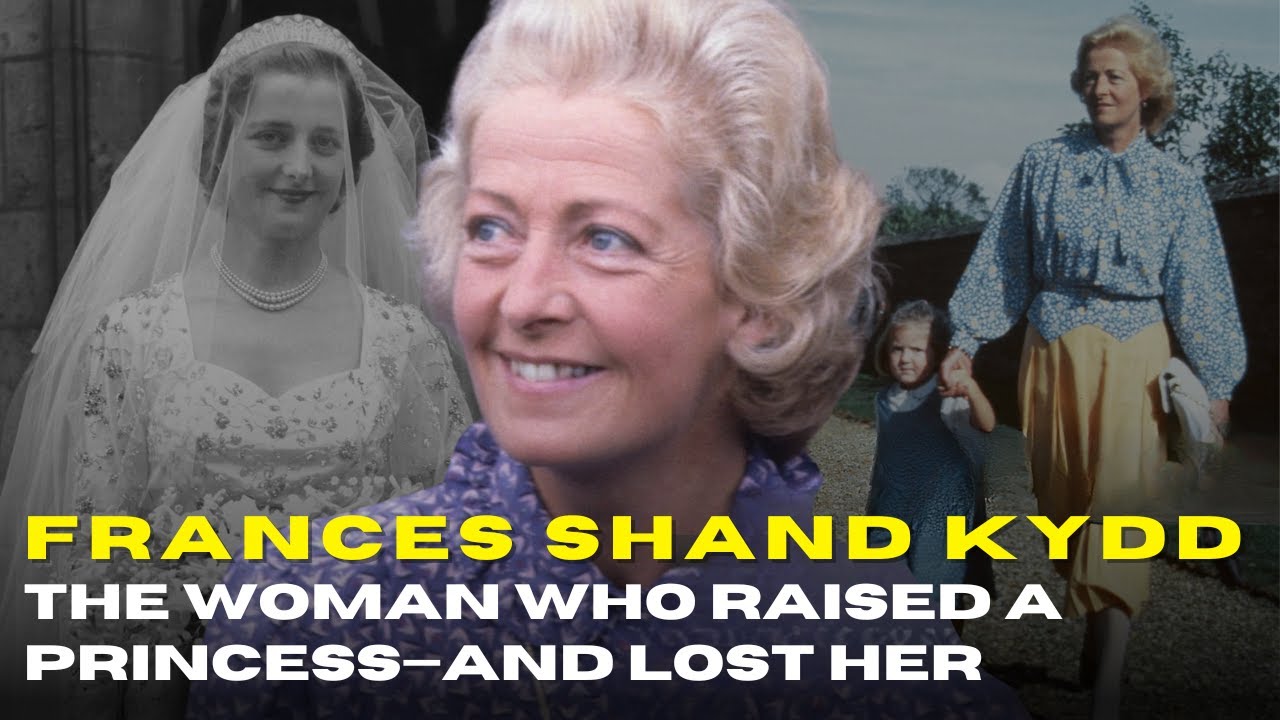
At just 17 years old, she caught the eye of one of Britain’s most eligible bachelors, Edward John Spencer, Viscount Althorp, a man 12 years her senior. To the outside world, it was a perfect match. Their wedding in 1954 was the society event of the year. Westminster Abbey was filled to the rafters, and the young Queen Elizabeth herself was a guest.
At only 18, Frances became a viscountess. She was the youngest bride to be married in the abbey in decades. The newsreels of the day show a radiant, if slightly overwhelmed, young woman on the arm of a proud, handsome aristocrat. They moved to Park House, a large home on the Queen’s own Sandringham estate in Norfolk. On paper, it was idyllic.
Children soon followed. Sarah arrived in 1955, then Jane in 1957. Frances had fulfilled her first duty. But the most important duty for the wife of an earl was yet to come. She needed to produce a son, a male heir to carry on the Spencer name. It was here, in the quiet isolation of Park House, that the first deep cracks in the fairy tale began to appear.
In January 1960, Frances gave birth to a son, John. The relief and joy were immense, but tragically short-lived. The infant boy was born with severe deformities and survived for only 11 hours. Today, we understand the devastating psychological toll of losing a child. But in the stoic culture of the 1960s aristocracy, there was no language for this kind of grief.
Frances was reportedly forbidden from even speaking of it or seeking comfort. Her husband, himself devastated, was a product of his time, unable to connect with her grief. Instead, Frances was immediately dispatched to Harley Street doctors in London. The mission was clinical and clear: find out what was wrong with her and ensure the next child was a healthy boy.
Imagine the immense pressure and suffocating loneliness. She was a young woman grieving the loss of her baby, treated not as a bereaved mother but as a faulty vessel. This trauma would echo through the rest of her life and profoundly shape the child she had next.
Eighteen months later, on July 1st, 1961, another daughter was born. She was a healthy, beautiful baby girl. But in the cold calculus of aristocracy, she was another disappointment. They named her Diana Frances. The future Princess of Wales entered the world under the shadow of a dead brother and the weight of her parents’ desperate desire for a son.
The birth of a son, Charles, three years later finally secured the Spencer succession. But it was too late to save the marriage. The shared trauma of baby John’s death had not brought Frances and Johnny closer. It had carved a silent, unbridgeable canyon between them. Johnny was absorbed in his duties as an earl, while Frances felt like a prisoner in the Norfolk countryside.
She was young, full of life, and desperately unhappy. Then someone else entered the picture. His name was Peter Shand Kydd. He was a handsome, charming heir to a wallpaper fortune in Australia. He was married with children, but like Frances, he was trapped in a loveless union. They met at a dinner party in London and began an affair.
In 1967, Frances made a decision that would detonate a bomb in the heart of the British aristocracy. She left her husband and she left her children. The scandal was immediate and immense. In her world, wives endured. They maintained the facade at all costs. For a woman to leave her husband and children for another man was an unforgivable sin.
The press and society branded her with a single devastating word: bolter. It haunted her for the rest of her life. She would later say, “I think bolter is a dreadful word. It sounds like a horse who’s broken out of its stable. I just went.” In her mind, it wasn’t an act of abandonment, but an act of survival.
But her decision came at a terrible price. Johnny Spencer sued for divorce on the grounds of her adultery. The custody battle that followed was brutal. In the witness box, a key figure testified against Frances, painting her as an unfit mother. That witness was her own mother, Ruth, Lady Fermoy.
Lady Fermoy, a staunch traditionalist and loyal courtier to the Queen Mother, was horrified by her daughter’s breach of protocol. She chose duty to the establishment over loyalty to her own blood. As a result, Johnny was granted full custody of all four children. Frances was allowed to see them during school holidays, a visitor in her own children’s lives.
Young Diana, only 7 years old at the time, remembered hearing the crunch of the gravel as her mother’s car drove away from Park House for the last time. It was a sound, she said, that she never forgot. That sense of abandonment would become a defining wound in Diana’s own life.
Frances married Peter Shand Kydd in 1969 as soon as their divorces were finalized. They fled the judgmental glare of London society and sought refuge on the remote windswept island of Seil, off the west coast of Scotland. Here she tried to build a new life. She ran a small gift shop, enjoyed the anonymity, and embraced the rugged beauty of her new home.
Her children would come to visit during their holidays. For a time, these visits were filled with a kind of chaotic, unconventional fun that was the complete opposite of their formal life with their father. Frances was a loving mother, but a volatile one. She and Diana in particular were cut from the same emotional cloth.
They were both passionate, stubborn, and could go from laughter to tears in a heartbeat. Their relationship was a tempestuous sea of deep love and fierce arguments. They were, as one friend put it, more like turbulent sisters than mother and daughter.
When Diana became engaged to Prince Charles, Frances was thrust back into the royal world she had fled. She was there at St. Paul’s Cathedral, watching her 20-year-old daughter marry the future king. But behind the scenes, things were complicated. Frances saw the immense pressure the monarchy was placing on her emotionally fragile daughter.

She understood the loneliness of being an outsider in that cold, formal world because she had lived it herself. She once told a biographer, “I knew from my own experience that it was a world where you could be incredibly lonely.” She worried for Diana, but her ability to help was limited. She was herself still seen as an outcast.
The parallels between their lives were uncanny. Both married older, more serious men in grand society weddings. Both felt isolated and emotionally starved within their marriages. Both sought love and validation outside their marital vows. And both were relentlessly pursued by a press that would build them up only to tear them down.
As Diana’s fame exploded, the distance between mother and daughter grew. Frances resented the media intrusion that now followed her, even to her remote Scottish hideaway. Diana, in turn, sometimes felt her mother didn’t fully understand the unique pressure she was under. Their phone calls could be loving one day and filled with screaming arguments the next.
Adding to Frances’s private turmoil, the escape she had fought so hard for began to crumble. After nearly 20 years of marriage, her second husband Peter Shand Kydd did to her what she had done to Johnny Spencer. In 1988, he left her for a younger woman. The irony was devastatingly cruel. The woman branded a bolter was now the one who had been bolted from.
In this period of profound loneliness, Frances made a choice that surprised everyone. In 1994, she converted to Roman Catholicism. For a woman born into the heart of the Anglican establishment, this was a radical step. It was a clear rejection of the world of her birth. But for Frances, it seemed to be a search for peace and forgiveness.
The most painful chapter of her life was still to come. As Diana’s marriage publicly disintegrated in the 1990s, she relied on her mother for support. They spoke on the phone constantly, but their relationship remained as volatile as ever. Then, in the spring of 1997, it broke for good.
The exact cause of their final rift is a matter of debate. In the spring of 1997, Diana was newly divorced and navigating a treacherous new world. She was finally free, but also incredibly vulnerable. The battle over her royal highness title wasn’t about vanity. Losing it felt like a deliberate final push out of the family she had given her life to.
Frances gave an interview to Hello magazine from her remote Scottish home. From her perspective, watching her daughter shed the constraints of royalty was a victory. She said it was wonderful that Diana was her own person now, adding, “You don’t need a title to be who you are.” She likely thought she was echoing her daughter’s own quest for freedom.
But Diana didn’t hear solidarity. She heard dismissal. She was working tirelessly to establish a new serious identity on the world stage, most notably through her campaign against landmines. She felt her mother’s public comments undermined these efforts. Worse, she was speaking about it to the press, the very institution Diana saw as a relentless predator.
There was another deeply personal layer to their dispute. Diana was embracing life, finding love again with heart surgeon Hasnat Khan and later Dodi Fayed. These relationships with Muslim men represented a bold step away from the stuffy world of the aristocracy. But for Frances, her newfound Roman Catholic faith had become the central pillar of her existence.
Some close to the family insist the final explosive argument was over her maternal concern about Diana raising the future king of England while in serious relationships with men from a different faith. It was a clash between Diana’s hard-won personal liberty and Frances’s deeply held spiritual certainty.

Whatever the precise words exchanged in that final furious phone call, the damage was absolute. Diana accused her mother of meddling and betrayal. According to an account provided by her butler, Paul Burrell, she ended the call with the devastatingly final words: “I am never going to speak to you again.” And she kept her promise.
The silence that followed was a cold, heavy blanket. For four months, Frances was completely shut out. The phone, which had so often been their lifeline, was now dead. Frances’s letters, filled with pleas for forgiveness, were sent back unopened. Each returned envelope was a fresh stab of rejection.
It was a tragic and ironic role reversal. The daughter who had spent a lifetime nursing the wound of being left was now inflicting a similar pain on the mother who had left her. Frances could only wait, hoping for a thaw that never came.
Then came the unthinkable. On August 31st, 1997, Frances was alone in her quiet house on the Isle of Seil when the news began to trickle out. She learned of her own daughter’s death the same way the rest of the world did, as a chaotic, unbelievable news story. The first official phone call she received was not from family. It was from a journalist.
The weight of that final unresolved argument must have crashed down on her with unbearable force. The ordinary shattering grief of losing a child was fused with the unique agony of knowing their last words had been spoken in anger. The door hadn’t just closed. It had been slammed shut, and now it was locked forever.
She flew to London, a journey into the heart of a global spectacle of mourning. The world saw a mother grieving her famous daughter. But she was a woman grieving the lost chance to ever say sorry, to ever hear her daughter’s voice again. She had lost her daughter twice, once to a bitter argument and now irrevocably to death.
So what is the legacy of Frances Shand Kydd? It’s easy to see her simply as a footnote in a more famous story, or to accept the cruel label of the bolter. But her life tells a much richer, more complex tale. It’s a story about the stifling expectations placed on women and the courage it takes to defy them, whatever the cost.
Her significance ultimately is measured in the daughter she raised. It was Frances who gave Diana her rebellious spirit, her emotional heart, and her deep-seated suspicion of the establishment. Diana’s empathy for outsiders wasn’t just a royal duty. It was in her DNA, inherited from a mother who had become an outsider herself.
In a strange way, Frances’s decision to leave, the very act that wounded Diana so deeply, may have also been the thing that prevented Diana from simply disappearing into the rigid machinery of the monarchy. It gave her an independence of spirit, a fire that the palace could never quite extinguish.
In her final years, Frances lived a life of quiet solitude on her Scottish island. She was a devout Catholic, a doting grandmother, and a woman who carried the immense weight of her past with a quiet grace. She rarely gave interviews, wanting no part of the media circus that had defined and destroyed so much of her family’s life.
She was a woman of profound contradictions. She was an aristocrat who ran a gift shop, a debutante who chose exile, a mother whose love was both her children’s anchor and their storm. Her choices brought great pain to herself and to those she loved most. But they were the choices of a woman trying to breathe in a world that was trying to suffocate her.
Frances Shand Kydd died in 2004 after battling Parkinson’s disease and brain cancer. She was buried in a quiet cemetery in Oban overlooking the Scottish sea that had been her final refuge. Her life was not a fairy tale and it did not have a simple happy ending. It was a messy, beautiful, tragic and deeply human story.
She was the mother who left, yes. But she was also the woman who gave the world Diana. And in the end, that is a legacy more powerful and enduring than any title.