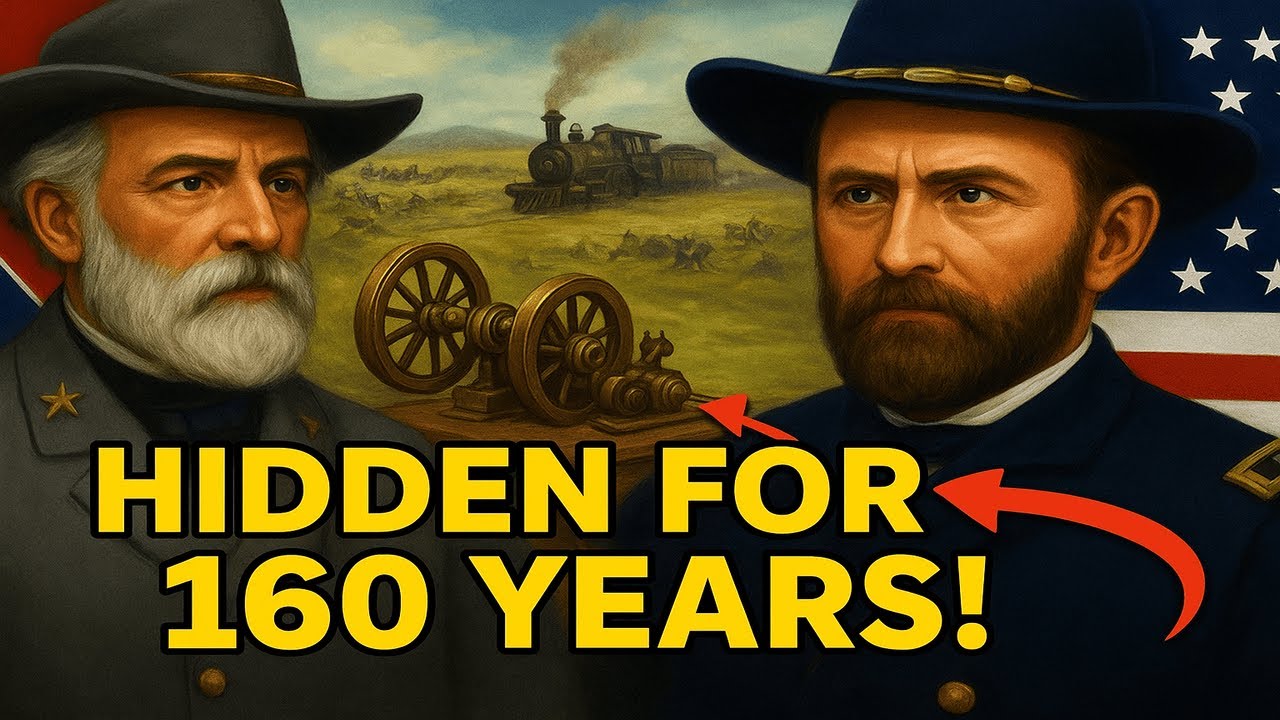
By July 1864, two generals faced each other in Virginia. Robert E. Lee, the master of maneuver, met Ulysses S. Grant, the relentless grinder. Behind the gunsmoke and cannon fire, another force shaped the war. It was not courage or strategy, but technology. The Civil War had become the birth of modern warfare, and Lee was fighting not just Grant, but the industrial revolution itself.
The telegraph was the first instant battlefield network. Before the war, generals relied on quills and couriers. Orders could take hours or days to arrive. Grant turned the telegraph into a weapon. The Union strung more than 15,000 miles of wire, connecting generals, rail depots, and headquarters. With a tap of his finger, Grant coordinated movements across hundreds of miles and received near real-time updates from Washington.
Lee had no such luxury. His army depended on couriers slipping through forests and enemy lines. Messages could arrive too late or never at all. Lee could plan a daring maneuver, but reinforcements might never arrive because orders were still bouncing along a muddy Virginia road in a messenger’s satchel. Grant was not just fighting Lee. He was fighting faster.
Railroads became the steel arteries of war. The Civil War was the first great conflict where railroads dictated victory. The Union controlled over 22,000 miles of track, almost triple the South’s. Grant could move an entire corps, thousands of men with artillery and supplies, in less than a day. His armies were not bound by the speed of marching feet.
For Lee, railroads were both lifeline and liability. Confederate tracks were narrow, worn, and few. Union cavalry raids tore up rails and burned depots, leaving Lee stranded. At Petersburg, Grant’s slow strangulation of Confederate supply lines hinged on cutting off the last railroads feeding Richmond. Once those lines were severed, Lee’s army began to starve.
The rifled musket and the minie ball changed the nature of combat. In Lee’s youth, armies fought at close range with smoothbore muskets effective barely 100 yards. By the 1860s, the rifled musket could kill with precision from 400 yards. The battlefield became longer, deadlier, and unforgiving.
Generals on both sides clung to Napoleonic tactics. Mass infantry charges across open fields became suicidal. At Cold Harbor, Grant ordered such an assault. Within 20 minutes, 7,000 Union men lay dead or wounded. Veterans called it a massacre. The weapon had outpaced the tactics, and both Lee and Grant were forced to adapt or watch their men die in heaps.
Artillery also underwent a revolution. Rifled artillery could hurl shells miles farther with shocking accuracy. At Petersburg, Union engineers mounted massive siege guns on rail cars, creating mobile artillery platforms. Lee, who once thrived on open-field maneuver, found himself hemmed in by a storm of iron. Every attempt to shift troops risked annihilation under shellfire.
The rifle and cannon forced both armies to dig. At Petersburg, men burrowed into the earth, carving labyrinths of trenches and bomb proofs. Soldiers lived like moles in a world of mud, smoke, and endless waiting. Attacks across open ground were near suicidal. Lee’s army endured this grinding siege for nearly ten months. It was a foreshadowing of the trenches of the Somme and Verdun half a century later.
For the first time, generals looked down on their enemy from the heavens. The Union Army’s balloon corps floated hundreds of feet above battlefields, observing troop movements and sketching maps in real time. With a telegraph wire dangling from the basket, observers sent reports straight to headquarters. Lee rarely had access to balloons. Confederate maneuvers were often exposed from above, robbing Lee of the surprise that once made him so dangerous.
The Union Navy with its ironclad warships enforced a brutal blockade, strangling the Confederacy’s economy. Grant’s capture of Vicksburg was made possible by naval guns clearing the way. Lee knew that without supplies from abroad, his army was doomed. Confederate attempts to break the blockade never matched Union industry.
Grant’s greatest ally was the industrial production of the North. Union factories produced rifles by the hundreds of thousands, along with artillery shells, uniforms, tents, and canned food. Grant could replace lost men and equipment within weeks. Lee could not. His soldiers marched barefoot, scavenged food, and carried rifles of mismatched calibers.

The Civil War was also the birth of modern military medicine. The Union developed an organized ambulance corps, field hospitals, and anesthesia for surgeries. Thousands of wounded men who would once have died were saved. Confederate medicine was starved of supplies. Infection and disease killed more Confederates than Union bullets.
Photography exposed the war as never before. Photographers like Matthew Brady captured Grant’s grim siege lines and the dead on battlefields once commanded by Lee. These haunting images traveled north, galvanizing public support to finish the war. They traveled south, too, breaking Confederate morale. The camera made war inescapable for civilians watching from their parlors.
The Union Signal Corps innovated with coded messages sent by waving flags by day and torches by night. Mobile telegraph wagons followed, stringing wires across fields as battles raged. Lee’s men had their own signal corps, but without the Union’s resources, their communication remained slower and more vulnerable.
In some Union regiments, troops wielded Spencer repeating rifles capable of firing seven rounds before reloading. Lee’s men faced a storm of lead they could not match. One Confederate officer remarked bitterly that it was unfair to fight men who load their guns but once a week.
Technology also waged war on the mind. At Petersburg, Union mortars bombarded Confederate trenches day and night, depriving soldiers of sleep and breaking their nerves. Lee’s men were not just fighting Grant’s soldiers. They were fighting Grant’s machines.
The Union Army of Engineers became an invisible army of its own. They built pontoon bridges in hours, allowing Grant to cross rivers that once shielded Lee. They demolished Confederate railroads. At Petersburg, they dug the infamous crater tunnel, filling it with explosives that ripped a gaping hole in Lee’s defenses.

Even technology bred counter-technology. Confederate spies tapped Union telegraph lines. The Union developed ciphers, code books, and secret transmission methods. The war became an arms race of brains and machines. Grant’s forces, with more resources, usually stayed a step ahead.
Grant’s engineers also mounted massive cannons on railroad flat cars, creating the world’s first railway artillery. These monsters could be moved quickly and brought devastating fire against Confederate positions. It was industrial power weaponized.
During the siege of Petersburg, Union troops experimented with early flamethrower-like devices, pumping flammable liquids through tubes. They were crude and rarely successful, but they terrified Confederate defenders. Rumors of Greek fire spread through Lee’s trenches.
In 1864, the Union Army introduced the Gatling gun, capable of firing 200 rounds a minute. Though not widely deployed, it saw action during Grant’s campaigns. Confederates who faced it were stunned by the terrifying rattle of mechanized death.
Union balloons gave Grant the edge, but Lee’s men were not passive. Confederate sharpshooters targeted balloon observers whenever possible. This was the first clash of aerial technology versus counter-sniper tactics.
Grant’s army used portable printing presses to issue orders, manuals, and even newspapers directly in the field. These boosted morale and standardized instructions. Advances in surveying and printing also allowed Grant’s staff to produce accurate war maps faster than ever before.
Lee fought with brilliance, but brilliance alone could not stop the march of technology. Telegraph wires, railroads, repeating rifles, trenches, and industry itself tilted the scales toward Grant. The Civil War began as the last war of the Old World, but it ended as the first war of the modern age. In that new age, it was not Lee’s daring maneuvers but Grant’s embrace of technology that proved decisive.