The war between Pablo Escobar’s Medellín Cartel and the Cali Cartel was never a simple dispute over territory. It was a collision between two opposing philosophies of criminal power that reshaped Colombia, transformed the international drug trade, and left tens of thousands dead. One side operated through terror. The other operated through infiltration.
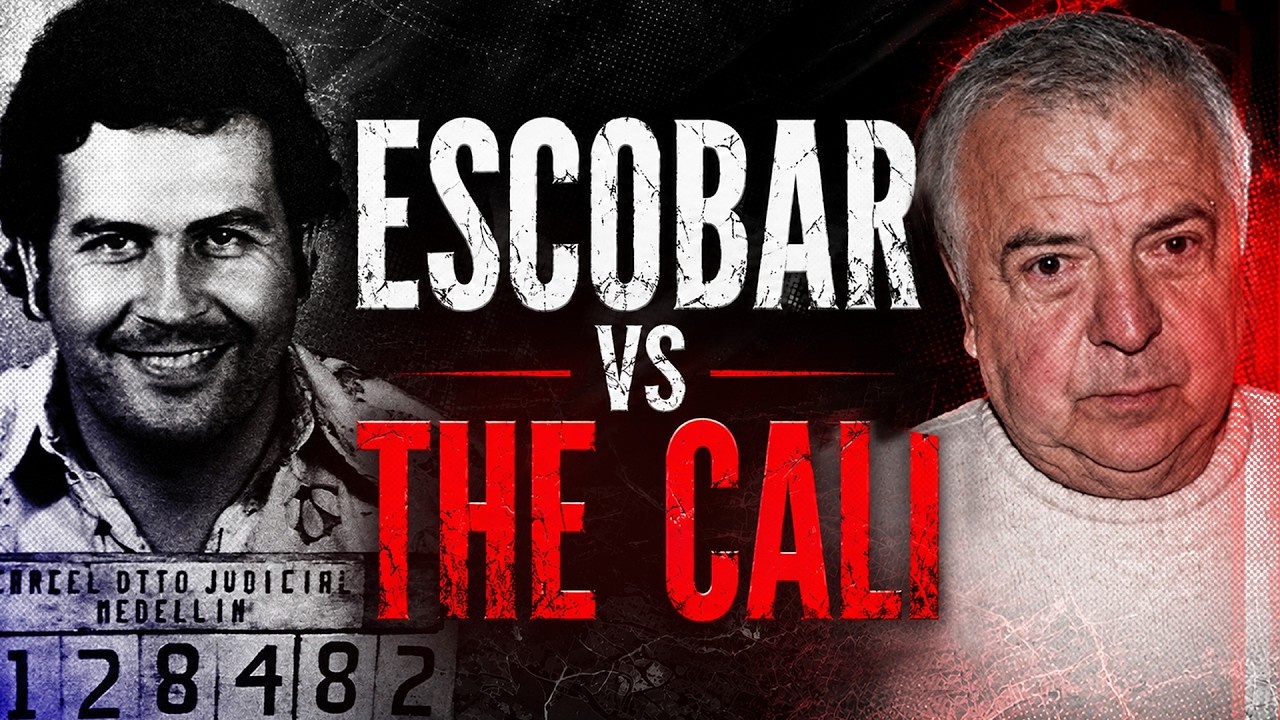
Both believed their strategy would protect them, and both were ultimately wrong. Pablo Escobar was born in 1949 in Rionegro, Antioquia, and grew up in the working-class neighborhoods around Medellín. His criminal career began with theft, contraband, and kidnapping. By the late 1970s, he saw cocaine as the path to the wealth and status that Colombian elite society had always denied him.
What made Escobar different from earlier criminals was his understanding that trafficking was as much political as logistical. He knew he could move cocaine with money and corruption, but the real obstacles were judges, politicians, the press, and the United States, which wanted him extradited. The Medellín Cartel, built with partners like the Ochoa family and Carlos Lehder, operated on a brutal principle: those who could be bought would be bought, and those who could not be bought would be killed. The phrase plata o plomo, silver or lead, was the actual operating philosophy of the organization.
Escobar’s network murdered a justice minister, a presidential candidate, a governor, and hundreds of police officers. At its peak in the mid-1980s, the cartel reportedly shipped 15 tons of cocaine into the United States every day. The money was so vast that the organization reportedly spent tens of thousands of dollars each month on rubber bands just to hold cash together. Escobar also craved legitimacy.
He won a seat in the Colombian Congress in the early 1980s before being removed, and he funded housing projects and football pitches in Medellín’s poorest neighborhoods to cultivate the image of a benefactor. When Colombia began negotiating extradition agreements with the United States, he launched a campaign of terror to force the government to abandon the policy. While Escobar built his empire in Medellín, a different kind of organization was taking shape 500 kilometers to the southwest in Cali. The Cali Cartel was a coalition of criminal entrepreneurs led by brothers Gilberto and Miguel Rodríguez Orejuela, along with José Santacruz Londoño and Helmer Herrera, known as Pacho Herrera.
According to DEA officials, it became the most powerful criminal syndicate the agency had ever known. Gilberto Rodríguez Orejuela earned the nickname El Ajedrecista, the chess player, because he thought several moves ahead. He invested in banks, pharmacies, and legitimate businesses, and cultivated relationships with politicians and lawyers. The cartel invested in the Drogas La Rebaja pharmacy chain, radio stations, and financial institutions.
Gilberto even secured a position on the board of the Banco de Trabajadores to launder narco dollars. Cali preferred corruption to confrontation, a strategic calculation, not moral restraint. The organization wanted to function quietly within Colombian commercial life, invisible to anyone not looking for it. Miguel ran the day-to-day logistics, Santacruz managed a sophisticated distribution network in New York, and Herrera became Escobar’s most direct personal antagonist.
Through the late 1970s and early 1980s, Medellín and Cali shared the same international pipeline and maintained periods of cooperation. But their visions were incompatible. Escobar wanted open dominance. Cali wanted quiet operation.
Tensions escalated over control of distribution corridors, particularly on the West Coast, and personal rivalry between Herrera and Escobar made coexistence impossible. The spark came on January 13, 1988, when a car packed with dynamite exploded outside the Monaco apartment building in Medellín’s El Poblado neighborhood, where Escobar’s wife and children were staying. Escobar was not present. His daughter Manuela suffered permanent hearing damage.
Three people were killed and at least ten wounded, with devastation spreading across a four-block radius. Escobar responded with cold fury. War had begun. The retaliation came in waves.
Escobar’s organization bombed the Drogas La Rebaja pharmacy chain, killing and injuring workers and customers with no involvement in the drug trade. Cali responded with targeted killings of people associated with Medellín’s networks. Both sides made anyone connected to the enemy feel the cost of that connection. Hundreds of people died, including civilians who happened to be in the wrong place at the wrong time.
The conflict never stayed within criminal space. In August 1989, presidential candidate Luis Carlos Galán, a leading advocate of extradition, was assassinated at a political rally. On November 27, 1989, a bomb exploded aboard Avianca Flight 203 about five minutes after takeoff from Bogotá, killing all 107 people on board and three more on the ground. The bomb was intended to kill candidate César Gaviria, who was not on the flight.
On December 6, 1989, a truck bomb containing about 500 kilograms of dynamite exploded outside the DAS intelligence headquarters in Bogotá, killing 63 people and wounding more than 2,000. These attacks against the Colombian state ensured that the full resources of the government, backed by the United States, would be mobilized against Escobar. The Cali Cartel watched with alarm. Escobar’s terrorism was generating precisely the international pressure that endangered everyone in the cocaine trade.
In 1991, under a new constitutional framework offering concessions, Escobar surrendered and was confined to La Catedral, a prison he had essentially designed himself. Reports described comfortable furnishings, communication equipment, and regular visits from associates. The arrangement collapsed after the reported execution of two Medellín associates, Fernando Galeano and Gerardo Moncada, inside the facility. When authorities sought to move Escobar, he simply walked out.
The government’s embarrassment was total, and the Search Bloc was reactivated. In late 1992, a coalition calling itself Los Pepes, an acronym for Perseguidos por Pablo Escobar, emerged. It included former Medellín associates, right-wing paramilitary figures, and people with documented ties to the Cali Cartel. Cali provided money, logistical support, and intelligence.
The group publicly claimed to be a victims’ organization but operated as a systematic assassination and destruction campaign targeting Escobar’s lawyers, associates, family, and properties. It was responsible for the deaths of more than 60 people connected to Escobar’s network. Whether official agencies deliberately channeled information to Los Pepes remains historically disputed. By 1993, Escobar was moving between rented properties in Medellín, knowing each radio transmission risked his position.
His greatest vulnerability was that he called his family. On December 2, 1993, Search Bloc units traced a transmission to a house in the Los Olivos neighborhood. Escobar was killed on a rooftop, shot multiple times, including a fatal wound to the head. The identity of who fired the killing shot remains disputed.
With Escobar gone, Cali emerged as the dominant cocaine trafficking organization in the world. According to the DEA, it controlled approximately 80 percent of the global cocaine market by the mid-1990s and was reportedly generating about $7 billion annually from the United States alone by 1996. The chess player’s strategy appeared vindicated. But victory came with a cost.
There was no longer a louder target absorbing enforcement attention. The financial sophistication that made Cali’s laundering effective had produced an extensive paper trail, bank records, wire transfers, and corporate filings that investigators could follow. On June 9, 1995, Gilberto Rodríguez Orejuela was arrested in Cali, found hiding behind a television set. He reportedly told officers, “You won.
I surrender. Calm, boys. Don’t kill me. I am a man of peace.
” José Santacruz Londoño was arrested in July 1995. Miguel Rodríguez Orejuela was arrested on August 6, 1995. Pacho Herrera surrendered in 1996. Santacruz escaped in January 1996 but was killed by police in March.
Herrera was murdered in prison in 1998. The era of the major Colombian mega cartels was over. The conflict was ultimately about two theories of criminal power. Escobar believed spectacular violence could make him untouchable.
It produced devastation but generated state pressure he could not sustain. Cali believed money and influence could keep it invisible. That strategy created evidence investigators eventually followed to its door. Both produced enormous violence and the same result.
The war killed thousands who were not cartel members, police officers, judges, journalists, pharmacists, passengers on a commercial flight, and workers in a government building. Both cartels used ordinary people as instruments of pressure, and the capacity to generate sustained fear was itself a form of power. The collapse of both cartels did not end the cocaine trade. It fragmented it.
The Norte del Valle Cartel emerged from elements of Cali’s network, and paramilitary groups filled part of the vacuum. Smaller, decentralized organizations became harder to target. Destroying a cartel does not destroy the market; it distributes the risk. Modern Colombia has changed dramatically.
Medellín underwent a celebrated urban transformation from one of the world’s most violent cities to a recognized example of urban renewal. Neither cartel exists in its historical form. The Rodríguez Orejuela brothers served 30-year sentences in American federal prisons. Escobar’s legacy in popular culture is a distortion of what he was: he presided over an organization that murdered thousands and systematically destroyed public institutions.
Cali’s quieter method caused lesser noise but equal harm, including corruption at the highest levels of Colombian politics. The Rodríguez Orejuela brothers eventually confessed to financing the 1994 presidential campaign of Ernesto Samper, creating a political crisis that consumed the country for years. Neither strategy saved its creators. When an organization becomes powerful enough, its enemies do not need to defeat the king at once.
They only need to dismantle everything around him until there is nowhere left to hide.