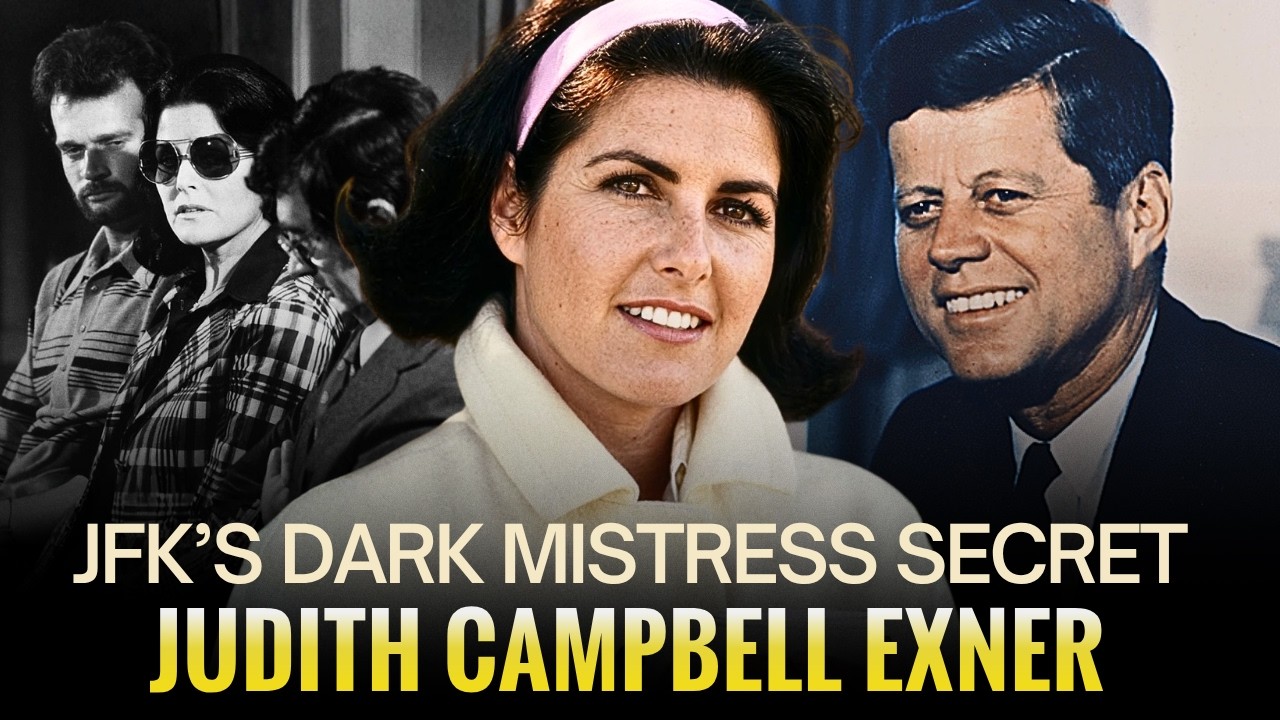
In 1960, the distance between the White House and the American mafia was exactly one woman. Judith Exner shared a bed with John F. Kennedy by day and lay in the arms of mob boss Sam Giancana by night. She was more than a mistress. She was a courier for some of the Cold War’s bloodiest secrets.
Judith Eileen Katherine Campbell was born in 1934 into a wealthy Los Angeles family. Her father was a prosperous architect. The household was rigid, Catholic, and obsessed with appearances. Private struggles were kept behind locked doors.
At 18, she married actor William Campbell. The marriage brought her into Hollywood’s inner circles but left her hollow. By 1958, the marriage was over. At 24, she was single, connected, and untethered.
In 1959, she caught the eye of Frank Sinatra. Their romance lasted only months, but the friendship endured. Sinatra liked that she understood the rules of the room. She never asked probing questions and never spoke to the press.
That comfort led her to Las Vegas on February 7th, 1960. She was staying at the Sands Hotel as Sinatra’s guest. John F. Kennedy was in the audience. The senator from Massachusetts was in the middle of a ruthless campaign for the presidency.
Sinatra made the introduction. The attraction was immediate. Kennedy was captivated by her elegance and her lack of intimidation. She spoke to him not as a political icon, but as a man. That directness hooked him.
The next day, the phone rang. Kennedy called her every single day despite his grueling campaign schedule. She was hesitant. She knew he was married. But the daily calls broke down her defenses.
On March 7th, 1960, they met privately at the Plaza Hotel in New York. The physical affair officially began. Judith stepped into the role of hidden mistress. She believed she understood the boundaries of an affair with a powerful man.
She did not know that Frank Sinatra had another introduction planned. In the final week of March 1960, Judith traveled to Miami Beach. Sinatra was performing at the Fontainebleau Hotel. He brought her to a table and introduced her to two men.
One was Johnny Rosselli, the mob’s liaison to Hollywood and Las Vegas. The other was introduced as Sam Flood. He was polite, attentive, and treated her with traditional respect. It was only later that she learned Sam Flood was an alias.
His real name was Sam Giancana. He was the undisputed boss of the Chicago outfit. He controlled gambling, extortion, and labor unions across half the country. He was ruthless and a primary target of federal law enforcement.
Within 60 days, Judith had become intimately involved with the Democratic nominee for president and the most powerful mobster in America. The two men operated differently. Kennedy was in constant motion, intense and transactional. Giancana was patient and protective.
Kennedy knew she was spending time with Giancana. Giancana knew she was spending time with Kennedy. Neither man demanded she stop. For Kennedy, her connection to the Chicago mob was not a deal breaker. It was an asset.
In November 1960, Kennedy won the presidency in one of the tightest margins in American history. The victory was secured in part by a suspicious surge of votes in Giancana’s territory of Cook County, Illinois.
When Kennedy moved into the White House, the logistics of the affair required serious operational security. The gatekeeper was Evelyn Lincoln, the president’s personal secretary. Over the next 18 months, Judith called the White House more than 70 times. These calls were routed through private lines to ensure no official record linked the president to Giancana’s associate.
When Judith visited the White House, she was cleared outside standard visitor logs. She was ushered through private corridors and given direct access to the presidential living quarters.
But the White House she entered was not the polished Camelot portrayed in the press. It was a place of deep moral decay and extreme recklessness. Kennedy viewed his executive power as a shield against consequences.
Young female interns were brought into the administration and maneuvered into compromising situations. Two White House secretaries, known as Fiddle and Faddle, were frequently summoned to the White House pool for private parties during the workday. Judith found the environment deeply unsettling.
Kennedy also relied on an illegal chemical regimen to maintain his public image. Dr. Max Jacobson, known as Dr. Feelgood, injected the president with cocktails of liquid methamphetamine, animal steroids, hormones, and placenta. The side effects were severe. Kennedy exhibited extreme mood swings, hyperactivity, and paranoia.
In May 1962, the situation reached a breaking point. During a stay at the Carlyle Hotel in New York, the president suffered a severe adverse reaction. He stripped off his clothing and ran frantically through the hallways in a state of complete delirium. Secret Service agents had to physically tackle him and summon a psychiatrist to sedate him.
By early 1961, Kennedy realized Judith was no longer just a companion. She was a tactical advantage. She held no government clearance and appeared on no official intelligence payrolls. She could move between the White House and the Chicago underworld without raising alarms.
Kennedy needed a secure channel to the mafia. He chose the woman who shared his bed. The transition from mistress to accomplice began with a simple request to carry a sealed envelope to Chicago. Judith agreed.
Over 18 months, Judith transported highly sensitive materials between the president and the boss of the Chicago outfit. She carried Manila envelopes sealed with tape, heavy with cash and classified documents. She facilitated approximately 10 face-to-face meetings between Kennedy and Giancana.
Initially, the envelopes contained payoffs. The mafia had mobilized resources to buy votes in crucial districts during the 1960 election. The cash Judith carried was the return on that investment.
Soon, the stakes escalated from election fraud to international assassination. The CIA and the mafia shared a mutual enemy in Fidel Castro. The mafia had owned Havana’s casinos before the revolution. Castro had kicked them out. The CIA recruited the mob to assassinate a foreign leader.
Kennedy was deeply involved in the shadow war. Judith was coordinating directly with Giancana regarding the Castro plot. The documents she carried were the blueprints for murder.
During one scheduled meeting in a Chicago hotel, Kennedy instructed Judith to hide in the bathroom. While the president and the mob boss discussed the logistics of assassinating a foreign dictator, Judith sat on the edge of a porcelain bathtub. She listened to their muffled voices through the door.
In that bathroom, her illusion of safety shattered. She realized she was the ultimate disposable asset. If anyone found out, she would be the first person thrown to the wolves.
The hypocrisy was staggering. While the president was secretly employing Giancana, his brother, Attorney General Robert F. Kennedy, was launching a massive public crusade to destroy the mafia. The mob was furious. They had bought the election and done the CIA’s dirty work. In return, the president’s brother was trying to lock them up.
The pressure took a severe psychological toll on Judith. But the final fracture came from Kennedy’s degrading behavior. By 1962, the president’s chemical stimulants fueled a relentless appetite for sexual extremity.
One afternoon at the White House, Judith walked into the bedroom and found another woman waiting. Kennedy looked at her with casual confidence and propositioned a threesome. He told her not to be afraid.
Judith was violently clarified. “My God, Jack,” she replied, her voice thick with disgust. “How could you do this?” She turned and walked out of the room.
Later in 1962, Judith missed her period. She was pregnant. The father was the president of the United States. In 1962, abortion was illegal and heavily stigmatized.
When Judith informed Kennedy, there was zero empathy. He approached the unborn child purely as a liability. He arranged for the funds and handed over the cash. He did not call to check on her. He simply shut down communication.
Judith underwent the abortion in profound isolation. The only person who offered her genuine humanity was Sam Giancana. The ruthless mob boss called her, checked on her, and offered emotional shelter. He treated her with a strange code of loyalty.
Unknown to Judith, the FBI had been listening. J. Edgar Hoover had been building a file. For nearly five decades, Hoover had maintained power by collecting leverage on every major politician in America. He kept files on vices, hidden financial crises, and secret relationships.
Hoover deeply despised the Kennedy family. Robert Kennedy had launched a crusade against organized crime, forcing Hoover to pivot and aggressively surveil the mafia. The FBI began wiretapping the Chicago outfit.
Agents heard about Judith. They traced her phone calls and cross-referenced her travel records with Giancana’s schedule. Then they made a discovery that sent shockwaves through Hoover’s office. The woman associated with the boss of the Chicago mafia was making direct calls to the White House.
The pieces snapped together. The president and the target of the attorney general’s criminal investigation were sharing the same woman.
On February 27th, 1962, Hoover sent a classified memo to Robert Kennedy and key White House aides. It was a warning shot. It vaguely outlined a connection between the Chicago mafia, a woman named Judith, and White House telephone logs.
On March 22nd, 1962, Hoover walked into the Oval Office for a private lunch. He brought a dossier. He laid out the telephone logs, the dates, the hotel records, and the surveillance reports. He presented undeniable proof that the FBI knew exactly who Judith Exner was.
Hoover did not need to make a direct threat. The presentation of the file was the threat. The message was clear: I hold your political life in my hands.
A few hours later, the phone rang in Judith’s apartment. It was Kennedy. His voice was cold and clipped. He told her her telephone lines were tapped. He told her J. Edgar Hoover knew everything. He told her they could never speak again. Then he hung up.
Kennedy never answered another call from her. To protect his crown, he threw her directly out of the moving vehicle.
Frank Sinatra was next on the chopping block. Kennedy cancelled a scheduled stay at Sinatra’s Palm Springs compound. The White House informed Sinatra the president would instead stay at the estate of Bing Crosby. It was a public humiliation.
The Chicago underworld realized what had happened. They had rigged an election and risked their lives for the Castro plots. In return, the president’s brother was trying to lock them up, and the president was cutting off all contact.
The mafia operates on a strict code of reciprocity. The Kennedys had broken the deal. The fury within the Chicago outfit was intense.
For Judith, there was no political machine to protect her. She was a solitary woman holding explosive truth. She was completely isolated. The president had cut the cord. The FBI was listening. And the most violent men in America were realizing they had been double-crossed.
The silence that followed was absolute. But the silence did not mean she was alone. Hoover did not close the file. He deployed psychological warfare.
Judith’s life turned into a suffocating nightmare. Unmarked sedans parked across the street. Men in dark suits followed her to the grocery store. Her phone lines clicked constantly. Her mail arrived delayed and tampered with.

She was entirely isolated. She could not tell her friends she was being stalked by the FBI because she had acted as a courier between the president and the mafia. They would think she had lost her mind.
In late 1962, Judith fell into a severe paralyzing depression. The paranoia became suffocating. She stopped eating. She suffered from chronic insomnia. Unable to see a way out, Judith attempted suicide. She survived, but she was mentally shattered.
Then came the morning of November 22nd, 1963. Judith was in Los Angeles when the news broke. President John F. Kennedy was dead.
The public mourned a martyr. Judith knew the man behind the myth. She knew about the drug cocktails, the reckless behavior, and the mafia alliances. Her fear was rooted in sheer survival.
If the mafia could orchestrate the murder of the most heavily protected man on earth and get away with it, what could they do to a civilian from California? She held the exact secrets that could connect the murdered president to the criminal underworld.
In the weeks following the assassination, Hoover took control of the narrative. He steered the investigation toward a lone gunman theory. Judith waited for the FBI to arrive at her door. The knock never came.
Hoover kept her name completely out of the official investigations. If he exposed Judith Exner, it would expose the fact that the FBI had been blackmailing the president. It would expose the classified CIA assassination plots against Castro. Hoover’s priority was protecting the institution of the FBI.
Judith was buried alive in the archives of the federal government. She spent the remainder of the 1960s living as a ghost.
She entered a brief relationship driven by loneliness and trauma. She became pregnant again. There was no president to hand over cash. She was unmarried, financially unstable, and entirely broken. She carried the baby to term and gave her newborn son up for adoption immediately after birth.
The decade closed with Judith living in deep obscurity. She believed the secrets of Camelot and the Chicago outfit would stay buried forever.
But history rarely stays quiet. In May 1972, J. Edgar Hoover died. His iron grip on the FBI’s archives vanished. Then the Watergate scandal destroyed the public’s faith in the executive branch. The demand for truth forced the Senate to take unprecedented action.
In 1975, the Senate formed the Select Committee to Study Governmental Operations with Respect to Intelligence Activities. It became known as the Church Committee. Investigators were looking for evidence of rogue intelligence operations. They uncovered the paper trail detailing the government’s alliance with the American mafia to eliminate Fidel Castro.
They found a glaring anomaly. A civilian woman from California had logged over 70 private phone calls to President Kennedy. FBI wiretap summaries confirmed she was closely associating with Sam Giancana and Johnny Rosselli, the two specific mobsters the CIA had hired for the assassination plots.
The Senate committee realized Judith was the missing link. She was the human bridge between Camelot and the underworld.
A federal subpoena was issued. Judith was summoned to Washington to testify under oath. She knew exactly what was at stake. She was being asked to testify about a massive illegal conspiracy involving state-sponsored assassination, election fraud, and organized crime.
As the Church Committee prepared its hearings, they also summoned Sam Giancana. Giancana’s life had spiraled. He had been deported back to the United States in 1974. He was living under heavy FBI surveillance in Oak Park, Illinois.
On the night of June 19th, 1975, just days before he was scheduled to testify, Sam Giancana was cooking sausages in his basement kitchen. Someone he trusted walked up behind him. He was shot in the back of the head. The assailant stood over him and fired six more rounds into his face and neck.
The assassination was a massive message sent directly to anyone thinking about talking to the Senate.
Judith went into a state of absolute psychological freefall. The man who had once protected her had been slaughtered to stop him from speaking. She was holding the exact same secrets he had died for.
She barricaded herself inside her home. She purchased a firearm and kept it under her pillow. She acquired guard dogs. She was entirely convinced she was next on the hit list.
She tried to fight the subpoena. But the government was unrelenting. With Giancana dead, Judith was their only remaining viable asset.
Her testimony before the Church Committee in 1975 was conducted behind closed doors. Judith made a desperate, calculated decision. She chose to tell a half-truth.
Under oath, she admitted to the affair with President Kennedy. She confirmed the timeline and the frequency of the phone calls. She admitted to her friendships with Sam Giancana and Johnny Rosselli.
But when investigators pressed her on the espionage, she flatly denied it. She lied to the United States Senate to save her own life. She calculated that admitting to an affair would destroy her reputation. Admitting to being a courier for an international assassination conspiracy would get her killed.
The Senate investigators were skeptical. But without Giancana alive to corroborate her deeper involvement, the committee could not legally prove she was a courier.

She survived the testimony, but the cost was immediate. Her name was leaked to the press. The media explosion was catastrophic. Newspapers ran headlines about the president sharing a mistress with the head of the Chicago mafia.
The political establishment launched a massive smear campaign. Former White House aides called her a liar. Evelyn Lincoln publicly denied knowing who she was. The media painted her as an opportunistic, delusional woman seeking attention.
The danger was violently confirmed a year later. In 1976, the Church Committee called Johnny Rosselli to testify. He gave the committee limited but explosive details about the CIA-mafia plots. Shortly after his testimony, Rosselli vanished.
A few weeks later, a fisherman off the coast of Miami found a heavy 55-gallon steel drum floating in the bay. Inside were the remains of Johnny Rosselli. He had been asphyxiated, his legs sawed off to fit inside the drum.
The triangle was gone. Kennedy had been assassinated in Dallas. Giancana had been executed in his basement. Rosselli had been chopped up and thrown in the Atlantic. Judith Exner was the only one left alive.
She retreated completely from the world. She changed her name and moved quietly. She spent the late 1970s and 1980s as a recluse, bearing the weight of a monumental historical secret.
In 1975, she married professional golfer Dan Exner. They moved to Newport Beach, California. She spent her days painting landscapes and avoiding the news. But the trauma did not vanish. The marriage buckled under the weight of her untreated PTSD. By 1988, they were separated.
Then her body made the decision for her. In the late 1980s, Judith received a devastating diagnosis: terminal breast cancer.
Terminal cancer operates as the ultimate truth serum. The mob could no longer threaten her. The government could no longer ruin her. She was already dying. What terrified her now was not assassination. It was erasure.
She looked at how history was being written. Kennedy loyalists had spent decades crafting a pristine, heroic narrative. Judith was either omitted or dismissed as a mentally unstable groupie. She realized that if she died without speaking, the establishment would win.
In 1988, she granted an interview to People magazine. For the first time, she explicitly admitted what she had denied under oath. She had been a courier. She confessed to carrying sealed envelopes between Kennedy and Giancana detailing cash and classified documents regarding the Castro assassination plots.
The political establishment attacked her credibility instantly. Former Kennedy aides called her assertions absurd. They challenged her to provide proof, knowing full well the cash handoffs were designed to leave no paper trail.
Judith did not retreat. In 1997, knowing she had very little time left, she sat down for a final exhaustive series of interviews with Vanity Fair and investigative reporter Liz Smith.
This time, she held nothing back. She detailed the White House pool parties, the drug injections, and the degrading proposition by the president. Finally, she revealed the deepest wound of all: the pregnancy in 1962 and the cold, detached manner in which Kennedy had handed her cash for an illegal abortion before discarding her completely.
The 1997 revelation shocked the American public. It was no longer just a story about political espionage. It was a brutal indictment of Kennedy’s humanity.
By the late 1990s, the shield protecting the Kennedy administration had severely cracked. The Freedom of Information Act had forced the declassification of thousands of FBI and CIA documents. Investigative journalists began cross-referencing Judith’s final confessions with the newly released government archives.
The vindication was absolute. Every single detail Judith provided matched the historical record. The dates she claimed to have traveled to Chicago aligned with FBI surveillance logs. The dates she claimed to have been in the White House aligned with Evelyn Lincoln’s private telephone records.
Retired Secret Service agents began speaking to reporters. They confirmed Judith’s presence. They confirmed she was ushered in through private entrances. They corroborated the reckless environment, the drug use, and the constant flow of illicit guests.
The government insiders who had called her a liar for 20 years were systematically proven wrong by their own internal documents. Judith Exner did not make up a single detail.
She lived just long enough to see her truth validated. She spent her final months in a small hospital bed in Southern California, ravaged by cancer but mentally unburdened. The heavy weight she had carried since 1960 was finally lifted.
Judith Eileen Katherine Campbell Exner died on September 24th, 1999. She was 65 years old.
Her story is not simply a footnote in a presidential biography. It is a chilling case study of how institutional power treats human beings. John F. Kennedy and Sam Giancana represented two opposite sides of the American spectrum: the absolute peak of legitimate authority and the absolute depths of the criminal underworld.
Yet to Judith, they were functionally identical. Both men used her as a tool. Both exploited her loyalty. Both were perfectly willing to let her be destroyed to protect their own empires.
For decades, the public was trained to view her as the villain. But the historical record reveals her true position. She was the collateral damage of a political system that was far darker, far more corrupt, and far more ruthless than the public was ever allowed to see.
In her final days, when asked to reflect on her life, Judith offered no grand political philosophies. The woman who had smuggled government secrets and stood between assassins and presidents stated simply that she had finally found peace by telling the truth.