In 1925, a 99-year-old country doctor in Northwest Arkansas sat down to write an account he had carried in silence for nearly half a century. Dr. Goff Tatum, the sole medical provider for a 30-mile radius around the settlement of Lockstep Crossing, had kept detailed ledgers of births, deaths, and broken bones his entire career. But one set of entries never left his private pages until the final year of his life.
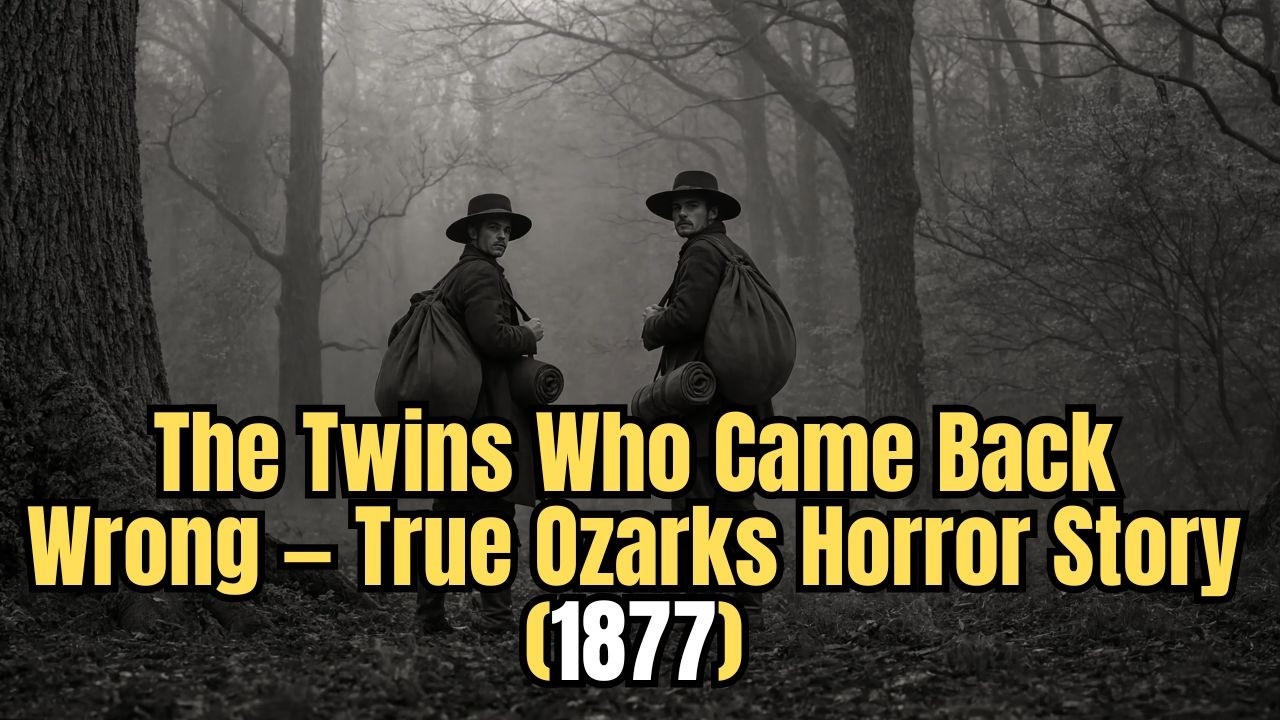
The tale begins on November 4th, 1877. Wiston and Talmage Pickrol, identical twin brothers aged 31, left their cabin in Witten Hollow at first light to check their trap line. They were experienced trappers who had worked the same 40 traps across three creek bottoms for nearly a decade. They knew every stone and every leaning sycamore in that country.
They told their nearest neighbor, an elderly widower named Renfro Cab, they expected to be gone three or four days and asked him to check on their horse. They did not return. On November 7th, Renfro noticed the brothers’ brindle hound, Bucket, back at the cabin alone, shivering under the porch. The dog had never come back without them.
By the 8th, a search party of nine men was riding up the hollow. For three days they found nothing: no tracks, no sprung traps, no campfire ash, no torn cloth, no blood. The trap line itself appeared to have vanished entirely, as if the brothers had walked onto the ridge and the ridge had closed behind them. One of the searchers, an old hunter named Hardacre, stopped mid-search, placed his hand on a tree, and told Tatum they would not find the brothers that day.
Then he added that they would not find them ever. When asked what he meant, he said only that the hollow had swallowed them, and that he would explain when it was over. He never did. On the night of November 19th, about an hour after sundown, the Pickrol brothers walked back into their own cabin yard.
Renfro Cab was inside. He had been sleeping there on a pallet by the stove, unwilling to leave the dog alone. He heard the porch boards creak and the door open. The brothers stood in the doorway wearing the same canvas coats and boots they had left in eleven days earlier.
The coats were clean. The boots were clean. The rifle was clean and oiled. Renfro found this deeply wrong.
Wiston Pickrol had never oiled a rifle in his life. He had always kept it coated in dust and the residue of the woods. Renfro later told Tatum the “hello” they gave him was the strangest he had ever heard. The voice was Wiston’s, but the cadence was off, as if someone were speaking a word they had just learned, carefully measuring its weight.
The brothers sat at their table simultaneously, folded their hands simultaneously, and stared at the wall. When Renfro set bowls of beans before them, they studied the spoons like objects whose purpose they had forgotten. Then they began eating slowly, together. Their hands moved in unison.
They swallowed in rhythm. Bucket retreated to the far corner of the cabin and refused to look at the table. When the bowls were empty, both brothers set down their spoons at the same instant. Wiston asked Renfro to fetch the doctor.
Renfro rode four miles in the dark without his coat, having forgotten it hanging by their door. He climbed Tatum’s stairs around three in the morning, teeth chattering, and told him the boys were home. Tatum went back up the hollow with him, dismissing much of what Renfro described. When Tatum entered the cabin, the brothers turned their heads simultaneously and smiled simultaneously.
The smiles were correct in every detail, but they arrived as one, like a single event happening twice. Tatum asked where they had been. Wiston said they were in the woods. Talmage said they were home now.
The doctor asked them to remove their coats for examination. Beneath, their shirts were clean and white, as if freshly washed. He took both their wrists to check their pulses, a practice he had performed for thirty years. Under both thumbs he felt the same heartbeat at the same moment, at precisely the same speed, not within a breath but exactly the same.
He released their wrists, told them to eat and rest, and rode home. That night he wrote in his ledger: pulses synchronous. In the days that followed, Tatum visited under professional concern. Men lost in November woods for eleven days should have been thinner, frostbitten, or raving from thirst.
These men were none of those things. They were always at the table when he arrived, always polite, always offering coffee, pouring simultaneously into two cups. Only one of them ever drank. When he asked what they had done in the woods, Talmage said they waited.
When he asked what they had waited for, both looked at him and said in unison: “We don’t remember. ” When he tested their memory, Talmage could not recall the name of the dog he had raised from a pup and named himself. Small things began to accumulate around the crossing. A horse that had stood beside the brothers for years would no longer let them touch it.
Birds lifted from fields as they passed, rising all at once in silence. The Methodist preacher told Tatum the brothers no longer came to meeting. They could sing, both of them in one voice with two mouths, he said, but he believed they no longer remembered the words. In late November, Tatum searched his ledger for the death certificate of the brothers’ mother, Cella Pickrol.
She had died in the fever winter of 1846, the same winter the twins were born. He found the certificate and noticed something he had missed: November 4th, the day the brothers entered the woods, was the exact anniversary of her burial. He walked to the cemetery behind the meeting hall. At Cella Pickrol’s grave, the earth at its foot had been disturbed.
Not freshly dug, but turned, smoothed back carefully, with clumps of moss placed on top to conceal it. Tatum, who had walked behind too many caskets in thirty years, recognized new dirt from old. He rode to the cabin and asked Wiston his mother’s name. For 31 years, the brothers had always answered that their father never spoke of her.
Instead, without pause, Wiston said: “Silla. ” The next morning, in rain, he asked Talmage the same question. Talmage gave the same answer. When Tatum asked how he knew, Talmage said: “She told us.
” When had she told him? “In the woods, Doc, when we were waiting. ”
In the second week of December, Hardacre came to Tatum’s rooms. He pulled out a plug of tobacco but did not chew it.
He told the doctor he had gone to see the brothers with his own eyes, having heard things he did not put weight in. He described the feeling of a hunter who once shot an eight-point buck, dressed it, and hung it in the smokehouse, only to know three days later that whatever was hanging there was not the buck he had shot. Same hide, same antlers, same bullet hole, but something else had gotten in. Hardacre told the doctor he had asked the brothers if they remembered him teaching them to set snares when they were small.
They answered together that they remembered the snare but did not remember the teaching. Hardacre had left their porch without sitting down, ridden home without stopping at the creek as he always did, feeling like he had stayed one minute too long and uncertain what might have happened if he had lingered. The next day, Tatum rode up the hollow alone, leaving his doctor’s bag behind and taking an old war pistol. He circled around the cabin and climbed to the high side, the cedar and limestone country on the second ridge, looking for where the brothers had spent eleven days.
Just before dusk he found it: a hollow within the hollow, a small limestone bowl where rock had collapsed into a shelter. The ground in the center was smooth and dark, as if swept. There was no ash, no fire ring, no remains. In the very middle, pressed into the dirt and nearly weathered away, were two impressions side by side, about three feet apart, the size and shape of seated men.
It looked as if two people had sat cross-legged facing each other for a very long time, long enough that their weight had marked the earth. Tatum knelt, looked without touching, and left. He rode home in darkness without lighting his lantern. He did not write about that place in his ledger for almost twenty years.
On the night of December 17th, 1877, nearly the exact anniversary of the night the brothers had returned, Wiston rode to the crossing alone and invited Tatum to dinner at the cabin. Tatum knew he should refuse. He went anyway, carrying a doctor’s bag with a small revolver at the bottom he had not carried in twenty years. He went, he wrote later, as a man who wanted to know.
The brothers had set the table for three with their mother’s good blue-rimmed china, kept on a shelf above the door their whole lives and almost never used. They ate in unison, with careful, deliberate motions. They told him they did not sleep much. When he asked if they had bad dreams, Talmage said simply: “We do not dream.
”
Around eight in the evening, the brothers urged him to stay the night. The wind was up, the road bad. He stayed. They climbed to the loft, their feet silent on the ladder.
Tatum lay on the pallet by the stove, eyes closed, not sleeping. Around midnight he heard from the loft a long, slow intake of breath, then a long, slow release, as if one of them had just remembered breathing was required. Around one in the morning, he heard it again. Nothing in between.
At two in the morning, Tatum’s eyes opened. The lamp had gone out. The stove was nearly cold. In the gray moonlight, Wiston and Talmage stood ten feet from his pallet, side by side in nightshirts, barefoot on cold boards, motionless, facing him.
He kept his eyes mostly closed and breathed like a sleeping man. They stood there for an hour. They did not shift weight. They did not blink as far as he could tell.
They did not breathe in any visible way. During that hour, the temperature of the room dropped. The cold came not from the dying stove but from around them, like an open window in January. Tatum could see his own breath in the moonlight and had to slow it so they would not see it too.
At three in the morning, they turned simultaneously and climbed back to the loft without sound. In that hour, Tatum opened his eyes once, just for a second. The man on the left wore the nightshirt with the mended collar tear he had always known as Wiston’s, but his head was tilted slightly, and the look in his eyes was not Wiston’s. The man on the right wore the nightshirt with the bone button at the throat he had always known as Talmage’s.
His face was Talmage’s, and the scar above the brow was Talmage’s, but the look in his eyes was Wiston’s. Tatum wrote that he did not know to this day what came back out of those woods on November 19th. He was 68 when he wrote his account, and he said he had not slept well since that night. In spring 1878, on April 15th, Wiston Pickrol walked out of the cabin at dawn with his canvas coat and Henry rifle, went up the ridge into the woods, and did not return.
This time no search was mounted. Renfro Cab rode down to tell the men of the crossing, and they listened. They did not saddle their horses. “Some things in a country like that you learn not to do twice,” Tatum wrote.
Talmage stayed. He kept the cabin and worked the trap line alone. When he came to the crossing every two weeks for pelts and supplies, he spoke when spoken to and paid his bills in full and on time. Bucket never returned, living out his days under Renfro Cab’s porch until he died in the autumn of 1881.
In early summer 1880, Talmage came to Tatum’s office and asked him to ride out the next morning. He wanted a witness. He took the doctor to a small clearing under white oaks where his father was buried. Two shovels were there.
“Doc, I’m going to dig my brother a grave,” he said. Tatum reminded him his brother was not known to be dead. Talmage answered: “My brother isn’t coming back. I know that the way I know my name.
And the law says a man should be in the ground, even if there’s nothing to put in him. ”
They dug an empty grave to regulation depth. Talmage set the wooden marker himself, with the name burned in: Wiston Elie Pickrol, born 1846, died 1877, the year of disappearance, not the year he walked off. “That was the year the brother I knew was gone,” he said.
He paid Tatum a quarter, and they rode home. The years passed. By 1882, Talmage was singing again at the Methodist meeting hall. The preacher told Tatum with tears that he remembered every word.
By 1890, people could sit beside him in a hayfield without feeling anything strange. He was older and grayer, never married, never spoke of his brother. He read his mother’s Bible by lamplight. People said whatever had happened up that ridge had happened to Wiston, and Talmage had survived it.
Tatum let them say it, but he wrote that he knew better. Talmage Pickrol died on October 18th, 1922, aged 76, in the back room of the crossing’s only boarding house. Tatum, then 96 and the last man alive who had been in that cabin in the winter of ’77, sat at his deathbed and held his hand. Talmage looked up from the pillow and said very clearly: “Doc, I’m here.
I’m Talmage. Doc, you remember that night? ” Tatum said he did. Talmage closed his eyes, was quiet for a long time, then said: “I remember it, too.
” And died. Tatum signed the death certificate: natural causes. He wrote that he could not quite get there. He could not quite believe it, in the three years that remained to him.
Dr. Goff Tatum died in 1926, four months after writing his final page, at the age of 99, as he had predicted. His ledger was found in 1961 behind a panel in the wall of a house in Lockstep Crossing, sealed there for 35 years until a new owner rewired the house and the wiring brought it out. The account concluded with the doctor’s final observation: the hollow is still there, the cabin is gone, both Pickrol graves remain, Talmage’s in the churchyard and Wiston’s empty one under the white oaks.
He wrote that on a still day in late November, you can sometimes hear at the edge of your hearing the sound of two men singing the doxology, in a perfect mirrored voice, in one body that has two mouths. He did not know who was singing. He wrote that he had a guess, but he would rather not say it out loud.