In 2006, two street performers from Maine orchestrated a simple experiment that would become one of the most iconic moments in early internet culture. Fritz Grobe and Stephen Voltz, known together as Eepy Bird, dropped Mentos candies into dozens of bottles of Diet Coke, triggering towering geysers of soda in a synchronized, choreographed display. The video spread across the globe at a time when the concept of going viral barely existed. Neither the candy maker nor the soda company had any involvement in the production of the video.
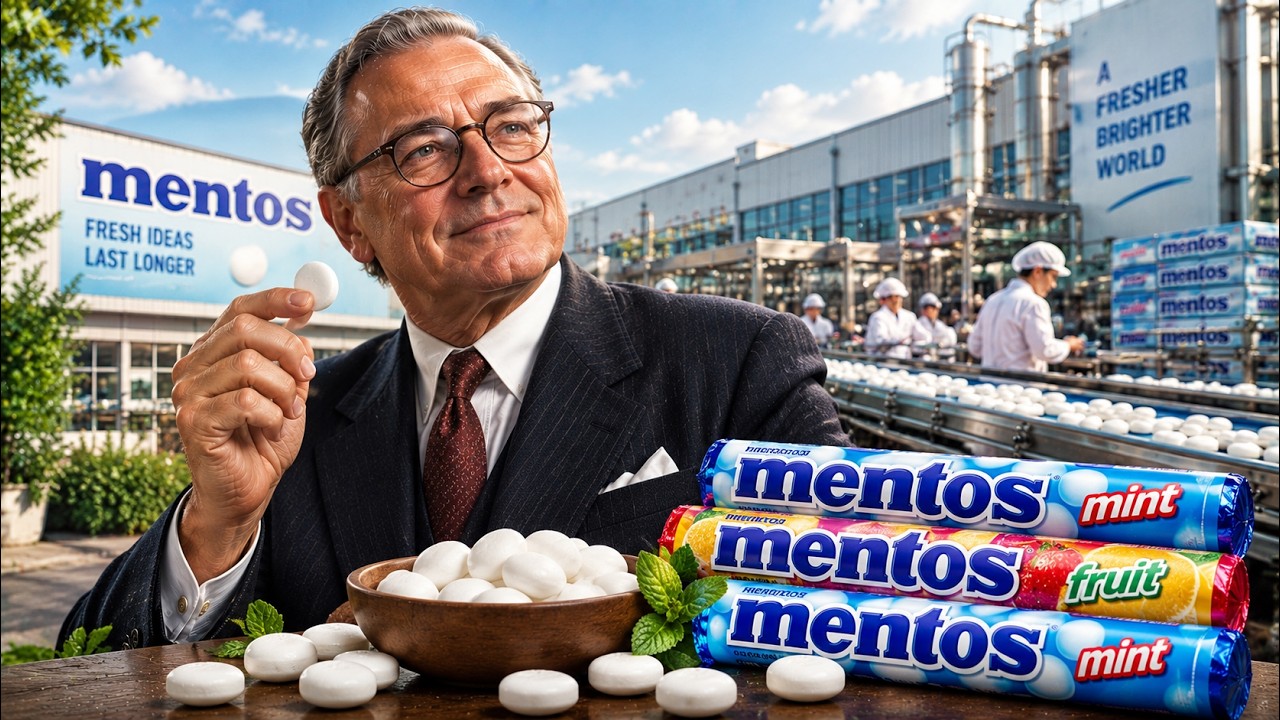
No marketing team orchestrated it, no one paid the performers, and no one secured permission to use the brand names. It was an entirely independent, spontaneous creative act. Yet the experiment became one of the most successful marketing stories in the confectionery industry, not because the company created it, but because the company recognized what was happening around its product at exactly the right moment and chose to embrace it. At the same time, a far less innocent rumor was spreading across the United States.
Whispers claimed that eating Mentos and drinking soda at the same time could be deadly. Concerned parents began forbidding their children from combining the candy with carbonated drinks. Some schools went so far as to ban the pairing in their cafeterias. Popular science programs eventually investigated the claims on air to separate scientific fact from public panic.
The story of Mentos begins in 1932 in the small Dutch town of Breda. The local family-owned company Van Melle, which had already spent decades producing gum and other confectionery, introduced a new mint candy with a firm, slightly chewy texture and a distinctive refreshing flavor. The product was designed as a modest addition to the company’s existing lineup, with no ambitions of international success in its early years. Its dense texture was achieved through a specialized sugar-processing method, while its round shape with a small hole on top became a lasting visual signature of the brand.
During the 1940s, 1950s, and 1960s, Mentos remained primarily a regional product, known mainly in the Netherlands and neighboring European countries through local distributors. Nothing during those quiet decades suggested that this unassuming mint from a small Dutch town would become a global brand or star in one of the most widespread science entertainment phenomena in internet history. The brand’s rise to international fame began in the 1990s when the company launched a memorable advertising campaign centered on the slogan “The Freshmaker. ” The ads followed a simple formula: a man finds himself in an awkward or absurd situation, quietly pulls out a pack of Mentos, eats one piece, and suddenly finds a clever way out of his predicament with calm confidence.
The campaign proved highly effective and adaptable across cultural contexts, allowing the brand to expand into dozens of international markets, including the United States. By the end of the 1990s, Mentos had established itself as a well-known global confectionery brand, though it still trailed many larger and more established competitors in total sales volume. In 2001, a significant structural change occurred in the ownership of the brand, though it went largely unnoticed by consumers. The Dutch company Van Melle merged with the Italian confectionery giant Perfetti to form a new unified company called Perfetti Van Melle.
The Italian side already owned a broad portfolio of global confectionery brands, and the merger created one of the largest privately owned candy manufacturers in the world, competing on a scale with industry giants like Mars and Mondelēz. Despite its enormous scale, operating in more than 150 countries with dozens of factories across multiple continents, Perfetti Van Melle remains entirely privately held. Unusually for a company of this size in the modern global economy, it is still controlled by one Italian family, the Lang family, which rarely appears in public and seldom gives extensive interviews about its internal business structure. In 2006, Grobe and Voltz, who had previously earned their living through street circus performances and magic shows, recorded an experimental video that would be remembered in internet history.
Their idea was simple. When Mentos mints are dropped into a bottle of Diet Coke, a violent physical reaction occurs, causing a powerful fountain of foamy soda to erupt from the bottle, rising several meters into the air within seconds of the candy touching the liquid. Drawing on their experience in spectacle, the two performers created an elaborate display using 101 bottles of Diet Coke. They released Mentos into every bottle simultaneously using a homemade mechanical device and captured the resulting scene in a single long take.
The result was a stunning sequence of fountains exploding in a precise rhythm, resembling a choreographed theatrical performance or a kind of liquid ballet made of foam and sugar. The video was uploaded to YouTube, a platform barely a year old at the time. It quickly attracted massive viewership and spread across the internet at a speed unprecedented for that era. Notably, neither Perfetti Van Melle nor the maker of Diet Coke had any role in producing the video.
In fact, neither company knew it existed until it was published online. It was a completely independent creative experiment by two ordinary individuals with no contractual or commercial ties to the marketing of either brand. The success of the first Eepy Bird video triggered a wave of imitation. Thousands of ordinary users around the world began filming their own versions of the Mentos and soda fountain experiment in their yards and garages, trying to outdo the original in scale, bottle count, or visual creativity.
The phenomenon soon extended beyond simple home experiments. The popular science television show MythBusters devoted an entire episode to a detailed investigation of the physical nature of the reaction. The show explained to millions of viewers that the explosive effect does not result from any chemical reaction between the substances themselves, but rather from a purely physical process known as nucleation. The rough, porous surface of the candy provides countless microscopic nucleation sites around which the carbon dioxide dissolved in the drink rapidly forms millions of bubbles.
Grobe and Voltz unexpectedly became internet celebrities. They began performing large-scale, technically complex Mentos fountain shows live on television, including appearances on David Letterman’s famous late-night talk show, where they amazed studio audiences with a device made of several hundred bottles of Diet Coke operated simultaneously by an intricate mechanical launch system. The duo also set Guinness World Records for the number of soda bottles used in a single performance, breaking their own records repeatedly over time. Each new attempt generated fresh media attention around a phenomenon that had originated as a casual creative experiment by two traveling artists, not as a deliberate marketing strategy.
By later videos, the pair were already experimenting with the shapes of the fountains themselves, adding synchronized movement between streams and testing different types of soda to achieve more impressive visual effects in each new show. As the phenomenon’s popularity grew, a more alarming rumor began spreading online, one originally unrelated to the innocent bottle experiment. The story claimed that if someone ate Mentos and drank soda almost immediately afterward, a similar violent reaction could occur inside the stomach, potentially causing severe internal injuries or even death. As the stories circulated, they accumulated increasingly dramatic details.
Some accounts linked specific deaths, though never documented or officially confirmed, of children and teenagers in various parts of the country to these alleged incidents. Public panic escalated to the point that it affected daily life in schools. Some American schools officially banned students from bringing Mentos into the cafeteria alongside any carbonated drinks. Worried parents demanded direct official explanations from manufacturers.
Perfetti Van Melle itself was forced to publicly address the situation and formally reassure the public that its product was safe when consumed normally and responsibly. Scientists, specialized publications, and even the previously mentioned MythBusters program explained the fundamental physical difference between the two situations to a wide audience. Inside an airtight glass or plastic bottle, dissolved carbon dioxide is released almost instantly and with significant mechanical force because the gas is under pressure and has no escape route other than the narrow opening of the bottle. Inside the stomach, however, the same process occurs slowly and gradually, as the body naturally expels excess gas before any dangerous level of internal pressure can build up.
The sheer scale of this urban legend’s spread across the country, and the genuine public concern it generated, reaching school cafeterias, parent committees, and local news broadcasts, demonstrated the powerful and sometimes unpredictable social impact of the originally harmless soda fountain experiment. Some of the most revealing moments in this story involve how the candy company responded. Executives at Perfetti Van Melle watched the unprecedented organic success of a phenomenon that brought the Mentos brand free fame and attention far exceeding what decades of traditional television advertising could have achieved. The company made a deliberate strategic decision not to fight the video’s spread across the internet, but rather to support it and formally take the lead in developing the phenomenon.
The company began working directly with Grobe and Voltz, officially providing financial sponsorship for their later productions, which became increasingly ambitious and technically complex, as well as their repeated record-breaking attempts. This stood in contrast to what the company might have done: distancing itself from the unexpected phenomenon or taking legal action against the video’s creators for using its trademark without permission for entertainment purposes. This case is frequently cited by marketing professors and business writers as one of the earliest and most illustrative examples of what would later become widely known in the marketing industry as user-generated content. It all happened long before that concept developed into a distinct discipline within digital marketing, with its own terminology, methodology, and professional practices now taught in business schools around the world.
Perfetti Van Melle received one of the most famous, widespread, and memorable viral marketing phenomena of the early 2000s entirely for free, without spending a single dollar on advertising its core product. The company then demonstrated enough marketing flexibility, awareness, and strategic foresight to recognize the true commercial value of what was happening around its product at the right moment and successfully integrated this accidental phenomenon into its official brand communication strategy for many years afterward. The final outcome of this story is striking. A modest mint candy from a small Dutch town, a product with no original ambition for global fame beyond its home country and decades spent living in the shadow of larger competitors, suddenly became one of the defining symbols of the early age of viral internet content.
This happened through a completely spontaneous creative experiment by two street artists from the small American state of Maine who had no connection whatsoever to the company itself. At the same time, the same story unexpectedly produced a less innocent side effect: a widespread urban legend about the alleged danger of combining an ordinary mint candy with a regular soft drink. The rumor spread widely enough to push actual American schools to impose official restrictions in their cafeterias, to drive concerned parents to write letters to manufacturers, and to force a major international company to explain the simple physics behind the process to a broad audience through the media. Perhaps the most revealing aspect of the story is how a massive global confectionery company found itself facing an entirely out-of-control viral phenomenon surrounding its product.
In the end, the company consciously chose not to resist it, but to embrace it and formally take the lead. In doing so, the company transformed what was essentially an independent, unsolicited creative work by traveling artists into one of the most effective and enduring marketing stories in its history.