When Lord Randolph Churchill died in 1895, a government official arrived at the family home to collect his parliamentary robes. Lady Randolph Churchill met him at the door and refused. When pressed, she offered a simple explanation: “I’m saving them for my son. ”
That son was Winston Churchill, and the woman guarding the robes was Jennie Jerome, an American from Brooklyn who had become one of the most talked-about figures in British high society.
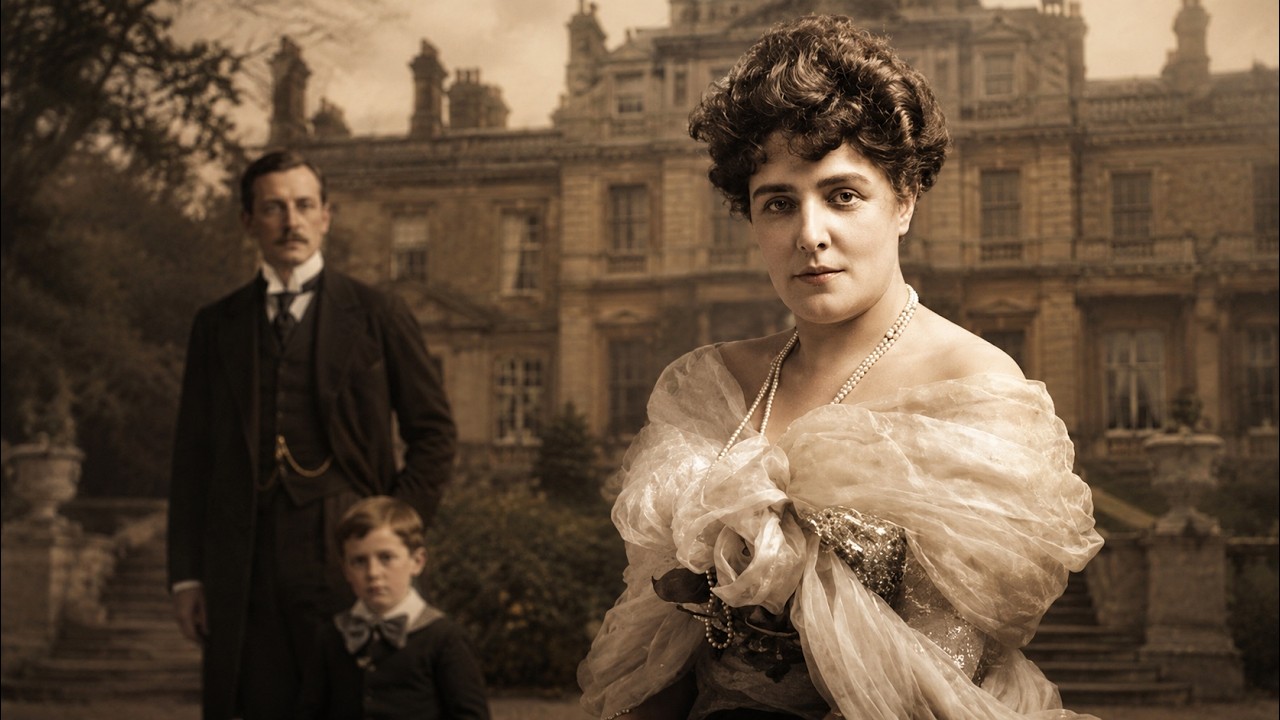
Her contemporaries described her with a phrase that stuck: “more panther than woman. ” What few knew was that she had spent nearly a decade concealing a devastating secret about her husband’s health—a secret that, if exposed, could have destroyed one of Britain’s most prominent political families. Born in Brooklyn in 1854, Jennie was the daughter of Leonard Jerome, a financier the papers called the “King of Wall Street. ” She grew up between Manhattan ballrooms and Parisian salons, studied piano in Paris, and developed a reputation for wit and magnetism.
In August 1873, while attending Cowes Week on the Isle of Wight, she was introduced by the Prince of Wales to Lord Randolph Churchill, a young Conservative politician. Three days later, he proposed. She accepted. The marriage was not without friction.
The Churchill family, led by the Duke of Marlborough, initially objected to the match, but a settlement from Jennie’s father—around $250,000—helped change their minds. The couple married in Paris in April 1874. Winston Leonard Spencer Churchill was born in November of that year, roughly seven and a half months after the wedding. Jennie arrived at Blenheim Palace as Lady Randolph Churchill, facing a household that had opposed her.
She responded by sitting at the grand piano and playing Chopin with concert-level precision, silencing the room and winning an early battle in a long campaign for acceptance. Lord Randolph’s political career rose quickly. By 1880 he was a leading voice in the Conservative Party. Jennie managed much of the machinery behind him: organizing campaigns, writing correspondence, and navigating the social world of London politics.
At the same time, she was raising two sons, Winston and his younger brother Jack. But she was often absent from their daily lives. Winston was sent to boarding school at age eight. His letters to his mother became a running thread of their relationship.
He asked her to visit; she rarely came. In one letter, written when he was around 13, he warned that he would be miserable if she broke a promise to see him, adding that he would “never trust your promises again,” then softened by saying he knew his mother loved him too much to let him down. She did not come to see Buffalo Bill’s Wild West show as he had hoped. Historians have noted the complexity of this relationship.
Winston later described his mother as like an “evening star”—radiant, constant, but always slightly out of reach. In the late 1880s, Lord Randolph’s behavior began to change. His speech became unreliable. His moods swung sharply.
There were moments of confusion and sudden rages. His doctor spoke privately with Jennie. Though many later attributed his decline to syphilis, and some medical historians have suggested a brain tumor, the diagnosis remains disputed. What is clear is that Jennie chose silence.
She continued to present a composed public face while managing a husband who was losing control of himself. In 1886, Lord Randolph resigned as Chancellor of the Exchequer in a tactical gamble that failed; the resignation was accepted and his ministerial career ended at age 37. By 1894, his condition had worsened enough that the family decided on a world tour. The itinerary—Egypt, India, Burma, Singapore, China, Japan, Canada—served partly to remove him from public scrutiny.
During that journey, Jennie learned that Count Charles Kinsky, an Austro-Hungarian diplomat with whom she had fallen in love, had married someone else. She continued on. In early January 1895, from Yokohama, she wrote to her sister that Lord Randolph was physically better but mentally “a thousand times worse,” adding that it would be hard if the truth got out. Three weeks later, on January 24, 1895, Lord Randolph Churchill died at the family home in London.
He was 45. Jennie was 40. After his death came the moment at the door—the refusal to return the parliamentary robes. The robes were kept for Winston.
Now widowed, Jennie faced financial strain. Lord Randolph’s income had died with his career. She launched a literary quarterly called the Anglo-Saxon Review in 1899, a beautifully produced but expensive publication that ran for nine issues and lost money. She also turned her attention to Winston, whose letters from his military postings in India, Sudan, and South Africa became more frequent and more equal in tone.
In 1900, Jennie remarried. The groom was George Cornwallis-West, a handsome captain in the Scots Guards who was 16 days older than Winston. The marriage was initially happy, but the couple struggled financially, and George eventually fell in love with actress Mrs. Patrick Campbell—the leading actress in a play Jennie had written.
The marriage ended by 1914. During World War I, Jennie threw herself into war work, chairing hospital committees and organizing fundraising efforts. Earlier, during the Boer War, she had helped charter the hospital ship Maine. She was, in many ways, as effective behind the scenes as she had always been.
In 1918, at age 63, she married Montague Porch, a British civil servant stationed in Nigeria, who was three years younger than Winston. The marriage was a quieter arrangement; Porch was kind and devoted, and much of their life was conducted at a distance. Asked about the age gap, Jennie reportedly said that he had a future and she had a past, “so we should be all right. ”
In the spring of 1921, she bought a pair of high-heeled shoes in Rome.
That May, while visiting a friend in Somerset, she fell down a staircase. The injury was serious: a badly broken ankle. She was moved back to London, where gangrene set in. On June 10, her left leg was amputated above the knee.
She was 67. Winston visited during her recovery. He was occupied with his own career, which was at a low point. On June 29, 1921, he arrived at her home, one hour too late.
His mother had died from a sudden hemorrhage following the amputation. Winston wrote afterward that she looked “very beautiful and splendid,” and that thirty years had fallen from her brow, recalling the woman he had admired as a child. He had always loved her, he said, like the evening star. Jennie died without a will.
She was buried in the churchyard at Bladon, Oxfordshire, beside Lord Randolph Churchill. The robes she had saved were kept, and the promise behind them was kept as well: Winston Churchill became prime minister in May 1940, led Britain through the war, and never surrendered.