In 1975, Larry John Wilson walked into a room filled with the emerging gods of outlaw country music: Townes Van Zandt, Guy Clark, and a young Steve Earle. A documentary crew for the now-legendary film *Heartworn Highways* was rolling. When Wilson began to sing, the rowdy room fell silent. Wilson was a quiet, bear-like man from Georgia with a major-label deal and a critically acclaimed debut album to his name.
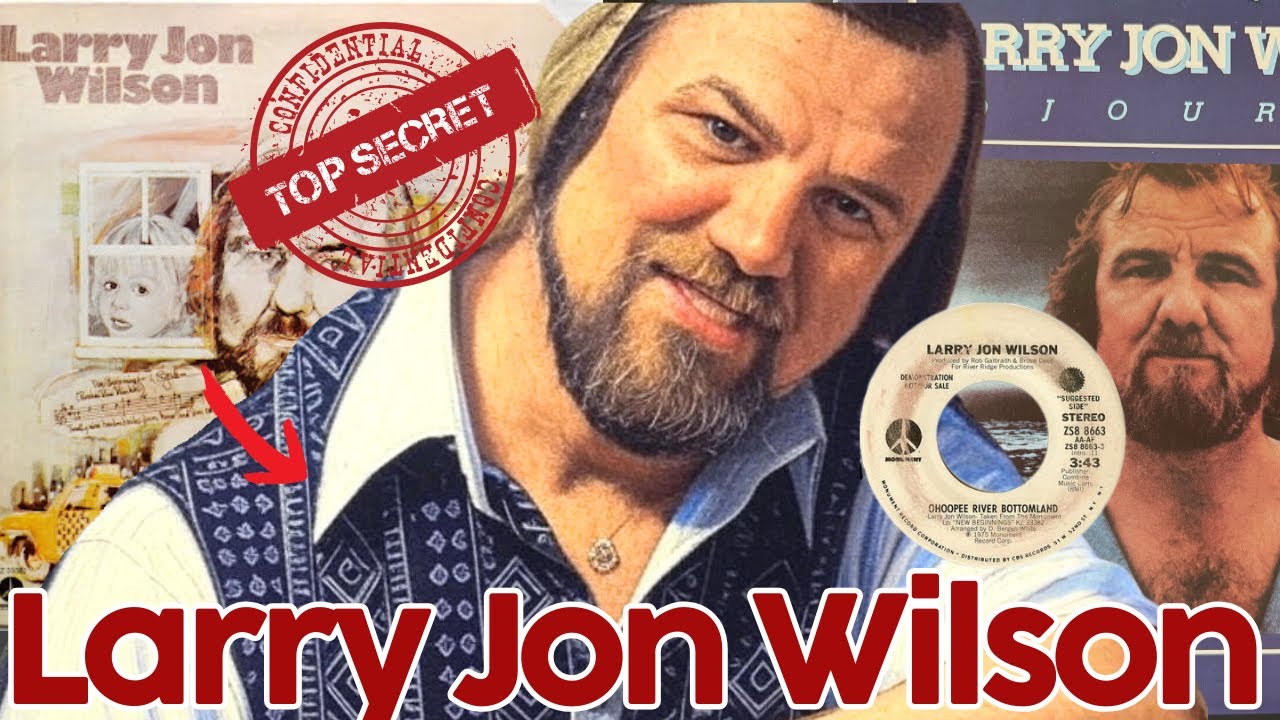
He had the respect of his peers and was viewed as the industry’s next big thing. Then, at the peak of that acclaim, he vanished. There was no scandal and no addiction. He simply put his guitar in a closet, turned his back on Nashville, and returned home to Georgia.
For more than 20 years, he did not say a word. His story did not begin in Nashville. It began in Swainsboro, Georgia, where he was born in 1940. He grew up in the pre-interstate, pre-air-conditioned Deep South, a world defined by church, community, segregation, and profound contradictions.
Music surrounded him. He absorbed white gospel harmonies and the raw passion of Black Baptist churches. He heard the blues of the Georgia Piedmont, the country storytelling of Hank Williams on the radio, and the soul of fellow Georgians Ray Charles and Otis Redding. To Wilson, there were no walls between these genres.
They all came from the same red dirt, and in his world, authenticity was not a style. It was simply the way things were. A few hundred miles northwest, Nashville was building an industry on something different. In the 1960s, the Nashville Sound was scrubbing the grit from country music, replacing steel guitars with string sections in a quest for pop radio success.
It was a factory for hits, and Wilson was a wild oak tree about to be transplanted into a climate-controlled greenhouse. The greatest irony is that Wilson never planned to be a musician. For his first 30 years, he lived a regular, middle-class life. A popular and athletic local kid, he studied science at the University of Georgia and graduated with a degree in chemistry.
He married his anchor, a woman named Sheldon, started a family, and became a fertilizer salesman. He drove the red clay back roads of rural Georgia, talking to farmers and listening to their stories. Music remained a hobby until the late 1960s when he heard Tony Joe White’s “Polk Salad Annie” on the radio. It was a swampy, soulful sound, and Wilson turned to his wife and said, “You know, I can do that.
”
At age 34, in 1974, the family man and scientist packed up and moved to Nashville. He signed with Monument Records, the label that had taken chances on Kris Kristofferson, and was paired with producer Fred Foster. The label gave him the best studio musicians, and in 1975 Wilson recorded his debut album, *New Beginnings*. The record was a revelation.
It opened with a swampy, soulful groove. His songs were philosophical dialogues, not simple hits. The centerpiece, “Sheldon Song,” celebrated a complex, long-term marriage, far from the radio staples of cheating and drinking. Other songs were portraits of rural life with dirt under their fingernails.
Critics called him the William Faulkner of country soul and the sage of the piney woods. But radio had no idea what to do with him. Programmers said he was too soulful for country, too white for R&B, and too complex for pop. He was a critical darling and a commercial nightmare.
The label began asking for a catchy single, a truck song, a cheating song. For Wilson, this was sacrilege. He could only write his truth. While he struggled in this creative limbo, the filmmakers of *Heartworn Highways* captured him at Guy Clark’s house.
In the film, Wilson explained his creative philosophy: a writer is “just a vessel” for what is floating around, and one must be “quiet enough and still enough” to let it come through. It was a profound description of an artistic process that was the exact opposite of the manufacturing industry of Nashville. He recorded a second album, *Let Me Sing My Song to You*, in 1976, and a third in the late 1970s. All were brilliant, soulful masterpieces.
All were commercial failures. When touring was suggested, his misery deepened. The introverted family man was crammed into vans, singing deeply personal songs to drunk crowds who just wanted noise. For a man who saw music as sacred, it was a spiritual offense.
After another record was shelved by the label, he made his decision. The greatest rebel act available to him was not to self-destruct, but to simply walk away. In 1980, he crossed the Tennessee state line heading home. Back in Georgia, he settled his family in a small town outside Marietta.
He took out his guitar, looked at it, and closed the case, putting it in the closet with a tired finality. He sealed the vessel. Wilson returned to real life. He got a job in industrial sales, fighting Atlanta traffic instead of waiting for the muse.
He was a good provider, a father, and a husband. But the music did not stop just because the recordings stopped. To save himself from the pain of hearing songs he could no longer sing, he clogged his own ears, filling the silence with work and the noise of modern life. It was a daily act of spiritual suppression.
Meanwhile, his legend began to grow without him. *Heartworn Highways* was released in 1981, flopped at the box office, and then became an underground sacred text through VHS tapes. Music fans would watch the film and ask, “Who was that big guy? ” His records went out of print and became holy grail treasures.
He became the J. D. Salinger of country music, the ultimate symbol of integrity, all while he was likely balancing his checkbook at his kitchen table. In the 1990s, a new alt-country movement inspired by artists like him began to form.
Bands mentioned Wilson’s name as a key inspiration. In Europe, where fans had been trading cassette tapes for decades, small festival promoters and independent labels began to search for him. By the late 1990s, Wilson was approaching 60, a grandfather preparing to retire. The phone finally rang.
A promoter from the Netherlands asked the man who sang “Ohio River Bottomland” to come and play. After nearly 20 years of silence, cult fans were offering him not fame, but a listen. They wanted the authentic, unchanged Wilson that Nashville had refused. Encouraged by his wife Sheldon, he opened the closet and took out the guitar.
He discovered that his smooth voice was gone. In its place was a raw, gravelly growl, the sound of 20 years of silence, regret, and resilience. It was not weaker; it was more true. He accepted the European gigs, standing before small, silent audiences that had waited two decades to truly listen.
The trip brought him back to himself. The run led to a self-titled album cut in Georgia in the late 2000s, on his own terms. It was not a commercial hit, but it proved he had been right. Wilson died in 2010, not as a regretful salesman, but as an artist who had completed his mission.
His story remains a controversy. Was he his own worst enemy, or a man of integrity who saw Nashville as soul-destroying and chose his family over fame? His tragedy was being trapped between eras, too early for the revolution he inspired. But in his 20-year silence, he proved that obscurity can be the most authentic form of success.
He lived by two rules: be true and don’t hurt your family. He never became a household name, and that was perhaps his greatest victory.