The 1999 film Galaxy Quest arrived looking like a lightweight comedy, but beneath the jokes and alien costumes was something far more ambitious—a film that genuinely understood why science fiction matters to the people who love it. What kept it from becoming just another spoof came down to a series of deliberate creative decisions that transformed the parody into something audiences never expected. The concept seemed simple on paper: take a group of burned-out actors famous for a beloved sci-fi show and thrust them into a real version of the adventures they had spent years pretending to have. From the opening convention scenes, the movie established its characters as people trapped by their own legacy—resented by castmates, exploited by fans, going through the motions of careers they had long stopped believing in.
The writers understood that for the parody to work, audiences first needed to genuinely care about these people. As the story shifted from satire to sincere adventure, the film quietly stopped winking at the camera and began playing everything straight. The heroes earned their heroism. The stakes felt real.
That shift from cynicism to sincerity is what separates Galaxy Quest from virtually every other spoof of its era. Behind the scenes, the production faced its own challenges. A significant portion of the main set was covered in Mylar, the highly reflective silver material chosen for the spaceship interior. Under the intense heat of studio lights, the Mylar began warping, bubbling, and pulling away from the surfaces it had been applied to.
The crew scrambled to manage the damage while production continued around the chaos. A casting dispute fundamentally altered the entire project. Director Harold Ramis wanted Alec Baldwin for the part of Jason Nesmith, believing his theatrical intensity was right for the character. The studio had a different name in mind: Tim Allen, whose comedic background and broad audience appeal made him the more commercially attractive option.
Ramis couldn’t reconcile the two visions and walked away from the project entirely. Dean Parisot took over as director, and Allen was cast in the lead. Ramis also had a clear position on Sigourney Weaver. He didn’t want actors with strong existing associations with science fiction, concerned that recognizable faces from the genre would pull viewers out of the film’s carefully constructed fictional world.
Weaver, whose identity had been shaped significantly by the Alien franchise, fell squarely into that category. When Ramis departed, that restriction left with him. Parisot brought no such reservations, and Weaver was approached and cast. The studio struggled to market a movie that was simultaneously a comedy, a sci-fi adventure, and a deeply sincere tribute to a genre most studios treated as niche.
Early promotional materials leaned heavily into broad comedy, positioning the film as lightweight family entertainment. Some trailers even incorporated visual effects that hadn’t been finished yet. The box office performance at release was solid but unspectacular, widely considered a reflection of this mispositioning. The creative spark behind the film traced back to an unexpected source.
Writer David Howard has spoken about how observing Star Trek actor Leonard Nimoy—and how deeply he had become identified with the role of Spock—planted the seed for the screenplay. Howard began thinking about the broader phenomenon of performers defined and sometimes confined by iconic sci-fi roles. The tension between resenting a role and ultimately finding real meaning in it runs through the entire film. An earlier version of Galaxy Quest carried a significantly darker tone with sharper edges and adult language that pushed it firmly into R-rated territory.
During the editing process, the studio pushed for cuts and re-recorded dialogue to bring the rating down to PG. Some of the replacement lines were dubbed in post-production, and careful viewers have noticed moments where the actors’ lip movements don’t quite match the words. The most frequently cited example involves a certain frustrated outburst from Sigourney Weaver’s character. The oath spoken by Alexander Dane throughout the film began its life as a simple placeholder—a dummy line inserted into the script while the writers searched for something better.
Nobody could find anything funnier. It stayed in the script by default, then gradually became something the production leaned into deliberately. Alan Rickman delivered it with such committed seriousness that the joke deepened every time it appeared. By the time the line appears in its most pivotal scene, spoken as a genuine farewell, audiences who had laughed at it multiple times found themselves caught off guard by how much it meant.
The film employed two distinct aspect ratios that switch at a carefully chosen moment. The transition occurs when Jason Nesmith first approaches the bay doors of the Protector and looks out into actual space. Up to that point, the film had been operating in a narrower frame—grounded, confined, earthbound. The moment he crosses into the reality of what’s happening, the image expands.
It signals that the characters and the film itself are no longer playing around. The design of the NSEA Protector owed more to copyright attorneys than to any single art director. Lawyers were brought in specifically to review design drafts and flag anything that crossed into legally problematic territory. The process shaped decisions about the ship’s silhouette, its interior layout, and even the fine details of its registry markings.
The ship’s registry number was quietly noted in production materials as NTE, standing for “Not the Enterprise. ”
For the Thermians, the voice emerged from a single actor’s instinct during an early audition. Enrico Colantoni employed a method of producing sound from an unusual position in the vocal tract, giving his speech a reedy, slightly breathless quality that felt genuinely non-human without tipping into parody. Parisot recognized it as exactly the right foundation and asked the rest of the cast playing Thermians to study and replicate it.
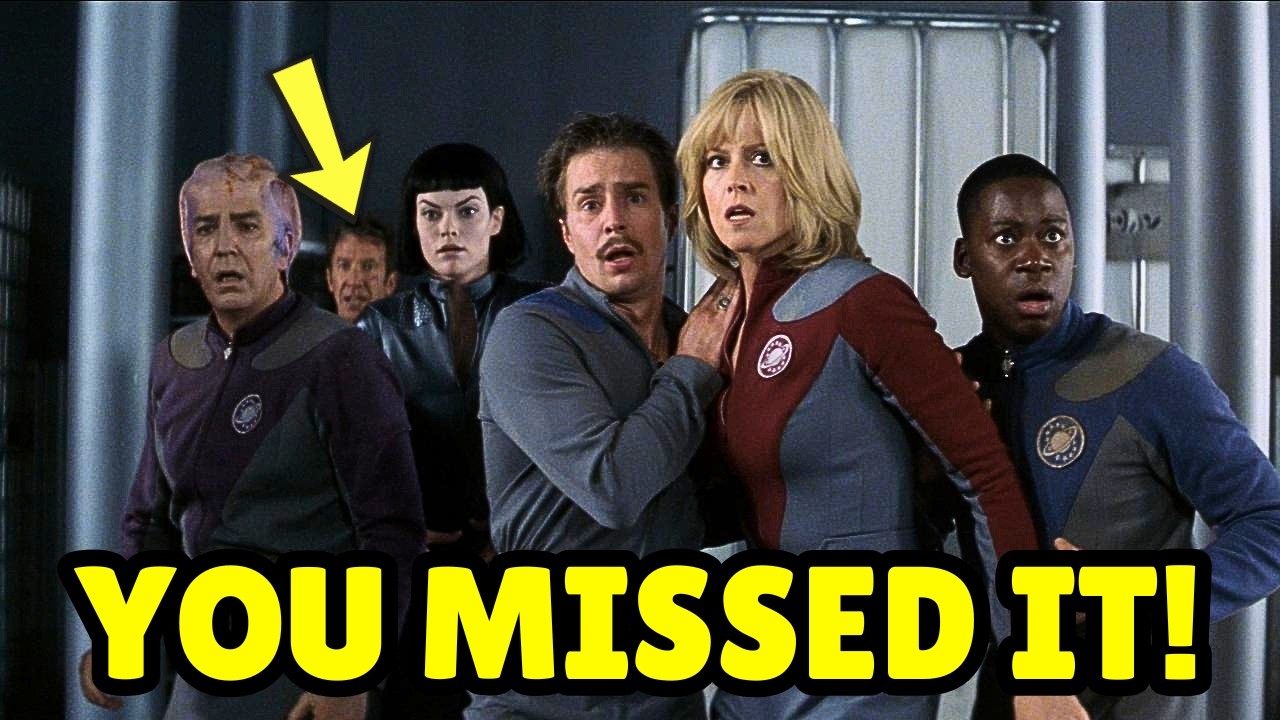
The actors playing the Thermians required a structured approach to physical preparation. The solution was an informal but intensive period of movement training that the cast nicknamed Alien School. Drawing on the visual language of older puppet-based science fiction shows, the actors practiced eliminating the natural fluidity of human motion—every gesture more considered, every shift in posture slightly slower and more mechanical than instinct would suggest. Sam Rockwell’s character Guy Fleegman, a background performer from the original television show who never had a character name, exists as a loving tribute to every unnamed crew member who ever put on a uniform and didn’t make it to the end credits.
The expendable crewman tradition stretched back to the earliest days of Star Trek, where characters introduced without established histories had a tendency not to survive the episode. Missy Pyle was a casting gamble that paid off. The casting director advocated strongly for a performer who was, at that point, relatively unknown at the feature film level. Pyle plays the character’s devotion with complete sincerity, never undercutting it with ironic distance, which is precisely why it’s so funny and so oddly touching at the same time.
Tony Shalhoub constructed a character defined almost entirely by an unshakeable sense of calm. Rather than mirroring the heightened energy around him, Shalhoub decided that Tech Sergeant Chen would respond to every new crisis with the same mild, slightly distracted equanimity. The near-constant snacking that became one of Chen’s defining traits wasn’t scripted in detail—it evolved as Shalhoub found ways to visually express a man who remains grounded in immediate physical pleasures. Allen has spoken about looking elsewhere entirely for his physical and emotional blueprint for the character of Jason Nesmith.
The actor he kept returning to was Yul Brynner, specifically the regal, almost imperious commanding presence Brynner brought to roles in films like The Magnificent Seven and The King and I. That quality, Allen felt, was closer to what Nesmith actually needed. Rickman was not interested in playing Alexander Dane as a joke. He pushed back against any interpretation that reduced Dane to a one-note comic figure, insisting on treating the character’s frustrations as genuine and his eventual emotional journey as something that deserved to be played with complete sincerity.
The cast has spoken warmly about how his seriousness gave them all permission to go further than they might have otherwise. The visual effects work was taken entirely seriously. Industrial Light & Magic handled significant portions of the film’s effects, approaching the assignment with the same standards they brought to productions that had no comedic dimension whatsoever. The production understood that comedy that exists within a credible world is significantly funnier than comedy that exists within a sloppy one.
The marketing campaign committed to presenting the fictional television show as if it had actually existed. A mock documentary presented the cast and history of Galaxy Quest, the television series, as real cultural history. The official website was designed to resemble a genuine fan community that had grown up around the show over decades. The sprawling modernist residence that establishes Jason Nesmith’s celebrity status is a real building—the Stahl House, formerly known as Case Study House number 22, perched above Los Angeles in the Hollywood Hills.
Designed by architect Pierre Koenig and completed in 1960, it became one of the most photographed pieces of residential architecture in the world. The DVD release included a complete alternative audio track presenting the entire movie dubbed into the Thermian language. The track required the voice cast to return and perform the full film in the alien dialect, extending that vocal universe to every line of dialogue in the movie. The pig lizard was built primarily as a practical creation.
A performer wore the suit, providing the creature with real physical weight and the kind of unpredictable organic movement that digital creations of that period often struggled to replicate convincingly. Mechanical components were integrated into the costume for facial expressions. Hidden references operate throughout the movie on multiple levels simultaneously. The Klaatu nebula name checks the alien visitor from the 1951 classic The Day the Earth Stood Still.
Visual compositions echo specific scenes from the Star Trek television series and films without directly reproducing them. The science fiction community formally embraced the film. It won the Hugo Award for Best Dramatic Presentation in 2000, one of science fiction’s most prestigious honors, voted on by the community itself. It was the first, and for a long time the only, comedic film to receive that recognition.
Star Trek cast members across the franchise’s history responded with genuine enthusiasm. Patrick Stewart admitted to laughing so hard during his first viewing that he had to leave the theater to compose himself. Wil Wheaton declared it the best Star Trek movie that was ever made, a statement he has stood behind in interviews since. Galaxy Quest endures because it understood something that most parodies never figure out: that the best way to honor something is to take it completely seriously.
Every creative risk documented in its production history points toward a film that genuinely believed in what it was making. The jokes land because the film means them. The emotional moments hit because the film earned them.