On April 9, 1865, in the small village of Appomattox Courthouse, the Civil War reached its quiet conclusion. Inside a modest brick home, General Robert E. Lee, commander of the Army of Northern Virginia, surrendered to General Ulysses S. Grant. The meeting lasted only a short time, but the moment carried the weight of four years of bloodshed.
When Lee rode away, Union soldiers began to cheer. Artillery crews prepared to fire a victory salute, but Grant stopped them. He ordered the cannons silenced. He did not feel triumph or satisfaction. He later admitted that instead of celebrating, he felt something much closer to sadness.
He had won the war that had cost over 600,000 American lives, yet he could not find joy in the moment.
To understand Grant’s reaction at Appomattox, it helps to go back three years to a place called Shiloh. In April 1862, Grant was a rising Union general. He had captured Fort Donelson and earned the nickname "Unconditional Surrender." But Shiloh was different. It was the first battle of the war with truly staggering casualties, nearly 24,000 men killed, wounded, or missing.
Grant’s army was surprised on the first day, and though he rallied to win on the second, the public was horrified. Newspapers called him a butcher. Critics demanded his removal. What the public never saw was Grant after the battle, standing in the rain, leaning against a tree, weeping.
An officer found him there. Grant looked up and said, "I can't stand the sight of the dead."
That moment shaped him. Grant was not a man who saw his soldiers as numbers. He knew their names, their towns, their families, and he understood that every order he gave would send some of them to their graves.
By 1864, Grant was general-in-chief of all Union armies. He chose to travel with the Army of the Potomac, sharing the hardships of his men. That spring, he launched the Overland Campaign, a relentless drive toward Richmond that became a grinding war of attrition.
At the Wilderness, the woods caught fire, burning wounded soldiers alive. At Spotsylvania, men fought for 20 hours in driving rain at a place called The Bloody Angle. At Cold Harbor, Grant ordered a frontal assault that cost 7,000 Union casualties in less than an hour. He would regret that order for the rest of his life.
After Cold Harbor, Grant wrote to his wife, Julia. "I have made up my mind to carry on the war until the rebellion is crushed, but I am tired of the sight of blood."
By the spring of 1865, Grant had lost more than 50,000 men under his direct command. He had come to understand something that few generals admit. Winning a war does not feel like winning. It feels like surviving.
In late March 1865, Grant broke Lee’s lines at Petersburg. The Confederate capital, Richmond, fell. Lee gathered what remained of his army, about 28,000 starving men, and attempted to escape west, hoping to unite with other Southern forces.
Grant pursued relentlessly, but he also opened a quiet correspondence with Lee, asking for surrender. When Lee hesitated, Grant wrote again. On April 7th, he sent a message. "The result of the last week must convince you of the hopelessness of further resistance."
The next day, he added a personal note. "I regard it as my duty to shift from myself the responsibility of any further effusion of blood."
Grant was thinking about the blood, his men’s blood, Lee’s men’s blood. He had spent four years spilling it, and now he wanted it to stop.
On April 9th, Palm Sunday, Lee agreed to meet. Grant arrived at the McLean house in the early afternoon. He was uncomfortable. He later wrote that he felt anything rather than rejoicing. For several minutes, he could not even speak.
Finally, he began talking about the only thing that came to mind, his last meeting with Lee 20 years earlier during the Mexican-American War. The two men chatted about old times, two soldiers who had once worn the same uniform, now sitting across from each other with the weight of a nation’s blood between them.
Then Grant turned to the terms. He wrote them out in pencil. They were remarkably generous. Confederate soldiers would be paroled and allowed to return home. Officers could keep their sidearms and private horses. Men who owned their own horses could take them home for spring planting. No one would be imprisoned or tried for treason.
When Lee read the terms, he said, "This will have a very happy effect upon my army." Then he mentioned that his men had been without rations for days. Grant immediately ordered 25,000 rations sent to the Confederate lines.
He did not ask for Lee’s sword. He later explained, "I felt that it was a great humiliation to him to surrender his army, and I wanted to make it as easy as possible."
When Lee rode away, the Union soldiers outside began to cheer. Artillery crews prepared to fire a 100-gun salute. It was what everyone expected, the roar of victory after four years of war. But Grant stopped them.
He issued a swift order. No celebrations. No cannon salutes. He said, "The war is over. The rebels are our countrymen again. Let us have no rejoicing."
Some of his officers were confused. One later wrote that Grant had a look of sadness which he had never seen before. Another recalled that Grant stood alone on the porch for a long time, staring in the direction Lee had gone.
When an officer approached and said, "General, this is the greatest day of your life," Grant replied quietly, "I feel more than I can express."
That was all he said. But the order itself sent a message far beyond Appomattox. In an age when victory was celebrated with cannon fire and triumphal parades, Grant chose silence. He understood that the men in gray were not demons. They were Americans, many of whom had fought with the same courage as his own soldiers.
One Union soldier recorded in his diary that day, "Grant looked as if he had lost the war instead of won it."
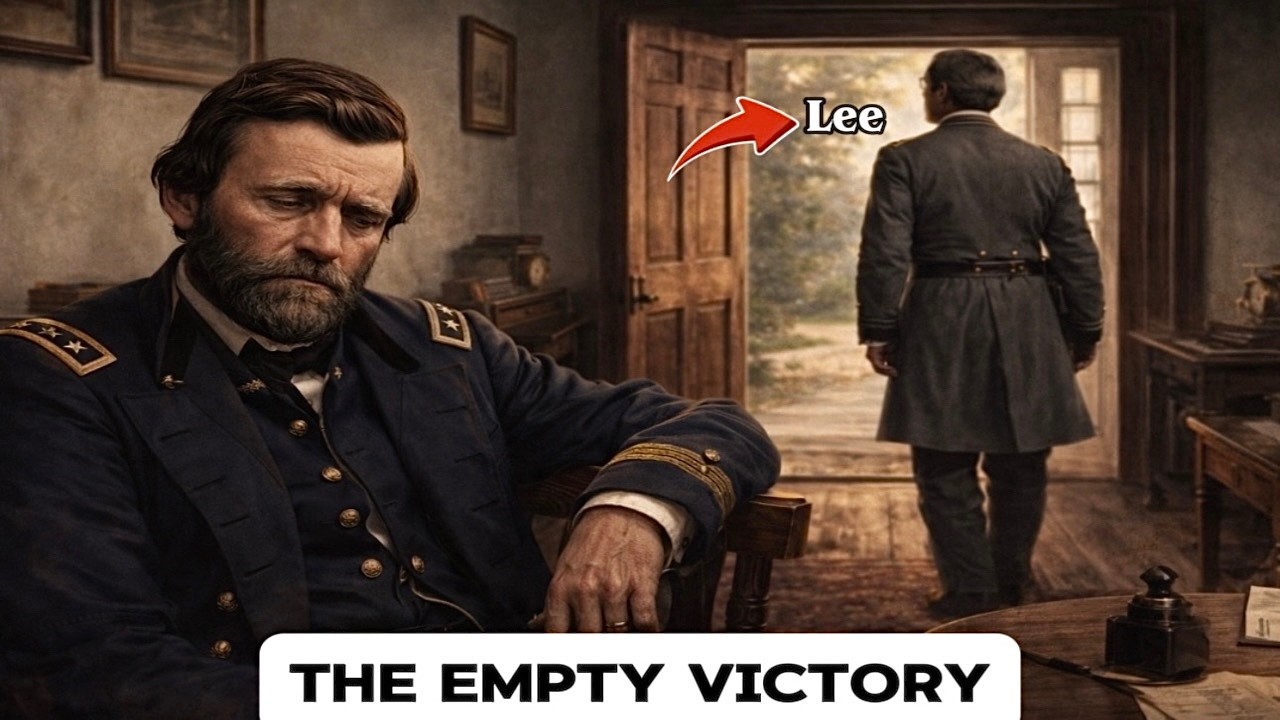
Other generals had celebrated their victories with grand displays. Grant’s silence became a quiet rebuke to the idea that war was something to be glorified. Later, when asked why he stopped the celebration, Grant would only say, "I could not rejoice at the downfall of a foe who had fought so long and so valiantly."
It was an answer that satisfied few. But for Grant, it was the only truth he could speak aloud.
Word of the surrender spread across the north like wildfire. Cannons roared in Washington. Crowds filled the streets, but Grant was not among them. He returned to his headquarters at City Point, Virginia, and wrote to his wife, Julia. "I have not yet felt the joy that I expected."
In the days that followed, Grant found himself unable to sleep. He later confessed to a friend that the faces of the dead haunted him. Not just Union soldiers, but Confederate boys he had seen lying in the fields along the retreat from Petersburg.
He wrote, "I felt that the war had been a terrible thing, and I was glad it was over. But the victory seemed to me to have been bought at such a cost that I could not feel triumphant."
Then, on April 14th, five days after Appomattox, came the invitation. President Lincoln asked Grant and Julia to join him at Ford’s Theatre that evening. Grant declined. He was exhausted and wanted to see his children, who were in New Jersey. He and Julia left Washington that afternoon.
That night, Lincoln was assassinated. Grant was shattered. He called Lincoln "the greatest man I ever knew." But in the quiet hours, he carried a guilt that never fully faded.
Many historians believe Grant felt that if he had been there, if he had accepted the invitation, he might have prevented the assassination. He never said so directly, but his biographers note that for weeks afterward, he rarely smiled, and his correspondence took on a darker tone.
The war had ended, but the peace that followed was violent. Grant found himself thrust into the role of mediator between a vengeful Congress and a defeated South. When President Andrew Johnson tried to pursue treason charges against Robert E. Lee and other Confederate leaders, Grant quietly opposed it.
He told Johnson that he had given his word at Appomattox that no one would be punished, and he intended to keep it. Privately, Grant threatened to resign if Johnson went back on the terms of surrender. Johnson backed down. Lee was never prosecuted.
Grant later wrote, "I had given my word. A man’s word, I believe, should be as good as his bond."
And in those pages, he returned to Appomattox. He wrote, "I had no taste for the war, and I had no taste for the victory. I felt that the South had been brave and had fought long and well. I felt sad and depressed."
Then he added something that stunned even his closest friends. "I suffered more than I ever suffered in battle."
Think about that. A man who had been under fire dozens of times, who had watched his soldiers die by the thousands. He said that the moment of victory was the greatest suffering of his life.
Why? Because Grant understood something that most of us don't. In the years after the war, Grant rarely spoke of his feelings about Appomattox. He became a reluctant politician, first as Secretary of War, then as president. His presidency was plagued by scandals he did not create but could not control.
Yet through it all, he remained a man of quiet integrity, fighting for the rights of freed slaves and trying to heal a broken nation.
Then, in 1884, disaster struck. Grant’s investment firm collapsed, and he lost everything. Bankrupt and dying of throat cancer, he faced a terrible choice. He could leave his family with nothing, or he could write his memoirs and hope they sold.
With the support of his friend Mark Twain, Grant began writing. He was in constant pain, unable to swallow solid food, dictating from a chair at a cottage in Mount McGregor, New York. In 10 months, he produced nearly 300,000 words.
For four years, he had built an emotional armor to order men to die. When the killing stopped, that armor didn’t fall away. It became a cage. He could not celebrate because celebration meant rejoicing in the cost. And the cost was too high.
One of Grant’s aides, writing after the war, remembered a conversation they had in the days following Appomattox. Grant said, "I think that a man who has been in a great war is never quite the same afterward. He sees things differently. He knows what men are capable of, both good and evil, and he knows that the line between the two is very thin."
Grant died on July 23rd, 1885, at the cottage in Mount McGregor. His memoirs were published by Mark Twain and became an instant bestseller, earning nearly $500,000, enough to secure his family’s future.
But the true measure of Grant’s legacy came in the weeks after his death. A funeral procession was held in New York City that drew more than a million people. Veterans from both the Union and the Confederate armies marched together in the streets. Former enemies walked side by side, mourning the man who had won the war and then refused to let victory become vengeance.
Grant’s body lay in a temporary tomb for 12 years while the permanent structure, now known as Grant’s Tomb, was built. On April 27th, 1897, over one million people gathered for the dedication. It was the largest public gathering in American history up to that time.
In his memoirs, Grant had written, "I feel that we are on the eve of a new era, when there is to be great harmony between the people of the North and the South."
He did not live to see that harmony fully realized, but his actions at Appomattox, the silence, the generous terms, the refusal to punish, planted the seeds. He understood that true victory was not about humiliating the defeated. It was about rebuilding a nation.
Maybe that is why we still remember him. Not for the battles he won, but for the silence afterward.