In the spring of 2002, PepsiCo paid Britney Spears $7. 5 million to endorse a new blue-colored, berry-flavored cola called Pepsi Blue. It was the largest celebrity endorsement deal in the history of the cola industry, and the product launch was backed by an estimated $150 million marketing budget. By the summer of 2004, Pepsi Blue had been quietly removed from American store shelves, disappearing without a press conference or a clearance sale.
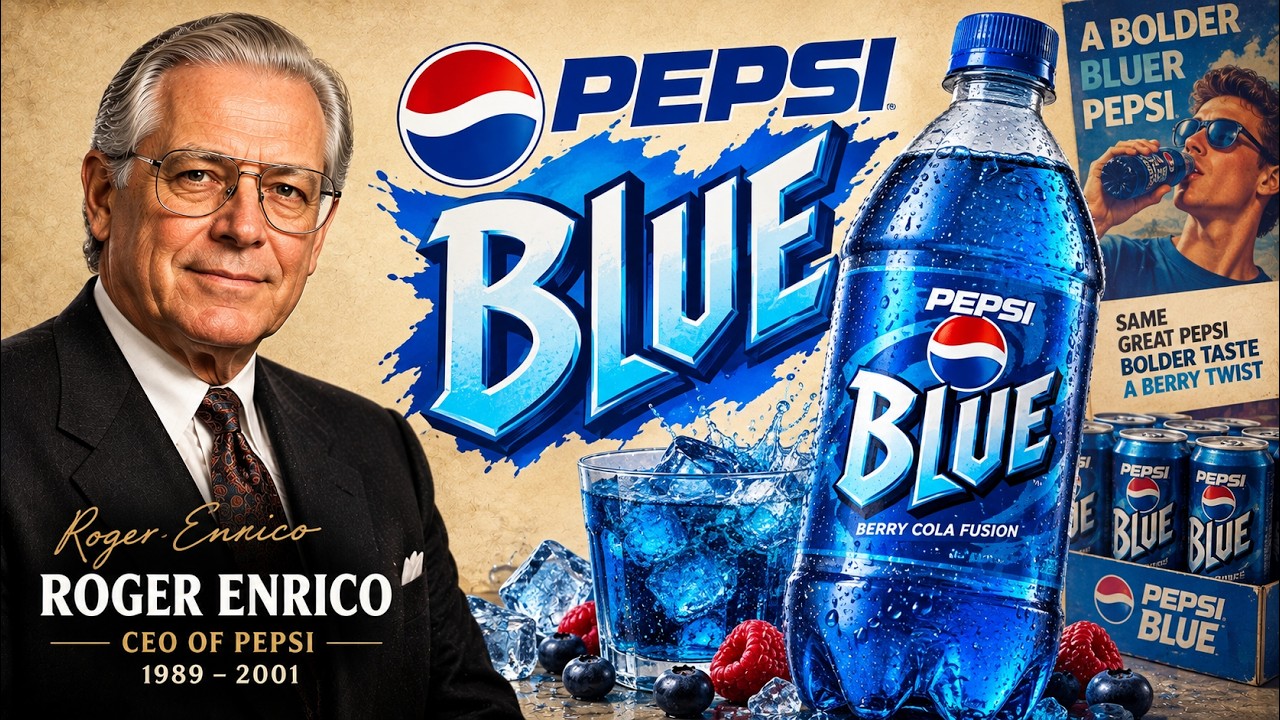
The strange part is what happened overseas. While Pepsi Blue failed in the United States, it became a lasting success in markets like the Philippines and Indonesia. As of 2024, it remains one of the top-selling cola variants in the Philippine market. The product rejected by America was adopted by the world.
The story of Pepsi Blue begins with a long-running rivalry. By the year 2000, PepsiCo was the second-largest food and beverage corporation in the United States, with revenues approaching $22 billion annually. It owned Frito-Lay, Tropicana, and Gatorade. But in the cola category that defined the company, it was losing to Coca-Cola, which held roughly 44% of the American carbonated soft drink market compared to Pepsi’s 31%.
More troubling was the direction of the market. Core cola drinkers were aging, and younger Americans were increasingly turning to energy drinks. Red Bull entered the U. S.
in 1997 and was selling rapidly by 2001 without traditional advertising. Under PepsiCo’s own roof, Mountain Dew had successfully repositioned itself around extreme sports, and its cherry-flavored variant, Code Red, sold 100 million cases in its first year. PepsiCo’s leadership drew an incomplete conclusion from this success. The man most responsible for what came next was CEO Roger Enrico, who had overseen the famous Pepsi Challenge campaign.
He authorized a project known internally as Project Blue, with a simple brief: create a cola variant that would capture Americans between the ages of 13 and 24. The product would be a vivid electric blue, a color no cola in American history had ever been. The flavor would be a sweet “berry cola fusion” designed for younger palates. By late 2001, the formulation was locked and a $150 million budget was approved, the largest single product launch spend in PepsiCo’s history.
All that remained was the face. Britney Spears, then 20 and the most recognizable pop star on the planet, was signed for $7. 5 million. The flagship television spot aired during the 2002 Super Bowl pre-show.
The ad was seen by an estimated 88 million Americans, and initial retail orders were extraordinary. Walmart placed one of the largest single product orders in its beverage aisle history. Then PepsiCo gave away 100 million free samples through schools, malls, sporting events, and direct mail, putting a free bottle in the hands of roughly one in every three Americans. The logic was that unfamiliarity was the barrier, and removing it would lead to purchase behavior.
The theory proved to be precisely backwards. Food psychologists had documented since the 1980s that blue was the rarest color in the natural food spectrum and that the brain did not trust blue things as edible. The flavor compounded the problem. Consumer response described Pepsi Blue as tasting like something that could not decide what it was, sweeter than standard Pepsi with a heavy finish.
While teenagers tried it and many found it interesting, interest did not translate into habit. The repeat purchase rate came back at numbers PepsiCo had not projected. By August 2002, distributors were quietly reassigning cooler space allocated to Pepsi Blue. Meanwhile, one data point gave the optimists hope: internationally, Pepsi Blue was accelerating.
The Philippines received the product in mid-2002 without the massive sampling campaign or celebrity contract. Within 60 days, it had outsold every other Pepsi variant in that market except the original. By the end of 2002, it was outselling Coca-Cola in several regional markets. The divergence was stark.
Novelty has different values in different markets. In the United States, the beverage aisle offered 40 to 60 choices, so novelty was cheap and consumers returned to habit. In the Philippines, the market was less saturated, and a new product from PepsiCo was an event. Filipino consumers returned to Pepsi Blue.
PepsiCo did not pivot toward those markets. Instead, it doubled down on American marketing. A second wave of the campaign launched in the fall of 2002 with new television spots and a 99-cent convenience store bottle format. Sales moved slightly and temporarily, but the trajectory was not recoverable.
The competitive landscape was also moving fast. In April 2002, the same month Pepsi Blue hit shelves, a small California company called Hansen Natural introduced a new product line called Monster. Monster Energy grew rapidly and captured exactly the demographic Pepsi Blue had been designed to reach. The teenager who wanted to feel like an outsider did not reach for a bottle Britney Spears had held in a Super Bowl commercial.
It was a lesson in the limits of trying to manufacture rebellion. Roger Enrico retired as CEO in February 2001, before Pepsi Blue reached shelves. His successor, Steve Reinemund, was a disciplined operator who did not move quickly on a decision carrying the weight of his predecessor’s legacy. Through 2002 and into 2003, Pepsi Blue remained on shelves, but marketing spend was reduced and the Britney Spears campaign was not renewed.
The product was being maintained rather than supported. By late 2002, roughly 60% of American teenagers had tried Pepsi Blue, but the repeat purchase rate was only about 8%. A successful new beverage typically requires a repeat purchase rate of 30% or higher. Eight percent was a signal that the product had no future in that market.
Formal discontinuation discussions with major retailers began in the second quarter of 2003. Regional chains were the first to act, and the pattern was consistent. Pepsi Blue’s sales velocity had declined to roughly 30% of its opening figures. In early 2003, PepsiCo quietly reformulated the product to taste more familiar, but the change did not move the repeat purchase numbers.
By the fall of 2003, the major national chains made their decisions. Walmart reduced Pepsi Blue’s shelf allocation, and Kroger and Safeway followed. In the fourth quarter of 2003, PepsiCo chose not to fight these decisions. The formal discontinuation in the United States was announced in 2004, to the extent it was announced at all, as a line in the trade publication Beverage Digest noting that PepsiCo would discontinue the product domestically while continuing production for international markets.
Warehouse inventory was liquidated through discount channels, and the blue dye ran out of the supply chain within a quarter. The American story of Pepsi Blue ended in 2004, but the global story did not. In the Philippines, the product never disappeared and remained commercially viable as of 2024. Indonesia, Malaysia, and several Gulf states adopted the product with consistency that the American market refused to provide.
Academic literature on Pepsi Blue offers two explanations for the split outcome. The first is the novelty threshold: in less saturated markets, novelty retains its value longer. The second is more uncomfortable for American marketers: the color blue carried a contamination signal in American food psychology that it did not carry with equal force in many Southeast Asian markets. The hesitation was a culturally conditioned American response, not a universal one.
PepsiCo had designed a product around the assumption that American consumer psychology was the baseline. There is no monument to Pepsi Blue at PepsiCo’s headquarters, and the institutional memory exists primarily in the heads of people who have long since moved on. What does exist in abundance is a secondary market. Original bottles sell on eBay for between $12 and $45, six-packs have sold for over $100, and vintage promotional materials sell for $20 to $60, moving within days of listing.
The collector market is populated by cultural archaeologists who understand that Pepsi Blue represents something precise about a specific moment in American consumer history. The failure exposed the limit of spectacle, celebrity, and the assumption that spending enough money and putting a product in front of enough people would change behavior. One hundred million Americans were given Pepsi Blue for free, and nine out of ten decided after tasting it that it was not worth buying. There is a footnote to the story.
In 2023, PepsiCo quietly reintroduced Pepsi Blue in the United States as a limited edition nostalgia product available online for approximately eight weeks. The product sold out within 72 hours. PepsiCo did not follow the limited release with a permanent reintroduction. The same American consumers who declined to buy it a second time in 2002, or their children, purchased every available unit.
They did not want it back permanently. They wanted to taste the specific flavor of a moment that had passed. PepsiCo understood data and misunderstood people. A product cannot create desire; it can only meet it.
Pepsi Blue arrived looking for a desire that had already moved somewhere else.