In the spring of 1895, the most envied woman in New York walked into a lawyer’s office and made a choice that horrified her world. Alva Vanderbilt, wife of heir William Kissam Vanderbilt, filed for divorce—and in doing so, set in motion the most expensive and scandalous society split of the Gilded Age. Before she filed, her own lawyers warned her not to. Her family warned her too.
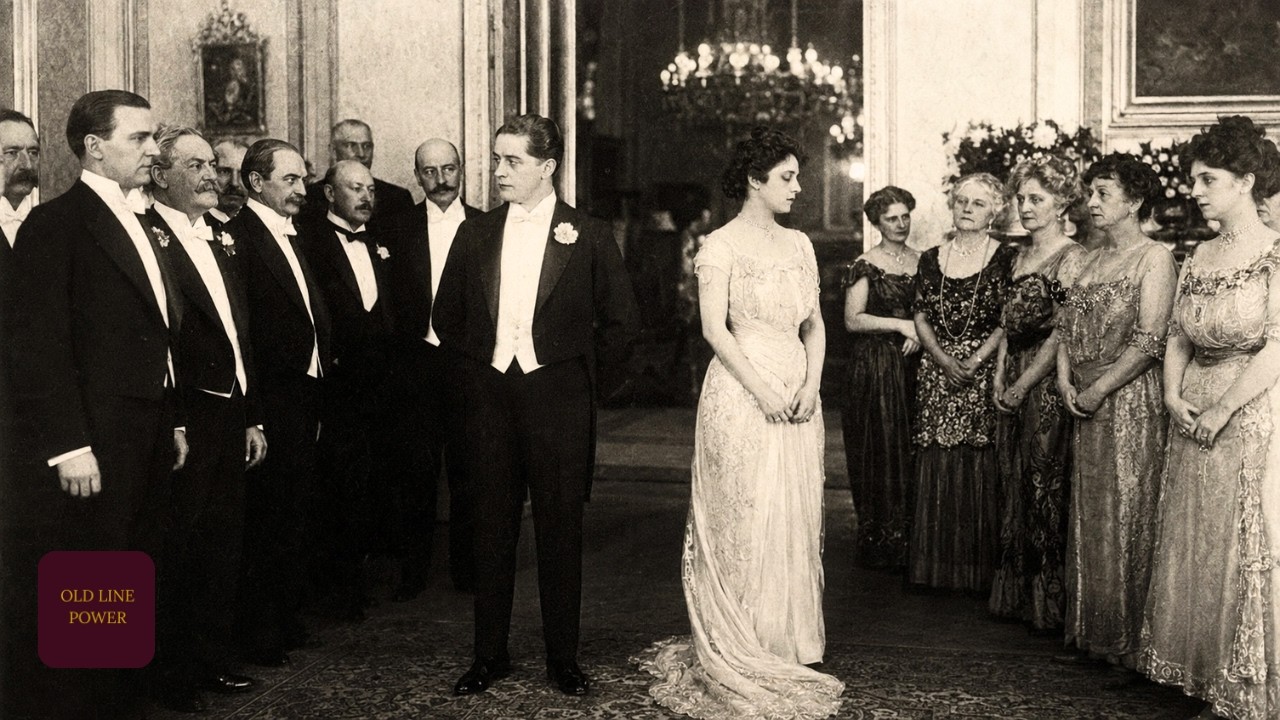
Everyone who cared about her understood that in New York’s highest social circles, divorce was a form of social death. A woman who divorced could expect her friends to vanish and her name to become a whisper behind gloved hands. Alva knew exactly what it would cost. She filed anyway.
Born in 1853 in Mobile, Alabama, Alva Erskine Smith had grown up poor after her cotton-merchant father’s fortune drained away. By her late teens, she had almost nothing—no beauty, no inheritance, no prospects. What she had was a will like a closed fist. In 1875, she married William Kissam Vanderbilt, grandson of the railroad commodore.
On paper, it was a rescue. In truth, it was the start of a harder fight. The Vanderbilts possessed enormous wealth but almost no social standing. New York’s oldest families judged their money crude and locked them out of the rooms that mattered.
Alva set out to take those rooms by force. She hired architect Richard Morris Hunt and built a French chateau at Fifth Avenue and 52nd Street. In 1883, she filled it with 1,200 guests for a costume ball that the whole city discussed for weeks. Dressed as a Venetian princess with jewels sewn into her gown, she achieved what she had set out to do: she forced Caroline Astor, the reigning queen of society, to acknowledge her in public.
Then came the rest of the empire—a Newport palace called Marble House, reported to cost $11 million and run by 36 servants, and a country estate on Long Island. She had three children, including her eldest daughter, Consuelo, who became the prize of her generation. By the early 1890s, Alva did not simply belong to high society. She ran it.
Hostesses copied her menus. Younger women studied how she entered a room. The girl from Mobile who had owned nothing now helped decide what counted as taste in America. From the outside, the marriage holding all of this together looked solid.
Whatever was going wrong between husband and wife stayed behind closed doors. That is what made her next move so hard to believe. In Paris, William Kissam Vanderbilt kept a second life, and he barely troubled to hide it. Her name was Nelly Neustretter, an American by birth who moved easily through wealthy Parisian circles.
William set her up in a fine apartment in the city and gave her a house at Deauville, close to the stables where he kept his racehorses. One newspaper claimed he handed her 40,000 francs so openly that friends begged him to show some discretion. He had no interest in discretion. William was in almost every way his wife’s opposite.
She was all drive and calculation. He was easy, charming, and far happier among his yachts and horses than in the social wars she fought on the family’s behalf. He had inherited a vast fortune and had never struggled for anything. By the early 1890s, he had stepped out of the marriage in all but name.
For Alva, the unbearable part was not the betrayal alone—it was the audience. The women she had beaten to reach the top were whispering behind their fans. In Europe, Nelly was notorious, and what was whispered in Paris did not stay in Paris. When the affair could no longer be ignored, William reportedly did not bother to deny it.
There was no scene, no plea, no promise to do better. Yet Alva did not move to end things right away. In November 1893, the couple boarded a ship for a long voyage through India. The cruise ran close to ten months, and it changed nothing at all.
Before she filed for divorce, every lawyer she consulted told her the same thing: do not do this. They were not being cowardly—they were being truthful. In the New York of the 1890s, divorce was a public judgment on a woman’s character, and that judgment followed her for life. Among families at the very top of New York society, divorce was almost unheard of.
The few separations that happened were hushed up and arranged so that no one had to say the word aloud. What Alva intended was the opposite: she would go to court, name her husband, and let the whole country read about it. The law was built to make that nearly impossible. Since 1787, New York had accepted only one reason to end a marriage: proof of adultery.
A wife could be wretched for decades, and the courts would shrug. To win her freedom, she had to prove in open court that her husband had betrayed her—with names and with dates. That requirement is what made the process so cruel. To free herself, Alva would have to put her own humiliation on the public record.
There was no dignified version of this. There was a sharper twist buried in the statute. New York punished the guilty party. The innocent spouse walked away free to marry again.
The one the court found at fault was forbidden to remarry while the wronged partner still lived. Alva did not need a kind statute. She needed a guilty husband—and she had one. Some time in 1894, against the advice of every person she trusted, Alva told her lawyers to proceed.
In March 1895, a New York court granted her an absolute divorce. The decree handed her full custody of all three children, confirmed her right to marry again, and placed William at fault, forbidden to remarry while his former wife lived. By the time the papers were signed, she was 42 years old and no longer Mrs. William Kissam Vanderbilt.
She was a divorced woman who had outwitted a brutally strict divorce law and won. Here is the question that has trailed this divorce for more than a hundred years: what if William wanted it? On the surface, the story could not be simpler—a husband strays, a wife catches him, she makes him answer in a courtroom. But sit with the details and the simple story begins to wobble.
William did not fight the divorce. A man of his wealth could have hired the finest lawyers money could buy, denied everything, and dragged the case out for years. He did none of it. He let the accusation stand and barely raised a hand to defend his own name.
Then there is the matter of the mistress. Nelly Neustretter had been the heart of the whole case—the living proof of William’s guilt. And the instant the trial ended, she was gone. The affair that had supposedly broken a marriage simply stopped almost on schedule.
And so a theory began to spread through the drawing rooms of New York. What if the affair had been arranged from the start? What if William, desperate to be free of a marriage he no longer wanted, had quietly paid a woman to play the role of his mistress? It would have handed Alva the grounds she needed and handed William the exit he craved.
There is no proof that the divorce was staged. There never was. It is a rumor born from suspicious timing and a husband who behaved strangely. But it was a rumor that serious people took seriously.
One of those people was Henry James. The novelist took a scenario almost identical to this one and built a short story around it—a rich man striking a quiet bargain with a woman who has no social standing so that he can be divorced on her account while his real affections lie elsewhere. Yet the tidy version of the theory has a hole in it. The formal grounds, by some accounts, named more than one woman.
Alongside Nelly Neustretter, the charge is said to have included a titled English woman, the Duchess of Manchester. If William had hired a single fake mistress, why would a second name ever appear? In the end, it may not matter which version is true. Real or staged, the outcome was the same.
Alva walked away with her freedom and her children. William walked away with his. When the terms of the divorce were reported, one figure stopped readers cold: $10 million. That sum in 1895 would be worth more than $300 million today.
An ordinary American worker in that era might earn a few hundred dollars in a year. The agreement reportedly gave Alva far more than a single payment. On top of the lump sum came an income said to reach $100,000 a year, arriving whether she remarried or not. She kept a share of the great family houses.
She kept full custody of the three children. She held on to the Vanderbilt name itself, which still opened any door in America. There was one more piece. Marble House in Newport was already hers—William had deeded it to her years before in her own name—so part of what the world saw as a generous settlement was simply Alva keeping a house she had owned all along.
Taken together, it was very likely the largest divorce settlement the country had seen up to that point. But for William, $10 million was not ruin. The Vanderbilt money came from the railroads the old Commodore had built, a fortune counted in the hundreds of millions of dollars. He handed over the largest settlement anyone had seen, and his wealth barely noticed it was gone.
What the settlement actually bought Alva was a way out of dependence for good. Her wealth was now hers alone. No man controlled it. No man could threaten to cut her off.
The invitations stopped first. For twenty years, Alva Vanderbilt’s calendar had been the fullest in New York. Now the cards that once flooded her hall slowed to a trickle, then to nothing. Dinners went on without her.
The Newport season filled with the same faces, missing only one. Polite society did not punish a divorced woman with shouting—it punished her with absence. Calling cards went unreturned. Old friends looked through her on the street.
Hostesses who had once begged for her presence found gentle reasons she could not be included. Some of the sharpest snubs came from women who owed her their own positions. Alva had built this world with her own hands. She had stormed the gates of old New York and forced its queen to receive her.
Now those same rules were turned against her, and the gates she had battered open were barred from the inside. Her wealth could not save her. A fortune could buy a grand house on the Newport cliffs. It could not buy back a seat at a table that had voted to remove you.
William, the man who had actually strayed, lost almost nothing. He kept his clubs, his friends, and his place in society. Society saved its full punishment for the wife—the wronged party who had dared to say out loud that the marriage was over. While society was busy burying Alva, she was already digging her way out.
The exile and the comeback were not two separate seasons of her life—they overlapped. Her first move was her daughter. In November 1895, only months after the divorce, Consuelo married the Duke of Marlborough in a wedding that stopped the country. It was a match Alva had pushed hard to make.
Overnight, a disgraced divorcee had become the mother of an English duchess. The title did not only lift Consuelo—it lifted her mother. Her second move was bolder still. Two months later, in January 1896, Alva married again.
The man was Oliver Hazard Perry Belmont, rich, charming, and the son of a great American banking family. He was also William’s former close friend. New York was scandalized all over again. In that age, two divorced people marrying each other was close to unthinkable.
No priest or minister in the city would agree to perform the ceremony. In the end, Alva had to turn to the mayor himself, William Strong, who married the couple in a civil service. She did not care in the slightest. The speed of the remarriage made an old whisper impossible to ignore.
What if Alva and Belmont had been drawn together long before the marriage ended? What if the real story had never been William’s wandering, but Alva’s own heart? There is no proof of it. Together, the two marriages did everything.
The duke gave Alva borrowed grandeur—a daughter who outranked the people who had shut her out. The Belmont match gave her a powerful new family to stand behind her. Within roughly a year of the decree, she had a duchess for a daughter, a new husband, and a new house from which to mount her return. While Alva fought to rebuild her world in New York, William did the simplest thing imaginable.
He left. He crossed the Atlantic and settled in France, finally getting the existence he had always wanted. He built a chateau in Normandy and poured himself into thoroughbred horses. Near the coast at Deauville, he founded a great racing and breeding stable.
Within a few years, the Vanderbilt name was winning important French races. Then came the part that should not have been possible. The divorce decree had branded William the guilty party, and the penalty was clear: he was forbidden to remarry while Alva still lived. She would live for nearly forty more years.
In 1903, he married Anne Harriman, a respected widow. The New York courts could do nothing about it—a judgment handed down in Manhattan had no power over a man who lived in France. By every sign, the second marriage suited him far better than the first. They stayed together until the end of his life.
William Kissam Vanderbilt died in 1920 in France, still enormously rich and still surrounded by the horses he loved. The most expensive divorce of the Gilded Age had cost him a fortune. By every account, he could not have cared less. Alva’s divorce was the one the whole country remembered, but she was not the only woman walking out of a marriage in those years.
Something was shifting across America. Across most of the country, divorce was punishingly difficult to obtain. So those with money went looking for a loophole, and they found one out west. In the young state of South Dakota, the divorce laws were unusually loose.
A person needed only 90 days in the state to use its courts. A steady stream of unhappy spouses began boarding trains for Sioux Falls. They settled into a comfortable hotel called the Cataract House while they waited out their 90 days. The newspapers gave the whole spectacle a name: the divorce colony.
More and more of the travelers on those westbound trains were women, deciding for themselves that a miserable marriage did not have to last a lifetime. Alva fit that pattern and stood apart from it. She never needed the divorce colony. She had what the New York court required and the money to fight her case at home in the open.
What Alva had that the quiet Sioux Falls divorces did not was the spotlight. Her case played out on every front page in the country. People who would never have read a word about Sioux Falls read every word about Alva Vanderbilt. She made the unthinkable visible.
The stigma that had nearly buried her slowly faded for the women who came after. What had meant social ruin in 1895 became within a generation a manageable embarrassment, and finally not much of anything at all. Alva paid the full price of divorcing in public. The women who followed paid less precisely because she had gone first and lived through it.
Of all the things Alva Vanderbilt might have become in her later years, no one predicted this: the woman who had spent two decades conquering ballrooms turned into a force in the fight for women’s right to vote. When Oliver Belmont died in 1908, Alva was widowed for the second time. She was in her fifties, immensely rich, and answerable to no one. She found a cause to pour herself into.
She became a suffragist. Her own life had taught her the lesson—she had felt firsthand how completely a woman’s fate could hinge on her husband’s goodwill and a man’s law. In 1909, she founded the Political Equality Association to push for a woman’s right to vote. A few years later, she became a major force behind the National Women’s Party, led by the young organizer Alice Paul.
In 1917, those women did something no one had dared before: they marched to the gates of the White House and stood there in silence day after day, holding their banners. Some of them went to jail and endured real brutality there. It was Alva’s money that helped keep them on that sidewalk. She put her famous houses to work as well.
Marble House, the Newport palace she had built as a monument to her own social ambition, was thrown open for the cause. In 1914, she gathered suffrage leaders there for a grand conference and opened the house to paying visitors to raise money. But there is a shadow across this story. In 1921, Alva took the witness stand in a courtroom.
The proceedings concerned her daughter Consuelo and the long-ago marriage to the Duke of Marlborough. Under oath, the great champion of women’s freedom said it plainly: she had held absolute power over her daughter. The girl had been given no real choice, and the marriage had gone ahead because Alva willed it. The woman fighting as hard as anyone in the country for a woman’s right to govern her own life had once denied her own daughter that exact right.
Both things were true. The vote came in 1920 when the 19th Amendment was ratified, and Alva lived to see the cause she had given her last years to become the law of the land. She went on to lead the National Women’s Party in the years that followed. When she died in 1933, her funeral was exactly the statement you would expect of her.
The pallbearers were women. The banners carried the slogans of the movement. Over it all hung three words borrowed from Susan B. Anthony: “Failure is impossible.
”
The money was never the real story. What Alva Vanderbilt discovered in 1895 was not wealth—she already had that. What she discovered was the full and frightening extent of her own power. She learned that she could take the rules written to trap her and turn them to her own ends.
She learned that she could lose everything and build it back. That same power runs through every part of her story, for better and for worse. It is the power that detonated her marriage and bent a daughter to her will. It is the power that hauled her back from ruin and that in the end helped win millions of American women the right to vote.
She freed herself, and she trapped her daughter. She broke the rules for her own gain, and then broke them again for a cause far larger than herself. Today, a monument in Washington still carries her married name, honoring the fight she helped fund. The most expensive divorce of the Gilded Age cost a fortune, but what it truly bought in the end was the right of one woman to decide her own life.
Alva spent the rest of hers making sure other women could decide theirs too.