Two cousins who traveled west to California in 1851 searching for gold discovered something far darker than hardship in the Sierra Nevada foothills. Samuel Pritchard and Benjamin Hargrave left Missouri and followed the California Trail for four months before arriving at a remote mining camp near a place called Temperance Creek, where roughly 200 men were working claims along a five-mile stretch of water. The journey had already worn them down physically and mentally, replacing youthful optimism with the hardened pragmatism of men who had watched others die from cholera, accidents, and sheer bad luck. Upon arrival in late May of 1851, they took over a claim about three miles upstream from the main camp, a spot abandoned by its previous owner for reasons no one wanted to discuss.
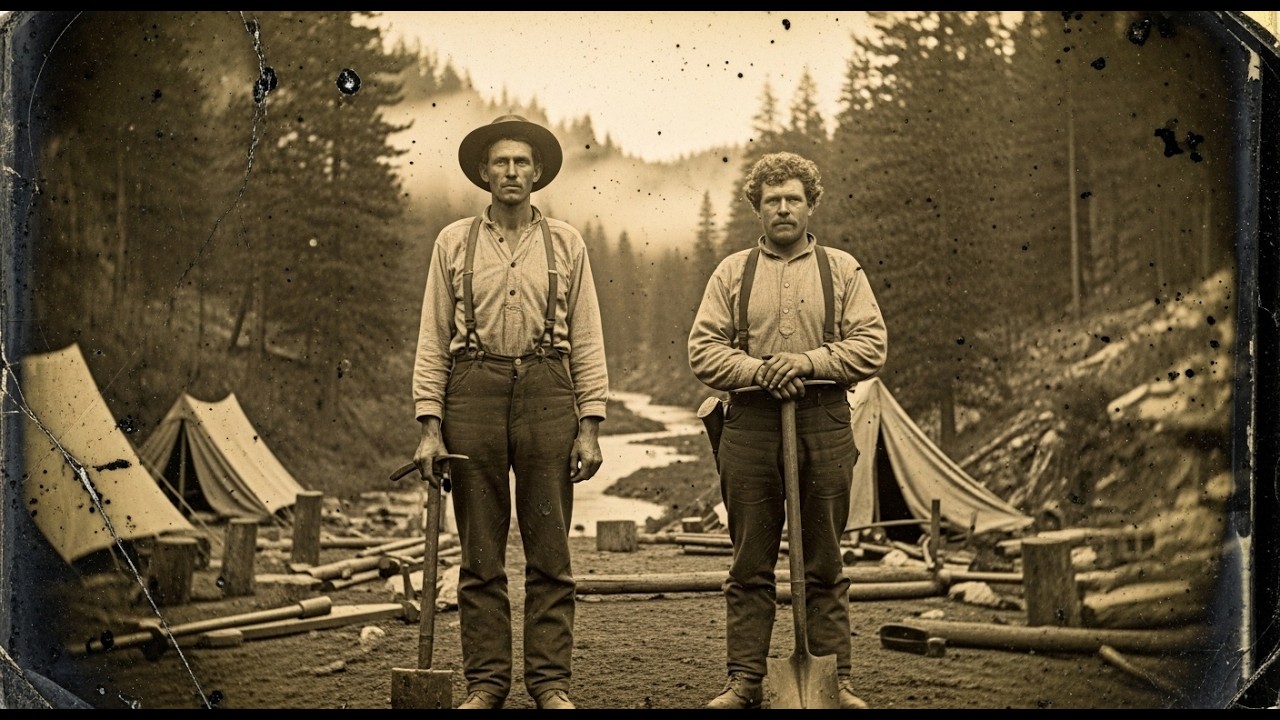
For their first week, the work was monotonous and brutal. They found small amounts of gold, enough to stay hopeful but nowhere near the fortune they had risked everything for. On the eighth day, while working alone, Samuel’s shovel struck something hollow beneath the soil. Digging carefully, he uncovered a buried wooden crate containing quality mining tools, a small bag of gold dust worth weeks of labor for most prospectors, and a leather journal wrapped in oilcloth.
The journal belonged to a man named Virgil Thorn, who had worked the same claim in 1850. The early entries were orderly and detailed, describing initial success pulling gold from the creek. Then the tone shifted. Thorn wrote about objects moving at night, tools disappearing and reappearing in different locations, the constant feeling of being watched, heavy footsteps circling his camp, and tracks in the mud that were almost human but too large, with toes splayed at wrong angles.
The handwriting grew increasingly erratic as the entries progressed. Thorn described waking to find campfires burning after he had extinguished them, gold dust scattered in strange patterns, voices speaking an unrecognizable language from still forests, and a sickly-sweet odor of decay drifting through camp. His final entry claimed he was abandoning everything because staying meant dying, or worse. The journal ended mid-sentence.
Benjamin dismissed the account as the ravings of a man broken by isolation and hard labor, but Samuel was unsettled by the consistency of the details. They decided to stay and work the claim while taking precautions. For two weeks, nothing unusual happened. They found steady gold, the weather held, and they fell into a comfortable routine.
Then, on the first night of June, Benjamin woke Samuel claiming something had been standing outside their tent, close enough that he could hear it breathing. Searching the soft earth by the creek, they found tracks. The prints were roughly human-sized but elongated, with wide-spread toes and deep impressions suggesting something heavy. Whatever made them had circled their tent multiple times, coming within inches of the canvas walls before heading into the forest.
They sat by the fire with rifles across their laps until dawn. When they reached the main camp, they found chaos. Three men had vanished during the night and two more had been found dead near the creek. Witnesses refused to describe the bodies in detail, though one old prospector said it looked as though someone had tried to arrange the men into some kind of message, with limbs and organs positioned in patterns that suggested meaning without clarifying it.
Most miners were packing up and leaving. Theories ranged from a rogue bear to hostile natives or bandits, but none of those explanations matched what the cousins had seen or what Virgil Thorn had written. A bear would have mauled bodies recognizably. Natives and bandits would have taken supplies and valuables, not left them arranged deliberately.
Against all reason, Samuel and Benjamin decided to stay, driven partly by their financial investment and partly by Samuel’s stubborn need to understand. When they returned to their claim that afternoon, their camp had been destroyed. The tent was shredded, tools broken, supplies scattered. In the center of the devastation sat a spiral of rocks with symbols carved into many of them, some weathered with age, others sharp and fresh.
At the center of the spiral lay all of their gold. When Samuel touched the gold, he felt a deep, unpleasant shock run up his arm. They moved their camp half a mile downstream and took turns keeping watch. Around three in the morning, Samuel saw the figure.
It emerged from the forest across the creek, roughly seven feet tall and skeletal thin, with limbs that bent at wrong angles and moved with a fluid grace no human frame should possess. It approached the rock spiral and made rhythmic, clicking sounds that seemed almost like a chant in a language that hurt to listen to. It rearranged the rocks and did something with the gold before turning to stare directly at Samuel’s hidden position, although it could not possibly have seen him in the darkness. Then it walked silently back into the trees.
Benjamin wanted to leave immediately. Samuel wanted to understand. They compromised by examining the claim at daylight and found the spiral completely rearranged into a more complex pattern suggesting mathematics or language. The gold was gone.
In its place were objects that did not belong in a mining camp in 1851: tools made from unidentifiable materials shaped for purposes they could not imagine, distorted carved figures that were unsettling to examine, and an ancient journal made from treated hide, covered in writing in a script neither cousin recognized. Over the following week, Samuel became obsessed. He spent hours studying the objects and trying to decipher the symbols. Benjamin watched his cousin grow sleepless and thin, increasingly resembling Virgil Thorn in his final entries.
Meanwhile, men kept disappearing from the dwindling camp downstream, one every few nights, their bodies sometimes found and sometimes never recovered. Samuel eventually made a breakthrough. Symbols carved into trees near the claim that he had dismissed as natural bark patterns matched some of the marks in the old journal. Mapping them, he discovered they formed an irregular circle that encompassed their claim and the areas where men had vanished.
He believed they were warnings marking the boundaries of a territory that belonged to something that did not want to be disturbed. Studying the patterns further, Samuel developed a theory that the symbols told a story of something bound or trapped in this place through a ritual or agreement made long ago. The binding had been maintained through periodic sacrifice and renewal. The relentless mining, digging, blasting, and disturbance of the earth had weakened those hold, and now the entity was breaking free.
They decided to test the theory by returning the strange objects to the center of the spiral along with a gift of their own supplies, food, tools, and items that might be of value. The figure appeared again around midnight with others, smaller and harder to see, moving through the trees. They examined the offerings and then spent the rest of the night constructing a cairn from rocks and branches, weaving the objects Samuel and Benjamin had left throughout the structure. Carved into the largest stone at the base was a symbol Samuel had tentatively translated as meaning debt, obligation, or balance.
The message seemed clear: they owed something for disturbing this place and taking gold that did not belong to them. Until the debt was paid, they would not be allowed to leave. They spent several days attempting to communicate with the figures, leaving objects in patterns and interpreting the responses. On the fourteenth night, the tall figure appeared closer than ever before, and in the firelight Samuel could finally see it clearly.
Its skin was like old bark, rough and textured. Its face almost but not quite formed a human pattern. The mouth opened vertically, and its eyes reflected the firelight with unmistakable intelligence. The figure communicated meaning directly.
It explained the debt for the disturbance and the gold taken from earth that was sacred in ways they could not understand. The price was specific and terrible: a willing sacrifice, someone who understood what they gave and chose to give it anyway, sealing a new agreement binding these things to the place for another cycle of years. The choice of who would pay was theirs. Samuel and Benjamin sat by their fire, not speaking for a long time.
One could pay the debt and the other would go free with enough gold to make the journey worthwhile. They could both refuse and almost certainly face death like the other miners. Benjamin argued they should refuse, insisting no amount of gold was worth a human life. Samuel had been thinking differently.
He had been thinking about the men who had already died, about the cycle of violence that would continue if someone did not stop it, about the symbols suggesting this was how it had always worked. The real price of gold in these mountains was not money or labor, but something older and darker. They argued through the night without finding an alternative. As dawn approached, Samuel made his decision.
He told Benjamin that because he found Virgil’s journal and insisted they stay, he should be the one to see it through. Benjamin refused absolutely, but Samuel had made up his mind. When Benjamin fell asleep from exhaustion, Samuel took the remaining rifle and walked alone to the rock spiral. The figures were waiting.
Samuel accepted the terms on the condition that they remain bound to the territory, leave the miners in peace, and give Benjamin safe passage with the gold. The tall figure inclined its head in what might have been a nod and gestured for Samuel to approach. Benjamin woke to find Samuel gone and ran to the claim. He found his cousin standing in the center of the rock spiral, alive but fundamentally changed.
Samuel’s eyes caught the light wrong with a reflective quality. His joints moved with a stiffness suggesting his body no longer fit him properly. His skin had a rough, bark-like texture, and his voice carried a subtly wrong cadence. Samuel said the debt was paid.
Benjamin needed to take the gold, waiting for him in a leather pouch near the cairn, leave Temperance Creek, and never return or speak of what happened except in the vaguest terms. Benjamin refused to leave, but Samuel explained there was no breaking it. He had become part of the binding, an anchor point for the agreement, keeping the figures contained for as long as the gold stayed in the mountains. Benjamin eventually took the gold because there seemed to be no other choice.
He walked away from Temperance Creek and made it to Sacramento, then back to Missouri. He used the gold to build a substantial farm, married, and prospered. He told people Samuel had died of fever in the gold fields like so many others. But for the rest of his life, Benjamin would wake around three in the morning and swear he could hear his cousin’s voice calling to him, conveying meaning about watching and waiting and holding back the darkness.
Official records show Benjamin Hargrave returned to Missouri in late 1851 and lived until his death in 1893 at age 69. Samuel Pritchard appears only in one line from a Sacramento newspaper from July 1851, which mentioned a prospector of that name who had disappeared near Temperance Creek and was presumed dead. Temperance Creek itself was abandoned by the end of 1851. Within a few years the name was forgotten, replaced on maps by other designations or left blank entirely.
The area still exists, deep in the Sierra Nevada foothills, accessible only on foot or horseback. Some hikers report feeling uncomfortable there, a sense of being watched or not welcome, and every few years someone claims to have seen something tall and thin moving between the trees that disappears when looked at directly. Rangers dismiss these reports. In 1947, a historian researching gold rush era mining camps found a collection of Benjamin Hargrave’s letters in a Missouri archive.
Most were routine business and family correspondence, but there was one letter Benjamin had written but never sent, dated 1892. In it, Benjamin wrote about Temperance Creek and about recent dreams where Samuel appeared to him, looking exactly as he had on that final morning, and told him the agreement was weakening, that the binding was fraying after 40 years, and that when Benjamin died there would be no one left who remembered the price paid or the promise made. Benjamin wrote that he did not know what would happen when the agreement finally broke, but he feared that whatever had been contained at Temperance Creek would be free again, and this time there might not be anyone willing or able to bind it. The letter ended with a plea for whoever found it to remember what happened and to understand that some debts cannot be measured in gold and some prices are paid in currency with no name.
That letter remains in the archive in Missouri, filed with thousands of other period documents. As far as anyone knows, no one has ever followed up on it. Samuel Pritchard would be well over 200 years old now if normal rules applied, but there is no reason to believe they do.
The mountains keep their secrets, and the places between the trees where light does not quite reach hold on to things the rest of the world has decided to forget.