On November 20, 1992, a spotlight ignited a curtain in Queen Elizabeth II’s private chapel at Windsor Castle, igniting the most destructive fire in the castle’s 900-year history. Within 15 hours, roughly a fifth of the world’s oldest inhabited castle was destroyed—nine principal state rooms lost and more than 100 others damaged. No lives were lost, but an even greater crisis ignited three days later when the British government announced taxpayers would cover the £37 million repair bill for a queen who had not paid income tax in 60 years. The fortress survived the flames.
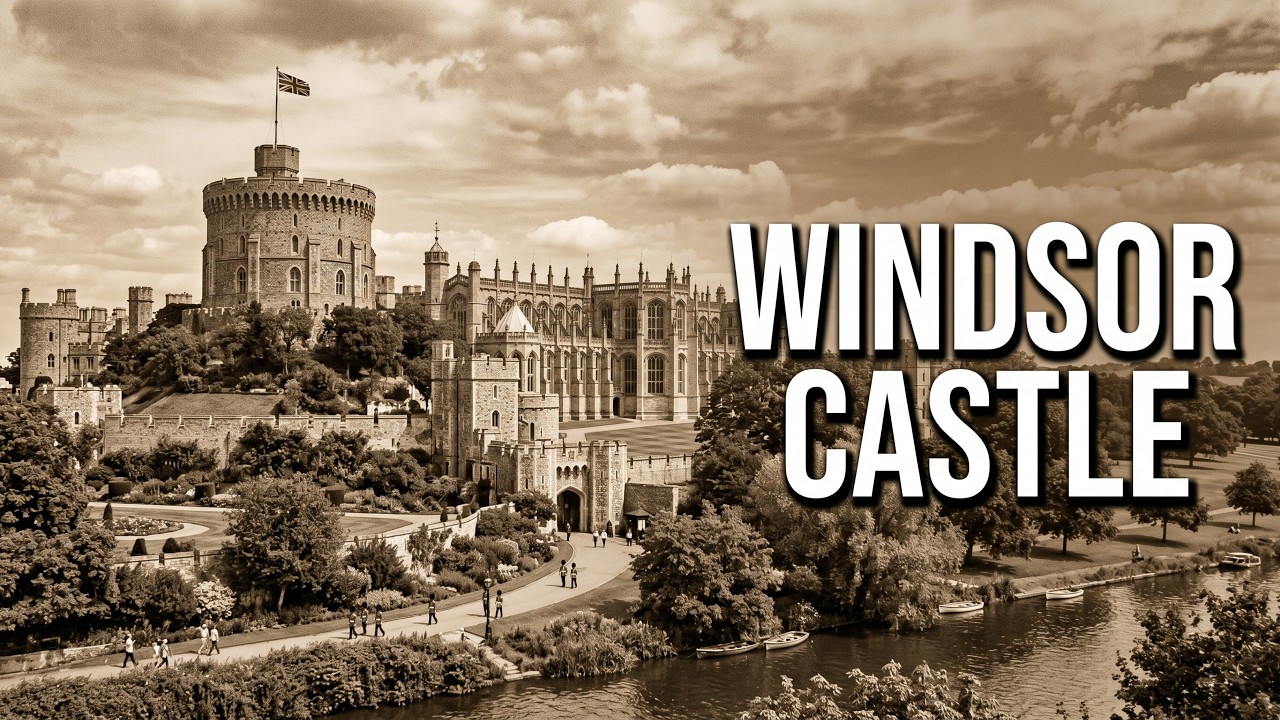
It nearly fell to a receipt. William the Conqueror built Windsor Castle in the 11th century not as a palace but as a military stronghold. A timber motte-and-bailey fortress, it was designed to keep a conquered England under control. Over centuries it evolved, transformed by Henry III, Edward III, Charles II, George III, and George IV into an irreplaceable symbol of royal power.
By 1992, it spanned 13 acres, held roughly 1,000 rooms, and housed treasures including the largest collection of Leonardo da Vinci drawings in the world, along with works by Rembrandt, Rubens, and Van Dyck. It had survived sieges, civil war, and German bombing—but it was never designed to withstand fire. The financial architecture that made the fallout so explosive stretched back to 1760, when King George III surrendered Crown Estate revenue to Parliament in exchange for the Civil List. The arrangement gave the Treasury steady income and the Crown financial stability, but it contained a hidden asymmetry.
Occupied royal palaces, including Windsor, belonged to the institution, not the monarch, and the taxpayer maintained them. Compounding this, since the 1930s, British monarchs had paid no income tax, not by formal law but by an unwritten convention. For two centuries, the system survived because it was invisible. It depended on public goodwill, and by 1992, that goodwill had vanished.
The year had already dismantled the monarchy’s mystique. In January and August, photographs humiliated the Duchess of York. In March, Prince Andrew and Sarah Ferguson announced their separation. In April, Princess Anne divorced Captain Mark Phillips.
Then Andrew Morton’s explosive book, “Diana: Her True Story,” portrayed the Princess of Wales as trapped in despair, revealing Charles’s long relationship with Camilla Parker Bowles. Intercepted phone tapes involving Diana and, later, Charles further shredded public sympathy. All of this unfolded during the worst recession since the 1930s, with unemployment above three million and repossessions running at 75,000 a year. On Black Wednesday, September 16, 1992, Britain’s humiliating exit from the European Exchange Rate Mechanism cost the Treasury billions.
The public was furious, and the monarchy was an obvious target. The fire began at 11:15 a. m. on the Queen’s 45th wedding anniversary.
Over 900 years, the castle’s wiring and concealed voids had become a hidden hazard. A high-powered halogen light, part of an ongoing rewiring project, stood near a 30-foot curtain. The fire spread into the chapel ceiling, then into a vast concealed space originally built for moving coal, which acted as a highway for flames above the state apartments. Firefighters arrived quickly, but the voids were unreachable, and St.
George’s Hall was soon fully ablaze. At its peak, 225 firefighters battled the blaze. The fire burned for 15 hours, and one and a half million gallons of water caused enormous further damage. As the castle burned, more than 470 people formed a human chain to save its contents.
Paintings by Rubens and Van Dyck were passed hand-to-hand through smoke-filled corridors. The great Waterloo Chamber dining table was disassembled and carried out. Thanks partly to the rewiring project, which had already emptied many threatened rooms, and partly to the salvage effort, no major work of art was destroyed. The castle’s architecture suffered terribly, but its contents largely survived.
The political crisis peaked on November 23, when Peter Brooke, Secretary of State for National Heritage, told the House of Commons the government would pay the full repair cost from public funds. The announcement ignited a landslide of public anger. Radio phone-ins ran 90% against taxpayer funding. Polls showed overwhelming opposition.
The crystallizing question was simple: if Windsor Castle belongs to the nation, why does the Queen not pay income tax? For the first time in the modern era, the financial relationship between Crown and country was scrutinized publicly and with hostility. On November 24, four days after her home burned, the Queen stood at a Guildhall luncheon celebrating the 40th anniversary of her accession. Suffering from a cold and a cracking voice, she acknowledged 1992 was not a year she would look back on with undiluted pleasure, calling it, using a Latin phrase suggested by a former private secretary, an “annus horribilis.
” Her voice cracked on camera, and for the first time in her 40-year reign, the monarch appeared publicly vulnerable. She did not apologize—a British sovereign does not—but commentators widely understood the speech as the closest thing to a public apology in living memory. On December 9, Prime Minister John Major announced that Prince Charles and Princess Diana had formally separated. The monarchy’s approval ratings fell to their lowest point in modern polling, with republican sentiment reaching levels not seen since the Victorian era.
The institution’s survival was suddenly in question. The Queen did not volunteer to pay income tax; the public left her no choice. After private negotiations, on February 26, 1993, the palace announced she had agreed to pay income tax on her personal income, effective April 6, 1993. It was the first time a British monarch had paid income tax since the 1930s.
The announcement was framed as voluntary, but everyone understood the timing was no coincidence. A broader package of reforms followed. The Civil List was reduced, and the Queen agreed to fund junior royals personally. Buckingham Palace was opened to paying visitors for the first time, and the revenue went directly to the Windsor restoration fund.
The Queen contributed about £2 million personally, with private trusts covering the rest. The aim was to fund the entire restoration without a single pound of new taxpayer money. The crisis also prompted the creation of the Way Ahead Group, an informal committee tasked with modernizing the monarchy to maintain public support in an age that no longer granted automatic deference. Restoration began in 1993, overseen by Prince Philip and led by conservation architects Donald Insall Associates.
The project faced a philosophical question: rebuild what burned or create something new? In some rooms, faithful restoration was chosen. But for St. George’s Hall and the Private Chapel, the committee chose a different path.
The new hammer-beam roof of green English oak, the largest structure of its kind built since the Middle Ages, honored medieval tradition while being unmistakably modern. Where the Private Chapel had stood, architect Giles Downes designed the Lantern Lobby, an octagonal space deliberately acknowledging the fire rather than pretending it never happened. Fire safety was transformed: over 550 new detectors, a dedicated on-site fire station, improved compartmentalization, and sprinklers in the most vulnerable areas. The sealed voids that had allowed the flames to spread unseen were divided into sections.
The project took five years and employed over a thousand craftspeople, reviving medieval woodworking techniques. The final cost was £36. 5 million, far below the original estimate of £60 million. On November 20, 1997, exactly five years after the fire and on the Queen and Prince Philip’s golden wedding anniversary, the restoration was completed.
The result was a castle superior to what had existed before, with more distinguished architecture and far better safety systems. The true achievement was political: by funding the project without new taxpayer money, the monarchy had answered the public’s challenge. The fire’s destruction, while severe, was much less total than it might have been. Natural barriers contained the blaze.
The Lower Ward’s St. George’s Chapel remained unharmed, as did the Round Tower housing the Royal Library and its Leonardo drawings. The rewiring project had inadvertently saved treasures by emptying rooms in the fire’s path. Fewer than a dozen significant works were lost out of tens of thousands.
Among the few notable losses was a massive portrait of George III by Sir William Beechey—ironic because the king had once ordered it destroyed, displeased with the likeness. The order was never carried out, and the painting survived two centuries before finally burning in the fire, two hundred years late. A stained glass window in the new Lantern Lobby depicts scenes from the fire and restoration, firefighters alongside images of St. George slaying the dragon, the castle rising from flames into clear sky.
The financial framework governing the monarchy has since been reformed beyond recognition. The Sovereign Grant Act of 2011 replaced the Civil List with a transparent, formula-based system tied to Crown Estate revenue. The estate’s annual revenue to the Treasury now exceeds £300 million, vastly more than the monarchy consumes. But the public no longer takes the arrangement on trust; the numbers are published, and the accounts are audited.
The fire did not threaten to destroy the monarchy because it damaged a building. It threatened the institution because it exposed a financial arrangement that could not survive public scrutiny. The curtain catching fire was an accident, but the crisis was the inevitable result of an institution that had confused tradition with entitlement and silence with consent. In forcing the Crown to pay tax, open its palaces, and make its finances public, the fire may have saved the monarchy.
The fortress learned to bend, and that is why it did not break.