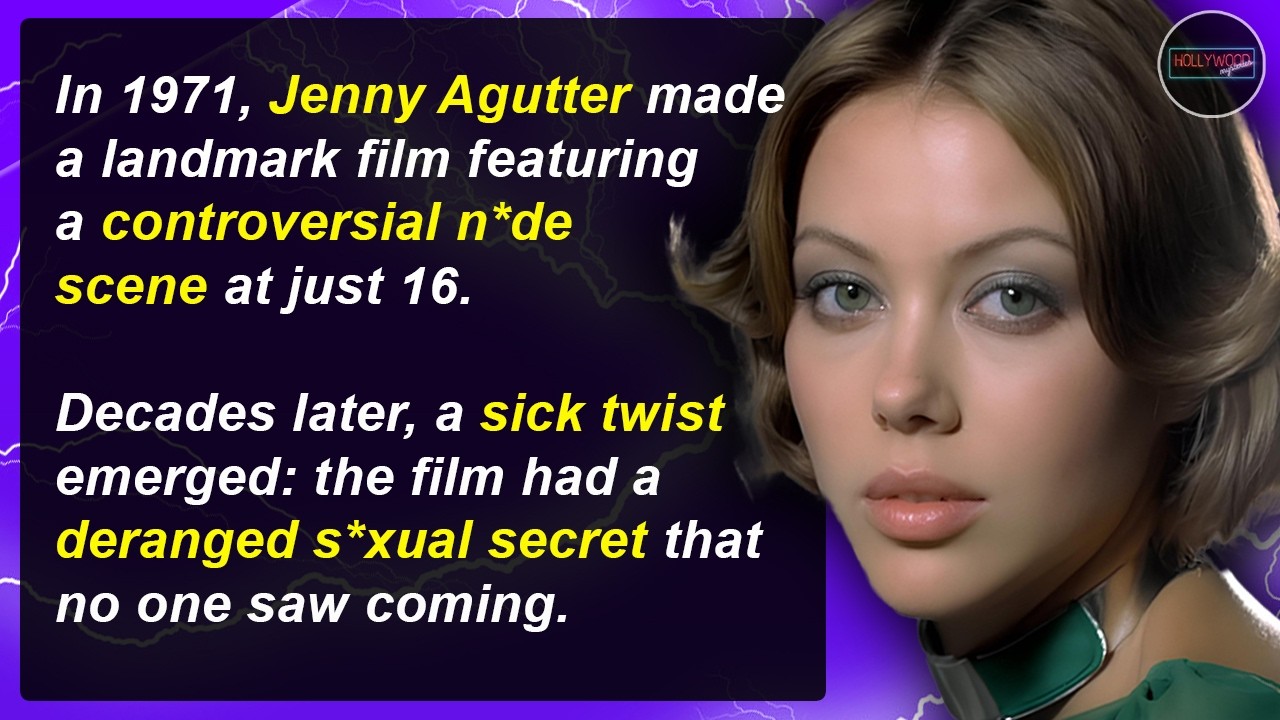
Nicolas Roeg filmed her naked in an Australian water hole when she was 16, telling her he wanted to create a Garden of Eden. More than half a century later, those frames were stripped of their artistic context, circulated online, and denounced by the actress herself as the work of “perverted” strangers. Between those two moments lies one of the most enduring and complicated careers in British cinema. Jennifer Ann Agutter was born on December 20, 1952, in Taunton, Somerset, the daughter of British Army officer Derek Brodie Agutter and his wife Catherine.
Her childhood was shaped by her father’s postings, with the family moving every few years across Germany, Singapore, and Cyprus before returning to England, a transition she described as “a big culture shock” after the heat and scent of frangipani in Singapore. At eight, she was sent to Elmhurst Ballet School in Surrey, a boarding school that doubled as a pipeline for casting directors seeking well-spoken English girls who could move gracefully. She later characterized the school as pleasant but academically thin, a place that prepared students to dance and perform but not necessarily to think. Her first screen appearance came at age 11 in the 1964 adventure picture East of Sudan, followed by the Walt Disney production Ballerina two years later.
The role that first lodged her in the national consciousness was Roberta, known as Bobby, in E. Nesbit’s The Railway Children. She played the part twice, first in a 1968 BBC serial directed by Julia Smith, then again in the 1970 film directed by Lionel Jeffries, who had seen the BBC version and insisted on casting the same girl. The climactic scene of Bobby running through steam on the platform at Oakworth Station shouting “Daddy, my daddy” became one of the most quoted moments in British cinema.
The British Film Institute later called the film an evergreen classic, describing Agutter as a “sensible and sensitive big sister Bobby. ”
Between the two Railway Children productions, Agutter flew to Australia to make Walkabout with Roeg. She was 16. The screenplay by Edward Bond ran to just 14 pages, and Roeg later said, “We didn’t really plan anything.
We just came across things by chance, filming whatever we found. ” Agutter played an unnamed teenager stranded in the desert with her younger brother, played by Roeg’s own son Luke, after their father’s suicide. They are found by a young Aboriginal man on his walkabout, played by David Gulpilil. The nude swimming sequence became the most defining and haunting image of her public life.
She has repeatedly described herself as a very reserved 16-year-old at the time of filming, but she trusted Roeg when he showed her photographs and explained his vision of creating a Garden of Eden. Most crew members were sent away on the day of filming, the camera was positioned at a distance, and she kept swimming while they filmed from several angles. Roger Ebert called the film “one of the great films” and wrote that it was ultimately about the mystery of communication. It competed at Cannes in 1971, and the BFI later placed it on its list of the 50 films you should see by the age of 14.
But none of that protected the scene from what technology would eventually do to it. As the internet expanded, the footage was extracted from context and circulated as pornographic content, with screengrabs proliferating across forums and websites. Agutter has addressed the issue with increasing directness. In a 2022 interview with The Independent, she drew a clear line: “Walkabout was meant to be innocent.
Was the nudity itself a problem? The exploitation of it is. ” She described the migration of images out of context online as something that shocked her. In a separate interview with the Times the same year, she was blunter still: “Unfortunately, what has happened is the internet and social media taking it out and putting it wherever.
Sorry to the people who are perverted and wish to do that, but I am not a part of that. ”
Her one regret was not the performance but the internet’s capacity to extract and redistribute it beyond her control. The timing is telling. The scene was filmed in 1969, released in 1971, and became a defining controversy decades later, not because new information emerged, but because new technology changed the terms of spectatorship.
The girl in the water hole did not change. The audience did. In the same period that Walkabout reshaped her public image, Agutter appeared in the 1971 television adaptation of Paul Gallico’s wartime fable The Snow Goose. The restrained performance caught the attention of American voters, and in 1972 the Television Academy awarded her the Primetime Emmy for Outstanding Supporting Actress in a Drama, making her, at 19, one of the youngest women to receive the honor at the time.
She did not rush to Los Angeles. Instead, at 21, she joined the National Theatre, playing Miranda in The Tempest opposite John Gielgud under Peter Hall’s direction. She later worked with the Royal Shakespeare Company, playing Regan in a 1982 production of King Lear directed by Adrian Noble, and returned to the National in the late 1990s for Peter Pan with Ian McKellen. After the National, she was signed by MGM and flew to Hollywood to make Logan’s Run, the science fiction dystopia in which citizens are killed at 30 to prevent overpopulation.
She played Jessica 6, and the diaphanous costume she wore cemented her as a science fiction pinup, a category she neither sought nor enjoyed. The film earned decent box office returns and an Academy Award for visual effects, but its cultural afterlife has been primarily as a cult curio. For Agutter, it provided a studio contract and a first taste of the Hollywood promotional machinery. Her experience in Hollywood left lasting scars.
In a 2002 interview with The Guardian, she was blunt: “You’re treated like in Hollywood. ” She described an industry in which courtesy was conditional on perceived bankability and yesterday’s leading lady was tomorrow’s voicemail. The role that reclassified her as a serious dramatic actress was Jill Mason in Sidney Lumet’s Equus, based on Peter Shaffer’s play about a psychiatrist investigating a teenage boy’s pathological relationship with horses. In 1978, BAFTA awarded her Best Actress in a Supporting Role for the film.
At 25, she was no longer the girl from Walkabout or the child on the railway platform. She was an award-winning actress with range. John Landis had known Agutter for years before he cast her as Nurse Alex Price in An American Werewolf in London in 1981. She later recalled, “If it hadn’t been Landis, I don’t think I would have done it.
As horror movies go, Alex was a really nice role. Usually, particularly at that time, women in horror movies were not strong roles. You’d spend your time running and screaming, and that’s about it. Whereas, Alex was very well written.
”
Her love scene with co-star David Naughton, set to Van Morrison’s Moondance, was filmed on the first day of shooting, a deliberate Landis strategy to get it over with before self-consciousness could set in. Naughton later observed that he felt the arrangement was harder for Agutter than for him, given that the crew was predominantly male. “But she was a trooper,” he said. Landis insisted on taking the cast to a dive of a cinema in New York for the premiere.
“We’re going to go to a real cinema. We’re going to see a real audience in there,” Agutter remembered him saying. The audience, restless at first, began shouting at the screen in the opening minutes, and then the film took hold. She recalled, “What was wonderful is that they laughed at their own reaction.
When something happened that was frightening, you’d get these screams and then laughter following that. ”
The early 1980s found her working constantly across genres and continents. She was also nominated for an Australian Academy Award for Best Actress for the horror film The Survivor in the same year. By the early 1990s, she was ready for a change, driven as much by personal need as professional calculation.
She met Swedish-born hotelier Johan Tham at an arts festival in Bath in 1989. His life’s work was the restoration of Cliveden House, one of England’s most storied country houses, into a luxury hotel. They married at Cliveden in August 1990. Five months later, on Christmas Day 1990, their son Jonathan was born five weeks premature.
“Thinking about it still makes me emotional,” Agutter told Saga magazine in 2025, recalling the fear and joy of that Christmas Day labor. She was 37. Her later career was characterized not by diminishment but by the steady accumulation of mature roles across British television. She appeared in Spooks and a succession of British productions.
Speaking of the double standard in which men are considered mature and interesting while women are simply labeled older, she told The Guardian in 2002, “It does make me slightly angry. ”
The role that anchored her late career was Sister Julienne in Call the Midwife, the BBC’s period drama set in a convent and nursing community in 1950s and 1960s East London. She has played the part since the show’s premiere in 2012. “Playing a nun is harder than it looks,” she observed.
“You’re asked to believe things that are absurd. ”
In 2012, she appeared in The Avengers as a member of the World Security Council, returning in Captain America: The Winter Soldier. In 2021, it was announced she would reprise the role of Bobby in The Railway Children Return, a sequel set during the Second World War. When the film was released in July 2022, she stood on the platform of Oakworth Station once more, 52 years after the Jeffries film and 54 years after the BBC serial.
She was no longer Bobby the girl; she was Bobby the grandmother. Agutter has been consistently outspoken on aging in the entertainment industry. In 2022, a Telegraph report covered her critique of cosmetic surgery culture. “One should be paying tribute to the years, not conceal them,” she said.
The thread running most consistently through her off-screen life is advocacy for cystic fibrosis research. The connection is familial. She has spoken publicly about siblings who died very young from the disease and about her niece Rachel, who has lived with the condition into adulthood. She served as a trustee of the Cystic Fibrosis Trust.
In 2012, she was appointed an Officer of the Order of the British Empire for charitable services. On November 17, 2025, Johan Tham died of cancer at the age of 81. The death left Agutter widowed at 72, with one adult son and a career showing no signs of slowing. She has continued to work and appear on screen in Call the Midwife.
As of early 2026, Jenny Agutter is 73 and working. She is simultaneously the embodiment of British childhood innocence and the figure around whom arguments about nudity, consent, and the male gaze continue to swirl. There is a scene near the end of Walkabout where the girl, now grown, stands in a suburban kitchen remembering the water hole. The memory is sunlit and wordless, suffused with a loss that cannot be named.
Agutter plays the moment with an almost unbearable stillness, the performance of a woman looking back at the girl she was, knowing she cannot return to the Eden that time and circumstance have sealed off.