By eight o’clock on workday mornings in 1932, women were already seated on the benches around a small green square at the corner of 167th Street and Jerome Avenue in the Bronx. Each carried the same thing in her lap: a brown paper package containing extra work clothes. They were waiting to be hired. A housewife would come to the neighborhood, inspect them, choose one, and set a price for the day—15 cents an hour, 20, 25 if the morning went well, or 30.
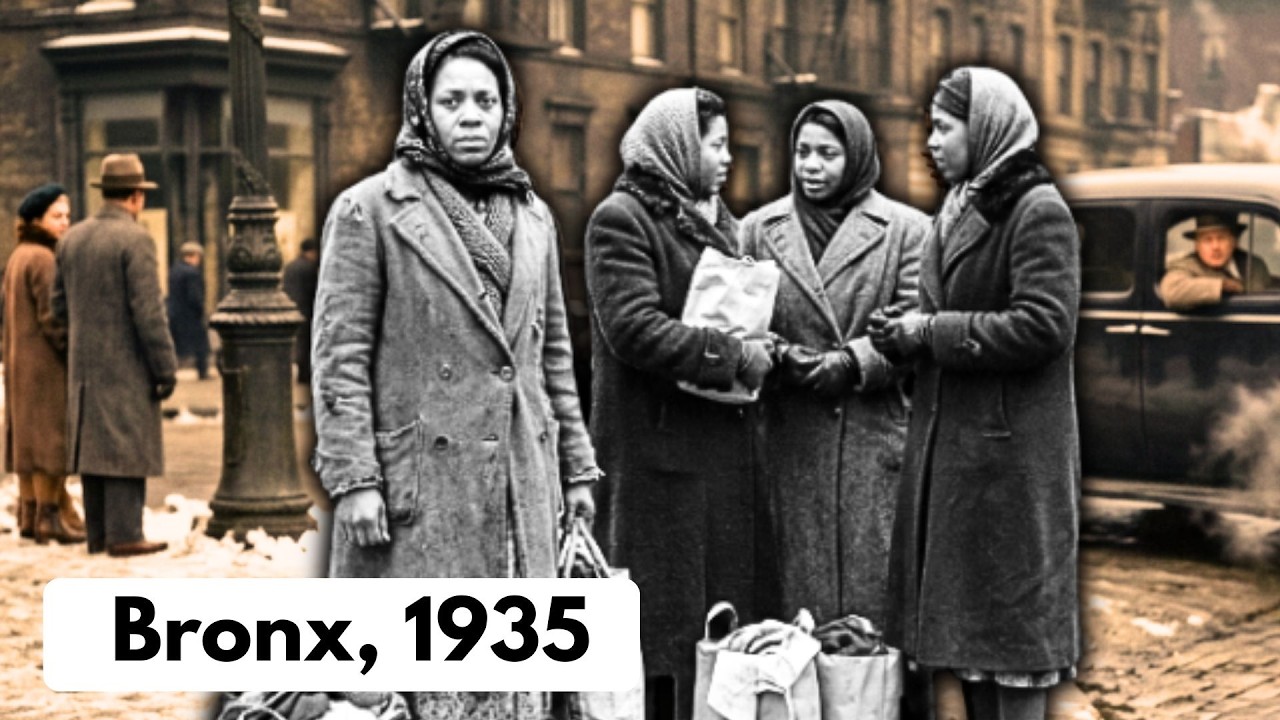
They stayed until one in the afternoon. If no one chose them by then, they went home with nothing. They came in the rain, in July heat, and in February cold, because that corner was the only labor market that would receive them. A few miles east, at the intersection of Simpson and Westchester Avenues, the same market operated without benches.
There, women stood with their backs against buildings and lampposts, or searched for a discarded box to sit on. It was the busiest corner, with heavy traffic and bidding at its peak, but it was not the only one. Similar markets formed at 170th Street and Jerome Avenue, in Brooklyn along Prospect Avenue and Fort Hamilton Parkway, and in Queens. The markets began appearing in the early 1930s.
The New York Age, one of the city’s Black newspapers, claimed it was the first to report on them and gave them a name. The name was “slave market. ”
The hardest thing to understand about those benches is who was sitting on them. Before the crash of 1929, many of these women held steady jobs in elegant homes in East Manhattan and in wealthier houses on Long Island and in Westchester, at wages that were more than adequate.
Others were factory workers let go as industry slowed. Some had never needed to work at all. None of them had ever been forced to look for work on a street curb. Three questions emerge from that corner.
Who were the buyers, and where did an entirely new class of employers come from in the middle of an economic collapse? Why was there no law in the United States making any of this illegal, while the country had just spent two years drafting new labor laws? And what happened in 1941, when New York’s mayor finally sent police to those corners, and the women discovered which line they were standing in? Most of the women waiting on Jerome Avenue did not wake up in the Bronx.
They woke up in Harlem and reached the corner the same way every morning, by train for five cents. Those who did not have the nickel walked. They walked north out of Harlem, crossed the river, and arrived in the Bronx before eight in the morning. If the day brought no work, they walked the same distance back home.
They carried paper packages because a woman could not ride the subway in work clothes, and she could not clean floors in her street clothes. Marvel Cooke, the Harlem journalist who documented their stories, named these women after those packages. She called them the “brown paper brigade. ”
What waited on the other side of the arrangement was hard labor.
Scrubbing floors and walls by hand on their knees. Cleaning bathrooms and kitchens from top to bottom. Polishing furniture. Washing piles of laundry, including heavy blankets, bedspreads, and upholstery covers, by hand over hot water tubs.
Much of this work was rarely done by the lady of the house herself, and it demanded strength and endurance from a woman who may not have eaten that morning. The task they all dreaded was window cleaning. Cleaning the outside of an apartment window in a multi-story Bronx building meant sitting on the windowsill and leaning out toward the street with nothing to hold onto but the frame. It was not a theoretical danger.
One woman was seriously injured falling from a sixth-floor window. Another woman died from a fall. Then came the moment of reckoning. This was where the day most often went wrong.
Some employers moved the clock hands forward an hour or more while the woman worked, to get extra time for free. Some paid only one dollar for a full day’s work, regardless of the hourly wage agreed upon at the corner. Some deducted the cost of a meager lunch from the worker’s pay. Some sent her away at the end of the day with nothing, knowing she had no contract, no witness, and no court that would take her complaint seriously.
There was another danger at those corners. Men came to them too. Sometimes they made explicit offers, sometimes they claimed to be hiring on behalf of wives waiting at home. Behind the closed doors of private apartments, the day worker had no protection at all.
The women faced this with whatever ingenuity they had. At certain corners, they agreed among themselves on a minimum wage and refused to work for less. Many flatly refused to clean windows. Some began wearing a wristwatch hidden under their sleeve, so they would know when employers tampered with the wall clock.
At midday on March 19, 1935, everything these women had been swallowing in silence erupted in the streets, about ninety blocks south in Harlem. It began at Kress’s five-and-dime store at 256 West 125th Street, where a sixteen-year-old boy was caught taking a ten-cent knife. The store declined to press charges and released him through a side door, but the crowds outside did not know that. An ambulance arrived to take an employee who had been bitten, but it left empty.
A hearse happened to be parked nearby. A rumor spread through the neighborhood that a boy had been beaten to death in the basement. By dusk, thousands were in the streets. Three Black men were killed, more than 200 people were injured, and property damage reached about two million dollars, almost all of it against white-owned businesses.
Mayor Fiorello LaGuardia appointed a commission to explain how a ten-cent knife caused all of that. Hearings lasted a year, the Black press followed closely, and the conclusion concerned work. The commission’s employment committee found that Harlem’s Black residents were concentrated in a few occupations, and that the largest category was domestic and personal service. Of seven industries surveyed, only three had a workforce that was more than ten percent Black.
The commission documented that most unemployed workers in Harlem were classified as unskilled despite possessing training, education, and professional experience. It also documented their exclusion from municipal jobs and public utilities. In its closing statement, it said the events of March 19 were an expression of Black workers’ long-accumulated resentment at being shut out of everything but lower-level jobs. Housing findings ran alongside those results.
Landlords placed Black families in dilapidated buildings and charged them higher rents than white families paid for similar spaces. In 1934, Harlem held more than 56,000 families, and most residents of overcrowded housing received some form of relief. The final report was handed to the mayor on March 19, 1936, exactly one year after the riot. It identified employment discrimination, police aggression, and segregation as major causes.
But LaGuardia marginalized the report. The city never officially released it. The only reason its contents became public was that the Black-owned New York Amsterdam News published it in installments. The relationship was now documented by the city’s own investigators.
The corners existed in the Bronx because Harlem’s women were shut out of nearly every other kind of work in New York. What made those corners legally immune was decided the same year in Washington. On August 14, 1935, President Franklin Roosevelt signed the Social Security Act. It was the largest expansion of economic protection in American history, but it excluded about half of the nation’s workers.
Among the excluded categories were agricultural workers and domestic servants. About 65 percent of Black workers in the United States worked in precisely those two categories. Charles Hamilton Houston testified against the exclusion on behalf of the NAACP, warning Congress that the bill would drop those at the bottom of the economic ladder. The law passed with the exclusions intact.
Historians still disagree about the motives. Researchers at the Social Security Administration concluded the exclusion came from the difficulty of collecting payroll taxes from scattered private employers, not from racist intent, noting that 27 percent of white workers were also excluded. But the resulting impact is undisputed. Those categories were only brought into the system in the 1950s.
The second law came the same year. The National Labor Relations Act, passed in 1935 to guarantee private-sector workers the right to organize and bargain collectively, also excluded domestic and agricultural workers. Taken together, the two exclusions clarify the situation on Jerome Avenue. The woman hired from that corner had no minimum wage, no maximum hours, no overtime, no unemployment insurance, no pension, no workers’ compensation if she fell from a windowsill, and no federally protected right to join a union and demand any of that.
She was not outside the law. She was working in a space the law deliberately left empty. One government program reached her and changed the price at that corner. Emergency relief, though inadequate, meant the threat of starvation no longer stood behind her while she negotiated.
With a small relief check as a floor, women who had been earning 15 and 20 cents an hour were able to hold out for 25 and even 30 cents. Many went to the market specifically to supplement relief payments that did not cover Harlem rent. Those modest gains would later be used against them. Within three years, a New York judge used that to accuse domestic workers of preferring relief rolls to work.
A journalist wrote that they were using public money to live in comfort. Before that, in November 1935, two women went to those corners and wrote down what they saw. The magazine was The Crisis, the NAACP publication long founded and edited by W. E.
B. Du Bois. The issue was dated November 1935. The authors were Ella Baker and Marvel Cooke, and the title was “The Bronx Slave Market.
” Cooke had come to Harlem from Minnesota in 1926 and began her career working with Du Bois at The Crisis. In 1928, she became the first female reporter at the New York Amsterdam News, helped organize the first union at a Black-owned newspaper, and was jailed for picketing during an eleven-week strike there. Ella Baker had come from North Carolina; twenty-five years later she would found the Student Nonviolent Coordinating Committee. Their article opened with questions about who the traders and victims were, what the causes were, and what forces worked against it.
Then it answered with details no official report had bothered to collect. It described the Jerome Avenue market as the more humane of the two because at least there were benches for the women. It described the Simpson Avenue market as the trade itself in its worst form, where labor and human intimacy were sold under economic coercion. It listed the hours, from eight in the morning until one in the afternoon.
It gave the wages: 15, 20, 25, and at best 30 cents an hour. It identified the buyers, which answers the first question raised earlier. The crash of 1929 created an entirely new class of employers. The lower-middle-class housewife who had long dreamed of having a maid found that dream within reach, standing on her street corner in the form of women pushed to the wall by poverty and discrimination.
Most of the buyers were white working-class women. Because the busiest markets were in predominantly Jewish neighborhoods of the Bronx, many of the jobs were in Jewish households, a fact that strained Black-Jewish relations among New Yorkers for years afterward. The article ended with the arithmetic of fraud. Few women received the full promised wage.
A day’s work often brought only one dollar. Most often the work clock was manipulated. Frequently the worker was sent home with nothing. The article did something no complaint had achieved before.
It gave the situation a name that stuck in print within a national magazine. After that November, the city could no longer claim ignorance. What happened next is that people began to organize. On February 14, 15, and 16, 1936, about 800 delegates gathered in Chicago for the founding convention of the National Negro Congress.
They came from churches, unions, fraternal associations, agricultural groups, youth organizations, and professional leagues. Nearly a third were women, an unusual proportion for a national convention in that decade. Women’s club members from California met trade unionists from New York. Teachers sat alongside domestic workers.
The Congress adopted, unanimously, a resolution on women calling for domestic service workers to organize into unions of the American Federation of Labor. That resolution mattered because it settled an ongoing debate. Charity and sympathy had been the usual response to street markets for five years, and it had changed nothing. The Congress declared that domestic work is work, and that the solution lies in unionization.
Two months later, in the April 1, 1936 issue of Woman Today, Louise Thompson published an article titled “Toward a Brighter Dawn” that presented the picture nationally. She wrote that the Bronx market stood as a monument to the exploitation of the most exploited section of America’s working population. She put the numbers on the table. About 85 percent of all Black women workers in the United States were in domestic service, and they formed two-thirds of the nation’s two million domestic workers.
Outside domestic service, the work available to them was often limited to laundries and tobacco factories in Virginia and the Carolinas, where conditions were appalling. The few in professional occupations faced discrimination and unequal pay. Thompson gave the situation a formulation that outlived the markets themselves. She wrote that Black women in America face triple exploitation: as workers, as women, and as Black people.
She also described the mechanisms on the buyer’s side, which made the article powerful. There were always plenty of women to choose from at the corners, so the price could always be driven down. Every dollar saved on a day’s cleaning wage was an extra dollar for the employer’s bridge game or theater ticket. In June 1936, the Domestic Workers Union of New York announced it intended to organize every domestic worker in private homes.
The union making that announcement was Local 149 of the Domestic Workers Union, affiliated with the Building Service Workers Union under the AFL umbrella. It had been founded in Sunnyside, Queens in 1934. That same year, a domestic worker named Dora Lee Jones helped found a Harlem branch. It was built specifically to oppose the street-corner markets.
By 1937, under the leadership of Jones and Rosa Rae Side, the multiracial union counted between 350 and 1,000 members, with Black women the largest group. The demands were specific. A minimum wage and maximum daily hours. Coverage under Social Security and workers’ compensation.
Higher pay, shorter hours, and a six-day workweek instead of an endless schedule. Two weeks’ notice before dismissal. Works Progress Administration projects for domestic service. And a specific clause prohibiting window cleaning included in the standard employment contract, because women had died doing it.
The union opened a free employment center at 2561 White Plains Road in the Bronx, available to any domestic worker, aiming to give the women standing at the corners another place to go. The lasting achievement was harder to see than membership numbers. The union reframed the entire debate by insisting that the private home is a workplace, not a private space where the employer’s behavior is nobody’s business. But the union could not solve the market problem.
It never had the money it needed. Organizing the women at the corners proved almost impossible. Domestic work isolates people by nature, one woman alone in one apartment. The market attracted the most vulnerable job seekers, those with the least training and the fewest options, and many of them said frankly that their chances on the sidewalk were better than at any agency, including the union’s own center.
Dora Jones spoke with public frustration about her inability to reach the women who needed the union most. In interviews, she sometimes described them in harsh language about “respectability” that was common at the time. Meanwhile, the courts were being tested. In 1937, a domestic worker named Bansie Kennedy sued her employer for unpaid wages of $10.
60 and won. But Judge F. Anthony Burke used the case to declare that domestic workers were unwilling to work because they could rely on home relief benefits, and that they spent extra money staying out late at night. The New York Times published that accusation in July 1938.
Marvel Cooke published a response in the Amsterdam News the same month. That same year, photographer Robert McNeill went to the corner at 170th Street and photographed the waiting women for Fortune magazine. The images still exist. In the fall of 1939, a domestic worker named Bessie Brown finished work in the home of a wealthy white couple in Mount Vernon, just north of the Bronx, and refused to leave the house without her pay.
The couple beat her, using racial slurs while doing so. She was taken to the hospital. With help from International Labor Defense and attention from the Domestic Workers Union, Brown sued the couple for assault. She lost the case.
The not-guilty verdict was read before a packed courtroom, and her photo ran on the front page of the New York Amsterdam News on September 30, 1939. After enduring the whole ordeal again in public, Brown said she was glad she had shed light on the conditions domestic workers faced. She had. The case, coming two years after Bansie Kennedy’s, made it very difficult to keep claiming the danger in this line of work was exaggerated.
That same year, graduate student Louise Taylor decided the only way to properly document these markets was to stand in them. She posed as a job seeker, spent months at Bronx street corners, and turned her research into a Columbia University master’s thesis in 1940. Her research recorded what newspapers were reluctant to print, including how the pressure of feeding a family pushed some women into sex work, and how they were judged by everyone, including some advocates who claimed to speak for them. The state finally moved in December 1939.
New York Industrial Commissioner Frieda Miller formed a committee on street-corner markets with a mandate to study and eliminate them. Its members came from local, government, civic, and religious organizations and included labor representatives. Dora Jones was among them. In June 1940, the committee issued its findings.
Its central recommendation was modest and practical. Open two free employment agencies in the Bronx so women seeking day work would have an indoor place to go, where wages could be recorded and the employer identified. The report was sent to the city. Months passed, and nothing happened.
Then in February 1941, the city acted on its own, and the women at the corners learned of it when the police arrived. On the morning of February 26, 1941, Mayor LaGuardia sent the NYPD, in cooperation with the Department of Welfare, to the Bronx street corners. About 100 women were rounded up and taken to relief stations, where they were held and interrogated for hours about their working conditions and whether they received home relief. The women were not told this was going to happen.
According to the Sunday Worker, they went to the relief stations believing they were being sent to jobs and would be paid for the day. The New York Herald Tribune reported they were asked to work as witnesses in exchange for a day’s pay and a meal. LaGuardia defended the operation, saying participation was voluntary and the element of surprise was necessary to get honest answers. Condemnation was immediate and came from every side.
The American Civil Liberties Union, the National Negro Congress, and the Domestic Workers Union all condemned it. Dora Jones called it an act of terrorism. What the city had actually done was round up the victims. The conclusion was worse.
The investigation declared that no exploitation had occurred in the markets, on the grounds that investigators found women earning 35 cents an hour instead of 10. The Sunday Worker accused the mayor of covering the whole thing up. When the report finally came out weeks later, its recommendation was the same one the street-corner markets committee had made nearly a year earlier. The Bronx would get two employment agencies.
One result from those interrogations deserves mention, because it settled a debate women had been losing publicly for three years. Almost none of the interrogated women received home relief at all. The 1938 judge’s accusation that maids preferred public assistance to work was false, and the city’s own police operation had proven it. The first new center, the Simpson Day Work Center, opened on Simpson Avenue in May 1941.
Some called it progress. The Militant ran a headline saying the Bronx slave market had simply been moved indoors, noting the women would now be protected from the weather, but not from the economic conditions that put them there. In fact, interactions between employers and workers inside the centers were not closely monitored, and many of the same abuses continued. By the end of September 1941, the committee reported that 6,000 domestic workers had been hired through the centers within five months.
The markets did not end. They quieted, and then the war economy took over. In January 1950, a five-part series began in the New York daily The Daily Compass, written by a reporter who worked undercover as a day worker at Bronx street corners. She scrubbed floors.
She sat on a windowsill to clean the outside of the glass, and a photo of her doing so ran with the series. The reporter was Marvel Cooke, the same woman who had co-authored the original investigation fifteen years earlier. By that time, she was the first Black woman to work as a reporter at a major white-owned newspaper in the United States. She wrote that standing at that corner waiting to be bought, she lived a century of insult.
She connected herself to a woman sold for two carriage horses at a Memphis street corner in 1849. The point of the series was blunt and direct. Fifteen years after the name was first printed, after a union, a government committee, a mayor’s investigation, and two new employment centers, the market was still operating. After 1950, the records begin to fade.
The markets seem to have faded rather than ended, and the reason was economic. World War II opened defense factories and workshops to Black women for the first time, offering an alternative to domestic service. But the real shift came later. About 60 percent of Black women workers were in domestic service in 1940; that fell to about 20 percent by 1970.
Most of that decline came after civil rights legislation in the mid-1960s finally opened other fields of work. What those corners produced alongside suffering deserves to be stated clearly. They produced a vocabulary. The term “triple exploitation,” written by Louise Thompson in 1936 to describe Black women as workers, as women, and as Black people, entered American political language and never left it.
They produced a legal principle for which the Domestic Workers Union fought and won in later decades: that the private home is a workplace, and the person who cleans it is an employee with rights. And they produced people. Ella Baker moved from documenting Jerome Avenue in 1935 to organizing the campaigns that built the movement. In 1960, she helped found the Student Nonviolent Coordinating Committee, which pushed young people into streets across the South.
The tactic those students used had been invented on a small scale on a sidewalk in the Bronx. Women, with no union, no legal protection, and no lawyer, stood together on one corner, agreed on a price below which none of them would work, and held to it.