For more than a century, scientists looked at the Ainu people of northern Japan and reached the same puzzling conclusion. These people did not seem to belong to their surroundings. Their thick, wavy hair, deep-set eyes, heavy beards, and unusually pale skin did not match the faces of the populations living around them. Experts developed a theory to explain it: they decided the Ainu were the lost remnants of a white race, somehow stranded at the far eastern edge of Asia.
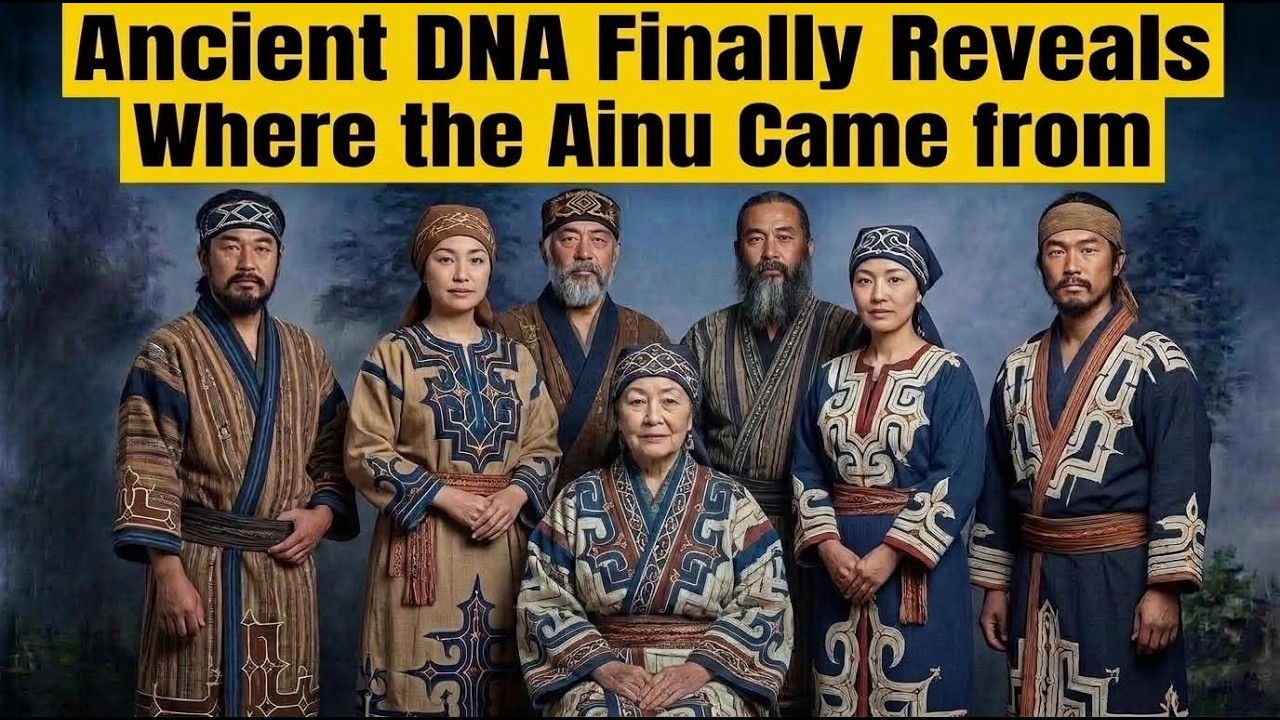
Explorers wrote this in their memoirs, anthropologists measured Ainu skulls and nodded in agreement, and for decades the idea became accepted truth. It was wrong, completely and embarrassingly wrong. When researchers finally decoded the Ainu genome and read the code written inside their cells, the results rewrote the entire story of who first settled Japan. The findings pushed the true origins of these people much further back in time than anyone was prepared to accept.
To understand why the discovery shocked so many, it helps to recognize how mysterious the Ainu have always seemed. They lived in the north, mainly on the island of Hokkaido, with communities that once stretched across Sakhalin and the Kuril Islands. They hunted deer and bears, caught salmon from the rivers, and built a spiritual world unlike anything in mainland Japan. For the Ainu, the natural world was filled with gods called kamuy.
A bear was not just an animal but a divine visitor wearing fur, and their most sacred rituals involved raising a bear cub and then returning its spirit to the mountains. Their language made them seem even stranger. Ainu is what linguists call an isolated language, with no proven relatives anywhere on Earth. It is not related to Japanese, Korean, Chinese, or the languages of Siberia.
It stands entirely alone, which usually means a population has remained separated from its neighbors for an enormous stretch of time. Then there was their appearance. European travelers in the nineteenth century were stunned. These were light-skinned people with heavy body hair, broad faces, and eyes that lacked the eyelid fold common in East Asia.
To Europeans, the Ainu looked almost familiar. That single observation gave rise to one of the most enduring myths in the history of anthropology. The idea took hold quickly. If the Ainu looked a little European, perhaps they were the last survivors of an ancient Caucasian people who had migrated across Asia and been swallowed up by the continent.
Scientists called them a Caucasian island in a sea of Mongoloid populations, using the crude racial language of the time. They collected Ainu remains, shipped skulls to museums in Tokyo, London, and cities across Europe, and built entire careers on measuring cheekbones and jaw angles, convinced that appearance alone could reveal origins. The myth was appealing because it let outsiders fit the Ainu into a story that flattered their own assumptions. If these northerners were secretly European, their presence in Asia became a romantic mystery, a lost white tribe, rather than their actual reality.
The idea spread widely, appearing in textbooks, newspaper articles, and the notes of serious academics who should have known better. Entire museum collections were built on it, and even today, some Ainu remains taken during that era are still being returned home. A bad idea disguised as science can outlive the people who invented it. But appearance lies.
It lies constantly. Two groups can look similar while sharing almost no recent ancestry, and two groups can look completely different while being closely related. The traits Europeans found remarkable, the hair, the beards, the deep-set eyes, are not European features at all. They are something much older, a set of traits carried by a very ancient branch of humans that most modern peoples simply lost over time.
The scientists of that era had no way to know this. They were trying to read a book they could not actually open, because the real answer was locked inside the cell in a long twisted molecule of DNA, and no one on Earth yet had the tools to read it. The story goes back thousands of years, not just a few hundred, to a Japan that would not be recognizable today. During the last ice age, sea levels were far lower than they are now, and the Japanese islands were connected to the Asian mainland by land bridges in the north.
Across those bridges, sometime around 30,000 years ago, the first humans walked into what would become Japan. They were not the ancestors of most people living in Tokyo or Osaka today. They were an older population, a group of hunter-gatherers who would establish one of the most distinctive cultures in human history. Archaeologists call them the Jomon, named after the cord pattern they pressed into their pottery.
That pottery is one reason they matter so much. Some of the oldest ceramic vessels ever discovered anywhere on the planet were made by these people, dating back more than 16,000 years. While most of the world was still deep in the ice age, the ancestors of the Ainu were shaping clay, firing it, and decorating it with intricate designs. They did not just survive; they thrived for an astonishingly long time.
The Jomon period stretched from roughly 14,000 BC to about 300 BC, more than 10,000 years of continuous culture. Most civilizations we celebrate lasted only a few centuries. The Jomon lasted over a hundred generations. They did this largely without agriculture, breaking one of the oldest assumptions in all of archaeology.
We are taught that complex societies only emerge after farming: agriculture creates surplus, surplus creates cities, and cities create everything else. But the Jomon never fully adopted agriculture. They did not need to. Japan was rich in resources.
The forests were full of deer and wild boar, the rivers overflowed with salmon, the sea provided endless fish and shellfish, and the hills produced tons of chestnuts, walnuts, and acorns. So the Jomon settled down without needing plows. They built villages with large wooden structures and established some of the oldest known permanent settlements made by hunter-gatherers anywhere on Earth. For thousands of years, these people lived across the entire archipelago, from the southern islands to the far north.
They developed regional styles, elaborate clay figurines called dogu with their strange eyes, and burial practices that hinted at a rich spiritual life. This was the world that formed the deep roots of Ainu ancestry. They were not a marginal group clinging to the edges of Asia; they were the indigenous population of an entire chain of islands, present for longer than almost any other culture in recorded memory. There is another important detail, later confirmed by genetics.
The Jomon were not a small, fleeting group. They were numerous, settled, and they remained on these islands, cut off from the mainland by rising seas, long enough to become genetically distinct from the populations of Korea, China, and Siberia. When the ice melted and the land bridges flooded, Japan effectively became a sealed room. Inside that room, the Jomon evolved alone, generation after generation, developing the unique genetic fingerprint that their descendants still carry today.
That long isolation is the hidden key to everything that followed. Then something happened. About 3,000 years ago, a new kind of people began arriving from the Asian mainland, most likely crossing over from the Korean Peninsula. They brought something the Jomon had never fully adopted: rice, wet-rice farming, metal tools, new pottery, and a completely different way of life.
Archaeologists call this the Yayoi period, and it represents one of the biggest turning points in all of Japanese history. The Yayoi migrants did not arrive all at once, and this was not a single dramatic invasion. It was a slow, steady flow of people and ideas over many centuries. But the impact was enormous.
Rice farming could feed far more people per square mile than hunting and gathering. The newcomers multiplied quickly, their numbers swelled, their settlements spread, and their genes began to mix with the old Jomon population wherever the two groups met. It was not just bodies that changed. With the rice came a whole worldview.
The Yayoi brought social hierarchy, stored surplus, competition for land, and eventually the seeds of the clans and states that would grow into imperial Japan. The old Jomon world of forest living began to recede. In the warm, fertile heart of the country, the ancient hunter-gatherer lifestyle faded within a few centuries. It survived only where the newcomers found the land too cold, too rugged, or simply not worth the effort, and no place fit that description better than the far north.
Over time, the two peoples mixed across most of Japan. The modern mainland Japanese population is the product of that blend, a mixture of the ancient Jomon hunter-gatherers and the Yayoi rice farmers who arrived from the mainland. This is the essence of what scientists call the dual-structure model, first proposed by anthropologist Kazuro Hanihara in the early 1990s. He argued that the Japanese were not one people but two, one layered on top of the other.
For a long time, this was just a hypothesis, elegant but unproven. Hanihara worked mostly from teeth, skulls, and patterns in the archaeological record. He could see the two layers in the shape of the evidence, but he could not prove them at the genetic level. That final proof had to wait for technology that did not exist in his lifetime, tools capable of reaching into a bone thousands of years old and extracting the actual instructions that formed the person it belonged to.
Here is the most important part. That blending did not happen evenly everywhere. In the heart of the regions where rice farming was easiest and where the Yayoi arrived in force, Jomon traits diminished greatly. But at the far ends of the country, the mixing was much weaker.
In the south, in the Ryukyu Islands around Okinawa, the older ancestry survived in higher proportions. And on the cold northern island of Hokkaido, where rice farming faced difficulties and the Yayoi had little reason to push in, the original Jomon population continued. They remained far more intact than anywhere else. Those people in the north, who held on to the old way of life while the rest of Japan transformed around them, became the Ainu.
They are not strangers who wandered into Japan from somewhere else. They are the exact opposite. They are the closest living descendants of the first humans to make these islands their home, and arguably everyone else came later. This single fact turned the old story upside down.
For a century, the Ainu had been seen as a strange phenomenon, a mystery in need of explanation. But DNA began to whisper a completely different truth. They were not the exception; they were the foundation. And the deeper scientists dug into their genetic code, the stranger and more ancient that foundation appeared.
For much of the twentieth century, all people had to work with was bones and appearance. Scientists could measure a skull, but they could not read it. That changed with the genomics revolution. Suddenly, researchers could extract DNA directly from living people and, even more remarkably, from ancient remains thousands of years old.
When they turned those tools toward the Ainu and the Jomon, the results were staggering. The breakthrough came when a team succeeded in sequencing the almost complete genome of an ancient Jomon individual. The remains came from Rebun Island off the northern coast of Hokkaido and belonged to a woman who lived nearly 3,500 to 3,800 years ago. Researchers gave her a simple label: they called her IK002.
But what her genome revealed was not simple at all. Extracting a genome from remains this old is not easy. DNA degrades over time into shorter and shorter fragments and becomes contaminated with DNA from everything that has touched the bones since, bacteria, soil, and the hands of the people who excavated them. Cold northern climates help because they slow decomposition, which is part of why Hokkaido preserved what it has.
Researchers work in sterile laboratories reassembling the ancient code piece by piece, like a torn document being glued back together. Once they had enough of the Jomon woman’s genome to compare, they were reading a message written by someone who died before the Great Pyramids of Giza were finished. When they compared her DNA to populations from around the world, they found that the Jomon lineage had split from other East Asian groups an extraordinarily long time ago. Not just a few thousand years back, but perhaps 15,000, 20,000 years, with some estimates reaching even further.
The Jomon were not a simple variation of East Asian populations. They were one of the oldest branches to split off from everyone else, a deep and ancient lineage that walked its own path for a very long time. This is why the Ainu look the way they do. Their features are not borrowed from Europe.
They are preserved traits of an ancient population that separated early, before many of the characteristics we now associate with modern East Asians had spread. The wavy hair, the heavy body hair, the deep-set eyes: these are ancient traits preserved in a group that remained isolated in the north while the rest of the region kept changing around them. The nineteenth-century scientists saw something genuinely unusual, but they reached a completely wrong explanation. There is a strange lesson buried in all this.
For most of human history, we have judged kinship with our eyes. We look at skin, hair, and facial shape and decide who is related to whom. But the eye is a terrible tool for reading ancestry. Traits like body hair or eye shape can appear, disappear, and reappear across groups that rarely connect, while people who look nothing alike can share huge portions of their genome.
The Ainu are the proof. Almost everything the human eye concluded about them was wrong, and everything their DNA revealed was invisible from the outside. Then the story grew even bigger because of a single letter. In genetics, we can trace the male line through the Y chromosome, which passes from father to son almost unchanged across generations.
Scientists classify these lineages into groups called haplogroups, marked by letters of the alphabet. The Ainu carry, at a remarkably high frequency, the Y haplogroup known as D, one of the oldest and strangest lineages in human genetics. It is a deep lineage, having split near the base of the human family tree outside Africa. Here is what makes it extraordinary.
This ancient lineage appears in only a handful of places on the entire planet, and those places are incredibly far apart. You find it among the Ainu in northern Japan. You find it in Tibet, high above the world. And you find it thousands of miles south among the Andaman Islanders, isolated peoples living in the Indian Ocean who are among the most ancient human groups on Earth.
Three groups separated by mountains, oceans, and vast distances all carry branches of the same ancient male lineage. It is like finding three pieces of a shattered vase, each hidden in a corner of Asia where newer peoples did not completely erase the old trace. What does this tell us? It tells us that haplogroup D is a relic.
It is a survivor of one of the earliest waves of modern humans to spread out of Africa and across Asia tens of thousands of years ago. Most descendants of that first wave were later absorbed, replaced, or simply overwhelmed by new populations that expanded across the continent. But in a few isolated pockets, high in Tibet, deep in the Andaman forests, and far in northern Japan, that ancient signal held on. The Ainu are one of those pockets.
They are a living link to a chapter of human migration that has almost completely vanished everywhere else. Consider how rare this is. Most of us belong to lineages that expanded, spread, and dominated. They are the genetic winners of the last 20,000 years.
Haplogroup D is not one of them. It is a lineage that lost almost everywhere, yet refused to disappear entirely. Every Ainu man carrying this lineage is living proof of a path humanity took long ago and then mostly abandoned. This is not just a curiosity.
It is part of one of the oldest chapters of our story as humans still beating with life. Here we must be careful, because this deep lineage has attracted wild theories. Haplogroup D shares an ancient common ancestor with another lineage called E, and haplogroup E is massively widespread throughout Africa. Because of that shared origin, some have jumped to dramatic conclusions, claiming the Ainu are secretly African, or that they prove a hidden lost migration no one wants to talk about.
It is worth pausing to be precise about what the science actually says. The truth is more nuanced, and frankly more interesting than the myths. The lineages that produced the Ainu, the Tibetans, the Andamanese, and many African groups ultimately trace back to the same human family, because all people on Earth ultimately have their origins in Africa. That is simply where our species arose.
What the Ainu preserve is not a recent African connection but a very ancient one. Their deep lineage branched near the beginning of the great human expansion across the world, which is why their roots approach the ancient origins shared by people spread across three continents. They are not a lost tribe that came from somewhere else. They are a preserved early branch of the human story, still growing quietly in the far north of Japan.
This is what the old skull measurers could never understand. They were obsessed with sorting humanity into ordered racial categories, black, white, Asian, as if those categories were written into the bones themselves. But the Ainu shatter those categories. They carry ancient East Eurasian genomes, a rare male lineage, and a set of physical traits that fit none of the nineteenth century’s ordered categories, because those categories were never real in the first place.
Human origins are an entangled river, not separate channels, and the Ainu are one of the oldest currents still flowing. This also forces a harder question about how we decide who counts as indigenous to a place. It turns out that the people who looked strangest in Japan were the ones who had been there longest. The faces that launched a hundred years of confused theories belonged all along to the closest thing Japan has to a founding population.
Sometimes the strangest figure in the story is its true origin, and everyone simply forgot that. Genetic evidence continues to deepen this picture. More recent studies, decoding additional ancient genomes, suggest that the story of Japan is not just a two-part mix of Jomon and Yayoi. It may include a third layer of migration during the later Kofun period, when additional groups arrived from the East Asian mainland.
But through all these waves, one thread remains unbroken. The Jomon signal, strongest in the Ainu, directly connects modern populations to those ice-age hunter-gatherers who made the world’s oldest pottery. The Ainu are not a marginal note in Japanese history. They are its opening chapter, still alive.
Every wave that swept over Japan added something and buried something. The Yayoi added rice and hierarchy. The Kofun period added more mainland ancestry and the machinery of early states. Layer after layer, the country that today considers itself homogeneous was actually assembled from repeated migrations, each folded into the one before it.
And beneath all of it, like a first coat of paint that can never be fully covered, lies the Jomon people. You cannot truly understand modern Japan without them, and you will not find them more clearly anywhere than among the Ainu. This makes what happened to them more painful. For a people representing the deepest roots of the Japanese islands, the Ainu were treated for centuries as unwanted outsiders in their own homeland.
As Japan expanded north into Hokkaido, especially during the modernization period of the late nineteenth century, the Ainu were forced off their lands, banned from hunting in traditional ways, and pressured to abandon their language and customs. Children were forced to speak only Japanese. Traditional tattoos and rituals were discouraged or outlawed, and an entire culture, older than any other in the region, was slowly pushed toward the edge of extinction. For a long time, the Japanese government did not officially recognize the Ainu as an indigenous people.
That recognition came shockingly late. Japan did not pass a law officially recognizing the Ainu as the indigenous people of the northern islands until 2019. A people who had existed for thousands of years, longer than anyone else, had to wait until the twenty-first century for this basic recognition. Today, the number of people who identify as Ainu is small, and the number who still speak the language fluently is even smaller, just a handful of elderly people holding on to words that go back millennia.
But a revival is underway. Young Ainu are reclaiming their heritage, relearning the language, and reviving the crafts, music, dances, and rituals for which their grandparents were once punished. Science is helping. Every new genetic study confirming their deep roots reinforces their standing, not as a curiosity or an anomaly, but as a living foundation of Japan itself.
In 2020, a national museum and cultural park dedicated to the Ainu opened in Hokkaido, a place called Upopoy, built to preserve the language, songs, and crafts that nearly vanished. For a culture that spent a century being told it did not belong, having the state finally build a home for its memory is a strange and hard-won kind of victory. The elders who remember the old oppression and the young people livestreaming Ainu language lessons are together keeping alive a lineage that has already outlasted empires. So think back to those nineteenth-century scientists, so confident as they measured skulls and declared the Ainu a lost white race stranded in the east.
They misunderstood almost everything. The Ainu were not part of Europe. They were not newcomers. They were not an evolutionary dead end to be classified and forgotten.
They were the closest living descendants of the first people to settle the Japanese islands, and carriers of one of the oldest and most isolated human lineages on Earth.