In December 1942, a chambermaid at the Dorchester Hotel found a woman unconscious in a suite, an empty bottle of sleeping tablets beside the bed. The woman died within a day. Within a week, a powerful press baron arrived, sorted her papers, and quietly removed two unsigned oil paintings. Both had been painted by Winston Churchill.
The woman was Doris, Viscountess Castlerosse. For decades, the Churchill family worked to erase her from his life.
Doris Delevingne was born in 1900 above a lace shop on Streatham Hill. Her father was a haberdasher of French extraction who imported lace from Belgium and Nottingham mills. The family was respectable but expected to know its boundaries. Doris tested them from the beginning.
By 16, she was tall, blonde, and striking. She left school early and practiced speaking until her South London vowels were trimmed into something closer to the tones she heard at West End theaters. In 1919, she took a job selling second-hand evening dresses to actresses.
In 1920, she met the actress Gertrude Lawrence. Within months, Doris was being introduced to men who ordered champagne without looking at the bill. She moved out of her family home into rented rooms off the Edgware Road.
She was honest with herself about her choices. In a letter to a friend, she described her face, figure, and wit as her "bank." She meant to spend that bank carefully on the right men until something more permanent could be arranged.
By 1924, she had a house in Deanery Street in Mayfair. Three powerful men competed to pay for it. Sir Robert Throckmorton, a South African gold heir, paid the rent. Stephen Sanford, heir to an American carpet fortune, paid for jewelry and dresses. Tom Mitford came and went as well.
She ran the arrangement with calm professionalism. There was no public scene. There was a kind of professional pride. By her early 20s, she was a famous face in London society.
Cecil Beaton described meeting her in 1925. He wrote that she was the most beautiful English woman he had ever seen. He said she looked like a tall white candle in a draft.
In the late autumn of 1925, she met Valentine Browne, heir to the Earldom of Kenmare. He was a large, funny Irishman and the most read columnist in the British press. Within minutes, everyone else in the room had stopped existing for either of them.
On May 16, 1928, she married the 20-stone Irish viscount. The wedding filled the front pages. Castlerosse was 36, had been shot at the Somme, and walked with a limp. He wrote the famous "Londoner's Diary" column for Lord Beaverbrook's Sunday Express.
The marriage was an honest bargain. He brought a title and a platform. She brought the most photographed face in the country. The marriage went wrong in private within months.
Castlerosse was a heavy drinker with a terrifying temper. By Christmas of 1928, Doris dreaded evenings at home. By 1929, he shook her until her head struck a wardrobe. The bruises took two weeks to fade.
She had her own affairs. She took up with Randolph Churchill, then a schoolboy of 17. There was a serious affair with Cecil Beaton. There were others.
She also deepened a secret arrangement with Lord Beaverbrook. He paid her a private retainer in exchange for gossip from her social circle. The material often appeared, veiled, in her husband's column.
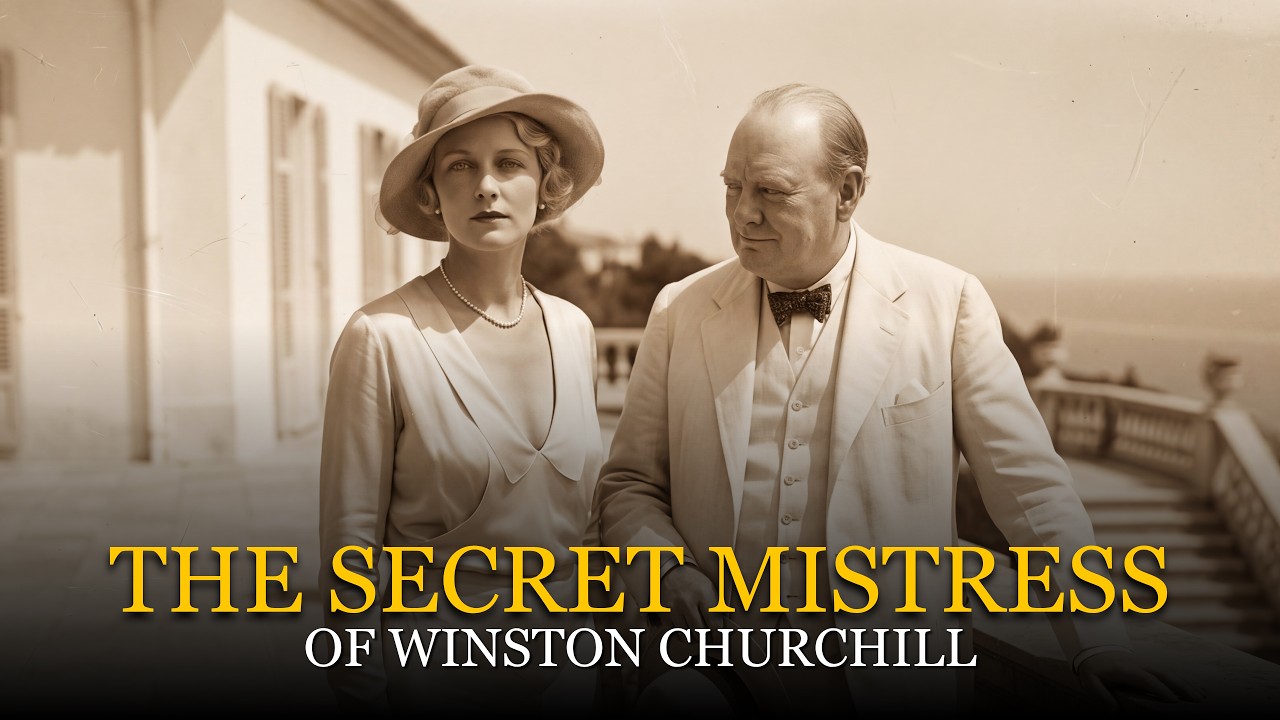
In the late summer of 1930, she met Winston Churchill for the first time. He was 55, out of office, and painting in the garden of Beaverbrook's villa in the south of France. He set down his brush when he saw her.
Churchill was in his wilderness years. He was out of money and out of patience with his party. He painted every weekend at Chartwell to calm himself.
In the summer of 1933, he began making trips to the south of France. Doris was at the same places in the same weeks. Photographs from the period show them together constantly, talking on terraces and on the decks of yachts.
He painted her at Chartwell on three visits between 1934 and 1935. There were at least two finished oil portraits. The first, which hangs at Chartwell today, shows her in a green dress. The second was a partial nude.
John Colville, Churchill's private secretary, saw the second painting once in 1937. It was leaning against the wall of the studio, turned to face the wall. He said it was the kind of painting a sensible wife would prefer to be removed.
In the summer of 1934, Churchill wrote Doris a letter in his own hand. He compared her to a ray of sunshine and signed it "Ever your loving W." It was, by any reading, a love letter.
The affair was active until the autumn of 1935. Clementine Churchill began writing to her husband almost daily, asking when he was coming home. The visits to France became shorter. The affair ended.
What was not over was the question of what Doris still had in her keeping. There were the letters. There were the photographs. There was the second painting.
In 1938, Doris obtained her divorce. Castlerosse paid her a single lump sum of 500 pounds. The divorce was granted on the grounds of her adultery with a named co-respondent who was openly homosexual and entirely uninvolved with her.

The second piece of business was more private. Churchill paid a thousand pounds to recover his own correspondence. Brendan Bracken arrived at Doris's house with a banker's draft. She handed over 42 letters tied with pale green ribbon.
The letters were burned in the fireplace at Chartwell within 48 hours. One letter survived: the "Ray of Sunshine" letter. It was rediscovered in the family papers in 2017.
In the summer of 1936, Doris leased a half-finished palace on the Grand Canal in Venice. She turned it into the most photographed party in Europe. She installed a black marble bathroom with silver taps and a white Carrara marble bath.
Her guests included Cecil Beaton, Lloyd George, Noel Coward, and the Aga Khan. Prince Philip of Greece visited with his uncle Lord Louis Mountbatten. She gave 53 dinner parties and one masked ball described as the most beautiful party in Europe since the war.
By the time the lease was up, the structure was cracking. The marriage was in lawyers' hands. The affair with Churchill was in its last weeks.
In 1940, she sailed for New York to find a rich American husband. She was 39, broke, and almost out of social credit in London. New York was a different city. The old families were not interested. The new fortunes were more careful.
She made a serious attempt on a wealthy widower named Charles de Rohan. He gave her a diamond bracelet at Christmas. He did not propose. By the summer of 1941, her credit had run out.
By Christmas of 1941, she was very nearly destitute and very nearly alone. She decided to come home in the autumn of 1942. The Atlantic crossing was dangerous. She wrote to Brendan Bracken to secure a seat on a Lisbon flying boat.
Churchill signed off on the priority that brought her home. She arrived back in London with two trunks, a small leather case, and almost no money. Churchill did not visit her once in the 74 days she had left to live.
She was given a small suite at the Dorchester Hotel. The hotel agreed to extend her credit. She did not find her feet. Most of the men she had known were dead, in uniform, or in office.
She began to sell off the last of her jewelry. The diamonds had been brought into England without declaration to customs. Selling undeclared diamonds during wartime was a serious criminal offense.
A customs officer visited her twice. He told her the matter would have to go to the magistrate's court before the end of the year. She was left in a state of visible terror.

By the last week of November, she refused to come down for meals. She ate in her sitting room off a tray brought by a chambermaid named Annie Sharp. On the evening of December 10, she rang down for warm milk and soda water. She did not ring again.
She was found unconscious on the morning of December 11. There was an empty bottle of barbiturate beside the bed. There was no note. She died without waking at 12:01 in the morning on December 12, 1942. She was 42 years old.
The inquest returned a verdict of death by barbiturate poisoning with an open question as to intent. In the language of the people who knew her, it was understood as suicide.
Lord Beaverbrook arrived at the Dorchester at noon on the day of her death. He spent an hour in the sitting room and 40 minutes in the bedroom. He left with a small leather case, a scrapbook, three jewelry boxes, and two flat brown paper parcels.
The parcels contained the two oil paintings by Winston Churchill of Lady Castlerosse. They were placed in the strong room at Stornoway House. They remained there for the duration of the war.
The funeral was held on December 17 at Golders Green Crematorium. The mourners numbered 14. There was no Churchill. There was no Castlerosse. The Times carried a notice of her death in three lines without a photograph. There was no obituary.
At Chartwell today, there is a small oil portrait of a woman in a green dress. The label reads: "Lady Castlerosse by Sir Winston Churchill, circa 1934." It says nothing else.
The second painting is the one the official history does not have to account for. Beaverbrook returned it to Lady Churchill in a sealed parcel in the late summer of 1946. It was never recorded in the house inventory. Its present whereabouts are not known.
The most likely explanation is the simplest. Clementine Churchill gave instructions to burn the unflattering Sutherland portrait of her husband on a bonfire. She very probably also gave instructions to destroy the second painting of Lady Castlerosse.
There is no document that names the destruction. There is no witness who saw it burned. There is simply the long absence of the painting from every inventory and the silence of every family member who has ever been asked.
What did settle the question of the affair was a tape recording John Colville made in 1985. He had been told by Churchill himself that the affair with Lady Castlerosse had taken place in the south of France between 1933 and 1935. The buyback of the letters in 1938 had been at Churchill's own personal cost.
The tape was opened by historians in 2017. Their findings were published in March 2018.
Doris Delevingne, the haberdasher's daughter from Streatham, the most photographed English woman of her generation, died alone in a small suite at the Dorchester Hotel. She had asked, in the end, for a thousand pounds and a polite handshake. She had taken the handshake and walked back into a life that the war and her own bad luck would close down on her within four years.
He could not save her. He did not, in any case, try.
The slow work of family loyalty has taken her down to one painting and a label. The label says her name. The label says nothing else.