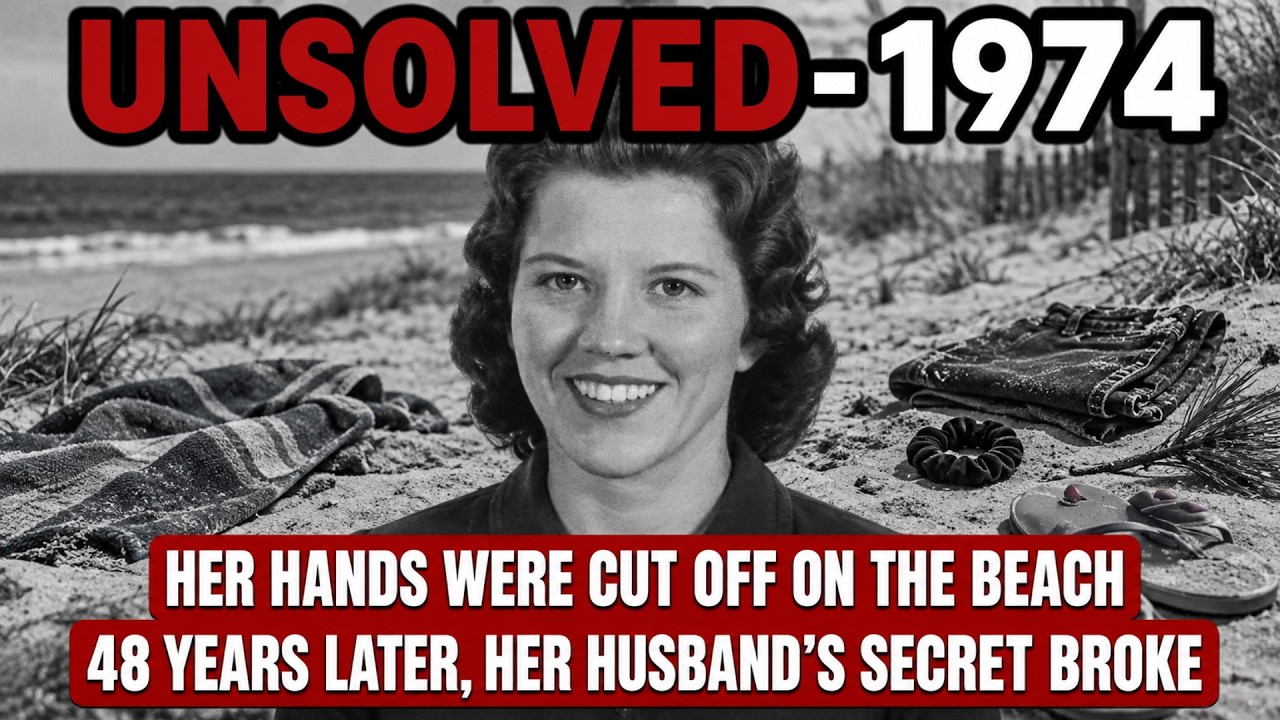
On July 26, 1974, a nine-year-old girl camping with her family in Provincetown, Massachusetts, followed a dog deep into the sand dunes of Race Point. The dog barked, and the girl followed. There, she found the body of a woman lying on a blue beach towel, her head resting on a neatly folded pair of jeans, as if she had fallen asleep sunbathing. But her hands had been cut off, her head was nearly severed, and the left side of her skull was crushed.
The killer had removed her teeth and cut off her hands at the wrist and elbow. Small piles of pine needles were placed on the sand where her hands should have been. He did not want anyone to know who she was. For 48 years, he succeeded.
No one came to claim the body. No one reported her missing. She was buried in October 1974 in St. Peter’s Cemetery, her headstone reading: “Body of unknown woman found in Race Point Dunes, July 26, 1974.” She became known as the “Lady of the Dunes,” the oldest unidentified homicide victim in Massachusetts history.
Police tried everything: ground-penetrating radar, psychics, two exhumations, and DNA comparisons with dozens of missing women. They floated theories involving Boston mob boss Whitey Bulger, serial killer Hadden Clark, and even a possible appearance in the film Jaws. None of the theories led anywhere.
It took nearly half a century, a breakthrough in investigative genetic genealogy, a son searching for his biological mother through a DNA test, and a family in Tennessee that never stopped searching before she was finally identified. When her identity was revealed, a darker truth emerged. The man she married months before her death was the same man suspected of killing his previous wife and her daughter 14 years earlier. He was the one who killed her.
This is the story of Ruth Marie Terry and the 48 years she spent buried beneath the sand without anyone knowing her name.
Race Point sits at the northern tip of Cape Cod, within the Cape Cod National Seashore in Provincetown. It is a quiet stretch of coast, a place where families come to camp and visitors enjoy the sun. The girl who found the body was named Sandra Lee. She was nine years old that summer, fleeing domestic violence at home.
She followed the dog about a mile from the Race Point ranger station. In a spot of low pine trees amid the sand and beach grass, she saw something no nine-year-old should see. Years later, Sandra Lee told WBZ about that moment. She said, “I was running from a bad situation, and I found a worse one.” She looked at the woman’s decomposed body and thought, “This is the end I might face if I don’t find a way out of this miserable life.”
The event saved her. Sandra contacted her paternal grandparents, which eventually led to her and her brother moving in with them, escaping the domestic violence. The death of an unidentified woman changed the life of a nine-year-old girl.
Provincetown police arrived at the scene within hours. Police Chief James Meads, 41, was among the first to arrive. What he saw would haunt him for the rest of his career. The body lay on half of a faded blue beach towel, as if she had been sharing it with someone. Her head rested on neatly folded blue jeans. Her reddish-brown hair was tied in a ponytail with a gold-studded elastic band. Her toenails were painted pink. She was naked.
Two sets of footprints led to the body. Tire tracks were found about 46 meters away. The sand and towel were undisturbed, with no signs of violence, leading investigators to believe the victim was killed elsewhere and then brought to this spot, placed carefully on the towel as if it were a deliberate staging. Someone brought her here and laid her out as if she were sleeping.
The autopsy revealed a level of violence that made even veteran officers recoil. The left side of the victim’s skull had been crushed by an instrument forensic experts identified as resembling a military entrenching tool. That was the cause of death: severe head trauma from a blunt force blow. Her head was nearly completely severed from her body. No weapon was found at the scene.
Both hands were cut off, one at the wrist and the other at the elbow. In place of the hands, the killer placed small, neat piles of pine needles on the sand. This was not an ordinary murder; it was an erasure of identity. Investigators believed the hands were removed to prevent identification through fingerprints, suggesting the victim may have had a record. They also believed she had a tattoo on one forearm, which is why that arm was cut higher at the elbow instead of the wrist.
Forensic examination showed the victim had been sexually assaulted after death. Some teeth were deliberately knocked out, but not all. Teeth that had undergone cosmetic work were left in place, while natural teeth were removed, leaving fragments in the mouth. The remaining cosmetic work was striking. Consulting dentists estimated its value at between $5,000 and $10,000, a huge sum in 1974. They called it “New York-style dentistry” due to the technique and quality of materials.
Police tried to trace the dentist who did the work, hoping it would help identify the victim, but they never found him. The medical examiner estimated the victim died between 10 days and 3 weeks before being found. She was about 168 cm tall, weighed about 66 kilograms, had an athletic build, and was between 25 and 40 years old.
Aside from the jeans, beach towel, a blue scarf, and the hair tie, nothing else was found despite a careful search of the surrounding dunes. No papers, no wallet, no keys. Nothing but a body someone desperately wanted to remain unidentified.
Meads did his best. He reviewed hundreds of books with information on missing women from various states. He interviewed vehicle owners who had been in the area. He contacted police in neighboring states. No one matched the description. This woman seemed to be in no system at all. No one was looking for her. No one called to ask about her. No one came to claim her.
In October 1974, when all leads ran out, the body was buried in St. Peter’s Cemetery in Provincetown. The headstone bore the words that would remain for 48 years: “Body of unknown woman found in Race Point Dunes, July 26, 1974.” She became known as the “Lady of the Dunes.” The case became an obsession for the town, a wound that would not heal, a question no one could answer.
In 1980, six years after the body was found, investigators decided to do the first exhumation. The goal was to reconstruct the face, an image the public could look at and say, “I know this person.” Experts worked on the skull and produced several versions: with and without freckles, with long and short hair, and different expressions. The images were widely distributed, published in newspapers, shown on television news, and sent to hundreds of police departments across the country. The result was silence. No one recognized her. No call led to a confirmed identity.
As the case remained stuck, theories began to emerge. The most famous and controversial involved James “Whitey” Bulger, Boston’s most notorious mob boss. There were good reasons investigators and media turned toward this theory. Bulger was known for his distinctive post-murder style, removing victims’ teeth to prevent identification through dental records. This was the same method used on the Lady of the Dunes, where natural teeth were removed, leaving only those with cosmetic work.
Additionally, Bulger frequented Provincetown in the early 1970s, especially the Crown and Anchor bar. Most importantly, eyewitnesses reported seeing him with a woman matching the Lady of the Dunes’ description: reddish-brown hair and an athletic build, around the time of the murder. But upon closer examination, the evidence proved to be coincidence. Police never treated Bulger as an official suspect, there was no physical evidence linking him to the crime, and no witness saw him near the crime scene on the day it occurred.
The next theory focused on Rory Gene Kesinger, a convicted woman who escaped from a detention center in Provincetown in 1974 and then disappeared completely. The story seemed plausible. Kesinger’s features matched those of the Lady of the Dunes in many ways: same age range, same build, same area, and same time. An escaped prisoner, killed, and her body placed on the dunes so no one would connect her to the escapee. This would explain why no one came to claim the body.
In 2000, the Lady of the Dunes’ body was exhumed for the second time. DNA technology had advanced significantly since 1974. Biological samples were collected. The DNA was compared to a sample from Rory Gene Kesinger’s mother. The answer came quickly: no match. Kesinger was not the Lady of the Dunes. The larger goal of the second exhumation was to extract enough DNA to compare against a broader database. The result was bitter disappointment. The blood sample extracted was not of sufficient quality. After 26 years in the ground, the body had not retained enough biological material for the technology of that time.
Then another theory emerged. Hadden Clark was a convicted serial killer serving life in prison for killing a woman in Maryland in 1992 and a six-year-old girl in Connecticut in 1986. In 2000, Clark confessed to killing the Lady of the Dunes. He sent investigators two drawings: one depicting a woman without hands lying on her stomach face down, and another a map indicating where the body was found. The details were precise enough to draw police attention.
But there was a serious problem. Clark had been diagnosed with paranoid schizophrenia and had a history of confessing to murders he did not commit. Experts and police considered his confession, however detailed, to be the product of delusion rather than true memory. Police used ground-penetrating radar to search for more evidence in the area Clark indicated, but found nothing.
In 2018, the strangest theory in the case’s history emerged from an unexpected source. Joe Hill, the horror writer and son of Stephen King, posted on social media a theory he had been thinking about for years. He believed the Lady of the Dunes may have appeared as an extra in the film Jaws. The film was shot on Martha’s Vineyard in the summer of 1974, the same summer the Lady of the Dunes was killed.
Hill pointed to a specific scene in the film where a woman with reddish-brown hair, wearing a blue shirt and jeans, appears briefly in a crowd on the beach. The blue scarf and folded jeans under her head at the crime scene matched the woman’s clothing in the film in a disturbing way. The theory went viral. But there was a fundamental problem. The Jaws production team never recorded the names of any extras. There was no list, no file, no way to confirm or deny it.
Over the decades, police were not the only ones interested in the Lady of the Dunes case. Bruce Jackson, who ran the biotechnology and forensic DNA program at Massachusetts Bay Community College in Wellesley, spent years studying the case. In 2015, he took five students to the crime scene at Race Point Dunes. Sandra Lee, now a woman in her sixties living in Quincy, Massachusetts, never forgot the woman on the dunes. Every year, sometimes more than once, Sandra visited the unknown grave in St. Peter’s Cemetery. She placed a flower or a seashell on the stone that read “Body of unknown female.”
In 2019, 45 years after the Lady of the Dunes’ body was found, something changed. It was not new evidence or a new witness, but new technology. Prosecutors in the Cape and Islands District Attorney’s Office began studying a method that had revolutionized criminal investigations across the United States: investigative genetic genealogy. This method combines DNA analysis with traditional genealogy research and public historical records. Instead of comparing DNA directly to a specific person, the new technique allowed scientists to find distant relatives of the victim through public DNA databases, then build a family tree in reverse until the identity was determined.
A DNA sample was sent to Astrium Labs, a Texas laboratory specializing in cold cases with degraded biological samples that previous technologies could not process. Elsewhere, a man was pulling another thread without knowing he was helping solve one of America’s most famous cold cases. In 2018, a man named Richard Hansche took a DNA test through ancestry.com. He was not interested in cold cases and did not know who the Lady of the Dunes was. He was looking for his biological mother, the woman who gave him up for adoption when he was very young.
The DNA test connected him to a family in Tennessee named Terry. They told him about a woman from the family who disappeared in 1974 and was never found. They had been searching for her for decades. On October 31, 2022, 48 years and 3 months and 5 days after the body was found in the Race Point Dunes, Joseph Bonavolonta, the special agent in charge of the FBI’s Boston division, stood at a press podium and spoke the words Provincetown had waited nearly half a century to hear. The Lady of the Dunes had a name. Her name was Ruth Marie Terry. She was 37 years old when she died. She was from Tennessee.
Astrium Labs had done what 48 years of traditional investigation could not. From a severely degraded DNA sample that previous laboratories had given up on, Astrium scientists assembled a genetic profile and compared it to public genealogy databases. The result led to the Terry family in Tennessee, the same family Richard Hansche had contacted through ancestry.com in 2018. Two threads crossed. The DNA of the Lady of the Dunes matched the Terry lineage. Finally, Richard Hansche, the man who had spent his life searching for his biological mother, found her remains. But she had died before he ever had a chance to know her.

To understand Ruth Marie Terry, one must go back to Whitwell, Tennessee, a small town nestled in the Appalachian Mountains, where life revolved around coal mines and churches. Ruth was born on September 8, 1936, in a cabin on a mountainside. Her father, Johnny Reed Terry, worked in the mines. Her mother, Eva Louise Kenner, was only 23 when she gave birth to Ruth. On September 20, 1937, when Ruth was just one year and 12 days old, Eva died of epilepsy at age 27.
Ruth grew up motherless in extreme poverty. She married Billy Ray Smith at just 13 years old. In Tennessee in the late 1940s, this was not unusual, but it was not a free choice. It was the only way for a poor orphaned girl to escape her miserable life. They separated, reconciled, and divorced again. During that time, Ruth had a son, but she could not keep him. She arranged for him to be adopted by Richard Hansche Sr., a co-worker, in exchange for paying off her debts. After the adoption, Ruth left. She tried to contact her son again in 1972, but he was not ready. They never met again.
Around 1957, Ruth left Tennessee for good. Her life became a series of gaps. She had connections to Michigan, California, and Massachusetts. She used multiple aliases: Terry Marie Vezina, Terry M. Vezina, Terry Shannon. A woman constantly changing identities, living on the margins of the system, leaving few documented traces. The years from 1958 to 1974 are almost entirely absent from records.
When her son, Richard Hansche, finally learned about his mother, he told journalists she was kind-hearted, perhaps too much so. When the FBI announced Ruth’s identity, the Terry family in Tennessee finally had an answer to the question that had haunted them for nearly five decades. Her nephew, Jim Terry, remembered the last time he saw his aunt in a hotel room in Chattanooga in July or August 1973, with her new husband. Her niece, Brittany Novongloski, told investigators her aunt was not herself with her new husband, that he was possessive and demanding.
Days after the FBI announced Ruth’s identity, investigators revealed a detail that changed the course of the case entirely. On February 16, 1974, just five months before her body was found in the Race Point Dunes, Ruth Marie Terry married a man named Guy Rockwell Muldavin in Reno, Nevada. When investigators began looking into Guy Rockwell Muldavin, their findings turned the case from mystery to horror.
Muldavin was born in 1923 and was adopted as a child. He was educated in Connecticut, New York, and Switzerland. Those who knew him described him as a cunning charmer, articulate and smooth. He was tall, broad-shouldered, muscular, with curly hair, and he knew how to win women’s trust. He worked as an actor, a DJ, an antiques thief, and according to the press of the time, a con man and a great lover wherever he went. He married at least five times, and not all the women who passed through his life survived.
In 1958, Muldavin, under the alias Raoul Guy Rockwell, married Manzanita Ellen “Manzy” Ryan in Coeur d’Alene, Idaho. Manzanita had an 18-year-old daughter named Dolores Ann Mearns. The mother and daughter moved into his lakeside home in Seattle. Between April 1 and 3, 1960, Manzanita and Dolores disappeared and were never seen alive again. Muldavin claimed his wife had run away and filed for divorce.
Six months after the mother and daughter disappeared, police searched Muldavin’s home and found freshly poured concrete over a septic tank cover. When they opened it, they found pieces of human flesh and body parts. The FBI issued a nationwide arrest warrant. Muldavin was arrested in Greenwich Village, New York, in December 1960. But with no direct evidence, he was never convicted of killing Manzanita or Dolores. He was only convicted of theft and sentenced to 15 years in prison, then released early after agreeing to return the money.
Fourteen years after the Seattle incident, this predator found his next victim: Ruth Marie Terry. Massachusetts State Police took over the investigation. They asked the public for any information about Terry or Muldavin being in New England in 1973 and 1974. Cape and Islands District Attorney Michael O’Keefe stood before journalists and announced the 48-year sentence. “It’s very possible that the perpetrator of this crime has died. But if he is still at large, the message to him is: we are coming.”
When investigators began piecing together the evidence, a picture of the last months of Ruth Marie Terry’s life emerged, vivid and terrifying. Muldavin was not the type one imagines when thinking of a killer. He did not hide in the shadows; he was the center of attention and enjoyed it. Ann Rule, the famous true crime writer, wrote about him in her book “Smoke, Mirrors and Murder,” describing him as a predator with deadly charm.
He was born in New York in 1923, adopted as an infant, raised on a cattle ranch in New Mexico, and educated by private tutors and at prestigious schools in Connecticut, New York, and Switzerland. He was adept at talking about art, literature, and philosophy, and knew how to enter any room and draw attention. The press of the 1960s described him as a con man, a master of deception, and a great lover.
He married at least five times. His first wife, Jo Ellen Lobb, was thrown out of their home and shared business. His second wife, Manzanita, and her daughter Dolores died in a septic tank in Seattle. He married his third wife, Evelyn Emerson, just four months after Manzanita and Dolores disappeared, then defrauded her stepmother of $10,000. His fifth wife, Phyllis, lived with him for nearly fifty years until his death.
Among all these women was Ruth Marie Terry. On February 16, 1974, Ruth married Muldavin in Reno, Nevada. When she signed the marriage certificate, she used the alias Terry Marie Vezina. He used the name Guy Rockwell Muldavin. Two people living false lives under names that were not quite their own.
After the wedding, the couple went to Whitwell, Tennessee, to visit Ruth’s family. It was spring 1974. It was the last time the family saw Ruth alive. What they saw worried them. Her niece Brittany Novongloski later told investigators her aunt was not herself with Muldavin. He was possessive and controlling. Ruth withdrew, became quiet, and was no longer the woman the family remembered.
Her nephew Jim Terry remembered the last time he saw his aunt in a hotel room in Chattanooga. There was the large man with curly hair, whom Jim described as huge and curly-haired. Jim’s mother thought Ruth was going to California. His father thought she was heading north. No one was sure. But everyone knew she would go with Guy Muldavin.
After the Whitwell visit, the couple left for a summer honeymoon in 1974. What happened on that trip, no one knows the details. But investigators know this: when the trip ended, only one person returned. In late summer 1974, weeks after Ruth’s body was found in the Race Point Dunes, Guy Rockwell Muldavin appeared in Tennessee. He went to visit Ruth’s family. He was driving a car the family believed was Ruth’s. He told a story. He said Ruth had disappeared from their home in California.

According to his sister-in-law Jan Terry, he stayed briefly and simply said he did not know where Ruth was. He showed no panic or concern and did not offer to call the police. He said it and left. But when Ruth’s brother asked for more details, Muldavin told a different version. He told the brother they had argued during the honeymoon and he had not heard from his wife since.
Imagine that. A husband tells his wife’s family she has disappeared and does not report it to police. He drives her car home. He says, “We argued and that was it.” And he expects the family to accept this answer. Ruth’s brother was not convinced. James Terry hired a private investigator to find his sister. The investigator came back with an answer that, in hindsight, seemed clearly from Muldavin. Ruth had sold all her belongings, left voluntarily, and joined a religious cult.
This story was enough to keep the family from digging deeper. Not because they fully believed it, but because they lacked the means. This was a family of coal miners in the Appalachian Mountains. They did not have the money to hire more investigators, no power to force the police to open a federal investigation, and no reason to believe Ruth was buried in an unknown grave in Massachusetts. Ruth was never officially reported missing. No one filed a report. No one called the police. She simply disappeared from life, and Muldavin made sure no one searched for her.
In the decades that followed, the Terry family dealt with Ruth’s absence the way many poor families in America deal with losses that cannot be explained. They accepted it. Ruth’s name was listed as deceased in family obituaries. There was no funeral, no grave, no end to the story. Her sister Carol offered her own theory. Ruth was in witness protection and could not contact the family. That was how a sister tried to explain the disappearance of her younger sister without a goodbye. It did not make sense, but it was easier than the truth.
The truth was that Ruth Marie Terry lay 400 miles from Whitwell under a stone that read “Body of unknown female.” And the man who killed her was living free, breathing clean air, and had paid no price. Muldavin continued his life after Ruth as if she had never existed. He married again and settled in the Monterey area of California, becoming a radio host at KAZU in Pacific Grove. In 1985, a local newspaper in Salinas wrote about him and his radio program. The article noted that Muldavin presented programs about homosexuality, cultural erosion, and the belief that killing had become a habit.
A man suspected of killing at least three people was appearing on the radio talking about murder as a social issue. No one knew who he was. No one connected the Pacific Grove radio host to the man wanted in Seattle in 1960. No one connected him to the body of the unknown woman found on the Provincetown dunes. Muldavin lived with his fifth wife, Phyllis, for nearly fifty years. He died in Salinas, California, in 2002 at age 79. His obituary did not mention Manzanita, or Dolores, or Ruth. He died an ordinary citizen, a father, a husband, and a former radio host. He was never convicted of killing anyone. He took the secret to his grave.
In August 2023, nearly a year after the FBI announced Ruth Marie Terry’s identity, Cape and Islands District Attorney Robert J. Galibois stood before journalists and made the statement the Terry family had waited 49 years for. “Based on the investigation into Ms. Terry’s death, it has been determined that Mr. Muldavin was responsible for her death in 1974.” The case was officially closed.
After nearly half a century, not only was the Lady of the Dunes known by name, but her killer was also known. But justice, if it could be called justice, came with an indelible bitterness. Guy Rockwell Muldavin had been dead since 2002. He was never tried. He was never convicted. He never had to sit in a courtroom and look into the eyes of the family of the woman he killed. He died a free man, was buried with respect, and was mourned without any mention of his victims. He had 28 years of freedom after killing Ruth. 28 years Ruth never got. And when the truth finally came out, he was not there to face it.
Investigators also confirmed that Muldavin was the primary suspect in the murders of Manzanita Rockwell and her daughter Dolores Ann Mearns in Seattle in 1960, and that he was also investigated in connection with a double murder in Humboldt County in 1950. At least four suspected victims over three decades, from 1950 to 1974, in at least three different states, and he was never convicted of killing any of them.
Guy Rockwell Muldavin was not an impulsive killer; he was a systematic predator. He targeted vulnerable women, those living on the margins of society, whose disappearances left no one with enough power to demand the truth. He married them, isolated them from their families, and when they disappeared, he made up a story and moved on. The wife ran away. The wife joined a cult. The wife died. Each time, the same scenario repeated, and each time, he left. And the justice system in every state, in every decade, failed to stop him.
When the case was closed, Richard Hansche, Ruth’s son, felt its weight most heavily. He had spent his life searching for his biological mother. He found her through a DNA test on ancestry.com, contacted the Terry family, and then discovered that the mother he never knew had been brutally murdered and buried in an unidentified grave for 48 years. He wrote his memoir, “Through His Eyes,” published in 2024, telling the story of his search for the mother he never met and the truth he wished he had never known.
Oxygen produced the three-part documentary “Lady of the Dunes: Hunting a Cape Cod Killer” about the case, with Hansche at its center. He told Fox News Digital, “I’m grateful the case is finally closed, but I’m saddened deep down because this case should have been solved a long time ago.” He was right. If Ruth’s disappearance had been reported in 1974, if a family member had the ability to force the police to investigate instead of believing a private investigator, if the system had not allowed a poor woman from the Appalachian Mountains to disappear without any agency recording it, Ruth might have been identified within weeks, not 48 years.
But Ruth lived on the margins of society. She used aliases. She had no documented file in the system. And when she disappeared, the system simply did not notice her absence. That was not just Muldavin’s failure; it was the failure of the system itself.
Sandra Lee, the nine-year-old girl from that day, now nearly sixty, was finally able to do what she had waited nearly half a century to do. She was able to go to St. Peter’s Cemetery in Provincetown and speak the name of the woman who changed her life. No more “Lady of the Dunes,” no more unknown body. Ruth Marie Terry. She placed flowers on the grave and thanked her by her real name.
Provincetown also changed the headstone. The name of the unknown body found in the Race Point Dunes on July 26, 1974, was replaced with her real name: Ruth Marie Terry (1936-1974). After 48 years, the grave finally knew who it belonged to.
The Lady of the Dunes case is not just a story of a murder and 48 years of waiting. It is living proof of the power of investigative genetic genealogy, the method that revolutionized criminal investigations and gave names to hundreds of unknown victims across the United States. It proves that time does not protect the killer, that 48 years is not too long, that a nine-year-old girl fleeing domestic violence can become the guardian of the memory of a victim the world had forgotten, and that a son searching for his biological mother through a DNA test can accidentally help solve the state’s oldest unsolved case.
It proves that a poor family in Tennessee never stopped searching despite lacking money and power, having no evidence but absence. And that a poor woman, motherless from infancy, married at thirteen, who gave up her child for adoption and lived under aliases on the margins of society, deserves to be called by her real name.
The Race Point Dunes still stand. The Atlantic winds still blow through the low pine trees and beach grass. Visitors still come to camp and sunbathe in the summer, spreading their towels on the sand, unaware that not far away, nearly half a century ago, a woman lay on her blue towel for the last time. But now, if you go to St. Peter’s Cemetery in Provincetown and walk down the hill behind the church, you will see a headstone. The line “Body of unknown female” is gone. The stone reads “Ruth Marie Terry.” And beside the stone, you may see a fresh flower or a seashell. Sandra Lee still visits. Only now she knows who she is visiting.