In February 1676, Mary Rowlandson and her children were captured by Wampanoag warriors during a raid on Lancaster, Massachusetts, that left many settlers dead, including her own daughter. The attack was part of King Philip’s War, a conflict launched by the Wampanoag leader Metacom, known to the English as King Philip, after more than fifty years of relative peace between his people and the colonists. Metacom’s father, Massasoit, had been the chief who sent Squanto to assist the English settlers in 1621, an act that led to what became known as the First Thanksgiving. But after Massasoit’s death in 1662, his son began planning war against the English.
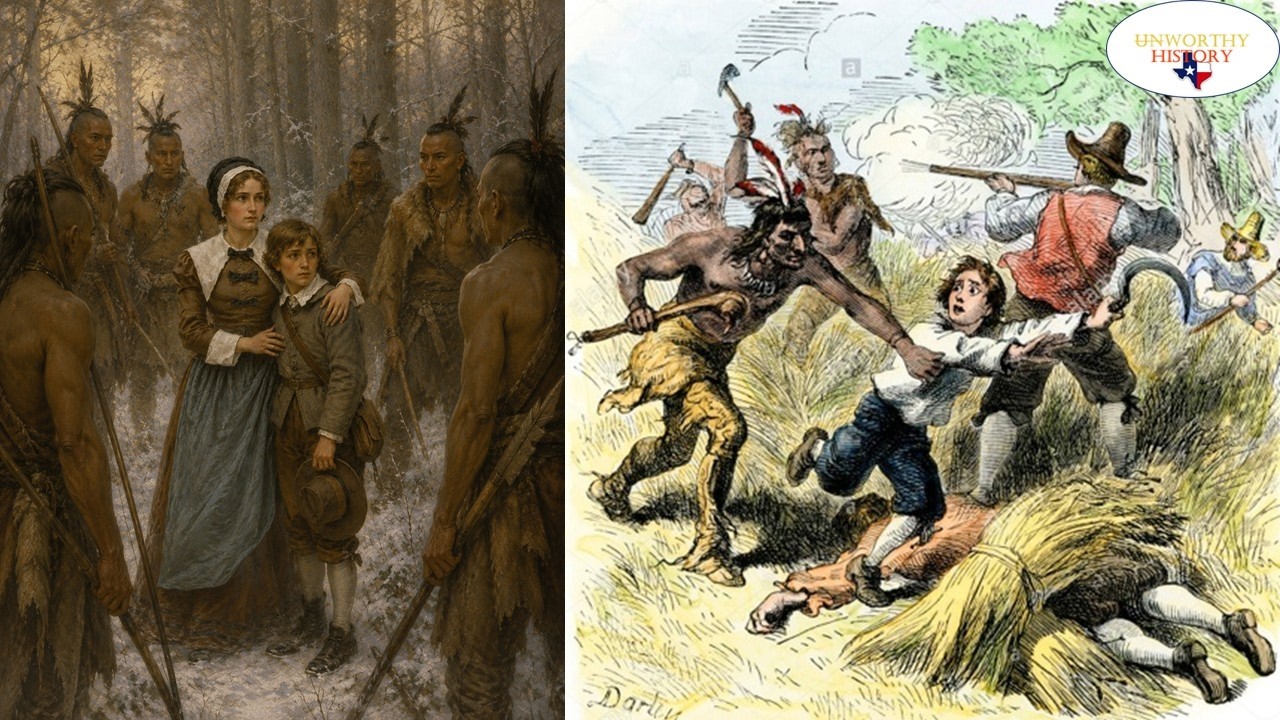
Rowlandson’s account of her captivity, published in 1682 as “A Narrative of the Captivity and Restoration of Mrs. Mary Rowlandson,” remains one of the most famous firsthand accounts of the conflict. In this portion of her story, Rowlandson describes being marched by her captors through western Massachusetts and then north toward the borders of Vermont and New Hampshire. She recounts her meeting with King Philip himself and details the harsh treatment she and her children endured at the hands of the Wampanoag.
During the fifth remove of her captivity, Rowlandson describes the group moving quickly because the English army was nearby in pursuit. The Indians marched as if fleeing for their lives, then selected their bravest men to send back and delay the English while the rest escaped. The group included the elderly, the sick, and the very young, with some carrying their aged mothers and others bearing wounded companions. Four men carried a heavy Indian on a litter, but when dense woods slowed them down, they took turns carrying him on their backs until they reached the Baquaug River.
On a Friday afternoon, the entire company reached the river. Rowlandson thought of counting them but found the number too great. Because of her injuries, her load had been lightened to her sewing work and two quarts of parched corn. Feeling extremely weak, she asked her mistress for one spoonful of corn, but was refused until the woman tasted it herself.
The group quickly cut dry trees to build rafts for crossing. Thanks to brush placed on the raft for her to sit on, Rowlandson’s feet stayed dry, while many others sank up to their legs in the cold water. Some crossed that night, but the rest did not complete the crossing until the following night. On Saturday, the Indians boiled the leg of an old horse they had obtained, and the captives drank the broth as soon as it was ready.
Rowlandson reflected that during her first week among them she had barely eaten. In her second week, her stomach was weakened by hunger, though she still found their foul food hard to swallow. By the third week, food that had once seemed revolting became sweet and delicious to her taste. Rowlandson was knitting a pair of white cotton stockings for her mistress and had not yet worked on Saturday.
When the Sabbath came, she was ordered to work. She told them it was the Sabbath and asked to rest, promising to do twice as much the next day. They answered that they would break her face. She marveled at what she called God’s providence in preserving these heathen, noting the hundreds of men, women, and children who crossed the river safely despite sickness and hardship.
On Monday they burned their huts and moved on. That same day the English army reached the river, saw the smoke, and yet was stopped by the water. Rowlandson lamented that the English were not granted the courage to pursue them, and reflected that if her people had been ready for such a blessing, God would have found them a way across just as He had for the Indians. In the sixth remove, they set out on a cold morning with a large brook ahead covered with ice.
Some waded through up to their knees or higher, while others, including Rowlandson, crossed at a beaver dam without wetting their feet. That day she walked mourning and weeping, moving farther from her home into what she described as a vast and desolate wilderness. She felt something of Lot’s wife’s experience when she looked back. They reached a large swamp and camped beside it.
When she reached the top of a hill overlooking the swamp, she thought they had come to a great Indian town, but it was only their own company. The Indians were as thick as trees, with what seemed like a thousand axes working at once. Wherever she looked, she saw only Indians, with no Christian soul near her. Yet she reflected on how the Lord preserved her safely.
After a night of worry and hunger, the next day was hard. The swamp was like a deep prison, and before it rose a high, steep hill. Before reaching the top, she feared her heart and legs would fail. While walking, she saw a place where English cattle had been, which was a small comfort.
Soon after, they came to an English road, which affected her so deeply she wished she could lie down there and die in peace. Later that afternoon they reached Squakeag, where the Indians scattered through abandoned English fields, gathering whatever they could find. Some picked up wheat ears, others found Indian corn, some found beans, and others found wheat bundles frozen together and threshed them. Rowlandson obtained two ears of Indian corn, but one was stolen while her back was turned, which grieved her greatly.
An Indian came by carrying a basket with a horse’s liver. She asked him for a piece, and he asked in surprise whether she could eat horse liver. She said she would try, and he gave her some. She placed it on the coals to roast, but before it was half cooked, half of it was taken from her.
She ate the rest as it was, with blood in her mouth, yet it was a savory mouthful to her. She found it a solemn sight to see fields of wheat and corn wasted and ruined, with what remained becoming food for their merciless enemies. That night they had a meal of wheat for supper. In the eighth remove, the group had to cross the Connecticut River to meet King Philip.
Two boatloads had already crossed when it was Rowlandson’s turn. As her feet touched the boat, sudden cries rose among the Indians, and she was forced to retreat. Instead of crossing, she had to walk four or five miles north. Some Indians ran one way, some another, apparently because they had seen English scouts nearby.
During a noon halt along the river, her son Joseph came to her unexpectedly. They asked each other how they were, mourning their miserable condition and the change in their circumstances. She asked if he wanted to read, and he said he did. She gave him her Bible, and his eyes fell on a comforting verse: “I shall not die, but live, and declare the works of the Lord.
The Lord hath chastened me sore, but he hath not given me over unto death. ” He said, “Look here, Mother, have you read this? ”
Rowlandson writes that one main reason she recorded these lines was to declare the works of the Lord and His wonderful power in preserving them in the wilderness while in enemy hands. They traveled until night, and in the morning they crossed the river to Philip’s company.
When she reached the opposite shore, the heathen crowded around her as she sat alone in the midst of them. They asked each other questions, laughed, and rejoiced over their gains and victories. Her heart weakened then, and she burst into tears, the first time she remembered crying before them. She had faced much distress before without shedding a tear in their sight, being stunned and amazed.
Now she could say with Psalm 137, “By the rivers of Babylon, there we sat down, yea, we wept, when we remembered Zion. ”
Someone asked her why she was crying. She barely knew what to say, but answered that they would kill her. “No,” he said, “no one will hurt you.
” Then someone gave her two spoonfuls of meal to comfort herself, and another gave her half a pint of peas, which she valued more than many bushels at another time. She went to see King Philip, who invited her to sit and asked if she would smoke, a common courtesy in those days among both good and bad. She declined, having given up tobacco since her capture, and reflected that it seemed like a bait of the devil to waste precious time. She remembered with shame how she had formerly been ready to take another pipe after two or three.
But she thanked God for giving her strength to resist it. The Indians gathered their forces against Northampton. All night someone cried out to communicate the plan, and they boiled beans and roasted corn for those who had provisions. In the morning they departed.
During her stay, Philip asked her to sew a shirt for his son, and she did, receiving a shilling. She offered the money to her master, but he told her to keep it, and with it she bought a piece of horse flesh. Later Philip asked her to make a cap for his son and invited her to dinner for it. She was given a pancake about the size of two fingers, made of parched, ground wheat fried in bear grease.
She thought she had never tasted anything more delicious in her life. A woman asked her to sew a shirt for her husband and gave her a piece of bear meat. Another asked her to knit a pair of stockings and gave her a quart of peas. She boiled the peas and bear meat together and invited her master and mistress to dinner.
But the proud woman, because it was served in one dish, ate nothing except one bit given to her on the point of his knife. When she heard her son had arrived, she went to see him and found him lying on the ground. He said he was not sleeping but praying, and lay that way so no one would notice. She prayed God would remember these things.
In this place, with the sun high and the smoke of the huts, she feared she would go blind and could barely distinguish one hut from another. Mary Thurston of Medfield lent her a hat, but as soon as she left, the Indian woman who owned Mary Thurston came running after her and reclaimed it. The woman who had given her the spoonful of meal was here, and Rowlandson put it in her pocket for safekeeping, but someone stole it and left five Indian corn grains in its place. Those grains were the best provision she got that day.
The Indians returned from Northampton with horses, sheep, and other goods they had taken. She begged them to take her to Albany on one of the horses and sell her for powder, as they sometimes spoke of doing. She had no hope of walking home the way she had come and could not bear thinking of the many weary steps. In the ninth remove, instead of going to Albany or home, they had to travel five miles along the river and then cross it.
A miserable Indian living there asked her to sew a shirt for him. When she finished, he paid her nothing, but since he lived by the river where she went for water, she constantly reminded him of her wage. He finally said that if she made another shirt for an unborn child, he would give her a knife, and he did. Her master asked her to give him the knife, and she was grateful to have anything they would accept.
Around this time, her master’s servant returned from Narragansett country after three weeks away, bringing about a peck and a half of corn stored in the ground. It was near the time their great leader Nenant was killed in Narragansett country. Her son was about a mile away, so she asked permission to see him. She set out but quickly lost her way among the hills and swamps and could not reach him.
She wondered at God’s great power and goodness, that although she met various Indians and people she did not know, none of them harmed her. She returned and met her master again, who showed her the way to her son. She found him ill, with a boil on his side causing him great pain. They shared their sorrow for a while, and then she returned.
Afterward she found herself more discontented than before, wandering and groaning, her spirit ready to sink thinking of her poor children. Her son was sick, and she could not help thinking of his sad looks. No Christian friend was with him to perform any act of charity for body or soul. Her poor daughter she knew not where, nor whether she was sick or well, alive or dead.
She turned to her Bible, her great comfort, and found the verse, “Cast thy burden upon the Lord, and He shall sustain thee. ”
She had to go find something to satisfy her hunger. Wandering among the huts, she entered one where a woman showed her great kindness and gave her a piece of bear meat. She put it in her pockets and returned home, but found no chance to roast it for fear they would take it from her.
It stayed in her ill-smelling pockets all day and night. In the morning she went to the same woman, who was boiling a pot of beans, and asked to boil her bear meat in the pot. The woman did and gave her some beans to eat with it. She reflected that although she had once shuddered at the thought of bear meat, now it tasted so savory that one would think what she ate was enough to disgust any creature.
On a very cold day, she found no place to sit by the fire. She went out not knowing what to do, but entered another hut where a woman spread a skin for her and asked her to sit. She gave her some beans and invited her to come again, telling her they would buy her if they were able. These were strangers she had never seen before.
That day a small part of the group moved about three-quarters of a mile, intending to go on the next day. Hungry, Rowlandson went back to the previous place to get something to eat, encouraged by the kindness of the woman who had invited her back. While she was there, an Indian came looking for her, and when he found her, he kicked her all the way home. She returned to find venison roasting that night, but they gave her not one piece.
Sometimes she was treated well, sometimes she met only frowns. In the eleventh remove, they set off intending to travel a full day along the river. She carried her load on her back and soon they waded the river and climbed weary hills. One hill was so steep she had to go up on her knees, holding onto branches and bushes to keep from falling backward.
Her head was so light she usually staggered as she walked, but she hoped all these weary steps were a forerunner of heavenly rest. In the twelfth remove, it was Saturday morning when they prepared to leave. She asked her master whether he would sell her to her husband, and he answered “Yes,” which greatly cheered her spirit. Her mistress had gone to a child’s burial before their departure, and when she returned, she found Rowlandson reading her Bible.
The woman snatched the book from her hand and threw it out the doors. Rowlandson ran out, picked it up, put it in her pockets, and never let her see it again. They packed to leave and gave her her load. She complained it was too heavy, and her mistress slapped her face and ordered her to move.
She lifted her heart to God, hoping deliverance was not far off. Thoughts of going home, which was their direction, made her burden seem light and almost nothing. But to her great surprise, things quickly turned. After traveling a short distance, her mistress suddenly stopped, refused to go further, and turned back, saying Rowlandson must return with her.
She called her son to come back too, but he refused and said he would continue the journey and return in three days. Rowlandson admitted her spirit was then in great distress, and she was nearer to losing her wits than ever. She thought death would be easier than going back. She could not describe her troubles, but she had to return.
When she had the chance, she took her Bible and found the comforting verse, “Be still, and know that I am God. ” Her spirit calmed, but she knew she would face hard times, especially after her master’s departure, for he had seemed the best friend among the Indians in cold and hunger. Soon proved right, she sat with a heavy heart but was so hungry she could not stay still. Walking among the trees, she found six acorns and two chestnuts, which served as her provision.
At night she gathered wood to keep warm, but at bedtime they ordered her out to sleep elsewhere, saying they had more guests than the place could hold. She told them she did not know where to go. They ordered her to find a place. She said if she went to another hut, they would be angry and send her back.
One of them drew his sword and said he would stab her if she did not leave at once. She had to obey that rude man and go out in the middle of the night without knowing where to go. She later saw him walking in Boston disguised as a friendly Indian, he and others like him. She went to one hut and was told there was no room, then to another with the same answer.
Finally an old Indian invited her in, and his wife gave her some beans, something to put under her head, and they made a good fire. Through God’s providence, she had a comfortable lodging that night. In the morning another Indian asked her to come at night and promised her six beans, which she did. They were about two miles from the Connecticut River, going to gather beans by the river in the morning and returning in the evening.
She walked with a heavy load on her back, for when they moved even a short distance, they took all their belongings. She told them her back was sore, but received no comfort, only that it did not matter if she lost her head too. Instead of heading toward the Bay as she had hoped, she had to go with them five or six miles down the river into a thick forest, where they stayed about two weeks. A woman asked her to make a shirt for her child and gave her a pot of broth thickened with meal made from tree bark, improved with a handful of peas and some roasted beans.
She had not seen her son for a while and asked an Indian when he had last seen him. He answered that his master had roasted him at some point and that he himself had eaten a piece the size of two fingers, and that it was good meat. But the Lord strengthened her spirit against this discouragement, and she reflected on their horrible addiction to lying, with not one of them feeling any remorse about telling the truth. In this place, on a cold night as she lay by the fire, she moved a branch that blocked the heat.
A woman put it back, and when Rowlandson looked at her, the woman threw a handful of ashes into her eyes. Rowlandson thought she would be blind forever, but lying down, tears washed the dust away, and by morning her sight returned. She remembered how often, sitting in their huts reflecting on the past, she would suddenly jump up and run outside as if she were home, forgetting where she was. But when she went out and saw only wilderness, woods, and a crowd of savage heathen, her senses returned quickly.
Around this time she began to think all hope of returning home was gone. The English army did not come to rescue her. The plan to be taken to Albany failed. Her master had said he would sell her to her husband, but instead he left her behind, and her spirit nearly collapsed entirely.
She asked permission to gather wood to be alone and pour out her heart before the Lord. She took her Bible, but found no comfort in it, which she was accustomed to find. She noted that it is easy for God to dry up the springs of comfort in the Scriptures, yet she could not say that God had left her to let her impatience rise against Him, for she knew He had dealt with her less than she deserved. Soon the Lord led her to verses that revived her, such as Isaiah 55:8, “For my thoughts are not your thoughts, neither are your ways my ways, saith the Lord,” and Psalm 37:5, “Commit thy way unto the Lord; trust also in him; and he shall bring it to pass.
”
Around this time, they came crying from Hadley, where they had killed three English and brought a captive named Thomas Read. They crowded around the poor man asking many questions. Rowlandson went to see him and found him weeping bitterly, thinking they would kill him quickly. She asked whether they intended to kill him.
She was told no. After he was a little comforted, she asked about her husband. He told her he had seen him at the Bay at that time, and that he was well but very melancholy, which made her know for certain that all the Indians had told her about him was false. Some had said he was dead and killed.
Others said he had remarried, and that the governor wished him to marry, telling him he had freedom of choice, and everyone persuaded him she was dead. She reflected how like these savage creatures were to the one who was a liar from the beginning. Once while she sat in a hut, Philip’s maid came in carrying a child and asked Rowlandson for a piece of her apron to make a cap for it. Rowlandson refused.
Her mistress ordered her to give it, but she said no again. The maid said if Rowlandson would not give a piece, she would tear one off. Rowlandson said she would tear her coat then. Her mistress rose and took a stick big enough to kill her and struck at her.
Rowlandson stepped aside, and the stick went into the mat of the hut. While the woman tried to pull it out, Rowlandson ran to the maid and gave her the whole apron, and so the storm passed quietly. When she learned her son had come to that place, she went to see him and told him his father was well but melancholy. He told her he grieved for his father as much as for himself.
She wondered at this, thinking her own troubles were enough to make her forget her husband and everyone else, as long as they were safe among friends. He also told her that his master, with other Indians, had once been going toward the French for powder, but the Mohawks intercepted them and killed four of their companions, causing the rest to turn back. Rowlandson thought his condition might have been worse if he had been sold to the French than it ended up being with the Indians. She went to see a young English man named John Gilbert of Springfield.
She found him lying outside on the ground. He told her he was very sick with dysentery from eating too much blood. He had been turned out of the hut with a dying Indian child whose parents had been killed on a very cold day, and he had no fire and no clothes except a shirt and waistcoat. The sight was enough to melt a heart of stone.
The young man writhed like a dog, and the child lay with eyes, nose, and mouth full of dirt, yet still alive and groaning. She advised John to get to some fire. He said he could not stand, but she urged him, fearing he would die there. With much difficulty she got him to the fire and returned home.
As soon as she got in, her master’s daughter came after her to know what she had done with the English man. Rowlandson told her she had brought him to a fire. At that moment she needed Paul’s prayer, to be delivered from unreasonable and wicked men. To appease the girl, she went with her and showed her where he was.
But before she got home, word spread that she was escaping and taking the young English man with her. When she entered, they began to cry out and ask where she had been and what she had been doing, and said they would knock him on the head. She told them she had been to see the young English man and would not run away. They accused her of lying, and one took an axe and came near, threatening to strike her if she went out again.
So they kept her inside the hut. She could say with David, “I am in a great strait. ” If she stayed inside, she would starve; if she went out, she would be struck on the head. This miserable condition lasted that day and half the next.
Then the Lord remembered her. An Indian came with a pair of stockings too large for him and wanted her to unknit them and knit them to fit. She showed willingness and asked him to ask her mistress if she could go with him a little way. The mistress said yes.
Rowlandson felt great relief at hearing that she had her liberty again. She went with him, and he gave her some roasted beans that revived her weak stomach. As soon as she was out of sight, she had time and freedom to read her Bible. Then that comforting verse appeared: “For a small moment have I forsaken thee, but with great mercies will I gather thee.
” Isaiah 54:7. So the Lord supported her from time to time. Then her son came to see her, and she asked his master to let him stay with her a while so she could comb his hair and care for him, as he was covered with lice. When she finished, he told her he was very hungry, but she had nothing to give him.
She asked him to go into the huts as he walked to see if he could get something. He did, and it seems he stayed a little too long, for his master was very angry and beat him, then sold him. He came running to tell her he had a new master who had already given him some beans. She went with him to his new master, who told her he loved him and that he would lack nothing.
His master took him away, and she did not see him again during the whole captivity until she met him at Piscataqua, in Portsmouth. That night they asked her to leave the hut again. Her mistress’s child was sick and died that night, which at least made more room. She went to a hut where they asked her in, gave her a skin to lie on, and a meal of venison and beans, a special dish among them.
The next day they buried the child, and afterward, morning and evening, people came to mourn and howl with the mother. Rowlandson admitted she could not comfort them much. She spent many sorrowful days in that place, often going off by herself. She mourned like a crane or a swallow, and chattered like a dove.
Her eyes failed with looking upward. She could say with Hezekiah, “Remember, O Lord, I have walked before thee in truth. ” She examined her ways and found her conscience did not accuse her of wronging anyone, though she knew she had been negligent in her walk with God. She said with David, “Against thee, thee only, have I sinned,” and with the poor publican, “God be merciful to me a sinner.
”
On Sabbaths, she looked at the sun and thought of people going to the house of God to revive their souls and rest their bodies, while she was deprived of both. She said with the prodigal son that she would fain have filled her belly with the husks that the swine did eat, but no man gave unto her. She remembered how on nights before and after the Sabbath her family, relatives, and neighbors were around her, praying and singing, refreshing their bodies with God’s good gifts and lying on a comfortable bed. Instead, she had only scant, poor food and slept on the ground like a pig.
She could not express to any human the grief that weighed on her spirit; only the Lord knew it. Yet that comforting verse often came to mind: “For a small moment have I forsaken thee, but with great mercies will I gather thee. ”
That concludes the second episode of this series drawn from Rowlandson’s 1682 account of her captivity among the Indians. Listeners heard how the Indians mocked her, claiming they had roasted and eaten her son when she had not seen him for some time, and how he was beaten, sold, and taken from her, so that she did not see him again for the rest of her captivity.
The next episode will cover the remainder of her captivity as the Indians moved her east toward Lancaster and Boston. The video also promoted a new edition of Rowlandson’s book published by the Unworthy History channel, available in paperback and hardcover. This edition includes an introduction and conclusion discussing the broader context of King Philip’s War from a perspective modern historians consider unworthy of mention, along with illustrative maps of her movements with the Indians, and additional material from the 1903 edition, including notes, a biography of Mary, references, and a copy of the final sermon of her husband, the Reverend Joseph Rowlandson. The channel was created because such history is often considered unworthy of television history channels or modern museums like the Smithsonian.
The goal is to keep this valuable history alive by reading directly from old books.