On the night of December 11, 1978, 15-year-old Robert Piest told his mother he was stepping out to meet a contractor and would return immediately. It was her birthday. He left the pharmacy in Des Plaines, Illinois, and never came home.
Ten days later, police dug beneath the contractor’s house and found 26 sets of human remains. Three more bodies were buried in the yard. Four others had been thrown into a river. The total was 33 victims.
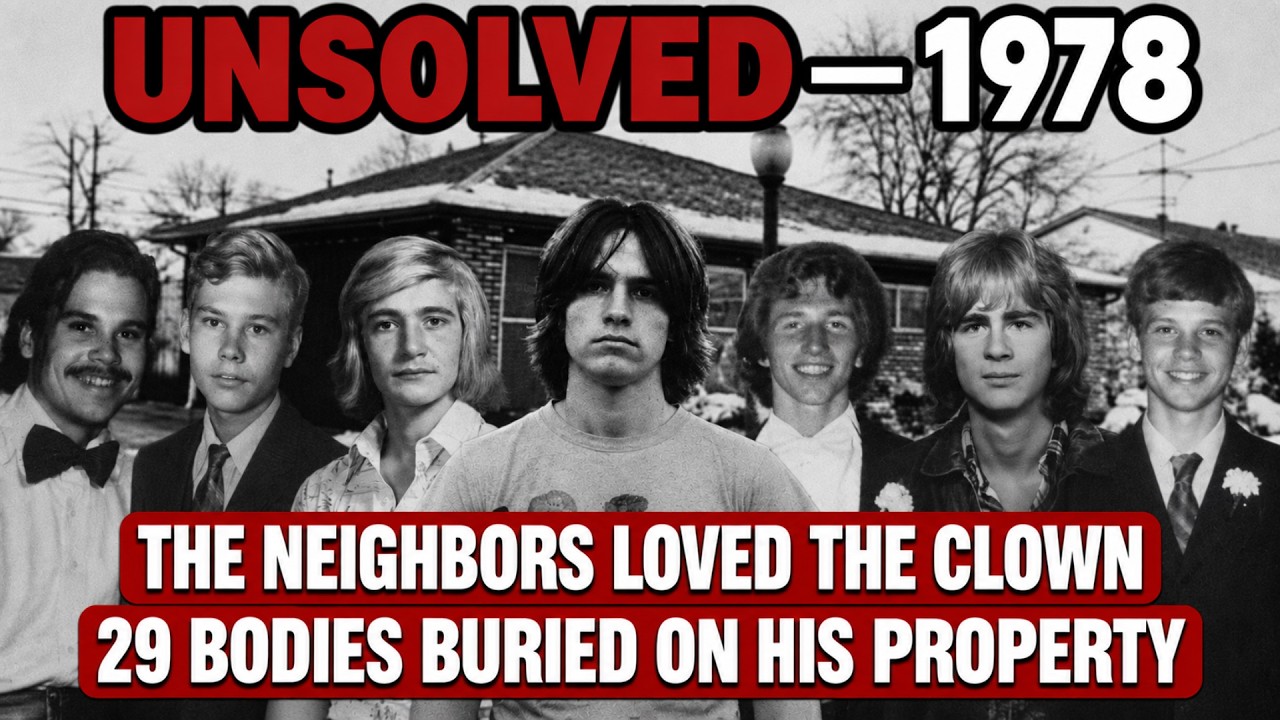
The contractor’s name was John Wayne Gacy. Neighbors knew him as Pogo the Clown, the man who entertained children at charity parties and once posed for a photo with First Lady Rosalynn Carter.
Over six years, Gacy killed young men inside his home and buried them beneath the floor he walked on every day. Dozens of families reported their sons missing. Police treated the cases as runaways. Officers questioned Gacy at least twice before Piest disappeared. Both times, they left without taking action. Each time they left, more people died.
Gacy was convicted of 33 murders and executed in 1994. But the story did not end there. Eight victims had no names. No family claimed them. No one knew who they were. Nearly half a century later, five remain unidentified.
This is the story of America’s most terrifying serial killer. It is also the story of forgotten victims and a decades-long fight to give them their real names back.
Robert Jerome Piest was born on March 16, 1963, in Des Plaines, about 17 miles northwest of downtown Chicago. He was the youngest of three children. His father, Harold, worked hard and spoke little. His mother, Elizabeth, held the family together. They were a middle-class suburban family, quiet, responsible, and close.
Robert attended Maine West High School. He competed in gymnastics and swimming and joined many extracurricular activities. Teachers described him as a diligent student who was always ready to help others. Friends said he was the kind of person you could count on. He was an ordinary 15-year-old trying to do everything right.
After school, Robert worked part-time at Nissen Pharmacy on Touhy Avenue in Des Plaines. He took the job seriously. One of his coworkers was 17-year-old Kim Byers, a fellow student. They often worked the same shifts.
On the evening of December 11, 1978, Robert was working the night shift. It was Elizabeth’s 46th birthday. The family had delayed the celebration until he finished work. The plan was simple: Robert would finish his shift, Elizabeth would pick him up, and the whole family would go home to celebrate together.
Elizabeth arrived at the pharmacy before 9 p.m. During the shift, Kim Byers borrowed Robert’s jacket because it was cold. While wearing it, she placed a photo development receipt in the pocket. She returned the jacket before Robert got ready to leave. No one paid attention to the slip of paper. It was just a receipt in a coat pocket. But that paper would become one of the most important pieces of evidence in American criminal history.
Before leaving the pharmacy, Robert told his mother he needed to step out for a few minutes. A contractor working near the store had offered him a summer job paying double his current wages. He wanted to talk about the opportunity. He said, “I’ll go out to meet the contractor and I’ll be right back, Mom.”
Those were the last words Elizabeth Piest ever heard from her son. Robert walked out into the freezing December night. He was thinking about a summer job. He thought he would return in a few minutes and the family would celebrate his mother’s birthday. He never came back.
Elizabeth waited 10 minutes, then 15, then 30. The store closed. Employees left. The parking lot emptied. Robert was nowhere. She called his name. There was no answer. She searched the store, the parking lot, and the neighborhood. There was no trace of him.
Robert Piest never stayed out late. He always called if plans changed. He promised to come straight back. He vanished on his mother’s birthday.
The Piest family did not wait until morning. They did not convince themselves he had gone to a friend’s house. They did not think he ran away. Robert was not that kind of child. Harold and Elizabeth called the police that same night.
Robert Piest was not the first young man to disappear in the Chicago suburbs during the 1970s. He was not even the tenth or the twentieth. Over six years, dozens of young men vanished across the northwestern suburbs. They disappeared from bus stops, from roadsides, from construction jobs they had just started.
Families reported the disappearances. The answer was always the same: your son probably ran away. Kids that age do that. Wait a few days and see what happens. No investigation was opened. No search was conducted. The system treated these disappearances with indifference.
But the Piest family was different. Not because they were richer or more influential. They knew their son. They knew Robert did not run away, and they refused to accept any answer other than the truth. That determination, a mother’s refusal to stay silent on her birthday without her son, would change everything.
Before Robert Piest, there was John Butkovich. He was 18 years old and worked for a small contracting company in the Chicago suburbs called PDM Contractors, which specialized in home repairs and renovations. He was a hard worker, the kind of young man who showed up on time and worked until the job was done.
In 1975, Butkovich had a dispute with his boss over wages. He told his family he was going to meet his boss to collect his final paycheck. He left and never returned. His parents reported him missing. They explained that their son was not the type to run away. Police took the report and did nothing. They never went to his workplace. They never questioned the boss. Butkovich’s body remained under that same boss’s garage for three years before anyone found it.
Gregory Godzik was 17 years old. He also worked for PDM Contractors, the same company as Butkovich. In 1976, one year after Butkovich disappeared, Godzik vanished too. His family reported it. This time, police did question the company owner. The man said Godzik quit and left. Police believed him. They closed the file.
Think about that. Two young men working for the same company, both disappearing within a year. When police questioned the boss, he had a ready answer for both cases. Both times, police withdrew without asking further questions. Each time they withdrew, more people died.
John Szyc, 19, disappeared in January 1977. His family reported it immediately. Police investigated and discovered Szyc’s car had been sold. They traced the buyer, who led them to the same name, the same company owner, the same man they had questioned the previous year about Godzik. He said Szyc sold him the car to get money and leave town. Police believed him. Again, they withdrew. Again, no one was held accountable.
A 19-year-old missing. His car in the possession of the same man connected to at least two other disappearances. The system treated it as a coincidence.
This was not the negligence of one person. It was a pattern. Throughout the 1970s in the Chicago suburbs, young men disappeared and the system ignored them. Not because there was no evidence. Not because there were no leads. But because these young men were not the kind of victims the system considered worth protecting.
Many were hitchhikers who depended on free rides. Many were runaways or young men living on the margins. Many were gay or bisexual in an era when the disappearance of gay men was not treated as a matter of concern. They were invisible people, and the system treated their disappearances as unworthy of time or paperwork.
While the Butkovich family waited, while the Godzik family waited, while the Szyc family waited, more young men disappeared. Police never connected the dots because, in their view, there were no dots worth connecting.
When Robert Piest disappeared and his family called the police that same night, it was the first time the system was forced to listen. Not because Robert was more important than John Butkovich or Gregory Godzik or John Szyc. Because the Piest family refused to leave when told their son might have run away. Because Robert was a diligent student with a steady job and a close family. He did not fit the mold police used to ignore previous disappearances. And because the Des Plaines Police Department, unlike the Chicago Police, actually opened an investigation.
It is a bitter irony. It took the 33rd victim for the system to act. The 32 victims before him were not enough.
John Wayne Gacy Jr. was born on March 17, 1942, in Chicago. He was the second of three children. His father, John Stanley Gacy, was a Polish-American mechanic, an alcoholic, and violent in a way neighbors knew but never discussed. He beat his son with a razor strap. He called his son stupid, a coward, someone who would never amount to anything.
When Gacy tried to work on a car, his father beat him for touching the parts. When a toy truck went missing, his father beat him. When his mother’s underwear was found in a sandbox under the porch, the boy said he liked the feel of the fabric. His father beat him with the razor strap. Then his father shot and killed the boy’s dog, not because the dog did anything wrong, but because he was angry at his son.
At age 11, Gacy was hit on the head by a swing at a playground. It caused recurring blackouts that lasted five years until doctors found a blood clot in his brain and treated it. In addition to his father’s abuse, Gacy was sexually assaulted several times in childhood by a contractor who was a friend of his father. He told no one.
None of this excuses anything Gacy later did. Many people have suffered worse and never hurt anyone. But every warning sign was there, and no one in the system, no teacher, no doctor, no neighbor, did anything about those signs.
Gacy dropped out of high school, lived for a time in Las Vegas, worked at a funeral home for a few months, then returned to Chicago and graduated from Northwestern Business College in 1963. In 1964, at age 22, he married Marlynn Myers and moved to Waterloo, Iowa, where he managed a Kentucky Fried Chicken franchise owned by his wife’s family. He joined the Jaycees, became a prominent member, and earned the community’s trust. From the outside, life looked perfect.
In August 1967, Gacy sexually assaulted 15-year-old Donald Voorhees Jr. In 1968, he was arrested and convicted of sodomy. A doctor who examined him concluded he had antisocial personality disorder. The doctor recommended long-term close supervision. Gacy was sentenced to 10 years in prison. His wife divorced him immediately. He never saw her or their two children again.
But John Wayne Gacy was a model prisoner. He earned his GED, became a head cook, joined the Jaycees in prison, and even campaigned for better pay for fellow inmates. After 18 months, he was released on parole. Ten years became 18 months. A convicted child sex offender, diagnosed with antisocial personality disorder, warned by a doctor to need close supervision, was released back into society.
In February 1971, another teenager accused Gacy of forcing him into sexual acts. The charge was dropped when the victim failed to appear in court. In October 1971, Gacy’s parole ended. One month later, his entire criminal record in Iowa was sealed by court order. The system did not just release him. The system erased him, as if what happened in Waterloo had never occurred.
John Wayne Gacy entered the 1970s with a clean slate. Thirty-three young men would pay for that.
Gacy bought the house at 8213 West Summerdale Avenue in Norwood Park, a Chicago suburb. It was a one-story house, so ordinary it was unnoticeable. He founded a contracting company called PDM, specializing in home repair and renovation, and began building a reputation as a reliable contractor.
In 1972, he married Carole Hoff, a woman he had dated in high school. Hoff and her two daughters from a previous relationship moved into the Summerdale house. From the outside, Gacy’s life looked like a perfect version of the suburban American dream. He threw annual summer parties with up to 400 guests, including local politicians, business partners, and neighbors. He got involved in politics and served as director of Chicago’s Polish Constitution Day parade. Through that work, he met First Lady Rosalynn Carter and had his picture taken with her. That photo still exists today. A serial killer standing next to the wife of the President of the United States, both smiling.
Then Gacy created the character of Pogo the Clown. He designed the makeup himself and sewed the costume himself. He dressed as a clown to visit sick children in hospitals, attend birthday parties, and community charity events. Children loved him. Parents trusted him. Neighbors described him as a model citizen, the most generous man in the neighborhood.
No one knew that while Pogo the Clown entertained children above ground, the bodies of young men were decomposing beneath the floor of his home.
The first victim Gacy personally admitted to killing was Timothy McCoy, 16, from Nebraska. In January 1972, McCoy was passing through Chicago and met Gacy at a Greyhound bus station. Gacy took him home. McCoy was stabbed to death and buried under the house. His identity was not confirmed until years later through dental records. He was the first known victim and the only one killed with a knife. All subsequent victims were killed by strangulation or asphyxiation.
Gacy developed his own system. He lured young men to his home with promises of work at PDM, or with money, alcohol, or an invitation to see a magic trick. The magic trick was the trap. He offered to put handcuffs on the victim as part of the trick, claiming it would be an impressive escape act. Once the handcuffs clicked shut, the trick was over. He also used chloroform to sedate victims. In some cases, he mounted a red light on his car to impersonate a police officer and pull young men over on the road.
They were all taken to 8213 West Summerdale. They were all killed inside that house. Twenty-six bodies were buried in the crawl space, a dark, damp area beneath the house, no more than three feet high. Three more bodies were buried in the yard. Gacy walked over that floor every day, ate his dinner there every night, watched television there every evening, directly above 26 decomposing bodies.
After his divorce from Carole Hoff in October 1975 and her departure with the children in February 1976, Gacy’s murder rate increased. From three victims in the first four years, he went to at least 30 victims in the final two years. There was no one left in the house to ask about strange noises, or the foul smell coming from the crawl space, or the unfamiliar young men who arrived and never left. The house became his alone, and he used it as a killing room.
When the Piest family called police, the Des Plaines Police responded very differently from the Chicago Police in previous years. Lieutenant Detective Joseph Kozenczak took the case and began investigating immediately. Within hours, police identified the contractor Robert said he was going to meet. He was the owner of PDM, the man doing repair work at the Nissen Pharmacy. His name was John Wayne Gacy.
Kozenczak sent officers to Gacy’s home. Gacy seemed cooperative, friendly, talkative, even joking with police. He said he knew nothing about the Piest boy, and that the kid probably ran away like many other teenagers. He was so relaxed that at one point during surveillance, he told an investigator something that officer would never forget. He said, “Clowns can get away with anything.”
Police did not laugh.
On December 13, the Des Plaines Police obtained a search warrant for Gacy’s home. The first search did not find Robert Piest or any bodies. But they found other things. A driver’s license that did not belong to Gacy. A high school graduation ring belonging to an unknown young man. A fake police badge. Handcuffs. Sex toys. Syringes and drugs. Child pornography. And a photo development receipt.
That receipt matched exactly the slip of paper Kim Byers had placed in Robert Piest’s jacket pocket that night. A small piece of paper, a random action, became the thread connecting Robert Piest to John Wayne Gacy’s house.
Meanwhile, police traced Gacy’s sodomy conviction in Iowa. Ten-year sentence, 18 months served, parole, record sealed. The picture began to come into focus. Gacy was placed under 24-hour surveillance. Detectives tracked him everywhere, recording every meeting, every call, every movement.
During surveillance, two Des Plaines officers were invited inside the Summerdale house. One of them, Officer Bob Schultz, was standing in the bathroom when the heating system kicked on. Hot air rose from the furnace through the crawl space gap, carrying a foul odor Schultz recognized immediately. “It smelled like a morgue,” Schultz told his partner once they were outside. “That smell coming from under the house wasn’t sewage. It wasn’t a dead rat. It was decomposing bodies.”
On December 21, 1978, ten days after Robert Piest disappeared, the surveillance team arrested Gacy on a minor charge of giving marijuana to a gas station attendant. It was enough to hold him. That same night, Gacy, drunk, confessed to his attorney. He said he had killed people. A lot of people.
Police obtained a second search warrant. This time they dug into the crawl space. Officer Daniel Genty was the first to crawl into the pitch-black space beneath 8213 West Summerdale. Within minutes, he found a piece of a human arm bone. Genty shouted to his colleagues above: “Charge him. I found one.”
They did not stop at one. In the days and weeks that followed, the excavation team recovered 26 sets of remains from the crawl space. Three more bodies were found in the yard. The final four bodies, including Robert Piest’s, were pulled from the Des Plaines River in the months that followed. Robert Piest’s body was found in April 1979 in the Illinois River.
In total, 33 victims. Thirty-three young men killed by the same man in the same house over six years. When news of what was found beneath the floor of 8213 West Summerdale spread across America, the country faced a question no one wanted to answer. How did this happen in plain sight for six years without anyone knowing?
When news of the 33 bodies under John Wayne Gacy’s house spread, the reaction in the Norwood Park community was a complete collapse of trust. Neighbors stood on the sidewalk watching the excavation team carry remains one after another from the house they had passed every day for years. They had attended parties in that backyard. Their children had played with Pogo the Clown in that front yard. Under that floor, 26 young men were decomposing.
One neighbor later said the worst part was not learning that Gacy had killed people. The worst part was realizing that the smell they had noticed coming from the house in the summer, which Gacy explained as moisture under the house, was the smell of human bodies. They had smelled it. They had asked about it. They had accepted his explanation.
The Piest family waited through the winter for news of Robert. In April 1979, his body was pulled from the Illinois River, dozens of miles from Gacy’s house. Robert was one of the final four victims Gacy threw into the river instead of burying under the house, because by late 1978, there was no more room in the crawl space. He had killed so many people the floor could no longer hold them.
Elizabeth Piest, the mother who waited for her son to return on her birthday, now had to bury him.
The Piest family filed an $85 million wrongful death lawsuit against the Iowa Parole Board, the Iowa Department of Corrections, and the Chicago Police for systematic negligence. The lawsuit asked the question every victim’s family wanted to ask: If Iowa had not released him after 18 months, would my son still be alive? If Chicago Police had investigated when Butkovich disappeared in 1975, would my son still be alive? If his criminal record had not been sealed, would my son still be alive?
The answer to all three questions is probably yes. No one in the system wanted to face that.

In 1979, the house at 8213 West Summerdale Avenue was demolished. Crowds came to watch. People stood across the street and watched a bulldozer tear down the house where 33 young men were killed. Some brought cameras. Some brought their children. When the house became a pile of rubble, many people applauded.
In 1986, a new house was built on the same lot with a new address, as if changing the house number could erase what happened beneath the ground.
John Wayne Gacy’s trial began on February 6, 1980, in Cook County Circuit Court in Chicago. Due to intense media coverage, the defense requested a change of venue. The request was partially granted by selecting the jury from Rockford instead of Chicago.
Gacy did not deny that 33 young men died in his house. He could not deny it. The physical evidence was conclusive. Twenty-nine sets of remains from his property, fingerprints, his confession, dozens of witnesses. Instead, the defense entered a plea of not guilty by reason of insanity.
Gacy claimed he had multiple personality disorder. He said an alternate personality named “Jack” committed all the murders while Gacy knew nothing. According to him, Jack was the killer. Gacy was just a person who happened to live in the same body.
The defense called 22 witnesses, including Gacy’s mother and sister. They described the verbal and physical abuse from his father, the beatings with the razor strap, the constant humiliation, the dog shot dead, a stolen childhood. Six psychiatrists testified for the defense, concluding as medical experts that Gacy suffered from schizophrenia-like conditions or multiple personality disorder. They argued he was incapable of understanding the nature of his behavior at the time of the crimes.
In the final days of the trial, Gacy seemed increasingly detached from the proceedings, repeatedly telling the judge he did not understand what was happening. Judge Louis Garippo ruled that Gacy was still competent to stand trial.
The prosecution responded with its own team of experts. A state psychiatrist diagnosed Gacy with antisocial personality disorder and narcissistic personality disorder, not any form of psychosis. They testified that Gacy was fully aware of the nature and consequences of his behavior, and that he was capable of complying with the law but chose not to.
One expert made an argument the jury would not forget. He pointed out that building the crawl space to bury bodies, pouring lime on the bodies to speed decomposition, and throwing the final four victims into the river when the house ran out of space, all showed deliberate calculation. This was not the behavior of an insane man. This was the behavior of a man who knew exactly what he was doing and effectively hid the evidence. An insane person does not plan how to dispose of bodies.
Prosecutor William Kunkle asked one of the defense psychiatrists whether he could guarantee Gacy would spend the rest of his life in a mental institution if found insane. The expert could not offer any guarantees. The question echoed through the courtroom. If Gacy was found insane, he would go to a mental hospital. If another doctor someday decided he had stabilized, he could be released.
A jury of 12 listened to weeks of testimony from both sides. They saw the physical evidence. They saw photos of the crawl space. They heard descriptions of how Gacy lured victims with the handcuff magic trick, how he strangled them with a rope, how he buried them under the house and then went upstairs to host parties directly above them.
After both sides finished, the jury withdrew to deliberate. They deliberated for one hour and 50 minutes. One hour and 50 minutes for all 33 murder charges. Less than four minutes per life.
The verdict was unanimous. Guilty. Thirty-three counts of murder. The jury completely rejected the insanity defense. They concluded that John Wayne Gacy knew exactly what he was doing when he killed each of the 33 victims, and that he was capable of stopping and chose not to.
Judge Garippo delivered the sentence on March 13, 1980. Gacy received life sentences for 21 murders committed before June 1977, the period before Illinois reinstated the death penalty. For the 12 murders committed after that date, he received 12 death sentences. At the time of sentencing, this was the largest number of murder charges against a single defendant in American judicial history.
Gacy was transferred to death row at Menard Correctional Center in Chester, Illinois. He remained there for 14 years. During those 14 years, he never admitted he had done anything wrong.
On death row, John Wayne Gacy did not live like a man waiting to die. He lived like a man building a brand. He began painting. His most common subject was clowns. He painted Pogo the Clown dozens of times with wide smiles and bright colors, as if that character was a happy memory rather than the mask he wore while killing young men. He also painted self-portraits, landscapes, and other figures.
Those paintings sold to collectors of killer memorabilia, a market known as “murderabilia.” Gacy’s paintings sold for hundreds, sometimes thousands of dollars each. He sold Polaroid photos of himself for one dollar if he signed them. A man who killed 33 people was making money from his infamy, and people were willing to pay.
Along with selling paintings and photos, Gacy denied everything. He recanted the confession he made the night of his arrest. He said that confession was made while drunk and had no legal value. He said the bodies under his house were placed there by someone else, that PDM employees had access to the crawl space and could have used it to hide bodies. He said he was innocent, a victim of conspiracy, betrayed by the justice system.
Thirty-three bodies under his house, fingerprints, graduation rings, victims’ driver’s licenses in his home. Still he stood before cameras and said he killed no one.
He filed appeal after appeal. Each one was rejected. In 1984, the Illinois Supreme Court upheld the conviction. In 1994, the U.S. Supreme Court declined to hear the case. Every legal avenue was closed.
On May 10, 1994, John Wayne Gacy was executed by lethal injection at Stateville Correctional Center in Joliet, Illinois. He was 52 years old. He had spent 14 years on death row. The injection process hit a technical problem when a tube clogged, prolonging the execution longer than planned. He died at 12:58 a.m.
His recorded last words were not an apology. He said that taking his life would not compensate for the loss of others, and that this was a killing carried out by the state. Even at the final moment, he still saw himself as the victim. Illinois Department of Corrections Director Howard Peters confirmed this when asked about Gacy’s final words. He did not speak one word to the 33 families. He did not mention a single victim’s name.
John Wayne Gacy died, and most Americans assumed the case was over. But the case was not over.
When police recovered 29 remains from Gacy’s house in late 1978 and early 1979, only 25 were identified. Eight remains had no names. No fingerprint matches. No dental record matches. No family came forward to claim them.
Eight young men lay in the crawl space beneath John Wayne Gacy’s house, and no one in the world knew who they were. They were buried in unmarked graves in a local cemetery. Each headstone carried only a number. Not a name.
Think about that. They were not only killed. They were not only buried under a killer’s house. They were buried a second time without anyone knowing who they were.
How could eight young men die without anyone noticing they were missing? The answers lie in the same system that failed from the beginning. Many of Gacy’s victims were hitchhikers. Many were runaways living on the streets, getting by any way they could. Many were sex workers. Many were gay or bisexual in an era when families sometimes abandoned their sons because of their orientation. Some left home because of violent families. Some were kicked out.
When they disappeared, no one reported them to police, because to those around them, they had already disappeared before Gacy ever touched them. In the system of the 1970s, if no one was looking for you, you did not exist. If no one reported you missing, you were not missing. You were just another young man passing through the city, and when you stopped passing through, no one noticed your absence.
These eight young men remained in unmarked graves for more than 30 years. Then in 2011, Cook County Sheriff Tom Dart decided that 30 years was long enough. Dart had no legal obligation to reopen the case. Gacy was dead. There was no defendant to prosecute, no trial to prepare for. Technically, the case was closed.
But Dart looked at eight numbered headstones and decided that closing the case did not mean the responsibility was over. He said, “As science evolves, we have an obligation to apply those new tools to old cases, just as we would to new ones, to help victims and their families.”
In 2011, DNA technology had advanced far beyond what existed in 1978. A new field was emerging: genetic genealogy. This method compares a victim’s DNA to online genealogy databases, where millions of people have submitted their DNA samples to learn about their family origins. If a distant relative of the victim had submitted DNA to one of those sites, investigators could build the family tree in reverse and eventually identify the victim.
The Cook County Sheriff’s Office partnered with the DNA Doe Project, a nonprofit specializing in using genetic information to identify unidentified deceased persons. The process began by re-exhuming the remains of the eight unidentified victims from the cemetery, collecting new DNA samples with modern techniques, and beginning comparisons.

The first result came within weeks of reopening the case. William George Bundy, 19, a construction worker, was identified as one of the eight victims. Bundy disappeared in the mid-1970s. No one knew what happened to him until DNA confirmed his remains had been under Gacy’s house for more than 30 years. A 19-year-old with a job and a life, vanished from the face of the earth, and no agency looked for him.
In 2017, the second result emerged. James Byron Haakenson, 16. Jimmy, as his family called him, was from Minnesota. Sometime in the mid-1970s, he called his mother and told her he was in Chicago. That was the last time his mother heard his voice. He never called again. He never wrote. He vanished.
His mother searched for him. She contacted authorities. She asked about him everywhere. She never stopped looking, but she did not know where to look and no one helped her. Decades passed.
Then in 2017, the DNA Doe Project compared the genetic profile of the remains under Gacy’s house to genealogy databases and found a match that led them to the Haakenson family. Jimmy Haakenson, the 16-year-old who called his mother from Chicago, had been under 8213 West Summerdale Avenue for more than 40 years. Finally, he had a name. Finally, he was brought home.
Two of eight were identified. Six remained waiting. The search continued.
In 2021, the third result emerged. On October 25, 2021, Cook County Sheriff Tom Dart held a press conference and announced that the fifth victim had been identified. The remains were found in the crawl space of Gacy’s house on December 26, 1978. His name was Francis Wayne Alexander.
He was from North Carolina. He would have been 21 or 22 years old when Gacy killed him sometime between early 1976 and early 1977. Alexander’s life in Chicago is documented only in scraps of paper. He was born in North Carolina, moved to New York, then to Chicago, where he married and divorced after about three months in 1975. After that, his trail went completely cold. No employment records. No fixed address. No one knew what happened to him.
His family in North Carolina did not know he was dead. For more than 40 years, they did not know. They did not know his remains had been recovered from a serial killer’s house in 1978. They did not know he was buried in an unmarked grave in a Cook County cemetery with only a number on the stone. They did not know he lay there for more than four decades while life continued above ground.
Identifying Alexander proved the power of genetic genealogy. The DNA Doe Project used a genetic profile created from Alexander’s remains and compared it to online genealogy databases. They found potential relatives. From there, they built a family tree and gradually narrowed the search until it led them to the Alexander family.
Alexander’s mother and a half-brother provided DNA samples for comparison. Combining genetic testing, financial records, autopsy reports, and other information, investigators confirmed the remains belonged to Francis Wayne Alexander. The Sheriff’s Office officially notified the family on October 22, 2021.
Caroline Sanders, Alexander’s sister, issued a statement on behalf of the family. She wrote, “We would like to thank Sheriff Tom Dart, Lieutenant Jason Moran, and the dedicated officers of the Cook County Sheriff’s Office, and the DNA Doe Project. Without their tireless efforts, our family would not have the peace of mind we now feel.”
Then she wrote the words Tom Dart read aloud before the cameras at the press conference. A mother now has peace of mind. Sisters now have peace of mind. Brothers now have peace of mind. “A mother waited more than 40 years to know where her son was, and now she knows.”
Three of eight were identified: William George Bundy, James Byron Haakenson, and Francis Wayne Alexander. Three names returned to three sets of remains. Three families finally knew what happened. But five people still had no names.
The Cook County Sheriff’s Office and the National Center for Missing and Exploited Children, known as NCMEC, released detailed facial reconstructions of two of the five unidentified victims, hoping someone would recognize them.
John Doe #10 was identified as a white male, between 17 and 21 years old, between 5 feet 7 inches and 5 feet 11 inches tall, with a healed fracture of the left collarbone and several dental fillings. John Doe #13 was identified as a white male, between 18 and 21 years old, between 5 feet 9 inches and 6 feet 2 inches tall, with wavy dark brown hair and an upper tooth located behind another tooth.
That is all we know about them. Height, hair color, fillings, a healed fracture. No name. No family. No story.
Investigator Jason Moran, who led the identification effort, said, “The hope is that based on that reconstruction image, we will get additional leads.” Anyone with information is asked to contact NCMEC at 1-800-THE-LOST.
These five young men are still waiting.
The John Wayne Gacy case left many legacies, and none of them are simple.
The forensic legacy is the most obvious. The case proved that DNA technology and genetic genealogy can identify victims decades after their deaths. Time is not the final barrier. Science can do what the original investigation could not. Every identification, Bundy, Haakenson, Alexander, is living proof that refusing to give up matters.
The legal legacy is more complex. The case exposed systemic failure in how police handled missing persons cases, especially when victims were teenagers, gay men, homeless people, or anyone society treated as not worth searching for. After Gacy, missing persons reporting procedures were revised in Illinois and many other states. The realization that every disappearance needs to be investigated seriously, regardless of the victim’s social circumstances, became a principle emphasized in police training, even if actual practice still has many shortcomings.
The cultural legacy is perhaps what the public knows best. The nickname “Killer Clown” became a terrifying archetype that haunts Western culture. The image of the clown with a wide smile hiding dark intentions appears in countless films, novels, and television shows. The fear of clowns, coulrophobia, which many people experience today, can be traced in part to John Wayne Gacy and the character of Pogo.
Netflix produced a documentary series titled “Conversations with a Killer: The John Wayne Gacy Tapes” in 2022, using previously unreleased recordings of Gacy. Dozens of books have been written about the case, including “Buried Dreams” by Tim Cahill and “Killer Clown” by Terry Sullivan, one of the prosecutors at the trial.
But the most important legacy of the case is not in films or books. It is the lesson of systematic failure. Five failures stacked on top of each other, paving the way for everything that followed.
The first failure: Iowa released a convicted child sex offender, diagnosed with antisocial personality disorder, after 18 months instead of 10 years.
The second failure: His criminal record was sealed, erasing the trace of his prior conviction.
The third failure: Chicago Police questioned Gacy at least twice after PDM employees disappeared, and both times they left without taking action.
The fourth failure: The system ignored victims because they were young, or hitchhikers, or gay, or because they lacked families strong enough to force police to act.
The fifth failure: Systemic homophobia meant the disappearance of gay men was not treated as a problem worth investigating.
Those five failures were not separate incidents. They were one system, and that system allowed John Wayne Gacy to kill 33 people over six years without being stopped.
On the night of December 11, 1978, Robert Piest told his mother he was going out to meet a contractor and would be right back. It was his mother’s birthday. He was 15 years old. He never came home.
But because his family refused to be silent, because Elizabeth Piest did not accept the answer “maybe your son ran away,” 33 victims were found. Twenty-eight of them have been identified. Three more were identified through DNA after decades. Five still await identification.
They are still there. Not under the house, but in DNA files, waiting for someone to recognize them. Perhaps an elderly mother in a small town wonders what happened to her son in the summer of 1976. Perhaps the answer lies in a genealogy database where she or a relative has not yet submitted a sample. Perhaps a single phone call, a DNA sample, or an old memory is all we need to give one of these five young men his name back.
Anyone with information is asked to contact NCMEC at 1-800-THE-LOST.
The case is not over. Five people are still waiting to be called by their names.