He was the most recorded drummer in history, playing on more than 18,000 songs—more than the combined output of the Beatles, the Rolling Stones, and Elvis Presley. His name was Buddy Harmon, and although he is largely unknown to the general public, his rhythm shaped the soundtrack of 20th-century America. When Buddy Harmon began his career in Nashville in the late 1940s, drums were essentially banned from country music. The Grand Ole Opry, then the dominant institution of the genre, treated the drum kit as unacceptable cultural pollution.
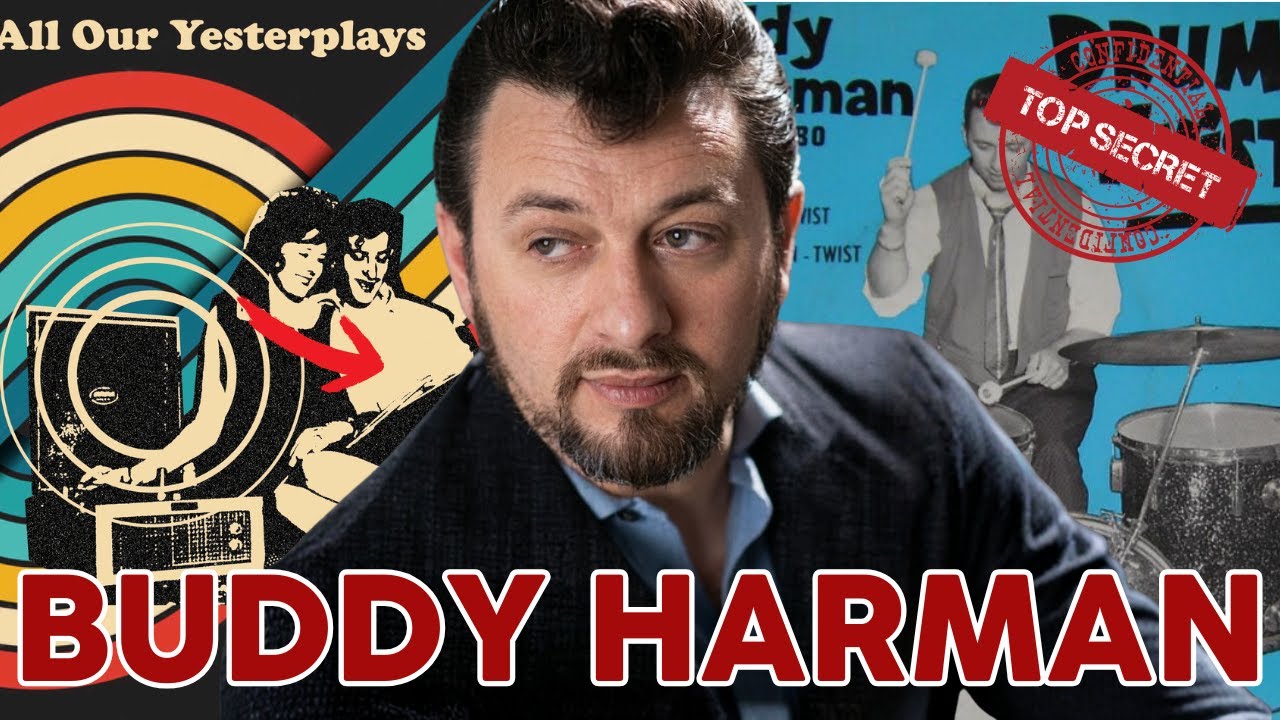
Its guardians believed country music should remain pure, with rhythm supplied by upright bass and guitar. Drummers were associated with jazz, swing, and blues—a sound the conservative Nashville establishment rejected. Born in Nashville in 1928 and raised in Alabama, Harmon was a clean-cut, soft-spoken young man who looked more like an accountant than a musical revolutionary. Yet he came from a musical family: his mother had played drums in a silent-movie orchestra, and his father was a musician.
Growing up, he was far more influenced by jazz drummers like Gene Krupa and Buddy Rich than by the country stars of his hometown. He was, in his own way, a jazz drummer living in a country town. When he arrived in Nashville in the early 1950s, the industry was still a small cottage operation. Sessions were recorded in converted garages and studio lobbies, with loose groups of musicians playing by feel.
Harmon, by contrast, was a precise technician. Early producers treated him as a necessary evil, hiding his drums behind baffles and curtains, stripping away his bass drum and cymbals. Rather than fight the system, he adapted. He learned to use brushes instead of sticks, producing a soft, subtle pulse.
He mastered the rimshot, creating a sharp crack that cut through a mix without overpowering the fiddle. The breakthrough came in the mid-1950s, when a new generation of listeners demanded smoother, more emotionally resonant songs. Harmon became part of the famed “A-Team,” a core group of Nashville session musicians that included guitarist Hank Garland, bassist Bob Moore, and pianist Floyd Cramer. They communicated almost telepathically using the Nashville number system, learning songs in minutes.
Harmon, in turn, helped develop the “country shuffle,” a rhythm that gave country music forward momentum. By playing just a millisecond behind the beat, he created a relaxed, confident swagger that made listeners want to tap their feet. The producers who once hid his drums began asking for more of him. By the late 1950s, the drums’ place in country music was no longer a question.
The Opry slowly accepted a full kit on the Ryman Auditorium stage, and Harmon became its first regular staff drummer. It was a quiet victory, without speeches or ceremony—but it permanently changed the sound of country music. As the 1960s arrived, Nashville grew into a global hit-making industry, with Harmon as its essential drummer. He recorded four sessions a day, seven days a week, for a flat fee of around $41.
25 per session. He backed the Everly Brothers, Roy Orbison, and later Elvis Presley. In 1961, he helped create Patsy Cline’s “Crazy,” a masterpiece of restraint in which his soft brushwork feels like a slowing heartbeat. A few years later, for Roy Orbison’s “Oh, Pretty Woman,” he delivered a loud, aggressive drum fill that announced rock and roll.
He could be both the velvet and the hammer. Harmon treated his kit as a melodic instrument, tuning his tom-toms to the key of a song and dampening his snare with his wallet to create a dry, fat sound. His versatility made him indispensable to Elvis Presley, who returned from the army in 1960 and needed a drummer who could follow his every shift in mood and tempo. Harmon learned to read Elvis’s body language, knowing when to speed up or drop out.
He captured the magic of countless all-night sessions, then went home, slept a few hours, and woke up to record a candy-bar jingle. He gave the same professional attention to a commercial as to the King of Rock and Roll. The economics of the music business, however, were brutally one-sided. Elvis bought Cadillacs; Harmon drove a sensible sedan.
Harmon was paid union scale, about $50 to $60 per session in the mid-1960s, whether a record sold ten million copies or ten. Session drummers received no royalties. Harmon helped build a billion-dollar industry while remaining a middle-class working man. He never publicly complained, often saying simply that he just liked to play.
In 1966, Bob Dylan came to Nashville to record Blonde on Blonde, and the city’s establishment was nervous. Dylan was unpredictable, changing tempos and lyrics mid-take. Harmon adapted, listening to Dylan’s foot tapping under the piano and creating rolling, oceanic drumming that carried his long, rambling epics. He proved that the Nashville session players were not merely country robots but versatile artists.
His indispensability became a form of confinement. Producers would not let him take vacations; when he was double-booked, one famous country star walked out of a session rather than work with another drummer. Harmon could not have an off day. He had to be perfect, every time.
The 1970s brought new challenges. Rock grew heavier, and drum machines began to appear. But Harmon survived, adapting to the “outlaw country” movement that rejected the polished Nashville sound he had helped invent. His deepest relationship of the era was with Johnny Cash, for whom he played the chugging, steam-train beat on songs like “Ring of Fire.
” It was a simple, primitive rhythm—and Harmon played it with total restraint, supporting Cash’s dark storytelling without stepping on it. His decades of physical labor took a heavy toll. By his 40s, Harmon suffered from chronic back pain and significant hearing loss, a cruel irony for a man whose livelihood depended on his ears. He arrived for sessions, took aspirin, and grimaced as he sat down—then smiled the moment the red recording light came on.
In the mid-1970s, Harmon briefly stepped out of the shadows as part of the instrumental supergroup Area Code 615. Their song “Stone Fox Chase” became the theme for the BBC show The Old Grey Whistle Test. For a short time, he was a star. But the public was not interested in instrumental albums from middle-aged session musicians, and the group disbanded.
He returned to the studio and to anonymity. By the late 1970s, the outlaw movement had dismantled the old studio system. Callers no longer demanded Harmon as often, and for the first time in decades, he found himself with days off. He was not bitter, but there was a melancholy.
The singers he had backed, Dolly Parton and Kenny Rogers among them, became global icons, while he still drove the same car and waited for his union pension. The 1980s proved he still had something left. As drum machines and synthesizers flooded the charts, a group of young neo-traditionalist artists—Ricky Skaggs, George Strait, and Randy Travis—decided to return to authentic country roots. They wanted a real drummer, and they hired Harmon.
In his 50s and 60s, he found a second wind, mentoring younger musicians and teaching them the lost secrets of the country shuffle. “Don’t hit it so hard,” he would say. “Let the stick do the work. You don’t have to kill the drum.
You just have to wake it up. ”
In the 1990s, Harmon formally retired from full-time session work due to his physical condition. He became the house drummer at the Grand Ole Opry, the one place where tradition still mattered more than trends. Guest artists, nervous or aging, would look back to the drum riser and see Harmon smiling at them, and they would relax.
They knew the train would not derail. Despite his unmatched output, Harmon never became wealthy. He lived a modest life, without the royalties that sustained singers and songwriters. In 2007, he was inducted into the Musicians Hall of Fame and Museum—but even then, he was honored in the “sideman” category, a reminder that a velvet rope still separated him from the stars.
Buddy Harmon died on August 21, 2008, of congestive heart failure at the age of 79. The news rippled through Nashville, and the pews at his funeral were filled with country royalty. Older men in cowboy hats wiped away tears, telling stories of his kindness, professionalism, and unshakable rhythm. With his death, an era truly ended.
The secrets of the Quonset Hut—how to tune a snare drum, how to play the perfect rimshot—went with him. The numbers remain staggering. Harmon played on more hit records than the Beatles, the Rolling Stones, and Elvis Presley combined. Turn on a radio in America between 1955 and 1980, and you were likely hearing him.
Yet he remains unknown, a ghost behind the stars he supported. There is no statue of Buddy Harmon on Broadway in Nashville. No bar bears his name. But walk past a honky-tonk and hear “Ring of Fire”—that beat is his.
Listen to “Oh, Pretty Woman”—that opening drum roll is his. Hear “Crazy”—that gentle brushwork is his. He is the concrete in the foundation of a building, unseen, unphotographed, but essential. His legacy is not fame.
It is permanence. While the singers were placed on pedestals, Harmon suppressed his own ego to serve the song. In an age of self-promotion, he offered a different lesson: there is dignity in the work itself.
The star may be the one in the spotlight, but the most important person in the room is often the one who says nothing at all and simply keeps the time.