The year was 1892. In the quiet coastal town of Ipswich, Massachusetts, the Whitmore estate stood as a testament to old New England prosperity. The three-story federal-style mansion, built in 1803 by shipping magnate Elias Whitmore, had been in the family for three generations. By 1892, the family's shipping empire had waned, but their social standing remained undiminished.
What began as a series of peculiar incidents would evolve into one of the most disturbing cases in Essex County's history. The records, yellowed with age and stained with what appeared to be water damage, had been sealed in a metal box and filed away under "unresolved matters 1890–1900." They remained forgotten until 1965, when a history student at Salem State College discovered them.
On March 17th, 1892, the Essex County Register reported that Thaddius Whitmore, patriarch of the Whitmore family, had reported his wife Eleanor missing. The authorities noted that Eleanor Whitmore, aged 42, had last been seen three days prior, departing for a visit to her sister in neighboring Rowley. She never arrived.
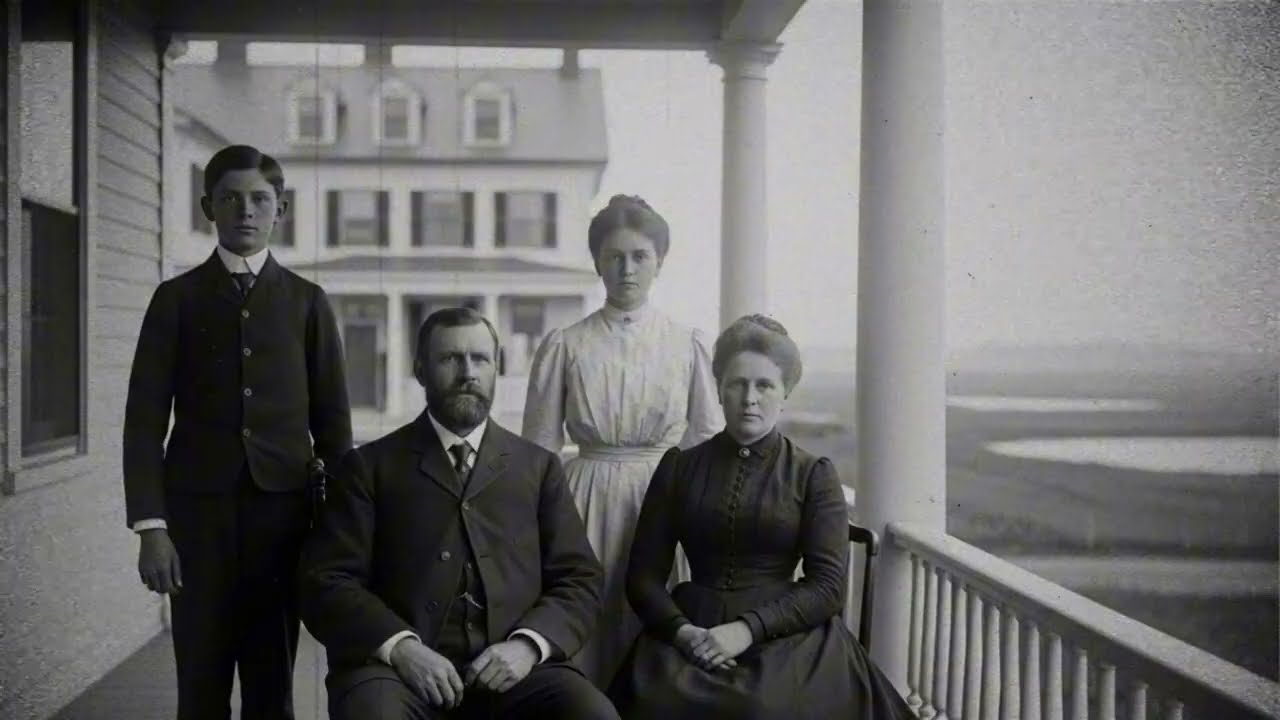
Thaddius Whitmore, a stern-faced man of 49 with a neatly trimmed beard graying at the temples, was well regarded in Ipswich society. His household consisted of his wife Eleanor, their daughter Charlotte, aged 20, and their son William, 17. The family employed three servants: Mrs. Agatha Collins, the housekeeper; Martin Reynolds, the groundskeeper; and Sarah Jenkins, who served as both kitchen help and Charlotte's lady's maid.
The Whitmores appeared to all external observers to be a model of New England propriety. But behind the polished facade, something had begun to crack long before Eleanor's disappearance. The winter of 1891–1892 had been particularly harsh, isolating the town for weeks. The Whitmore estate, situated at the end of a long private drive, would have been even more secluded.
Dr. James Harrison had been called to the Whitmore home six times between November 1891 and February 1892. The visits were ostensibly for Eleanor, who was described as suffering from nervous exhaustion. In a later deposition, Dr. Harrison elaborated: "Mrs. Whitmore displayed none of the physical symptoms typically associated with hysteria. Rather, she presented as a woman under considerable mental strain."
Mrs. Collins, the housekeeper, would later provide testimony that painted a more complex picture. She described how Eleanor had become increasingly withdrawn after the new year. "She would start at small noises," Mrs. Collins recounted. "More than once, I found her standing at the window of her bedroom, staring out at the grounds as if expecting someone."
On the morning of March 14th, 1892, Eleanor Whitmore reportedly announced at breakfast that she would be visiting her sister in Rowley. According to Thaddius's statement, he had offered to have Martin drive her, but she had declined, preferring to take the 11:30 train from Ipswich station. Sarah Jenkins's account of that morning adds a telling detail: as she helped Mrs. Whitmore with her hat, Eleanor pressed a small envelope into her hand and whispered, "Give this to Charlotte if I am not back in 3 days."
Three days later, when Eleanor had not returned or sent word, Thaddius contacted the authorities. A telegram was sent to Katherine Perkins in Rowley. Her response transformed a minor domestic irregularity into something far more troubling: Eleanor had never arrived.
The first investigative steps were routine. Sheriff Thomas Caldwell dispatched deputies to check the train station. The station master confirmed that he had sold Mrs. Whitmore a ticket on the morning of the 14th, but could not recall with certainty whether she had boarded the train.
On March 29th, exactly two weeks after Eleanor's disappearance, Charlotte Whitmore found a letter in her mother's sewing basket. The letter, dated March 13th, read in part: "My dearest Charlotte, should anything happen to me, know that I have not abandoned you willingly. For some time now, I have felt a darkness growing within these walls. Your father is not the man you believe him to be. I have discovered things, terrible things, that I cannot commit to paper. Trust no one in this house save yourself. Look to the accounts. The truth lies in the numbers."
Charlotte brought this letter directly to Sheriff Caldwell rather than showing it to her father. In her statement, Charlotte explained that in recent months, her mother had grown watchful, almost furtive. "More than once I found her in his study when he was away, examining his papers."
The sheriff's subsequent interview with Thaddius revealed his claim that Eleanor had been experiencing paranoid delusions. He suggested that the letter was further proof that she had not been well. Sheriff Caldwell, however, found the timing suspicious.
On April 3rd, Deputy Frank Morris discovered a torn piece of dark blue fabric caught on a bramble near the path leading from the Whitmore house to the marsh. The fabric matched the description of Eleanor's traveling dress. Most telling was the presence of a pearl button still attached to the fabric, which Charlotte identified as identical to those on her mother's garment.
The investigation intensified. Martin Reynolds, questioned about the family carriage, noted that on the morning of March 15th, he had found the vehicle unusually dirty with marsh mud caked on the wheels. When he mentioned this to Thaddius, the master of the house had explained that he had taken a brief drive the previous evening to clear his head.
Suspicions continued to mount when Sheriff Caldwell requested access to the Whitmore family's financial records. The ledgers revealed troubling discrepancies. The family's shipping investments had been performing far worse than publicly known. Several properties had been mortgaged and significant sums had been withdrawn from accounts over the previous six months.
Most damning was the recent change to Thaddius's will, executed in February, which removed Eleanor as beneficiary. Furthermore, Eleanor's personal inheritance had been transferred to accounts accessible only by Thaddius. This transaction dated from January 1892 and bore Eleanor's signature, though her sister would later testify that Eleanor would have been unlikely to relinquish control of her inheritance.
The case took another turn on April 7th when Martin Reynolds approached Sheriff Caldwell privately. Reynolds reported that on the night of March 14th, he had been awakened around midnight by the sound of Thaddius's carriage. The master was driving with purpose, and the carriage was laden with something heavy. When the carriage returned nearly two hours later, whatever burden it had carried was gone.
On April 8th, as the tide was particularly low, the search party was able to examine sections of the marshy coastline normally submerged. In a tidal pool approximately 50 yards from the old dock, they discovered a woman's boot matching the style Eleanor was known to favor. The location was significant: this area of marsh is accessible only by the private road from the Whitmore estate or by boat.
The discovery was enough for Sheriff Caldwell to bring Thaddius Whitmore in for formal questioning. The interrogation lasted seven hours. Thaddius suggested that Eleanor might have gone to the dock herself, perhaps to take her own life due to her deteriorating mental state.
On April 25th, 1892, Thaddius Whitmore was arrested on suspicion of murdering his wife. The arrest caused a sensation in Ipswich and throughout Essex County. The Boston Globe ran a front-page story on April 26th with the headline, "Prominent Ipswich businessman arrested in wife's disappearance."
The trial began on August 15th, 1892, and became one of the most sensational legal proceedings in Essex County history. The courtroom in Salem was filled to capacity each day with reporters from as far as Boston and New York in attendance.
The prosecution, led by District Attorney Robert Gaskell, presented a compelling narrative. Thaddius, facing exposure of his financial crimes, had killed Eleanor to silence her, transported her body to the marsh in his carriage, and waited it down in the tidal waters.
The defense argued that the evidence remained circumstantial. The remains, while likely Eleanor's, showed signs of decomposition consistent with someone who had drowned, possibly by suicide. The defense suggested that Eleanor, upon discovering her husband's deceptions, had taken her own life.

Charlotte's testimony proved pivotal. When asked if she believed her father capable of murder, she paused for a long moment before responding, "I no longer know the man who raised me." She described her mother's increasing fear in the weeks before her disappearance and her father's controlling behavior afterward.
William's testimony was equally damaging. He revealed that on the morning after his mother's disappearance, he had noticed his father's boots caked with marsh mud. When he mentioned them, Thaddius claimed to have briefly walked the property the previous evening. Three days later, when William sought those same boots to examine them more closely, they were nowhere to be found.
The most dramatic moment of the trial came when Harrison Wells, the Boston businessman whose threatening letter had been discovered, testified for the prosecution. Wells described how Thaddius had approached him two years earlier with an investment opportunity that promised exceptional returns. Over time, Wells had invested nearly $12,000 in Whitmore's schemes.
The prosecution's final witness was Katherine Perkins, Eleanor's sister. She testified about her sister's state of mind in the weeks before her disappearance. Eleanor's letters had grown increasingly troubled. In February, she wrote asking if she and her children might visit for an extended period, something she had never suggested before.
On September 3rd, 1892, after three days of deliberation, the jury returned a verdict of guilty. Thaddius Whitmore was sentenced to life imprisonment at the Massachusetts State Prison in Charlestown. As the verdict was read, he stood motionless, his face betraying no emotion.
The aftermath was as tragic as the crime itself. The Whitmore name, once respected throughout Essex County, became synonymous with betrayal and murder. Charlotte, unable to bear the whispers and stares, sold the family estate at a fraction of its value and moved to Europe. She never returned to America.
William abandoned his plans to attend Harvard and instead enlisted in the army. Records indicate he died of yellow fever in Cuba in 1898, leaving no descendants. Among his possessions at the time of death was a small gold key on a chain, purpose unknown.
The Whitmore mansion passed through several owners in the decades that followed, none staying longer than a few years. It gained a reputation as an unhappy place. The house was eventually demolished in 1927 to make way for a new coastal road.
Thaddius Whitmore died in prison in 1906, maintaining his innocence until the end. In his final letter to the prison chaplain, he wrote, "I have been punished not for what I did to Eleanor, but for what I failed to be for her. That is justice of a kind, I suppose."
The case might have remained simply another tragic footnote in Essex County's history had it not been for the discovery made by Sarah Jenkins in 1904. Jenkins, who had left the Whitmore household immediately after the trial, came forward with a startling revelation.
In a sworn statement to the Essex County Prosecutor's Office, she claimed that Charlotte Whitmore had confided in her shortly before leaving for Europe. According to Jenkins, Charlotte had admitted to finding her mother's complete diary, not just the excerpts presented at trial. The full diary reportedly contained entries suggesting that Eleanor had been planning to leave Thaddius for some time and had been secretly corresponding with a former suitor from her youth.
Jenkins's statement read in part: "Miss Charlotte showed me entries from her mother's diary that were not presented in court. These entries spoke of Mrs. Whitmore's enduring affection for Mr. James Thornfield, whom she had known before her marriage to Mr. Whitmore."

A partial diary entry dated March 14th read: "I leave today with mixed emotions. T suspects something I fear. Last night he questioned me about the missing documents from his study. Documents that would prove his guilt. I told him nothing, but his eyes. I have never seen such coldness there before. If I can reach the station without incident, all will be well."
The final piece of the puzzle emerged in 1968 when renovations to an old bank building in downtown Ipswich revealed a safety deposit box that had remained unopened since 1892. The bank's records showed it had been rented to Eleanor Whitmore in January of that year.
Inside was a journal chronicling Thaddius's financial misdeeds in meticulous detail, along with original documents proving his fraud. Also in the box was a letter addressed to the Essex County District Attorney, never sent, in which Eleanor outlined her fears that her husband might harm her if he discovered her knowledge of his crimes.
The most revealing item was a small leather-bound notebook containing what appeared to be coded entries. When deciphered, the notebook proved to be Eleanor's record of her own financial preparations for escape. It detailed funds secretly withdrawn from her personal accounts and assets transferred to a Montreal bank.
A note tucked into the notebook, written in what appears to be Eleanor's hand, read: "He knows. Confronted me tonight about the missing papers. Threatened. Must leave immediately. Changed plan. Marsh path to avoid the house. Signal arranged with Martin to bring carriage to dock at midnight. Pray I reach sea safely."
This note suggested a critical alteration to Eleanor's escape plan. Rather than departing openly for the train station, she may have planned to slip away at night via the marsh path to the old dock. Did Thaddius discover this plan? Did he confront her on the marsh path? Or did Eleanor, attempting to navigate the treacherous marsh at night, simply meet with a tragic accident?
A final tantalizing clue appeared in 1972 when a retired Ipswich fisherman named Thomas Marsh came forward with a story passed down from his father. According to the younger Marsh, his father had found more than just partial remains and a locket that day in 1892. He had also discovered a small leather satchel buried in the silt nearby containing papers in a woman's purse.
Among the papers were letters that suggested Eleanor had been meeting secretly with James Thornfield and planning to leave her husband. Most significantly, there was a train ticket and a substantial amount of cash, funds that would have facilitated her escape.
Why had Henry Marsh kept this evidence secret? According to his son, the elder Marsh had been deeply religious and disapproved of a wife abandoning her husband regardless of the circumstances. He had also been financially indebted to Thaddius Whitmore for a loan that had saved his fishing boat years earlier.
Today, the site where the Whitmore mansion once stood is marked only by a weathered stone wall and the gnarled remains of what was once a formal garden. The marsh road has long since been reclaimed by nature. Yet the story of the Whitmores, of appearances maintained at terrible cost, of secrets festering behind closed doors, continues to resonate.
The most harrowing aspect of the Whitmore case is not what it reveals about that particular family, but what it suggests about the potential darkness lurking within any household, behind any respectable facade. The terror lies not in the supernatural, but in the all too human capacity for deception, betrayal, and the desperate measures taken when carefully constructed lives begin to unravel.
In the cold waters where the Ipswich River meets the Atlantic, secrets still swirl in the currents, never entirely revealed, never entirely forgotten. And sometimes on particularly still nights, locals say the marsh path seems to hold the faintest impression of footsteps. A solitary figure making her way toward the freedom she would never reach.