In 1970, Royal Crown Cola held roughly 10% of the American soft drink market, making it the fourth-largest cola company in the United States. In blind taste tests staged across the country, consumers repeatedly picked RC Cola over both Coca-Cola and Pepsi. Then the brand virtually disappeared from national prominence, reduced to a legacy product searched for in gas station coolers. The story begins in Columbus, Georgia, in 1901.
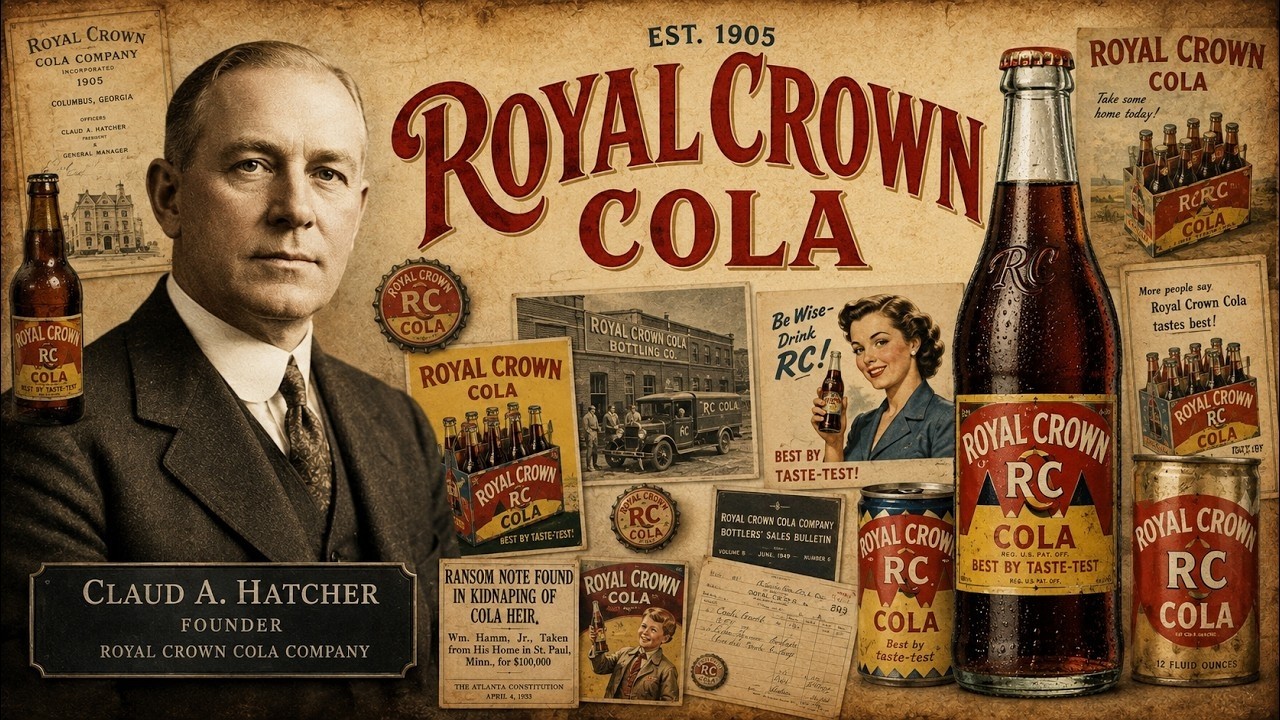
Claude Adkins Hatcher, a trained pharmacist from a merchant family, ran a wholesale grocery business with his father. One of his suppliers was Coca-Cola, whose local representative refused to negotiate on wholesale prices. Hatcher pulled Coca-Cola from his shelves and set out to create his own alternative. In 1905, working in a basement beneath the family grocery store, Hatcher produced a sharp ginger ale he named Royal Crown Ginger Ale.
That same year, he and his father founded Union Bottling Works. By 1907, Hatcher had developed a cherry-inflected cola called Chero-Cola, which quickly became the company’s best-selling product. In 1912, the operation was reorganized as the Chero-Cola Company. Rather than building factories himself, Hatcher sold syrup and franchise rights to local businessmen with existing trucks, ice houses, and delivery routes.
By 1920, the company supplied 700 franchise bottling plants across the country. When sugar prices spiked in the early 1920s, Hatcher bought sugar-refining equipment and brought the process in-house, protecting his network from the crisis. But consumer interest in Chero-Cola began to fade, so in 1924 Hatcher introduced Nehi, a line of fruit-flavored sodas, using the same franchise infrastructure. The bet paid off, and in 1928 the company changed its name to the Nehi Corporation.
Claude Hatcher died on December 31, 1933, at age 57. Vice President H. R. Mott took over, inheriting a company with real debt and a cola formula losing ground.
Mott ordered a full reformulation of the old Chero-Cola recipe, assigning the work to chemist Rufus Cam. After six months, the new cola was named Royal Crown, reaching back to Hatcher’s very first product. The relaunch in 1934 was an immediate success. During the Great Depression, RC Cola became part of a working-class ritual.
A nickel bought a Moon Pie from Chattanooga Bakery and a nickel bought a bottle of RC. Together, ten cents provided lunch for mill workers, sawmill hands, and filling station customers. The pairing became so culturally embedded that country singer Big Bill Lister recorded “Give Me an RC Cola and a Moon Pie” in the 1950s. The company also built a national identity through the “Best by Taste Test” campaign, one of the industry’s first large-scale blind taste tests.
RC was pitted against Coca-Cola and Pepsi, unlabeled, and won often enough that the company built its advertising around the claim “You bet RC tastes best. ”
Two national crises shaped the company’s path. When Georgia banned alcohol in 1907, becoming the first Southern state to go dry, soft drinks filled the space left behind. National prohibition in 1920 repeated the pattern across the country, and Chero-Cola’s existing distribution network gave it a decisive advantage.
During World War II, federal sugar rationing imposed hard production ceilings on every bottler, but Royal Crown’s in-house sugar-refining capacity, built decades earlier, helped it weather the shortage. By the mid-1950s, Royal Crown was setting the industry’s pace. In 1954, it became the first company to sell cola in cans. It introduced a larger 16-ounce bottle at a price that made the value arithmetic impossible to ignore.
Then in 1958, it launched Diet Rite, the first diet cola sold nationally in the United States, marketed on the sweetener cyclamate, which tasted far closer to sugar than available alternatives. In 1969, the FDA banned cyclamate outright after studies linked it to tumors and birth defects in laboratory animals at extreme doses. Diet Rite’s formula was suddenly illegal. Royal Crown scrambled to reformulate, but the ban arrived just as Coca-Cola and Pepsi were preparing to enter the diet category themselves.
The multi-year head start that had carried the company to its 10% peak vanished in a single federal decision. The 1970s brought steady decline. During the 1980s, as Coca-Cola and Pepsi escalated the Cola Wars with massive advertising campaigns, Royal Crown largely stopped advertising at national scale. Bottlers began declining to renew RC contracts, consolidating around brands investing in shelf presence.
The 700-plant distribution network that had built the company began to erode, one franchise at a time. Into this weakened company stepped Victor Posner, a corporate financier known for buying companies with heavily leveraged debt and extracting value from their assets. Posner acquired Royal Crown in the 1980s and moved its headquarters from Atlanta to Miami, removing the brand from the region that had defined it for 80 years. Under his control, marketing budgets were stripped year after year to feed the debt structure of his acquisitions.
By the early 1990s, Posner’s empire was under federal investigation. Shareholders of his holding company DWG Corporation sued, alleging that Posner and his son had drained the business for personal enrichment. In December 1993, a federal judge in New York barred both men from ever running a public company again, writing that Posner had shown open contempt for shareholders’ interests. The Miami plant shut down that same year.
Ownership passed to Triarc Companies, then in October 2000 to Cadbury Schweppes, which already owned Dr Pepper. Royal Crown, founded to spite a Coca-Cola salesman in a Georgia grocery store, now shared a corporate structure with one of its longtime rivals. In 2001, Cadbury split the brand: US operations stayed under Cadbury’s American arm, while international rights were sold to Cott Beverages of Canada. In 2008, Cadbury spun off its American beverage division into Dr Pepper Snapple Group, which took Royal Crown’s US business with it.
In 2018, that company merged with Keurig Green Mountain to form Keurig Dr Pepper, the current holder of Royal Crown’s US rights. Internationally, the brand passed from Cott to Refresco in 2021, then to RC Global Beverages, then in 2023 to Macai Holdings, based in the Philippines. Royal Crown Cola did not go out of business. It was folded into a portfolio large enough that it is no longer anyone’s flagship product, kept alive largely by loyalty and nostalgia.
Today it is a regional legacy brand, present in some stores and absent in others, while its international rights sit with a holding company thousands of miles from Columbus, Georgia. The corporate transfers could never erase the brand’s cultural roots. Every June, the small town of Bell Buckle, Tennessee, population about 500, holds the RC Cola Moon Pie Festival. It began in 1994, the year Moon Pie turned 75, and still runs with a parade, races, and the ceremonial cutting of the world’s largest Moon Pie.
In Columbus, Georgia, the Hatcher Family Cola Museum preserves the basement laboratory, the dispute with the Coca-Cola salesman, and the artifacts of a company that once believed it could out-taste and out-distribute anyone. Royal Crown won public taste tests against Coca-Cola. It was first to the can, first to the diet cola category, and first with a large-scale blind taste test campaign. What it never had was Coca-Cola’s capital, Pepsi’s advertising budget during the cola wars, or an ownership structure that cared about the brand’s origins.
The company lost not to a better product, but to a bigger balance sheet, a wider distribution net, and sale after sale that moved the brand further from the town that built it.