On April 12, 1945, General George S. Patton arrived at the Ohrdruf concentration camp in Germany. He was accompanied by Generals Dwight D. Eisenhower and Omar Bradley. The camp, a subcamp of Buchenwald, had been liberated eight days earlier by the 4th Armored Division.
Ohrdruf Nord was established in November 1944. Prisoners, including Jewish men, Soviet POWs, and political detainees, were forced to build an underground telephone exchange for the German High Command. By January 1945, the camp held approximately 11,700 prisoners. By April 4, as American forces closed in, the SS garrison ordered a death march. Those too weak to walk were shot. The bodies were left stacked in courtyards, barracks, and on the roads.
When the 4th Armored Division entered the camp, they found approximately 3,200 corpses. Eisenhower made the decision to visit personally. He understood the visit was not just tactical but evidentiary. He walked through the camp for two hours. Bradley later called it the most shattering experience of his military career. Patton became physically ill outside an execution shed and vomited in full view of his staff. He did not leave.
Patton examined the gallows, the cremation pits, and the starvation barracks. He counted and documented everything. He demanded his staff do the same. The SS guards who had run the camp had not fled in shame. Local civilians in the town of Ohrdruf claimed they knew nothing. Farmers whose fields bordered the camp claimed ignorance. The mayor denied knowledge when confronted with photographic evidence. That evening, he and his wife went home and hanged themselves.
Patton recognized the lie. The smell of the camp was detectable for miles. The sound of gunfire had been audible in the town for months. The civilians had organized their lives around pretending the murder did not exist. Patton decided to destroy that pretense.
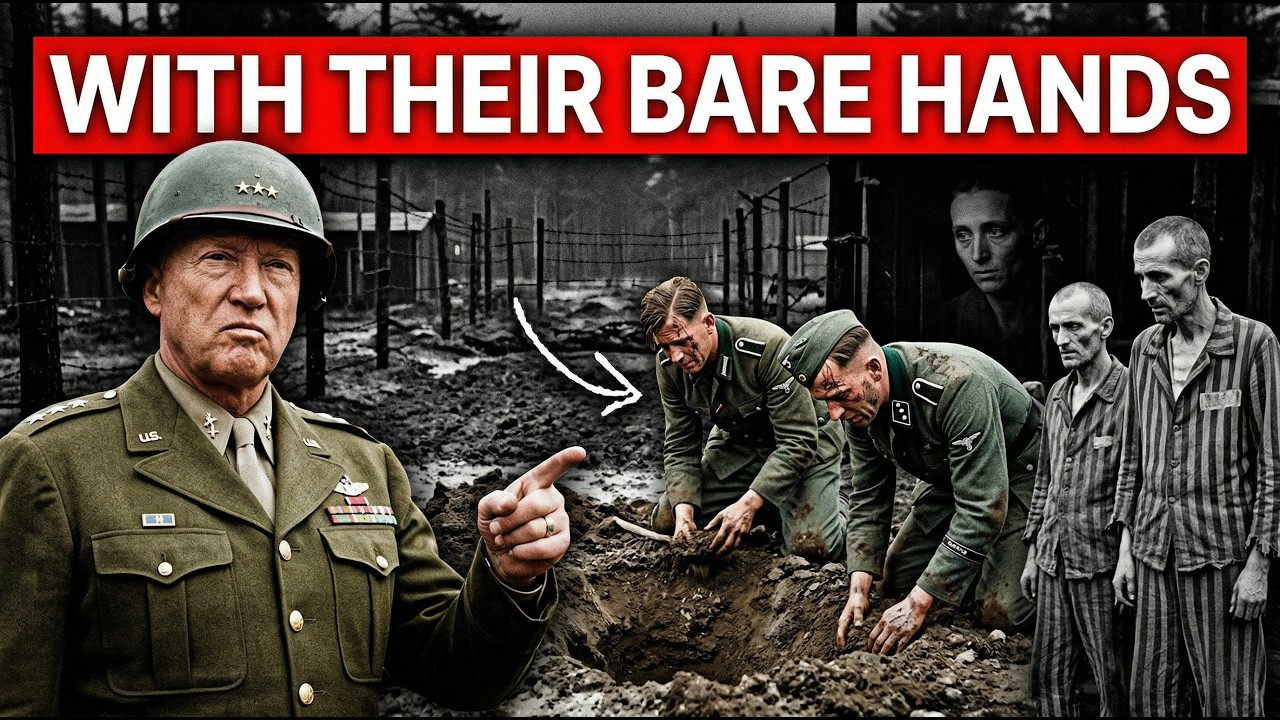
He ordered the German civilian population of Ohrdruf to enter the camp. Every man, woman, and able-bodied person was required to walk through every building, courtyard, and execution site. They were forced to look at every body. He then ordered the captured SS guards to bury the dead. They were not given machinery. They dug with their hands.
The SS guards had laughed at the prisoners they starved. Survivors described guards conducting arbitrary beatings for entertainment. They selected prisoners at random during roll calls and beat them to death in front of the assembled ranks. The cruelty was not random. Camp documentation showed the SS had maintained prisoner morale assessments and increased public executions when prisoner solidarity appeared to strengthen. The terror was managed and optimized.
One captured SS officer told American interrogators that guards competed informally for the highest individual kill count during the death march. He described it without visible emotion, like a factory worker describing a production quota. The report reached Patton’s desk on April 14. His aide recorded Patton’s response. He said, “These are not soldiers. These are not even criminals in any category I understand. Find me every one of them.”
From April 15 through April 18, every captured SS guard from Ohrdruf was assigned to burial details. The work was conducted under armed guard but with minimal physical coercion. The guards were not beaten. They were required to do the work until it was finished. The civilian population was marched through the camp on April 15, 16, and 17. Children above the age of 12 were included. Patton made that decision personally.
The reactions among the civilians varied. Some wept. Some vomited. Some walked through in apparent numbness. A smaller number displayed contempt, not for the dead, but for the Americans forcing them to look. That group disturbed Patton most. He wrote that he could not process men and women who looked at evidence of industrialized mass murder and found in it a reason for resentment toward the witnesses rather than the perpetrators.
On April 18, the burial of Ohrdruf’s dead was completed. Army chaplains conducted a brief ceremony. The SS guards were transferred to prisoner of war processing. Eisenhower had already replicated the approach at Buchenwald and Dachau. At Buchenwald, the mayor of Weimar and his wife also took their own lives after the mandatory tour.
Eisenhower had ordered that everything be documented. He transmitted his exact words to Washington and London on April 12. He wrote, “I made the visit deliberately in order to be in a position to give first-hand evidence of these things if ever in the future there develops a tendency to charge these allegations merely to propaganda.” He was thinking about the future. He was right to fear it.
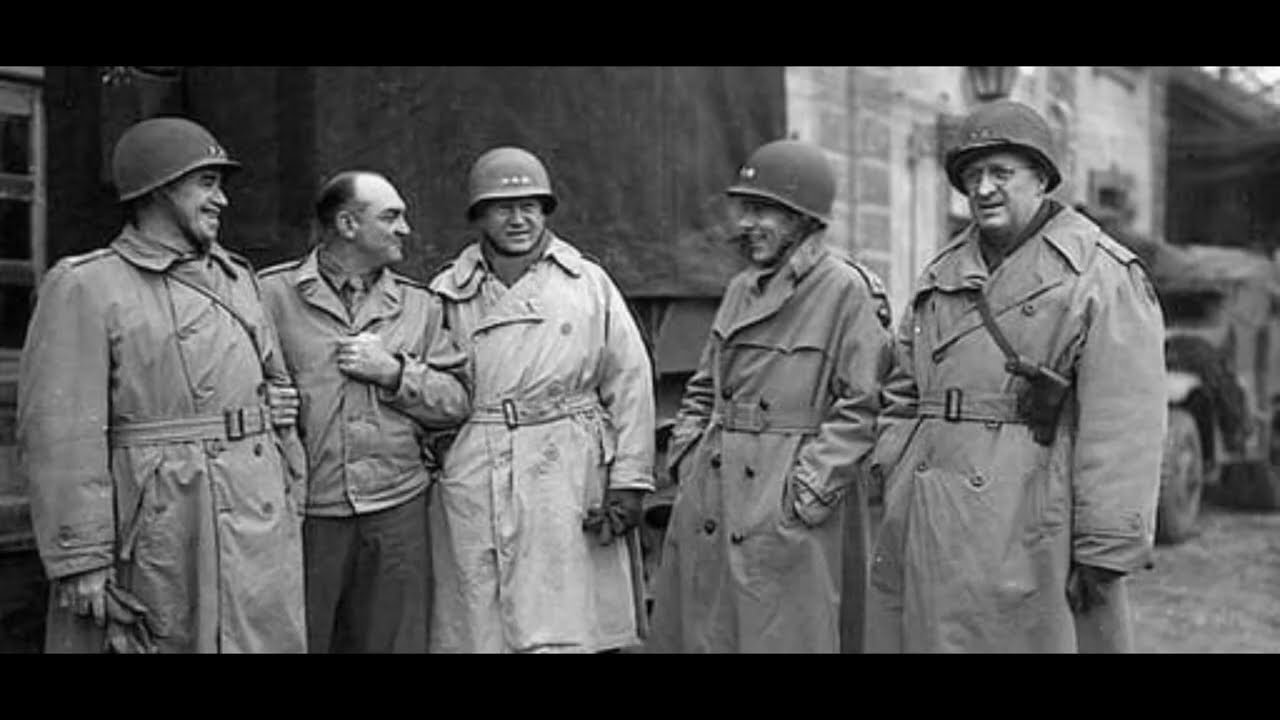
The documentation effort produced approximately 80,000 photographs taken by Army Signal Corps personnel. Combined with the testimony of 1,200 American military witnesses, this formed the primary evidentiary base for the Nuremberg war crimes proceedings. The German defense argued that senior officials had no direct knowledge of the camps. That argument collapsed under the weight of the documentation Eisenhower had collected.
The burial operation also produced an unexpected result. One SS guard began talking to his American guard in functional English. He had lived in Cincinnati, Ohio, between 1928 and 1936 before returning to Germany and joining the SS in 1941. He provided American intelligence officers with a detailed organizational map of the camp command structure, the names of 11 guards who had fled, and the locations of three documentation caches. Those caches contained prisoner registration records for 11,700 individuals. Those records became part of the International Tracing Service archive, which today holds documentation on 17.5 million victims and survivors of Nazi persecution.
Patton died on December 21, 1945, in a Heidelberg hospital. He never saw Nuremberg conclude. He never saw the documentation he helped preserve turned into verdicts. He had written in his diary on April 15, 1945, “I have seen many things in this war that I will not be able to forget. This I will not try to forget. I think it is important that I remember exactly what I saw because I believe the time will come when someone will need me to say, ‘I was there, and this is what it was.’”
He was right. That time came. His eyewitness account was entered into the Nuremberg record. Eisenhower’s formal testimony was read into congressional proceedings. The most powerful weapon against atrocity is not the force used to stop it, but the documentation that makes it impossible to deny. Patton understood that liberation without documentation is temporary. He turned the SS’s own bureaucratic thoroughness against them. Eighty years later, the photographs are still there. The burial records are still there. The testimony is still there. The laughter is not.