On October 20, 1968, Aristotle Onassis left his own wedding reception and flew to Athens. He spent the night with Maria Callas, his mistress of nearly a decade. The bride, Jacqueline Kennedy Onassis, stayed alone in the villa and unpacked her luggage.
It was not an act of impulse. Onassis wanted his new wife to understand the arrangement from the very first night. And she did. This was never a love story. It was a contract, and both parties knew exactly what they were buying.
The wedding took place on the private island of Skorpios, just five years after Jackie Kennedy became the most famous widow in the world. America had viewed her as a symbol of grace and dignity, frozen in mourning after the assassination of President John F. Kennedy. The bloodstained pink suit, the quiet composure at the funeral, the way she held her children’s hands—all of it had made her untouchable.
Then she married a Greek shipping magnate 23 years her senior. The world was shocked. But the world did not know how cold the marriage would become.
The First Meeting
Jackie met Aristotle Onassis in the summer of 1963 aboard his yacht, the Christina. She traveled to the Mediterranean with her sister, Lee Radziwill, who was friends with Onassis. The yacht was 325 feet long, with a swimming pool that converted into a dance floor and bar stools upholstered in whale skin.
Onassis was 57 at the time, short and stocky, with a voice hoarse from heavy smoking. Jackie was 34, still the First Lady, still married to the President. They sailed from Athens to Istanbul, and Onassis watched her closely. He asked about her life, her children, her daily routine. She seemed relaxed for the first time in years, away from the cameras and the pressures of Washington.
He took note of that. He had built his fortune by understanding people, by knowing what they needed before they said it aloud. When Jackie returned to the White House in August, she sent him a polite thank-you note. Nothing more. Three months later, John F. Kennedy was dead.
The Pursuit
In the weeks after the assassination, Jackie withdrew from public life. She left the White House, moved her children to a rented house in Georgetown, and tried to build a quiet existence. Onassis called her. Then he called again. He sent flowers, long letters, and invitations to visit Greece. He did not pressure her, but he never stopped.
In 1964, he traveled to Washington and took her to dinner. In 1965, he invited her back to the Christina. She went, and this time she stayed for weeks. He positioned himself as her protector, offering security, privacy, and more money than she could spend in a lifetime. He told her she could raise her children away from the press, away from those who wanted to exploit her grief.
Jackie listened. She was 36, a widow with two children and an uncertain future. The Kennedy family controlled her money, her image, and her choices. Onassis offered her a way out. But Jackie had her own reasons for letting him in, reasons that had nothing to do with love.
The Contract
In the summer of 1968, lawyers for both sides began drafting what would become one of the most detailed prenuptial agreements ever written. It had 170 clauses. Jackie would receive $3 million upfront, plus a monthly allowance of $30,000 for personal expenses. The contract specified which homes she could use and when. It stipulated separate bedrooms. It even included provisions for her children’s education, their trust funds, and exactly how much she would inherit if Onassis died, calculated by years of marriage.
Jackie’s lawyers negotiated every clause. She wanted financial independence, protection for Caroline and John, and a guarantee that the Kennedy legacy would remain intact. Onassis wanted a famous wife who understood her role. Both got what they asked for.
One clause hinted at the humiliation to come. It addressed Maria Callas. The opera singer had been Onassis’s companion since 1959, traveling with him on the Christina, dining with him in Paris, waiting for him in hotel suites across Europe. She had left her husband for him. By 1968, she believed she would become Mrs. Onassis. He had promised her nothing had changed, visiting her between meetings with Jackie’s lawyers. He did not tell Callas about the engagement until one day before the wedding was announced.
The World Reacts
On October 17, 1968, the Boston Herald Traveler broke the news. By noon, reporters surrounded Jackie’s apartment on Fifth Avenue. By evening, the story had reached Athens, London, and Rome. The woman Americans had mourned five years earlier was marrying a foreign businessman known for his ruthlessness and extravagance.
The Vatican newspaper called it a public scandal. A Gallup poll showed 68 percent of Americans disapproved. Magazines that had once praised Jackie now published editorials questioning her judgment, her motives, and her loyalty to Kennedy’s memory. One headline read simply: "America Lost a Saint."
In Greece, the reaction was worse. Citizens marched through Athens carrying signs calling Jackie a gold digger. They burned an effigy of her in Syntagma Square. Greek women who had admired Onassis as a national success story now viewed him as a fool seduced by American fame. Even his sisters refused to attend the wedding.
The Wedding Night
The ceremony on Skorpios ended just after five in the evening. Rain flooded the small chapel. Fewer than 30 guests watched Jackie Kennedy become Mrs. Aristotle Onassis. But as the last guests left, Onassis made an unusual request. He told Jackie he had urgent business in Athens. Within two hours of exchanging vows, he boarded his private plane and flew to the mainland.
He did not return to Skorpios that night. Instead, he went directly to Maria Callas’s apartment. He stayed until morning. Jackie spent her wedding night alone in the villa. It was not neglect or impulsiveness. Onassis wanted Jackie to understand the agreement from the first night. That night set the foundation for everything that followed, but Jackie had already done her calculations.
Jackie’s Calculations
Jackie married for protection. After Robert Kennedy’s assassination five months earlier, she told friends she feared for her children’s lives. The Kennedy compound felt like a cage, and Rose Kennedy’s control over the family trust limited Jackie’s independence. Onassis offered $3 million upfront, plus $1 million for each child. He guaranteed her an annual income and the freedom to live wherever she chose. She would never need to ask the Kennedy family for permission again.
She knew what kind of marriage she was entering. The 170-clause prenuptial agreement covered everything, from travel allowances to sleeping arrangements. Jackie signed it without argument. Friends later said she described the arrangement as a business partnership, not a love match. She accepted that Onassis would continue seeing Callas. What she did not expect was how public the humiliation would become.
Separate Lives
From the beginning, Jackie and Onassis kept two separate villas on Skorpios. His was near the harbor. Hers overlooked the eastern cliffs. Some weeks, they only met for dinner, if they met at all. Onassis never hid his ongoing relationship with Callas. He called her daily, often while Jackie was in the same house. Photographers captured him leaving Callas’s Paris apartment at dawn, and the photos appeared in European tabloids within days.
Jackie spent more time in New York than in Greece. By the end of 1969, she had returned to Manhattan for seven of the first twelve months of their marriage. She kept her Fifth Avenue apartment, decorated it with her own furniture, and rarely mentioned her husband to friends. Staff on Skorpios later described the marriage as two parallel lives that occasionally intersected.
But Onassis had one expectation Jackie had to meet, regardless of where she lived: she had to be the public wife. He insisted she attend dinner parties in Paris, celebrations in Monte Carlo, and business gatherings with European industrialists and Greek shipping magnates. Jackie would arrive perfectly dressed, speak French with ministers’ wives, and smile for photographers who had been notified in advance. She played the role of devoted wife with such precision that even those who knew the truth found it convincing.
Then, as soon as the cameras stopped, she would book the first flight back to New York or arrange another shopping trip to London. Onassis did not care where she went between appearances. What mattered was the image, the headline in Paris Match or The Times showing Aristotle Onassis with the most famous woman in the world. And every time she performed that role, the price went up.
The Spending
In the first year alone, Jackie spent more than $1.25 million on clothes from Valentino and Givenchy and dozens of small fashion houses across Europe. She bought paintings, redesigned her apartment twice, and ordered jewelry from Van Cleef & Arpels that required special insurance. The press began calling her Jackie O and tracking her purchases in detail.
Onassis told friends he did not mind. Her taste and extravagance reflected well on him, proving his ability to afford her. But by 1970, the bills were piling up: $600,000 in one month, another $400,000 the next. Onassis stopped laughing about it at dinner parties. By the second year of marriage, the spending had become something else: a weapon in their private war, an act of revenge.
Jackie knew exactly what she was doing. Every purchase added to his accounts. Every invoice from an antique dealer on Madison Avenue was a deliberate reminder. He had bought her as a trophy, and she intended to make that trophy expensive. When he spent weekends with Maria Callas, Jackie bought a $125,000 painting. When he ignored her calls for a week, she ordered custom furniture. Friends later said she was keeping a precise record, not of what she spent, but of what he did to deserve the bill.
Onassis understood the message. He complained to his lawyers, his bankers, and anyone who would listen that she was bankrupting him out of spite. He was right. Onassis responded by cutting off her accounts without warning.
The Ultimatum
In the spring of 1970, Onassis issued an ultimatum. If Jackie wanted to stay married, she had to reduce her spending to $20,000 a month and spend at least six months a year in Greece with him. Jackie’s response was immediate. She refused both conditions, packed her bags, and flew back to New York.
For the next six months, she did not set foot on Skorpios. Onassis waited for her to surrender. He had always been the one with power, the one who set terms. But Jackie stayed away, kept spending, and never called to negotiate. By autumn, he was the one who blinked. He restored her accounts to normal and stopped asking when she would come home. But something had changed. Jackie was no longer afraid of losing him.
Christina’s Hatred
Christina Onassis hated Jackie from the moment her father announced the engagement. She cried through the entire wedding and refused to call Jackie anything but "that woman." In Christina’s view, Jackie was a cold opportunist who had replaced her mother, Tina, and was now draining the fortune that should have belonged to her and Alexander.
The two women exchanged perhaps 12 words in 5 years. When Jackie arrived at family gatherings on Skorpios, Christina left. When Onassis tried to mediate a reconciliation, his daughter told him that Jackie had married him for one reason only, and it was not love. She was not wrong about the money. But Christina would later claim Jackie did something far worse than marry her father.
The Death of Alexander
On January 22, 1973, Alexander Onassis took off from Athens in a small amphibious plane on a routine flight. Six minutes later, the aircraft plummeted toward the ground. He was 24 years old. Onassis rushed to the hospital and sat beside his son for 24 hours before Alexander died without regaining consciousness.
It was the only time anyone saw Aristotle Onassis cry. He hired investigators, demanded an autopsy, and accused the mechanics of sabotage. He became convinced the crash was not an accident, that someone had tampered with the controls. He stopped sleeping. He stopped eating. He spent his days chasing phantom conspiracies. Jackie barely attended the funeral. She stayed three days, then returned to New York.
The Accusation
Within weeks of the funeral, Onassis was telling anyone who would listen that Jackie had brought the Kennedy curse to his family. The same dark shadow that had taken John F. Kennedy had now taken Alexander. He described the marriage as the worst decision of his life. Friends watched him collapse, screaming about omens he had ignored and warnings he should have heeded.
He confessed to Maria Callas that he had sacrificed his son’s life for a famous name. His sister Artemis tried to reason with him, but he would not listen. Alexander died on January 23, 1973. By February, Onassis had stopped speaking to Jackie entirely, except in front of photographers.
But the accusation revealed something deeper about what Onassis had always believed about the marriage: superstition. He had grown up in Smyrna, where his grandmother read coffee grounds and his mother wore an evil eye pendant. Even after becoming a billionaire, he refused to light three cigarettes with one match. He kept an ivory amulet given to him by a fortune teller in Buenos Aires in his desk drawer at Olympic Maritime.
After Alexander’s death, superstition consumed him. He consulted four different spiritual mediums between March and September 1973. One in Athens told him Jackie’s presence had negatively affected the energy around his children. Another in Paris said she saw a dark-haired woman standing between him and his destiny. By autumn, he was consulting astrologers weekly. They all reached the same conclusion: the charts indicated conflict, loss, and a marriage made under unfavorable circumstances. One predicted he would not live past 1976 if he stayed with her.
The Divorce Plan
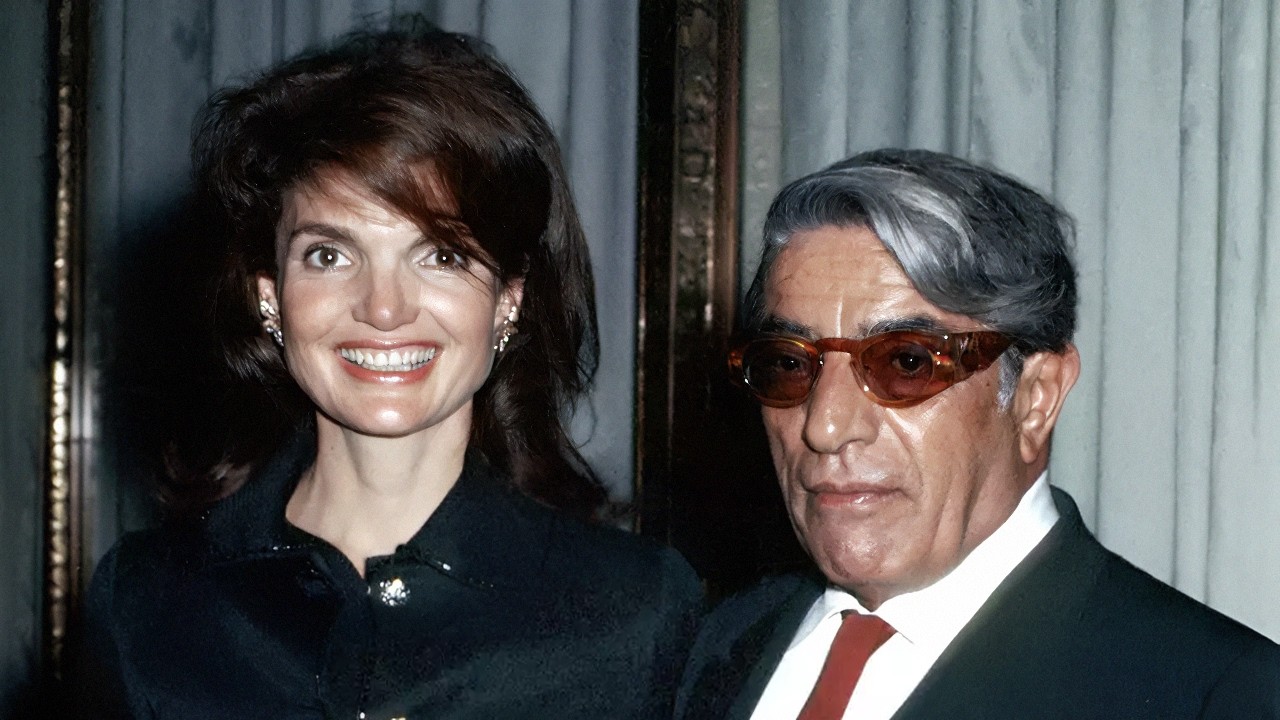
In November 1973, Onassis summoned his lawyer, Stelios Papadimitriou, to Skorpios. He wanted divorce papers drafted within a month. No negotiation, no delay. He would pay Jackie $8 million to leave quietly and never speak about the marriage again. Papadimitriou warned him that Greek law required grounds, evidence of fault. Onassis did not care. He ordered his lawyer to find something. Perhaps abandonment. Jackie was spending 350 days a year in New York. That had to count for something.
By December, the formal papers were nearly complete. Onassis planned to serve them in January 1974, exactly one year after Alexander’s death. He told Christina the nightmare would finally end, that she would get Skorpios back, and that the Kennedy image would be erased from his life. But Jackie’s lawyers had been preparing for this moment, and their countermove stunned Onassis.
Jackie’s Leverage
Jackie’s lawyers had studied Greek family law in secret for months. They informed Onassis that as his legal wife, Jackie was entitled to 25 percent of his entire fortune in the event of divorce. This was not $25 million. It was more than $250 million, possibly more depending on how assets were valued.
Onassis had built his empire to evade taxes, hide assets, and keep governments guessing. Now his wife could force him into financial disclosure. If Jackie insisted on divorce on her terms, all his shell companies, offshore accounts, and hidden oil tanker registrations would be exposed in court. Greek authorities, the US tax service, and his competitors would all have access. The case would expose his entire financial empire, including the parts he had hidden from authorities.
It was a stalemate. Throughout the spring and summer of 1974, lawyers exchanged proposals. Onassis offered settlements Jackie’s team dismissed as far too low. Jackie’s team responded with numbers Onassis called blackmail. He did not pay what she asked. She did not sign what he offered. And so they remained nominally married while living on opposite sides of the Atlantic, barely speaking, each waiting for the other to collapse.
Onassis began telling friends he would outlast her, that she would eventually accept a smaller amount just to be free. Jackie told almost no one what she really thought. She attended parties in New York, visited her children, and gave no interviews. Then Onassis’s health began to decline in a way no one had expected.
The Illness
In October 1974, doctors in Paris diagnosed Onassis with myasthenia gravis, a rare autoimmune disorder in which the body attacks its own muscles. His eyelids drooped. His speech slurred. He became too weak to lift a telephone. Doctors recommended intensive treatment, possibly experimental drugs. Onassis refused most of it.
He continued working from his bed, shouting at executives over the phone, trying to close another oil tanker deal, another acquisition. His assistants watched him wither. The man who once stayed up until dawn and piloted his own seaplane now struggled to sit upright in meetings. But he did not stop. He did not rest. He told a friend he would rather die working than waste away idle.
Jackie visited him once at the hospital. What she did during that visit shocked even his closest aides.
The Hospital Visit
She arrived at the American Hospital in Paris on February 11, 1975. The medical staff had been told to prepare for her arrival. But when she entered his room, Onassis barely looked at her. He was thin, pale, his eyelids heavy from the myasthenia gravis. Jackie stayed three days. She sat beside the bed, spoke quietly when he asked for something, and returned to her hotel each evening.
Nurses who worked that week said the silence between them was suffocating. She was not cruel. She did not argue. But she did not comfort him either. One assistant later told his biographer that Jackie seemed to be performing a duty, so no one could claim she had not come.
On the morning of February 13, she met with his doctors privately in a small conference room at the end of the corridor. The conversation lasted no more than ten minutes. One nurse later claimed Jackie asked the doctors a question that revealed her true concern. According to two hospital staff members, Jackie wanted to know how much time he had left. It was not the question of a grieving wife, but of someone calculating time. She asked if he would live for weeks or months.
The doctors told her his condition was serious but unpredictable. He might survive for weeks, possibly longer. Jackie listened, nodded, and then asked a second question. She wanted to know if he was still of sound mind to make legal decisions. One nurse who heard the exchange later told a journalist that Jackie seemed concerned about whether the divorce proceedings would conclude before Onassis died. If he died while they were still married, she would have inheritance rights as his widow. If the divorce went through first, she would get whatever the settlement determined, nothing more.
She left Paris the next day. She never visited him again. Three weeks later, Onassis was dead.
The Death
He died on March 15, 1975, at 3:15 in the afternoon. He was 69 years old. His daughter Christina was at his side. His former wife Tina had died two years earlier. Maria Callas was in Paris, but she was not allowed into the room.
Jackie was in New York when the news came. She issued a brief statement through her secretary expressing grief and requesting privacy. She did not travel to Greece. She did not attend the funeral on Skorpios, where he was buried next to his son Alexander. The Greek press described her absence as an insult. Christina, who had despised Jackie for years, made no public statement, but those close to her said she felt relief that Jackie did not attend.
The island was gray that day. The sky hung low and heavy over the chapel. Onassis was laid to rest beside Alexander, the son he believed Jackie’s presence had cursed. The marriage was over. Her absence ignited a new battle, one that would be fought over his fortune.
The Will
The will was read in Athens on March 20, 1975, one week after the funeral. Onassis left the bulk of his empire to Christina. The ships, the islands, the airline, the properties spread across five continents, all went to his daughter. Jackie’s name appeared only once. She would receive an annual allowance of $250,000 paid from the estate’s income.
It was a fraction of what the prenuptial agreement had specified, not enough to cover her clothing expenses for a year. Onassis’s lawyers made their position clear: the will, signed three months before his death, superseded any prior agreement. Jackie had no right to claim anything beyond what he had chosen to leave her. They expected her to accept it quietly, as a widow should.
Jackie’s response was immediate and decisive: legal war.
The Legal War
Her legal team filed lawsuits in three jurisdictions: New York, where the prenuptial agreement was signed; Greece, where Onassis died; and Monaco, where most of his fortune was held. Each suit rested on the same argument. Under the prenuptial contract, Jackie was entitled to 12.5 percent of the estate’s value, which her lawyers estimated at $180 million. Under Greek inheritance law, she had the right to claim her full widow’s share, regardless of what the will stated.
The case threatened to freeze the empire for years. Ships could not be sold. Debts could not be settled. Business decisions could not be made. Jackie’s lawyers made clear they were prepared to wait as long as it took. Christina, desperate to end the dispute, made an offer that revealed how much she wanted to be rid of Jackie.
The Settlement
The negotiations took 18 months. Christina’s representatives met with Jackie’s lawyers in Paris, London, and New York. The figure rose from $10 million to $20 million, then higher. In April 1977, an agreement was reached: Christina would pay Jackie $26 million in cash. In exchange, Jackie would relinquish all claims to the Onassis estate, waive any future rights to the family name, and withdraw permanently. She would have no connection to the empire her marriage had briefly granted her.
Jackie signed on April 18. The money was transferred three days later. She invested it carefully, buying artwork, Manhattan real estate, and a compound in Martha’s Vineyard. Within five years, she had doubled her wealth. But the settlement terms included one clause that haunted Christina until her death: the silence clause.
The Silence Clause
The settlement papers included a provision that Jackie’s lawyer advised her to reject: she would never write her memoirs, never give a press interview about her marriage, and never cooperate with any biography covering her years with Onassis. Christina insisted on it. She told her lawyer she wanted to protect the Onassis name and bury the family humiliations.
The price of Jackie’s silence was built into the $26 million. Jackie signed without objection. Friends said she had no desire to revisit those years anyway. But Christina kept a copy of the clause in her personal safe for the rest of her life, checking it periodically to make sure Jackie had not violated the agreement. It worked. Jackie never spoke about the marriage publicly. Even so, without Jackie’s testimony, the truth of the marriage began to emerge.
The Stories Emerge
In 1976, a former maid on Skorpios gave an interview to a French magazine. She described a household where Mrs. Onassis and Mr. Onassis occupied opposite wings of the villa and sometimes went weeks without speaking. A butler confirmed their bedrooms remained separate from the wedding onward. They often ate alone. When Jackie hosted guests, Onassis frequently left the island rather than join the gathering.
The staff spoke cautiously, but their accounts painted the same picture again and again: a marriage that looked like a business arrangement, two people living parallel lives under one roof, bound by a contract neither could escape. One servant, interviewed in Athens in 1978, went further. He had worked at the wedding in October 1968 and remembered that night in detail.
The servant revealed a detail from the wedding night that confirmed the worst rumors: the Athens trip. The staff stated plainly that Onassis left Skorpios by helicopter shortly after midnight. The flight plan filed that night showed his destination as Athens. When Jackie asked where her husband was going, staff were told to say he had urgent shipping business. Maria Callas was staying at a small hotel near the harbor. A driver confirmed he picked up Onassis from the helipad at 1:47 a.m. and took him to that address. Onassis returned to Skorpios late the following afternoon.
The story spread quickly. Journalists pressed Callas for comment. She refused for years. But in a 1973 interview with an Italian journalist, she finally answered. Her account was brief, not the triumphant reunion people had expected. She said Onassis arrived agitated, confused, and already drunk. They argued. He told her the marriage meant nothing, but he could not back out of it. By dawn, he was gone.
Callas’s Account
In a 1974 interview with a French magazine, Callas finally spoke about that night. She said Onassis did not come to her out of love or even desire. He came, she said, to punish them both. He wanted to prove to himself that Jackie meant nothing, and to prove to Maria that she mattered even less.
Callas told the interviewer it was the worst night of her life. She said she felt like an instrument he used to humiliate his own choices. Friends who saw her after the interview said she looked exhausted, as if telling the truth had drained whatever strength she had left. Three years after that interview, Callas was dead.
The End of Callas
Maria Callas died alone in her Paris apartment on September 16, 1977. She was 53. The official cause of death was a heart attack, but her maid found her on the floor, and doctors said her heart had simply stopped. Friends told journalists she had been living like a ghost for years, barely eating, refusing visitors, spending her days in bed.
One of her closest confidants said Maria lost the will to live the day Onassis married Jackie, and his death two years later only made it worse. She left behind recordings that would immortalize opera for generations and a reputation as the greatest soprano of the twentieth century. But those who loved her said she died of something an autopsy could not identify. Her death left only one person who knew the full truth of the marriage, and Jackie never spoke.
Jackie’s Silence
Throughout her life, Jackie Onassis honored the silence clause in that settlement. She refused every request for an interview about Aristotle, every book offer, every attempt by journalists to get a statement from her. When asked directly, she would smile and change the subject. She never wrote memoirs. She never made a deathbed confession.
Christina had bought with $26 million exactly what she wanted: silence so complete that historians, even decades later, had to piece the story together from fragments. Jackie’s lawyers estimated she refused more than $40 million in book and interview deals between 1975 and her death in 1994. She kept her word and kept the money. But Jackie’s friends began telling a different story, one that contradicted the image of a gold digger.
The Real Jackie
Jackie’s closest friends painted a different picture. She did not enter the marriage ignorant or naive. She knew Aristotle Onassis was not Jack Kennedy, and she was not looking for another love story. What she wanted was stability, protection for her children, and perhaps companionship over time. She thought they might become genuine partners, that respect could grow into something warmer. She was prepared to settle for that.
But the humiliation, the public affairs, the contractual negotiations over every visit, every appearance, every moment together, were more than she had expected. She had anticipated distance. She had not anticipated cruelty. One of her friends revealed what Jackie said about the marriage in a private moment, and it changed everything.

The Confession
In the early 1980s, nearly a decade after Onassis’s death, Jackie confided in a friend during lunch in New York. She said her marriage to Aristotle Onassis was the worst mistake of her life. It was not the money she regretted, nor even the humiliation of being photographed next to Maria Callas in Athens restaurants. It was what the marriage did to Caroline and John.
She told her friend her children had been ashamed of her. They watched their mother, the president’s widow, marry a man who treated her like a commodity. They watched her smile through it, and they did not understand why. Jackie said she thought she was protecting them. Instead, she lost their respect.
Caroline’s Distance
Caroline Kennedy had opposed the marriage from the start. At age ten, she made her feelings clear. She did not want a new father, and she especially did not want Aristotle Onassis. After the wedding, Caroline spent as little time as possible on Skorpios. She stayed in New York, attended boarding school, then university. Her visits to the island were short, formal, and quiet.
Onassis noticed and complained to his staff. The warm relationship Jackie had once shared with Caroline grew strained. They spoke less, and their conversations became cautious, polite, and cold. Caroline rarely called, and when she did, she kept the call brief.
John’s Anger
John Jr. was seven years old when Jackie married Onassis. He cried at the wedding. In the years that followed, he refused to attend school on Skorpios. His teachers noted rebellious behavior, fights, and difficulty concentrating. Family friends said John never stopped blaming his mother. As a teenager, he would leave the room if anyone mentioned Onassis’s name. At university, he told a girlfriend that Jackie had traded their father’s memory for a yacht and a checkbook.
The rift between them continued into his late twenties. Jackie would send letters asking him to visit. John would make excuses. She would call, and the conversations would be tense, formal, as if he were speaking to a stranger. But when John reached adulthood, he began to understand something about his mother’s choice.
The Reconciliation
In 1987, Jackie and John sat in her Fifth Avenue apartment. She was 58. He was 26. She told him the truth she had never been able to say before. She married Onassis because the Kennedy family could not protect them. The trust fund Bobby had set up paid $175,000 a year, never enough for security, for schools, for a life outside the Kennedy orbit.
She told him she had been terrified. After Bobby’s death, she believed someone would come for her children. Onassis had $500 million, an island, and the power to protect them. That was what she bought with the marriage. John listened, and for the first time, he understood. He apologized. They spent the next seven years rebuilding what had broken, calling each other every week, traveling together, growing close again.
That explanation revealed the essential truth of the marriage, the one Jackie had hidden from everyone: fear. She married Onassis out of fear. Not the passing kind, but the kind that settles deep and does not leave. She feared poverty, losing control, watching her children grow up under the weight of the Kennedy family, which treated her as a symbol rather than a mother. But more than anything, she feared violence.
Jack had been shot in Dallas. Bobby had been shot in Los Angeles. Martin Luther King Jr. had been shot in Memphis two months before her wedding. She told friends she felt it coming, that she could not sleep, that she needed to move her children somewhere the world could not reach them. Onassis offered an island, a fortune, and distance from America. She accepted. She signed the contract, walked down the aisle, and let the world judge her, because the alternative was staying in a country that seemed to be tearing itself apart.
The Isolation
The marriage cost Jackie more than her reputation. It isolated her from the world she had once commanded. Friends stopped calling. Invitations dried up. The woman who had hosted heads of state at the White House became the subject of cocktail party gossip in American high society, but they refused to sit with her. Even after Onassis’s death in March 1975, the stigma remained.
She returned to New York a widow for the second time, but this version of Jackie did not inspire the sympathy the first one had. For many Americans, she had squandered something sacred, and they were not ready to forgive her. She attended some charity galas and tried to ease back into the circles she had once moved through effortlessly, but the warmth was gone. People were polite, never cruel, but the distance was obvious. She became an object of curiosity rather than a member of society, someone you pointed at from afar but did not approach.
One incident in 1975 revealed how far she had fallen in public esteem.
The Protest
That summer, Jackie drove to Hyannis Port for a Kennedy family gathering. It was her first visit since Onassis’s funeral, and she hoped to feel like she was coming home. Instead, she found protesters waiting outside the compound gates, holding signs describing her as a disgrace to Jack’s memory. The group was small, perhaps twenty people, but their voices were loud. They shouted as her car passed, their voices carrying across the lawn where children were playing.
Jackie stayed less than three hours. She told Rose Kennedy she had a headache, kissed her on the cheek, and left before dinner was served. She did not return to Hyannis Port for two years. Ethel Kennedy later said Jackie looked stunned that day, like someone who had been struck in public and did not know how to react. The family tried to reach out, but Jackie kept her distance. She had learned that some doors, once closed, do not reopen just because you knock.
The Editor
In September 1975, six months after Onassis’s death, Jackie walked into the offices of Viking Press on Madison Avenue and asked for a job. It was not a figurehead position or a consulting role. She wanted to be a working editor, reading manuscripts, meeting authors, and coming in five days a week. They offered her $10,000 a year. She accepted.
Her friends were puzzled. Why would a wealthy woman sit in a cramped office editing other people’s books? Her critics seized the opportunity, calling it a publicity stunt, a desperate attempt to seem relevant. But Jackie showed up every morning at nine-thirty, took the subway when the weather was nice, and stayed late when a manuscript needed work. She told a colleague it was the first time in years she felt like a human being rather than a symbol.
At Viking, and later at Doubleday, no one cared what she wore to an inauguration or who she married. All they cared about was whether she could spot a good story, whether her edits made the prose sharper. For the first time since 1963, Jackie lived a life of her own.
The Identity
The work revealed something Jackie had lost during the Onassis years: her identity. During those years, she had been reduced to a one-dimensional character. The press described her as a spendthrift, a socialite, a woman who sold her principles. Even those who had once admired her began to view her as decoration, someone whose only role was to spend money and look beautiful on a yacht.
At Doubleday, none of that mattered. Her colleagues knew she had married two powerful men, but they also knew she could edit manuscripts, suggest book ideas, and guide authors through revisions. She was good at her work, and that gave her something she had not had in her marriage: a sense of self that was not attached to someone else’s name.
Friends noticed the change. She seemed lighter, more focused. One editor remembered Jackie staying late at the office, working on a biography, completely absorbed in the text. It was a kind of quiet satisfaction she had not felt in years. But the Onassis money remained in her life, complicating everything.
The Inheritance
Jackie used the $26 million settlement carefully. She bought the Martha’s Vineyard property where her children spent summers, invested in art and real estate, and established trusts for Caroline and John. The money gave her something rare: the ability to live exactly as she chose, without asking permission or making concessions.
She never had to work. Her salary at Doubleday, about $20,000 a year when she started, was modest compared to what she could have lived on. But she kept working for 19 years, until just months before her death in 1994. The work mattered to her. She wanted to earn something, to contribute something, to be known for more than her marriages.
Still, the settlement carried its own weight. Every time she wrote a check, bought a painting, or helped her children financially, the money came from Onassis. It funded her independence, but it also tied her to a marriage she had spent years trying to move past.
The Reputation
No matter how many books Jackie edited or how much respect she earned in the publishing world, the public never let her Onassis marriage fade. The 1994 obituaries led with Kennedy, then pivoted to Onassis. The profiles portrayed her as the widow who shocked the world by marrying a Greek shipping magnate for his fortune. That narrative stuck.
Even people who admired her later work could not resist mentioning the marriage, usually with a note of mild disapproval. It became the thing she was judged for, the decision that overshadowed almost everything else. Friends said she rarely spoke of it, but she knew what people thought. In her final years, Jackie focused on her grandchildren, her work, and her privacy. She built a life she was proud of, but 1968 kept following her.
A journalist asked her in 1993 whether she regretted the marriage. Her answer was surprising. Jackie said she regretted the publicity, the headlines, the damage to Caroline and John. But she did not regret the decision itself. She needed security. She needed protection. Onassis provided both, however briefly. She would not apologize for choosing to survive. Her voice was steady as she said it. She had made peace with her choice, or so it seemed.
The Private Regret
Friends who knew Jackie well said she carried a different kind of regret. Not for marrying Onassis, but for staying so long. She believed she could have left earlier, before the worst humiliations, before Christina’s cruelty became unbearable, before the tabloids made her marriage the talk of the world. She had thought she needed the money, the protection, the island. But by 1973, she realized she could have survived without them. She had survived worse.
That belief haunted her. She chose to endure when she could have left. That raised a question Jackie never answered publicly: why did she stay?
The Trap
Leaving would have meant admitting the marriage was a failure. It would have meant facing the press again, enduring the same judgments she had hoped to escape. And it would have meant losing the financial security she had married for. The prenuptial agreement guaranteed her $3 million if Onassis died first. If she left, she would get far less. She felt trapped by her own calculations. She had chosen money and security over love. Now she could not leave without admitting that choice had been wrong.
So she stayed. She endured Christina’s attacks, Onassis’s coldness, the tabloid mockery. She stayed until Onassis died and the money became hers. But there was another reason, one even her closest friends did not know until after her death.
The Letters
In May 1994, Jackie Kennedy Onassis died in her Fifth Avenue apartment. Her children began sorting through her belongings. In a locked drawer, they found something unexpected: a small bundle of letters tied with string. Some were from friends. Some were from John Kennedy, written during their White House years. But three were from Aristotle Onassis, written between 1972 and 1974, in the final years of his life.
They were not love letters. They were written in Greek, later translated by a family friend, and they were so personal they surprised even Caroline and John. Onassis was not emotional in public, not vulnerable, not the type to apologize. One letter in particular explained why Jackie stayed, and it was not what anyone expected.
The Apology
The letter was dated September 1972, written aboard the Christina while Jackie was in New York. Onassis began by acknowledging his wedding night on Skorpios, the night he humiliated her by leaving to see Maria Callas. He wrote that he had been cruel, that he had married Jackie not out of love, but to hurt Maria and to repair his own image after Bobby Kennedy’s assassination.
He admitted the coldness, the photographers, the public cruelty had been deliberate. He said he was sorry, not for the marriage itself, but for what he had done to her inside it. He wrote that she had endured more than anyone should, and that he respected her for staying when most people would have left. But the apology came with a request that revealed Onassis’s deepest vulnerability.
The Request
He asked her to stay with him, not as a wife in any real sense, but as a companion. He told her he was afraid of dying alone. By 1972, Maria Callas was no longer taking his calls. His son Alexander was dead. Christina blamed him for everything and refused to speak to him for months at a time. His business empire was crumbling, his health was failing, and he had no one left.

He admitted in the letter that he had driven everyone away, that his pride, his cruelty, and his need for control had left him isolated, and that Jackie, the woman he had used and humiliated, was the only one who had stayed. Jackie’s reply to that letter was never found. But her actions were clear.
The Choice
Jackie stayed. She visited him in the hospital, sat beside his bed, and accompanied him through his final weeks. Their marriage had been cold for years, and those last days did not change that. Friends who saw them together believed she stayed out of pity, not love, not duty, not contractual obligation, not fear of losing the inheritance, but simple pity for a man who had spent his life accumulating everything and ended up alone.
She had every reason to leave. He had humiliated her publicly, treated her like an employee, and made clear she was not the woman he loved. But when he was dying, she was the one who stayed. That act of pity defined the marriage more than anything else, and it revealed the shocking truth about both of them.
The Truth
The marriage was never a love story. It was not even a successful transaction. They were two broken people using each other to survive. Jackie needed financial security after Bobby Kennedy’s death, after years of living under the scrutiny of a country that expected her to remain a widow forever. Onassis needed someone to witness his life, to sit beside him at dinner tables and legitimize the empire he had built.
They both got exactly what they needed. And they lost everything else. Jackie lost her privacy, her reputation, and years of her life in a cold, transactional arrangement. Onassis lost his son, his relationship with his daughter, and any chance at real intimacy in his final years. They made a deal, and it cost them more than they realized when they signed the contract.
But the story did not end with Onassis’s death, because Christina carried the damage with her.
Christina’s Spiral
After her father’s death in 1975, Christina Onassis inherited the shipping empire and a fortune worth more than $500 million. She was 24 years old. She had spent her entire life watching her father chase wealth and status, watching her parents’ marriage collapse, watching Jackie replace her mother. She married four times. Each marriage was short, turbulent, and ended badly. She struggled with depression, addiction to barbiturates and amphetamines, and an eating disorder that caused dramatic weight fluctuations.
She blamed Jackie for destroying her family, and she never stopped blaming her. Friends described her as generous, reckless, and desperate for affection. She gave millions to people she barely knew. She bought homes she never lived in. She moved between Paris, New York, London, and Athens, never staying anywhere long enough to build a life.
In 1988, Christina died under circumstances that were never fully explained. She was found in a bathtub in Buenos Aires on November 19, 1988. She was 37 years old. The official cause was heart failure, but Christina had been taking antidepressants and diet pills for years. Friends who saw her in those final weeks said she looked exhausted. She had gained weight again, then lost it again, married for the fourth time, and filed for divorce after six months. Her doctor in Buenos Aires said her heart simply stopped. But others believed it was an overdose. Whether it was accidental or intentional, no one could say for certain.
She left behind a three-year-old daughter, Athina, who would inherit what remained of the Onassis fortune. With Christina’s death, the Onassis empire began to crumble.
The Fall of the Empire
Christina was the last direct heir, the last one carrying the name and the company in her blood. Within a year of her death, the shipping company began to break apart. Olympic Airways was sold to the Greek government in 1993 for a fraction of what it had once been worth. The oil tankers were divided, sold, and merged into larger conglomerates. By the late 1990s, the Onassis name no longer appeared on the side of any ship.
The fortune was distributed among trustees, executors, distant relatives, and legal entities registered in Monaco and Liechtenstein. Athina inherited $800 million when she turned 18 in 2003. But the empire itself was gone. The private island of Skorpios was eventually sold in 2013 for $153 million to a Russian billionaire.
Jackie outlived them all. Aristotle, Maria, Christina. She watched the empire collapse from afar.
Jackie’s Final Years
She returned to New York and built a quiet life. She worked as an editor at Doubleday, took the subway to the office most mornings, and edited books about ballet, history, and photography. She spent weekends in Martha’s Vineyard with her grandchildren, riding horses and walking on the beach. She never spoke publicly about her marriage to Onassis.
In 1989, a publisher offered her $5 million to write her memoirs. She refused. In 1992, a journalist asked if she regretted marrying Aristotle. She smiled and said she did not give interviews about her personal life. Those who knew her in those years said she seemed lighter, more at ease. She wore jeans and sunglasses, went to the theater, and read manuscripts in Central Park. When she was diagnosed with non-Hodgkin lymphoma in January 1994, one of her last requests concerned Onassis.
The Final Request
As Jackie’s health declined that spring, she asked Caroline and John to focus her obituaries on her nineteen years at Doubleday and Viking, and on the hundred books she had overseen. She wanted to be remembered as an editor, a mother, and a woman who built a quiet, meaningful life after the spotlight stopped following her. She told them she did not want to be defined by her marriages, or the thousand days in the White House, or the seven years with Onassis. She said those were chapters, not the whole story.
She died on May 19, 1994, at the age of 64, surrounded by her children and a few close friends. The tributes poured in within hours, but every obituary led with the same two names: Kennedy and Onassis.
The Legacy
In the decades since, Jackie’s editorial work has been relegated to footnotes, her intelligence acknowledged in passing. But when people talk about her, they talk about the pink suit, the yacht, the sunglasses on Skorpios, and the marriage to Onassis that was supposed to give her freedom and instead became inescapable. That marriage overshadowed her resilience, her reinvention, and the careful life she built in those last twenty years.
Aristotle had promised her the world. In a sense, he delivered. But the price was that the world would never see her as anything but his wife. The fortune has since dissipated, divided and spent. With Christina’s death, what remained was squandered. But the marriage endures in public memory, more vivid than any book Jackie edited, more influential than any choice she made for herself.
The contract had 170 clauses. Ari’s lawyers drafted it in Greek first, then in English. Jackie’s team added amendments for six weeks. The contract specified which island she could use, which yachts, which planes. There was a clause about her Secret Service detail, another about press access, another about staff who would report directly to her. The prenuptial agreement was not just about money. It was a manual for coexistence between two people who never planned to live as husband and wife.
Maria Callas met Ari in 1957 at a party in Venice. She was married then to an Italian businessman 30 years her senior. Ari pursued her for months, and by 1959 they were inseparable. She left her husband for him and canceled her performances. Her voice, once magnificent, began to weaken under the strain. Opera houses noticed. Critics wrote about her vocal decline. Maria attributed it to age, but friends said it was the pain of separation and constant waiting. When Ari told her he was marrying Jackie, Maria was in Paris, expecting a proposal herself. Instead, she read about the wedding in Le Figaro. She did not leave her apartment for three days.
The Christina, Ari’s yacht, had a crew of sixty and cost $4 million to build in 1954. The bar stools were upholstered in whale skin. The fireplace was lit with jade. There were nine guest suites, each named after a Greek island. Jackie had her own suite, decorated in pale blue silk. Ari’s suite was across the hall, dark wood and leather. They never shared a bedroom on the yacht. Crew members later told journalists they rarely saw the couple speak.
On their wedding night, October 20, 1968, they stayed in separate cottages on Skorpios. Staff brought dinner to each of them separately. Jackie’s cottage faced the small chapel. Ari’s faced the harbor. The next morning, they were photographed having breakfast together, smiling for the cameras.
Jackie’s spending became legendary within weeks. She bought 47 pairs of shoes in one afternoon in Paris. She ordered custom furniture for her Fifth Avenue apartment worth $600,000. She redesigned the apartment three times in the first year. Ari’s accountant sent him monthly reports. In December 1968 alone, Jackie spent $187,000. Ari circled the figure in red ink and left it on her desk. She ignored it. The next month, she spent $203,000.
Christina was 18 when her father remarried. She was living in London, studying at Queen’s College. She traveled to Skorpios for the wedding but refused to attend the ceremony. She stayed on the yacht drinking champagne with the crew. She called Jackie "the widow" in private. In public, she was barely civil. At family dinners, Christina spoke only Greek, forcing Jackie to sit in silence. Ari never corrected her.
Alexander was 20, studying aviation. He was quieter than Christina, less confrontational, but he told friends his father had made a terrible mistake. He believed Jackie was using Ari for money and status, nothing more. Alexander died on January 23, 1973. His Piaggio seaplane crashed while taking off from Athens. The control stick had malfunctioned. He was piloting. The plane hit the water at 120 miles per hour. Alexander survived the impact but never regained consciousness. He died 24 hours later in a hospital bed surrounded by machines. Ari was with him. Jackie arrived from New York, but Alexander was already gone. She stood at the door of the hospital room and did not enter.
Ari hired 30 investigators. He wanted to know if the plane had been sabotaged. They found nothing. The control cables had been installed incorrectly during routine maintenance. It was human error, not conspiracy. Ari never believed that. He began saying Jackie had cursed him. The Kennedys were cursed. Everyone knew that. Joe Jr. in the war, John in Dallas, Bobby in Los Angeles. Now Alexander. He told Christina that marrying Jackie had brought death to the family. Jackie heard about the accusation from a friend in Athens. She confronted Ari in New York. He did not deny it. He said he had married her for status, and it had cost him his son. She left the apartment and did not speak to him for six weeks.
Divorce lawyers met in Paris in the spring of 1974. Ari wanted out. His team offered Jackie $20 million to leave quietly. She refused. Her lawyers said the prenuptial agreement entitled her to $120 million if he initiated the divorce. Ari called it blackmail. Jackie had a simple piece of leverage: she knew everything, the offshore accounts, the tax havens, the deals that bent maritime law. She had been his wife for five years, and Ari talked business at the dinner table. A single affidavit in a New York court could expose his empire to audits in seven countries.
Ari’s lawyers advised him to wait, to divorce her after the audits were complete, to reach a quiet settlement. But Ari was sick by then. He had been diagnosed with myasthenia gravis, a neuromuscular disease. His eyelids drooped. His speech was slurred. He did not have time to wait. He collapsed in Athens in February 1975. Doctors flew him to Paris, to the American Hospital in Neuilly. Christina was with him. Jackie was in New York, but she traveled within 24 hours.
She visited him twice. The first time, she sat beside his bed for 90 minutes. Ari was awake but barely responsive. Christina stood in the corner watching. Later, she told friends Jackie did not cry, did not touch him, just sat there as if performing a duty. The second visit was shorter, 20 minutes. Ari’s eyes were closed. Jackie leaned in and said something no one else heard, then left. He died three hours later, on March 15, 1975. He was 69.
The will left Jackie $250,000 a year for life, plus $25,000 a year for each of her children. It was far less than the prenuptial agreement had promised. Christina contested it immediately. Jackie’s lawyers filed a countersuit in New York, arguing the Greek will violated American marriage law. The legal battle lasted 18 months. Depositions were taken in three countries. Accountants combed through every transaction. Finally, in September 1977, they reached a settlement. Jackie would receive $26 million, paid over four years. In exchange, she would relinquish all further claims to the Onassis estate. The settlement included a clause prohibiting Jackie from writing her memoirs, allowing an authorized biography of the marriage, or giving interviews about Ari’s business or personal life. If she violated the clause, payments would stop and she would face a $10 million penalty.
Staff from Skorpios began publishing stories in 1976. A maid told Paris Match that Jackie and Ari argued in English so the Greek crew could not understand. A chef said Jackie ate alone most nights, usually a salad and fruit. A sailor from the Christina claimed Ari kept a photo of Maria in his cabin, hidden in a drawer. When Jackie found it, she threw it overboard. Ari made a copy and put it back. These stories were never verified, but the tabloids published them anyway.
Jackie traveled to Athens once after Ari’s death. In 1978, she visited his grave on Skorpios. She brought flowers, white roses. She stayed for ten minutes. Photographers followed her from the airport, but she did not speak to them.
Maria Callas gave one interview to a French journalist in 1974 in which she discussed her relationship with Ari. She said Ari loved her, not Jackie. She added that the marriage was a business arrangement: he needed respectability, and Jackie needed security. As for love, she said, that belonged to her and Ari. Maria died in Paris on September 16, 1977, alone in her apartment, at age 53. The official cause was a heart attack, but friends said she had been taking sedatives for years, mixing them with alcohol. She stopped singing in 1974. Her voice was gone.
Jackie never spoke publicly about Maria. In a private conversation, she told a friend that Maria had wasted her talent on a man who would never marry her. That may sound harsh, but Jackie did the opposite. She married him and kept her independence. Which was the greater waste?
Caroline Kennedy was 11 when her mother married Ari. She was polite to him but reserved. She spent summers on Skorpios because her mother insisted, but she did her homework and stayed in her room. Ari tried to warm up to her, but Caroline was not interested. John Jr. was eight. He loved the yacht, the speedboats, the swimming. Ari bought him a pony. But as John grew older, he began to resent Ari’s presence. He told a teacher that his real father was John F. Kennedy, and Ari was just a rich man his mother had married.
After Ari’s death, Caroline rarely mentioned him. John mentioned him once in a 1993 interview. He said Ari was generous, but it was complicated. John said: "We didn’t need a father figure. We needed our mother to be happy. I’m not sure she ever was."
Jackie’s fear in those final years with Ari was that she had become invisible, not as his wife, but as herself. People introduced her as Mrs. Onassis. Magazine covers featured the Greek billionaire and his American prize. Her name came second. She began calling herself Jackie Kennedy again in 1975, immediately after Ari’s death. Professionally, she used Jacqueline Kennedy Onassis, but her friends called her Jackie Kennedy. It was a quiet reclamation, a way of saying the five years with Ari had not defined her.
She got the job at Viking Press in 1975. She was hired as a consulting editor at $10,000 a year. It was not about the money. It was about having something of her own. She took the subway to the office. She edited manuscripts at her kitchen table. In 1977, she moved to Doubleday. Her salary rose to $20,000. She worked on books about ballet, Russian history, and art. She was good at it. Authors loved her. She never used her fame to sell books. She let the work speak for itself.
Her inheritance from Ari, the $26 million, was placed in a trust that generated about $2 million a year in interest. Jackie lived comfortably but not extravagantly. She kept her Fifth Avenue apartment. She bought a house in Martha’s Vineyard for $1.1 million in 1979. She flew commercial, sometimes not even first class.
Her reputation never fully recovered from the Onassis years. The spending, the tabloid photos, the impression that she had sold out. In a 1981 poll, Americans were asked to name the most admired woman in the world. Jackie did not make the top ten. In 1964, she had been number one.
There is a story Jackie told a close friend in the 1980s. She said if she could go back, she would not marry Ari. Not because he was cruel, but because he cost her the one thing she treasured most. She had maintained her dignity since Dallas. A friend asked if she regretted the money. Jackie said no, the money gave her freedom from the Kennedys. But the price was that the world stopped seeing her as a person. She became a symbol of greed and desperation. She said that was worse than bankruptcy.
Jackie and Ari’s letters surfaced in 1996, offered at auction by a former employee. There were 34 letters, written between 1968 and 1974. Most were mundane, about travel arrangements and schedules. But three were personal. In one, from 1970, Jackie apologized for missing his birthday. She said she knew the marriage was not what he had hoped, but she was grateful for his patience. In another, from 1972, Ari wrote that he missed the early days when they talked for hours on the yacht. Now, he said, "we are strangers who share a name." The third letter was from Jackie, dated January 1973, immediately after Alexander’s death. She told Ari she was sorry, that no father should lose his son. She said she understood if he needed someone to blame, but she asked him not to hate her. That letter was never sent. It was found in her desk drawer.
Christina Onassis inherited $500 million when her father died. She was 25. She married four times. She struggled with weight, depression, and amphetamine addiction. Friends said she never recovered from her father’s death, or from her belief that Jackie had stolen him. Christina died in Buenos Aires on November 19, 1988, at age 37. The cause was listed as a heart attack, but rumors of an overdose circulated. She left a daughter, Athina, who inherited what remained of the Onassis fortune, about $800 million.
The Onassis shipping empire, once valued at $1 billion, disintegrated after Ari’s death. The oil tankers were sold. Olympic Airways, which Ari had founded, was nationalized in 1975 and later went bankrupt. The private island of Skorpios remained in the family until 2013, when it was sold to a Russian billionaire for $153 million.
Jackie’s final years were quiet. She worked at Doubleday until 1994. She walked in Central Park every morning. She attended ballet and opera performances. She was seen with Maurice Tempelsman, a diamond dealer, but they never married. She valued her independence too much. In 1993, she was diagnosed with non-Hodgkin lymphoma. She continued working through chemotherapy. In her final weeks, she asked Caroline and John for one last thing. She asked them not to let the Onassis years define her obituary. She wanted to be remembered as a mother, an editor, and a woman who rebuilt her life twice.
The obituaries, when they were published in May 1994, led with John Kennedy and the Onassis marriage. Two paragraphs. Ari’s name was mentioned once. That was what she wanted. But the truth is more complicated. Her marriage to Ari lasted five years, a short span of her 64-year life. But it left a deeper mark than the Kennedy years ever did.