Hermann Göring arrived at Nuremberg determined to win. Stripped of the morphine substitutes that had padded his wartime bulk, the man who appeared in the dock in late 1945 was sharp, alert, and spoiling for a fight. He had decided that his defense would not be an appeal for mercy but an argument for German nationalism, a performance designed to turn the trial of the century into a platform. When the American chief prosecutor, Justice Robert Jackson, cross-examined him on March 18, 1946, Göring ran circles around him.
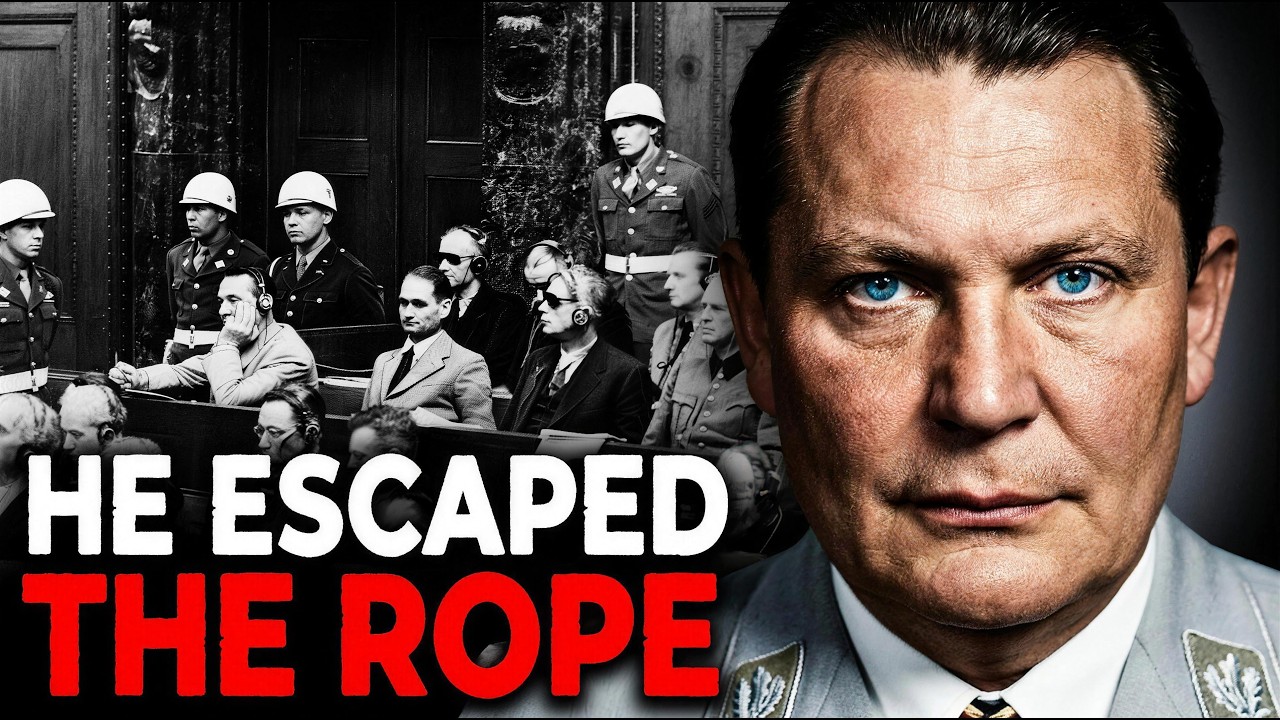
He interrupted, deflected, and challenged the legitimacy of the tribunal itself, calling it victor’s justice. He acknowledged the facts of Nazi policy while disputing that they were crimes under international law. He was quicker and more verbally agile than Jackson had prepared for, and the exchange grew so heated that the tribunal’s president had to intervene. The American delegation was furious.
But the facts were the facts. The documents were the documents. On October 1, 1946, Göring was found guilty on all four counts: conspiracy to wage aggressive war, crimes against peace, war crimes, and crimes against humanity. He was sentenced to death by hanging.
He accepted the verdict with theatrical stoicism and then began plotting how to deny the executioner his moment. He had no intention of dying by the rope, which he considered an undignified end for a soldier. On the night of October 15, 1946, hours before he was scheduled to hang, Göring bit down on a cyanide capsule and died. He was 53 years old.
The suicide denied the Nuremberg tribunal the finality of carrying out its sentence on the man who had, in many ways, been the face of the Nazi regime at trial. How a man who had been the second most powerful person in the Third Reich arrived at that small cell in Nuremberg is a story that begins in the skies of the First World War. Göring was born on January 12, 1893, in Rosenheim, Bavaria, the fourth child of a former German colonial governor. For the first years of his life, he was essentially raised by his godfather, Hermann von Epenstein, a wealthy Jewish physician and landowner who owned two medieval castles.
It was within those romantic walls that young Hermann developed a lifelong obsession with medieval grandeur, heraldry, and the aristocratic life. He was sent to cadet school at eleven, graduated with distinction, and entered the Imperial Army as an infantry officer in 1912. The static horror of the trenches soon pushed him toward the air service, where he proved to be an exceptionally gifted combat pilot. His natural aggression and willingness to take suicidal risks made him one of the most effective fighter aces of the war.
By the armistice in November 1918, he had shot down twenty-two confirmed enemy aircraft, earned the Pour le Mérite, and commanded the legendary Jagdgeschwader 1, the same fighter wing once led by Manfred von Richthofen. He was twenty-five, decorated, celebrated. Then Germany surrendered, the Versailles treaty dissolved the air force, and Göring found himself without purpose in a republic he despised. His politics took shape in the beer halls of postwar Bavaria.
He attended a speech by Adolf Hitler in 1921 and was electrified. He joined the Nazi Party almost immediately and was placed in command of the SA, the party’s street-fighting force. In November 1923, he marched beside Hitler in the failed Beer Hall Putsch and was shot in the groin. The wound was badly treated, and he was given large doses of morphine to manage the agony.
He spent the next four years in exile, his dependency deepening into an addiction that would torment him for the rest of his life. He returned to Germany in 1927, physically bloated, emotionally volatile, but politically sharper than ever. He leveraged his war hero status and his connections to the aristocracy to open doors for the Nazi Party. By 1932, he had become president of the Reichstag.
When Hitler was appointed Chancellor on January 30, 1933, Göring was rewarded with control of the Prussian police. The speed with which he weaponized that police force was breathtaking. Within weeks, he purged it of political opponents and created an entirely new instrument of state terror. On April 26, 1933, Göring officially established the Geheime Staatspolizei, the Gestapo.
It was not merely a police force. It was a political surveillance apparatus explicitly designed to operate outside the normal legal framework, empowered to arrest without judicial oversight, to hold prisoners indefinitely, and to use interrogation methods excluded from the usual prohibitions on brutality. The Gestapo became the pipeline through which communists, socialists, trade union leaders, journalists, clergy, and eventually Jews flowed into the concentration camp system. This was not an accident.
This was the design. Göring later transferred control of the Gestapo to Heinrich Himmler and the SS in 1934, but the institution he founded continued to operate on the principles he had established until the end of the war. He was also deeply involved in the construction of the broader police state. When the Reichstag burned on February 27, 1933, Göring arrived within minutes and immediately declared the fire a communist conspiracy.
The Reichstag Fire Decree, signed the next day, suspended the guarantees of individual liberty and became the legal foundation of the Nazi dictatorship. By 1935, Hitler had appointed Göring commander-in-chief of the newly revealed Luftwaffe, whose existence had been kept secret in violation of Versailles. Göring threw himself into building the air force, overseeing the development of aircraft like the Messerschmitt Bf 109 and the Junkers Ju 88. In 1936, Hitler made him plenipotentiary for the Four-Year Plan, giving him sweeping authority over the entire German economy.
It was Göring who convened the meeting on November 12, 1938, following the violence of Kristallnacht. He expressed irritation not at the pogrom but at the economic disruption it had caused, reportedly wishing they had killed two hundred Jews instead of destroying so much property. He moved methodically to establish the legal and economic framework for the complete expropriation of Jewish wealth, imposing a collective fine of one billion Reichsmarks and forbidding Jewish-owned businesses from operating. On January 24, 1939, he ordered Reinhard Heydrich to solve the Jewish question through immigration and evacuation.
On July 31, 1941, with Germany deep into the invasion of the Soviet Union, Göring signed a second directive instructing Heydrich to carry out preparations for the total solution of the Jewish question in Europe. That document is considered by historians to be the formal authorization of the Holocaust. The Luftwaffe’s crimes under Göring’s command demand their own accounting. The Blitz against British cities, beginning in September 1940, killed approximately forty-three thousand British civilians.
The bombing of Coventry on November 14, 1940, killed nearly six hundred people and destroyed the city’s medieval cathedral. On the Eastern Front, Göring was one of the primary architects of the so-called hunger plan, a deliberate policy of starvation designed to feed the German army by allowing Soviet civilians to die. His economic planning staff estimated that the policy would result in the deaths of many tens of millions of people. He signed off on it.
He also supervised the systematic looting of Europe’s cultural heritage. Through an organization given first pick of confiscated art, Göring acquired approximately 1,375 paintings along with hundreds of sculptures and tapestries, housed primarily at his estate Carinhall, named after his first wife, who had died in 1931. The works had been stolen from Jewish families across Europe, many of whose owners had been murdered by the state he commanded. His political relationship with Hitler deteriorated as Germany’s military fortunes worsened.
The first serious crack appeared during the Battle of Britain, when Göring assured Hitler that the Luftwaffe could bring Britain to its knees. He was catastrophically wrong. Then came Stalingrad. When Field Marshal Friedrich Paulus’s Sixth Army was encircled in November 1942, Göring personally guaranteed that the Luftwaffe could supply three hundred thousand men by air.
The airlift was a catastrophe. The encircled army starved and froze. On February 2, 1943, approximately ninety-one thousand survivors surrendered. Of those, fewer than six thousand would survive Soviet captivity to return to Germany.
Hitler never forgave him. As the war ground on, Göring’s health collapsed, his weight soared, and he retreated to his estates while Himmler, Bormann, and Speer moved to fill the vacuum. The final act began on April 23, 1945, as Soviet forces fought through the suburbs of Berlin. Göring, at his retreat in Bavaria, sent a telegram to Hitler announcing that he was prepared to assume leadership of the Reich.
Hitler interpreted it as treason. Göring was stripped of all his offices and ranks, placed under house arrest by the SS, and sentenced to death, a sentence suspended in the chaos of the Reich’s last days. On May 8, the day Germany surrendered, he surrendered himself to American forces. He was treated with some deference at first, dining with American generals, but as the Allies confronted the scope of what they had found, the atmosphere shifted.
He was indicted at Nuremberg, the trial opened on November 20, 1945, and the rest became history. His name is associated in the historical record with the founding of the Gestapo, the authorization of the Holocaust, the hunger plan, the deliberate bombing of civilian populations, and the industrial-scale looting of Jewish cultural heritage. Everyone who met him in person described something genuinely likable about the man. He was funny, generous, and a devoted father to his daughter Edda.
This is perhaps the most disturbing thing about him. The man who signed the directive authorizing the Holocaust was not a monster in the way we generally imagine monsters. He was charming and capable of ordering the murder of millions while maintaining a warm personal manner. His defenders argued that he had not known what Heydrich would do with the directive.
The tribunal rejected that argument. The Einsatzgruppen were already murdering Jews by the hundreds of thousands in 1941, and Göring received regular reports. He knew. In a conversation with the prison psychologist Gustav Gilbert, Göring observed that it was always a simple matter to drag the people along, that all you had to do was tell them they were being attacked and denounce the pacifists.
He described the technique with the detachment of an expert who had used it himself. The cyanide capsule that killed him has never been fully explained. The most widely accepted theory is that an American officer with some sympathy for him smuggled it in. His body was cremated and his ashes were scattered in the Isar River near Munich, a deliberate choice to ensure there would be no grave that could become a site for Nazi commemoration.
The art he looted remains scattered in museums and private collections across the world, many pieces never returned to families who were themselves murdered. The Nuremberg trial established legal principles that continue to shape international law, the principle of individual criminal responsibility for crimes against humanity, the rejection of the superior orders defense. Göring beat the hangman. He did not beat history.
The crimes were real. The deaths were real. The families destroyed were real. The paintings stolen from murdered Jews are real.
And many of them are still out there, waiting for a reckoning that has been too long delayed.