On March 15, 1781, a British general named Lord Cornwallis won a battle in the backcountry of North Carolina. His red-coated soldiers held the field. They captured four American cannons, and by every official standard of eighteenth-century warfare, the British were victorious that day. But when Cornwallis looked around at what remained of his army, he found that more than a quarter of his men had fallen dead or wounded on the ground around him.
The finest infantry units in the British army had been reduced to nearly half their strength, while the American general who lost the battle, a former Quaker ironworker from Rhode Island named Nathanael Greene, had pulled his army away almost entirely intact. What happened at Guilford Courthouse was not in fact a defeat. It was a trap. And within seven months, it would cost Britain the entire war.
To understand how a single afternoon in the Carolina woods could break an empire’s grip on a continent, you have to go back about two years. By late 1778, the British had a problem. Their war in the northern colonies had stalled. They held New York, but little else.
Washington’s Continental Army refused to surrender, the French had entered the war on America’s side, and British high command in London desperately needed a new strategy. So they looked south. The idea was straightforward. Georgia and the Carolinas teemed with loyalists, people who still supported the king.
The southern colonies were the wealthiest in America, producing enormous quantities of rice, indigo, and tobacco that yielded enormous profits for whoever controlled them. If the British could sweep through the South, rally the loyalists to their side, and crush any rebel forces in their path, they could deny the United States that wealth and extinguish the rebellion entirely from its base. Control the South, recruit local support, then march north toward Virginia and trap Washington between two armies. On paper, it looked like a winning plan.
And for a while, it actually worked. In December 1778, British forces captured Savannah, Georgia. In May 1780, they captured Charleston, South Carolina, along with an entire American army of more than five thousand men. That was the worst American defeat of the entire war.
Then in August, the British general Cornwallis destroyed another American force at Camden, South Carolina. The American commander there, a general named Horatio Gates, fled the battlefield so quickly that he covered nearly two hundred miles in three days on horseback. The southern colonies lay completely exposed. The Continental Army in the South had effectively vanished, and Cornwallis was ready to march straight through North Carolina and on into Virginia to finish the job.
At that moment, George Washington made one of the best personnel decisions of the entire war. He sent Nathanael Greene south to take command of what remained. Greene was an unusual choice in several respects. He had grown up a Quaker in Rhode Island, raised in a family that did not believe in war at all.
His own religious society had expelled him for attending a military parade years before the war began. He walked with a limp from a childhood injury. He had no formal military training, but he had taught himself strategy from books. He had served as Washington’s quartermaster general, and Washington trusted his judgment more than almost anyone in the army.
Greene was not a showman. He was patient, methodical, and exceptionally good at thinking three steps ahead. He arrived at Charlotte, North Carolina, in December 1780, and what he found was not encouraging. His so-called army consisted of about 2,300 men, most of them hungry, poorly clothed, and barely trained.
He had almost no supplies, very little ammunition, and the morale of the entire southern resistance was near zero. Cornwallis, meanwhile, had a professional, well-equipped, experienced army that had been winning battles all year. A direct confrontation was suicide. So Greene did something most generals would never consider.
He divided his small army in half. He sent Brigadier Daniel Morgan with about one thousand men on a wide sweep southwest into South Carolina, while Greene himself marched east with the rest of his forces toward Cheraw. The military manuals tell you never to divide your forces in front of a stronger enemy. Greene did it anyway, and he did it for a specific reason.
He wanted to force Cornwallis into a choice: chase Morgan, chase Greene, or split his own army to pursue both. Any of those options would create problems for the British, and that was the whole point. Cornwallis swallowed the bait. He sent his best light infantry commander, a fearsome cavalry officer named Banastre Tarleton, with about 1,100 soldiers to track down Morgan and destroy him.
Tarleton was aggressive, fast, and notorious for brutality. His men had massacred American prisoners at Waxhaws the year before. Nobody in the South wanted to face him. Morgan, however, had his own plan.
On January 17, 1781, Tarleton caught up with Morgan at a cattle pasture called Cowpens in the upper part of South Carolina. Morgan had arranged his men, about one thousand strong, in three lines across the open meadow. He ordered the militia in the two front lines to fire a few volleys and then fall back behind the regular Continentals in the third line. It was a calculated gamble that exploited the strengths of his untrained militia, who could not be expected to stand and exchange fire with the British, but who could certainly fire a few accurate shots before withdrawing.
The plan worked almost perfectly. Tarleton’s infantry charged straight into the trap. They absorbed volley after volley as they advanced through the first two lines, and by the time they reached the Continentals, they were exhausted and disorganized. Morgan’s men counterattacked, and the result was a devastating rout.
Tarleton lost nearly eight hundred of his eleven hundred men killed, wounded, or captured. It was one of the most complete American victories of the entire war, and it enraged Cornwallis. The news of Cowpens struck Cornwallis like a thunderbolt. He had lost his best light troops, hundreds of prisoners, stores, and weapons.
But instead of retreating to regroup, Cornwallis made a decision that would define everything that followed. He decided to pursue Morgan and Greene himself, determined to destroy them. To move faster, he ordered his army to burn its baggage: tents, spare clothing, food stocks, supply wagons, even his own personal belongings. All of it was thrown into the flames.
His men carried only their weapons, ammunition, and a few days of food. The entire British army in the Carolinas became a light pursuit force with no safety net and no plan for retreat. One of his officers, General Charles O’Hara, later said they meant to pursue Greene’s army to the end of the world. What followed was one of the most grueling military chases in American history.
Known as the Race to the Dan, it covered more than 250 miles of frozen, muddy Carolina countryside in the depths of winter. Greene and Morgan met up and headed north toward the Dan River on the Virginia border. If they could cross the Dan, they would be safe in Virginia, where they could regroup and gather reinforcements. If Cornwallis caught them before the crossing, it would be the end of the southern army.
The pursuit nearly ended at the Catawba River on February 1. Cornwallis’s forces crossed the river under fire and overran a small American rearguard, whose commander, General William Lee Davidson, was killed. It was a heavy loss, but the sacrifice gave Greene the time he needed to keep moving north. At the Yadkin River, Greene crossed his men and seized every boat in the water, forcing Cornwallis to march twenty-five to thirty miles upstream to find a crossing.
Every river was a race, and Greene kept winning them. Both armies averaged ten to fifteen miles a day through constant freezing rain and cold on roads that were little more than muddy tracks through the forest. Greene sent scouts ahead to collect every boat they could find along the Dan. He also detached a small force of about seven hundred men under Colonel Otho Williams, including the cavalry of Lieutenant Colonel Henry Lee, to cover his movements and slow the British advance.
Williams and Lee fought a continuous series of skirmishes and rearguard actions that kept Cornwallis guessing about Greene’s true destination. The British rushed toward the upper fords of the Dan, where the river was shallow enough to cross on foot, but Greene had sent his men to those fords as a decoy. His real crossing point lay miles downstream, where the boats were waiting. On February 14, 1781, Greene’s last men crossed the Dan into Virginia and pulled every boat over to the far bank behind them.
When Cornwallis reached the Dan on the morning of February 15, he found a raging river with no boats and no way across. He had burned his supplies, exhausted his men, and marched more than two hundred miles in terrible conditions for almost nothing. Greene had slipped away. But here Greene’s true strategy began to reveal itself.
Most generals, after miraculously escaping destruction, would have stayed in Virginia and counted their blessings. Greene waited only eight days. On February 22, he crossed the Dan back into North Carolina. He had received new reinforcements and new militia from Virginia and North Carolina, and he was now looking for a battle on his own terms.
Over the following three weeks, Greene built his army up to about 4,400 men. Only about 1,500 of them were regular Continental soldiers, the professional troops. The rest were militia, men who had volunteered for short terms and had little training or combat experience. Cornwallis, meanwhile, had about 1,900 soldiers, but every one of them was a hardened professional: British regulars, Hessian mercenaries, the legendary Foot Guards, and Scottish Highlanders of the Seventy-First Regiment.
They were among the best-trained soldiers in the world. But they were also exhausted. They had been sleeping outdoors for seven weeks with no tents since Cornwallis had burned them. They were short of food.
Their ammunition was running low. Cornwallis needed a decisive battle, and he needed it soon, because his army was falling apart. Greene knew all of this, and he chose his battlefield carefully. He picked a spot near Guilford Courthouse in what is now Greensboro, North Carolina.
The terrain was a mix of open farm fields, dense woods, and rolling hills, all centered around a road called New Garden Road. He had scouted the area weeks before and knew exactly how to exploit it. Greene devised his battle plan using the same basic idea Daniel Morgan had used at Cowpens two months earlier: a defense in depth made up of three separate lines of troops, each separated by about four hundred yards. The concept was brutally simple.
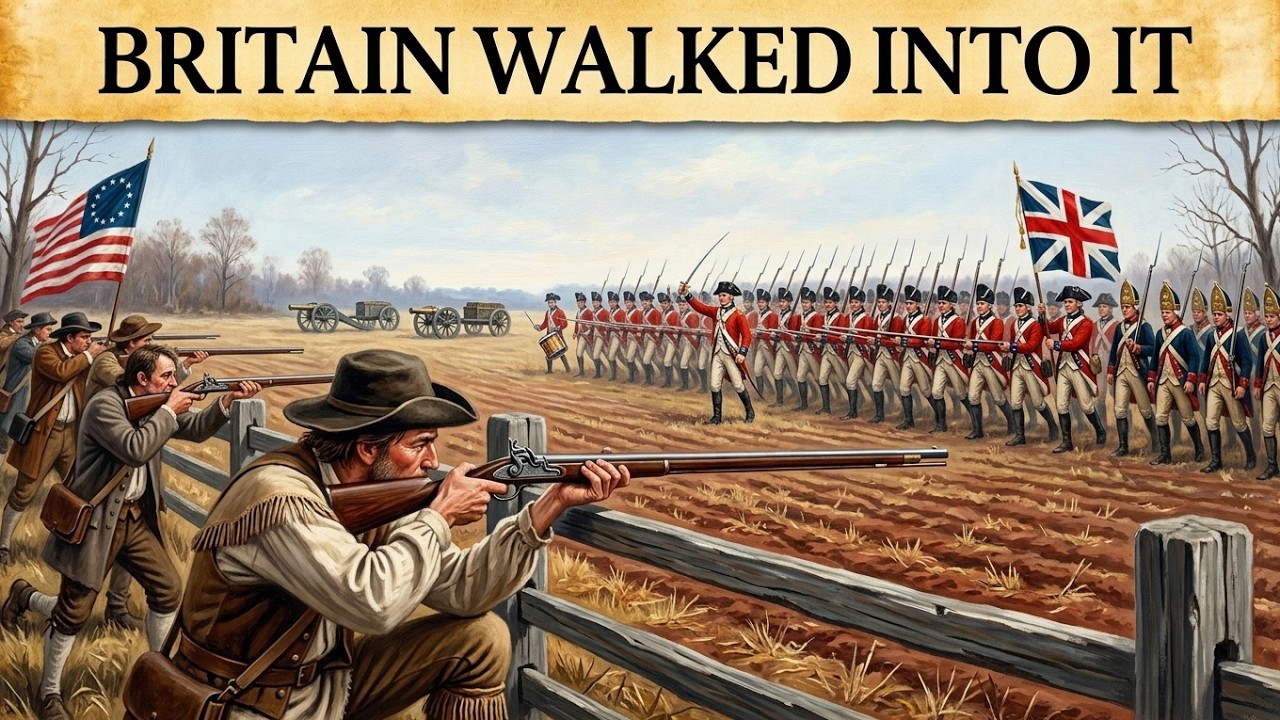
Force the British to fight through three successive lines of resistance, each stronger than the one before. By the time they reached the final line, they would be so worn down and disordered that they could not win. The first line was deliberately the weakest. Greene placed about eight hundred North Carolina militia at the edge of a farm field, their muskets resting on a wooden fence.
He asked them to fire two volleys at the advancing British and then fall back behind the second line. That was all he asked of them: two good shots, then withdraw. On both flanks of this first line, Greene posted veteran riflemen from Virginia and North Carolina, along with Continental cavalry under Lieutenant Colonel William Washington on the right and Lieutenant Colonel Henry Lee, known as Light-Horse Harry, on the left. These flanking troops were the fangs of the first line.
The militia in the center were the bait. The second line was stiffer. Greene placed Virginia militia in the dense woods behind the first field. These men were more experienced than the North Carolinians, and the forest terrain would break up the British formations as they advanced, forcing them to fight in scattered groups instead of their disciplined shoulder-to-shoulder lines.
The third and final line was the hammer: Continental regulars from Virginia and Maryland, positioned on high ground near the courthouse itself. These were trained, professional soldiers who could stand and fight with bayonets against whatever the British could throw at them. If the first two lines did their work and exhausted the British advance, the Continentals in the third line would deliver the killing blow. In the predawn darkness of March 15, Cornwallis roused his men and marched them up New Garden Road toward Greene’s position, roughly twelve miles away, without having eaten breakfast.
Along the way, the advancing British forces clashed with American scouts and small cavalry detachments. Heavy fighting broke out at a Quaker meeting house on the road. Tarleton himself was shot in the hand during one of these skirmishes. By noon, the full British force had arrived in front of Greene’s first line.
The two sides opened with artillery duels. The American six-pounders fired into the forming British columns while the British three-pounders replied. Casualties during the bombardment were light on both sides, but the thunder of cannon rolling across the Carolina fields told every man there that the real fight was about to begin. Then the British infantry advanced.
They came on in two columns, then deployed into three, with bayonets fixed, marching with steady steps across the open field toward the wooden fence where the North Carolina militia waited. The Americans watched them come. The British held their fire, waiting to get close enough to do real damage. When the redcoats reached about 140 yards, the first line opened fire.
Some of the shots struck home hard. One American soldier later said the British fell like wheat-stalks before a scythe, but most of the militia could not get off more than a shot or two before panic set in. These were farmers and tradesmen, not professional soldiers, and the sight of disciplined British infantry advancing with bayonets was more than they could take. Most of them dropped their muskets and ran.
The first line collapsed entirely within minutes. But as the center fell apart, the forces on the flanks held their ground on both sides. Lee’s men on the left and Washington’s cavalry on the right kept fighting, forcing the British to pull troops away to deal with them. As a tactical position, the first line had failed, but as part of Greene’s larger plan, the first line had done exactly what was required.
It had forced the British to advance across open ground, take casualties, and begin exhausting their energy before the real battle even started. The British surged into the woods where the Virginia militia waited in the second line. Here the battle turned bloody. The organized British formations broke apart in the dense forest.
Soldiers lost sight of their officers. Units tangled with other units moving in different directions. The Virginians fought fiercely for about thirty minutes. Vicious close-quarters fighting erupted across a wide front as groups of soldiers from both sides clashed among the trees.
In the confusion, American forces in some places mistook blue-coated Hessian troops for their own Continentals and let them approach before realizing the mistake. The fighting was chaotic, bloody, and exhausting for both sides. Eventually, the Virginians fell back, but they had inflicted severe damage. By the time the British stumbled out of the woods and reached Greene’s third line, they were in terrible shape.
Their formations were scattered. Officers in almost every unit were killed or wounded. The soldiers were physically drained. And now they had to attack uphill against a line of fresh Continental regulars who had been watching and waiting the whole time.
The fighting at the third line was the fiercest of the entire battle. The Second Battalion of British Guards, considered the elite of the British army, managed to turn the American left flank when the Second Maryland Regiment collapsed and fell back. The Marylanders were a newly formed, poorly trained unit that could not hold up in the chaos of battle. The Guards surged forward into the gap, and for a moment it looked as though they would sweep the entire American line.
But William Washington’s cavalry, the horsemen, charged with sabers into the exposed Guards. The First Maryland Regiment, battle-hardened veterans, turned and fired into the British flank at close range. The Guards suddenly found themselves caught in a vicious fight from both sides, and they began to break. This was the decisive moment of the entire battle.
Cornwallis was watching from nearby, and he could see his best troops on the verge of annihilation. He made a decision that would become one of the most controversial moments of the war. He ordered his artillery brought up, loaded with grapeshot, a cannon that fires a spray of iron balls like a giant shotgun, and ordered them to fire directly into the mass of struggling men. His own soldiers were mixed in with the Americans, fighting face to face only yards apart.
His second-in-command, General O’Hara, wounded and lying nearby, reportedly begged him not to do it. Cornwallis gave the order anyway. The cannons fired into the melee. British and American soldiers fell together.
Grapeshot did not care what uniform you wore, but it did what Cornwallis wanted. The shock of the artillery fire ended the close combat and forced both sides apart. Washington’s cavalry withdrew. The surviving Guards re-formed, and the immediate crisis passed, though the price had been terrible.
Greene, watching from behind his third line, had his own decision to make. His Continentals were still in good shape. Parts of his lines still held. William Washington’s cavalry was still an effective fighting force.
He could press the attack and try to destroy Cornwallis right there. But Greene realized something most commanders in his position would not have accepted. The goal was not to destroy Cornwallis himself. The goal was to destroy Cornwallis’s ability to fight, and that had already been accomplished.
If Greene kept fighting and lost his regulars, there would be no American army left in the South at all. Their loss would be a catastrophe no battlefield victory could offset. As Greene himself said, he knew he had hurt Cornwallis badly and did not want to risk too much. So he ordered the retreat.
His men fell back along the road toward Troublesome Iron Works about fifteen miles away, taking most of their army with them. They left behind the four pieces of artillery, too slow to move during a quick withdrawal, but the army survived. Cornwallis held the field. In the official language of eighteenth-century warfare, it was a British victory.
But the numbers told a very different story. The British suffered about five hundred casualties, killed and wounded, out of 1,900 men who began the fight. That meant 27 percent of his entire army had been lost in a single afternoon. The Guards battalions, the best infantry units in the entire British army, suffered 56 percent casualties.
Almost all their officers were dead or wounded. One British sergeant wrote that the Guards were so depleted that the survivors could barely form a single company. The Americans, meanwhile, lost about seventy-nine regular soldiers, along with several hundred militia counted as missing, most of whom had simply run away early and gone home. Greene’s actual fighting strength, the regulars he could not afford to lose, was largely intact.
Cornwallis himself seemed to grasp what had happened. In a letter after the battle, he was reported to have written that he never saw such fighting since God made him, and that the Americans fought like devils. When news of Guilford Courthouse reached London, the reaction was not celebratory. Member of Parliament Charles James Fox summed it up when he said that another such victory would destroy the British army.
Cornwallis could not pursue Greene. He could not stay where he was either. His men had no tents, almost no food, and dwindling ammunition. He left his wounded behind at Guilford Courthouse and began a painful retreat southeast toward the coast, eventually reaching the port town of Wilmington, North Carolina.
He had effectively abandoned every inch of interior Carolina territory the British had spent more than two years fighting to control. That was the genius of what Greene had done. He had fought a battle he expected to lose and made the cost of winning it greater than the cost of losing it. While Cornwallis nursed his wounds at Wilmington, Greene turned his army around and marched back into South Carolina.
Over the next few months, he fought a series of battles and sieges, none of which he won decisively, but all of which weakened the remaining British garrisons. He used the same strategy again and again: attack, inflict casualties, withdraw, then attack again. In his own words, they fought, got beaten, and then fought again. By the end of 1781, British influence in the South had shrunk to a few coastal cities.
Greene had recovered the interior of the Carolinas without winning a single major battle. Cornwallis, meanwhile, made a fateful decision. Instead of turning back to fight Greene in the Carolinas, he decided to march his exhausted army north into Virginia. He believed that seizing Virginia would cut off supplies to the southern rebels and win the war in a single stroke.
It was bold thinking, but it left him exposed and vulnerable. In late summer of 1781, he settled his army at Yorktown, a small coastal town in Virginia, to await the British navy for supplies and reinforcements. The navy never came. Instead, a French fleet under Admiral de Grasse closed the blockade on Chesapeake Bay, trapping Cornwallis from the sea.
George Washington, watching from the north, saw his opportunity. He marched his army south at full speed, joined the French forces under General Rochambeau, and surrounded Yorktown with a combined force of roughly seventeen thousand soldiers against Cornwallis’s nine thousand. After three weeks of constant bombardment, with supplies cut off and escape by sea impossible, Cornwallis surrendered his entire army on October 19, 1781. Legend says a British band played a tune called The World Turned Upside Down as the soldiers stacked their arms.
Whether that story is accurate or not, the title was fitting. The war was effectively over, and the road to Yorktown had begun on that field in the North Carolina woods seven months earlier. What makes Guilford Courthouse exceptional is not what happened on the field that day. It is the strategy that turned a losing battle into a winning campaign.
Greene understood that the Americans did not need to defeat the British army in the South. They only needed to make the British army in the South incapable of fighting. He lured Cornwallis into chasing him across two states, straining British supply lines until they collapsed. He forced Cornwallis to burn his own equipment just to keep pace.
He chose the battlefield. He set its terms. And when the fighting was over, he walked away with the one thing Cornwallis could not replace: an intact army. Cornwallis won the field at Guilford Courthouse, but he lost everything else.
He lost the men, the supplies, the entire southern campaign, and eventually, the war itself. Sometimes, the winner of a battle is the one who walks away with enough strength to keep fighting. Greene lost at Guilford Courthouse, and that defeat destroyed the British grip on the American South, pushed Cornwallis into the trap at Yorktown, and helped give birth to a new nation.