At 1:20 a. m. on October 16, 1946, Field Marshal Wilhelm Keitel stepped onto the gallows inside the gymnasium of the Nuremberg Palace of Justice. He had been sentenced to death just over two weeks earlier, on October 1, alongside eleven other senior figures from the political and military leadership of Nazi Germany.
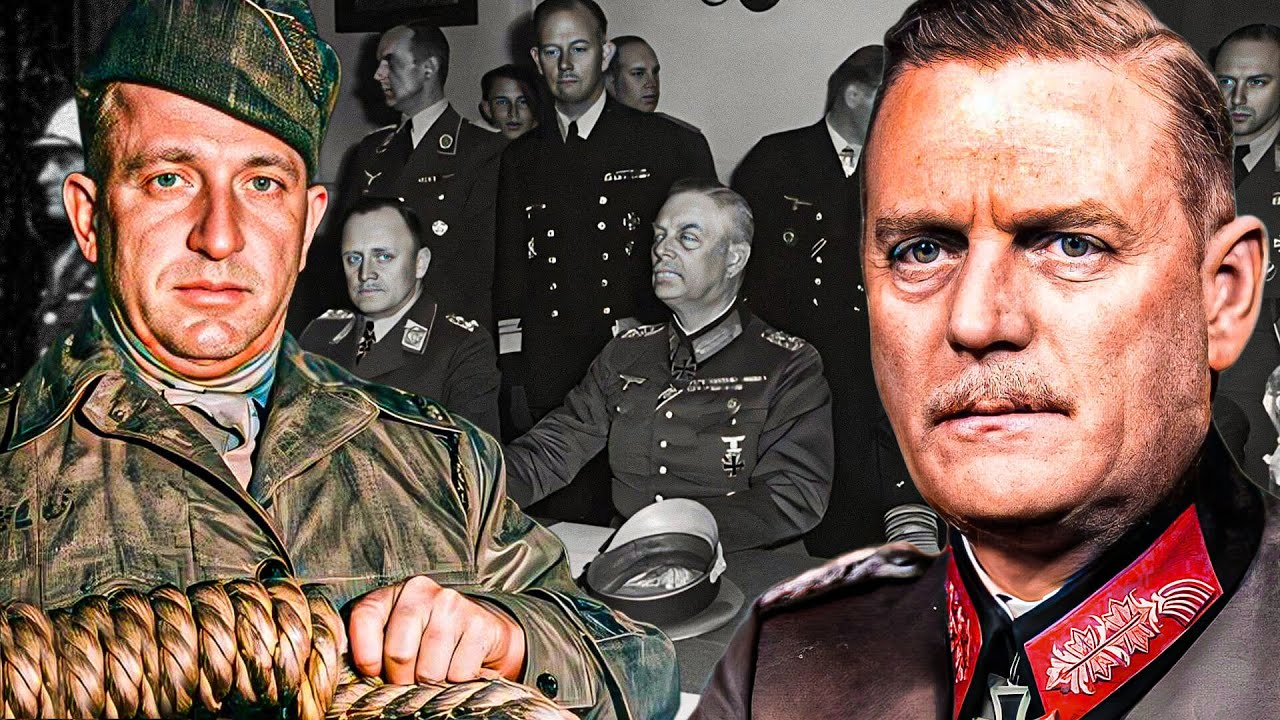
Now, with his hands bound and a black hood over his head, the former chief of the Wehrmacht’s High Command offered his final words, calling on Almighty God to have mercy on the German people and declaring that he followed his sons, all for Germany. The trapdoor opened, but instead of a clean, swift death, Keitel’s head slammed against the wooden door. The rope was too short. He would spend the next twenty-four minutes slowly strangling to death while witnesses watched the rope swing wildly back and forth.
Keitel’s path to the gallows had begun more than six decades earlier. Born on September 2, 1882, in Helmscherode, Germany, he was a career soldier from the start. He joined the Prussian Army and served on the Western Front during the First World War, ending the conflict as a lieutenant colonel. In the Weimar Republic, he remained in the Reichswehr, but his rise came through his involvement in Germany’s secret rearmament, an effort that brought him to the attention of Nazi officials.
In 1935, he was appointed head of the Armed Forces Office in the War Ministry with the rank of lieutenant general. His career advanced through a mixture of loyalty, ambition, and ruthlessness. When he passed information to Hermann Göring suggesting that War Minister Werner von Blomberg’s wife had once been a prostitute, he helped bring about Blomberg’s dismissal. Blomberg had once described Keitel as the man who ran his office, a loyal senior officer who followed orders.
Hitler saw in Keitel someone willing to turn on his own superior to advance himself yet still bound by obedience, precisely the kind of man he could control. In 1938, Hitler promoted him to field marshal and appointed him chief of the Oberkommando der Wehrmacht, a position that earned him the nickname “Lakeitel,” a play on his surname and the German word for lackey. Keitel was far more than a passive administrator approving the Nazi regime’s policies. He signed the infamous Commissar Order, which instructed German officers and soldiers to summarily execute captured Soviet political commissars.
He called for ruthless and energetic action, especially against the Jews, whom he described as the main carriers of Bolshevism. While he did not originate the Night and Fog Decree, which ordered the secret arrest, deportation, and disappearance of individuals suspected of anti-German activities, he expanded its reach to all territories under German occupation. His particular contribution was handing prisoners who were not immediately executed over to the Gestapo, a fate from which few survived. In October 1942, he added the Commando Order to his record, instructing the Wehrmacht to execute Allied special operations troops even when they were captured in full uniform.
He continued carrying out these duties until the very end. On May 13, 1945, eight days after Germany’s unconditional surrender, he was arrested. When the International Military Tribunal convened in Nuremberg on November 20, 1945, Keitel was indicted on four counts: conspiracy to commit crimes against peace, waging wars of aggression, war crimes, and crimes against humanity. His defense, that he was only following orders, was rejected.
On October 1, 1946, he was sentenced to death. Ten other high-ranking Nazis received the same sentence. Hermann Göring, Joachim von Ribbentrop, Ernst Kaltenbrunner, Alfred Rosenberg, Hans Frank, Wilhelm Frick, Julius Streicher, Fritz Sauckel, Alfred Jodl, and Arthur Seyß-Inquart all awaited execution, along with Martin Bormann, who was sentenced in absentia because the Allies did not yet know he had died in Berlin in May 1945. The executions were scheduled for October 16 in the gymnasium of the Nuremberg Palace of Justice, carried out by U.
S. Army personnel. The order placed Keitel directly behind Ribbentrop. The man chosen to carry out the executions was Master Sergeant John C.
Woods. By many accounts, he was neither professional nor experienced. A native of Wichita, Kansas, Woods had spent a year in the U. S.
Navy before being dishonorably discharged after going absent without leave and receiving a court-martial. He was also diagnosed with psychopathic inferiority without psychosis. When the United States entered the war, he was allowed to enlist in the Army, likely because no one checked his prior records. Assigned to Company B of the 37th Engineer Combat Battalion, part of the 5th Engineer Special Brigade, he probably landed on Omaha Beach on D-Day.
Only a few months later, he jumped at a safer job when the Army sought volunteer executioners for soldiers sentenced to death for murder, rape, or desertion. Woods’s supposed experience hanging inmates in Texas and Oklahoma was a fabrication, yet the Army promoted him to master sergeant and hired him as chief executioner. Later records revealed that he had botched at least eleven hangings of U. S.
soldiers between 1944 and 1946. When the time came to convert the gymnasium into an execution chamber, Woods and his assistant, MP Joseph Malta, set the stage for what would become a gruesome spectacle. By 1:00 a. m.
on October 16, everything was ready. Göring had cheated the gallows the day before by biting down on a cyanide capsule. Ribbentrop went first, stepping up to the gallows at 1:11 a. m.
Woods tightened the noose around his neck and positioned him over the trapdoor. After Ribbentrop spoke his final words, Malta pulled the lever. The rope swung back and forth with a creak, and for a moment, all seemed to be proceeding as expected. A few minutes later, Keitel entered the gymnasium.
He climbed the thirteen steps stoically, maintaining his military bearing until the end. At the top, his hands were bound, the hood was placed over his head, and the noose was set. At 1:20 a. m.
, Malta pulled the lever. Instead of a short drop and a sudden stop, Keitel’s head struck the trapdoor. Woods had made the opening too small, and the rope was set far too short. When Woods and a doctor went behind the curtain beneath the gallows, Keitel was convulsing, slowly being strangled as his face bled from the impact.
Ribbentrop was also still alive, enduring the same slow strangulation. His official time of death was recorded at 1:30 a. m. Keitel struggled for another twenty-four minutes before being pronounced dead at 1:40 a.
m. The remaining executions went just as badly. At least one other condemned man, Frick, also struck his head against the trapdoor. All of them died by strangulation over periods ranging from fourteen to twenty-eight minutes.
The last execution, that of Arthur Seyß-Inquart, was reported complete at 2:59 a. m. The bodies of the executed men, along with Göring’s, were cremated at the Ostfriedhof Cemetery in Munich, and their ashes were scattered into the Isar River. The drawn-out, painful deaths mirrored the suffering of countless victims of the Nazi regime, but they also sullied what was supposed to be a final act of justice.
Woods was not removed from his position, and he showed no shame. He continued carrying out executions, badly, for several months afterward. He bragged about his work in interviews, saying he had hanged those Nazis and was proud of it, insisting that a fellow could not afford to have nerves in this business. When his services were no longer needed, he was reassigned to the 7th Engineer Brigade on Enewetak Atoll in the Marshall Islands.
He remained convinced he had done a good job, claiming that ten men in 106 minutes was fast work and that he had carried out a total of 347 executions, though the real number was likely closer to ninety. He kept making such claims until his own death, which came quickly and ironically, by electrocution on July 21, 1950, while changing a light bulb in a pool of water.