On May 6, 1944, a young woman stood in a London register office and married the man she had waited six years for. Of her entire family, only one person came. Her name was Kathleen Kennedy, the favorite sister of the future president of the United States. She had given up her faith, defied her mother, and chosen England over everything she had been raised to be.
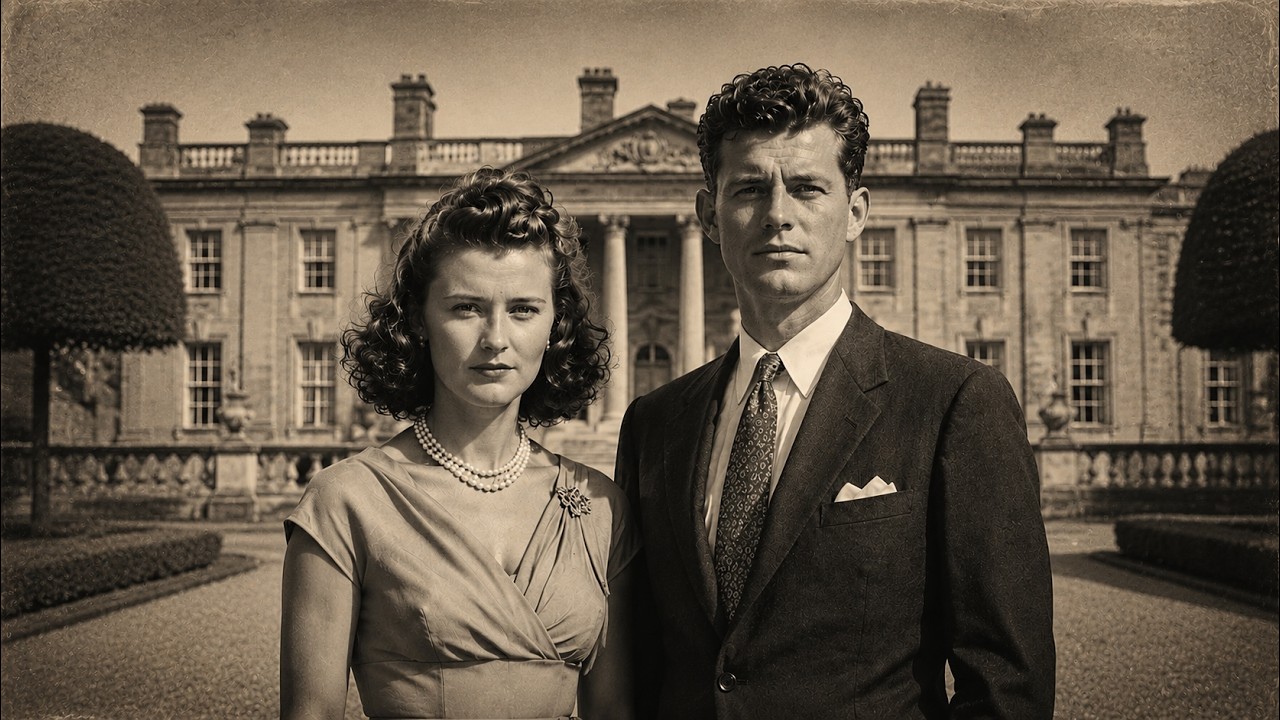
Four months later, her husband was dead. Four years after that, so was she. Only her father came to her funeral—the same father who had not come to her wedding. In the village of Edensor, tucked inside the estate of Chatsworth in Derbyshire, a grave stone reads: “In loving memory of Kathleen, 1920 to 1948, widow of Major the Marquis of Hartington, killed in action, and daughter of the Honorable Joseph Kennedy, sometime ambassador of the United States to Great Britain.
” Beneath her name are four words: “Joy she gave. Joy she has found. ”
When Kathleen was buried in that English churchyard, only one member of her famous family stood by the grave. Her father came alone and looked, one observer later said, like a man who had been crumpled from the inside.
Her mother did not come. Her brother Jack, the one she had called her other self, did not come. She was 28 years old and was buried not as a Kennedy but as a Cavendish, in the family plot of the English aristocracy she had chosen over everything she had been raised to be. Almost everyone who loved her called her Kick.
She arrived in London in the spring of 1938, 18 years old, the daughter of the new American ambassador to Great Britain. The city took one look at this compact, sparkling, entirely unself-conscious girl from Massachusetts and fell in love. The English press called her the American princess. The London social set called her the best thing that had happened to their season in years.
Somewhere in that last golden summer before the war, she met a young man named Billy Cavendish—quiet, thoughtful, impeccably English. They fell so deeply in love that it would cost her everything: her faith, her family, her country, and eventually her life. Kick was the only rebel of the nine Kennedy children. The only one who refused to march down the road her parents had drawn for her.
The only one who looked at everything her name required of her—the faith, the ambition, the carefully managed image—and said, “Not this time. ”
Her story begins in the last summer when everything was still possible. In July 1938, at a garden party at Buckingham Palace, she met William Cavendish, 20 years old, the eldest son of the Duke of Devonshire and heir to Chatsworth, one of the grandest estates in England. He was tall, reserved, and thoughtful, exactly the kind of young Englishman who had been educated to carry great weight without appearing to feel it.
They were in almost every visible way completely unlike each other. They talked until the party ended. The world they were living in was balanced on the edge of something enormous. The newspapers were full of Hitler.
There was a quality to that summer, a particular brightness that people would later describe as the brightness of something that knows it is about to end. Kick threw herself into London. She made her formal debut on May 12, 1938, and the press named her debutant of the year. She attended the races at Goodwood with Billy and a circle of friends that included the Mitford sisters.
Deborah Mitford, later the Duchess of Devonshire and later Billy’s sister-in-law, would become one of her closest friends. Debo would write that Kick had a quality she had never seen before or since—the ability to make everyone in a room feel that they were the most interesting person in it. Then September came, and a month that changed everything. Germany invaded Poland.
Within 48 hours, Britain declared war, and Joseph Kennedy, the American ambassador, made a decision that would define his daughter’s next four years. He sent his family home. Kick was 19 years old. She begged to stay.
Her father said no. She sailed back across the Atlantic on a ship crowded with refugees and diplomats, leaving behind the friends she had made, the city she had fallen for, and Billy, who was already looking to enlist. She spent the next four years in America. She attended the Finch School, studied briefly in Florida, volunteered with the Red Cross in New York, and took a job as a research assistant at the Washington Times Herald.
She wrote home to her friends in England whenever she could, kept up with the war news with the particular obsessiveness of someone who has people in it, and waited, because she was Kick Kennedy and she did not know how to give things up. What America gave her in those four years was also a clearer picture of what she was returning to. Rose Kennedy ran the household with the precision of a campaign. Sunday mass was not optional.
The faith was not background. It was architecture. What was expected of a Kennedy daughter was straightforward: you married within the faith. You did not marry a Protestant.
You certainly did not marry the heir to one of the most aggressively anti-Catholic aristocratic families in England. As her biographer Lynne McTaggart would later write, Kick was the only one of the nine Kennedy children who didn’t march down the prescribed road. In July 1943, she wrote to her brother Jack that she had found a way back to England. The American Red Cross was sending volunteers to London, and she had signed up.
She would work 12-hour days providing food and supplies to American officers. She told Jack she had spent a day and a half in the country with Billy. “For 24 hours,” she wrote, “I forgot all about the war. ” She had found him again, and everything she had been carrying for four years—the waiting, the distance, the stubborn refusal to let the thing go—had come flooding back.
“Billy is just the same,” she wrote. “A bit older, a bit more ducal, but we get on as well as ever. ”
The problem was not that Billy didn’t want to marry her. The problem was the children.
Billy Cavendish was not just a Protestant. He was the heir to a dukedom built on the Protestant settlement. Under the laws governing the peerage, if his children were raised Catholic, they could not inherit the title. Five hundred years of the Devonshire line, Chatsworth and all that Chatsworth represented, would pass to someone else.
Billy was not asking Kick to change her faith for him. He was asking her to consider what her faith would cost their children. Kick went to priests and sat with the question for months. She wrote to her brother Joe, the eldest, the one she trusted most, and asked him what she should do.
Joe told her the truth—that he thought she should follow her heart, that the church’s position was not the only position, and that if Billy was the man she loved, the rest could be worked through. He was the only Kennedy who said that, and he would also be the only Kennedy who stood beside her on her wedding day. She wrote to her father. Joe Senior’s response was characteristically practical.
He was not going to tell her what to do, but he was going to make clear that whatever she decided, she would be deciding alone, and the consequences would be hers to carry. She never asked her mother. She already knew what Rose would say. When it became apparent that her daughter was seriously considering marrying outside the church in a civil ceremony with no Catholic dispensation and no promise of Catholic children, Rose responded with the full weight of everything she believed.
She told Kick that what she was contemplating was a mortal sin. She said, according to those who were present, that this was the darkest day she had ever known. She did not come to the wedding. Rose Kennedy was not a simple villain.
She was a woman of genuine faith under genuine anguish, acting according to a moral framework that was entirely consistent and entirely sincere. She believed with every cell of her body that her daughter’s soul was in danger. But the effect on Kick, who had spent her whole life trying to be everything her mother needed her to be, was devastating. On the morning of May 6, 1944, Kick signed the register at Chelsea Register Office on King’s Road in London.
The ceremony was civil, quick, and unadorned. Kick wore a pale pink dress and carried pink camellias brought from Chatsworth that very morning—the first gesture from the Cavendish family that said, “You are one of us now. ” Billy stood beside her in his Coldstream Guards uniform. Joe Junior signed the register.
The Duke of Devonshire signed the register. A small group of friends stood around them in the plain room and watched. Four hundred miles away in America, Rose Kennedy did not attend. Jack Kennedy, who had wanted to come and had written to say he was sorry, was in the Pacific recovering from injuries sustained when his patrol boat was destroyed by a Japanese destroyer.
He sent his love from a long way away. It was by any measure one of the loneliest wedding mornings in living memory. But those who were there said Kick was radiant—not performed radiance, but something quieter and more real. The particular expression of a person who has paid a price and decided finally that it was worth it.
Billy’s mother, the Duchess of Devonshire, took Kick aside after the ceremony and told her never to forget that marrying Billy had given him complete happiness. Four weeks after the wedding, Billy was called up. He reported for duty on June 13, 1944, seven days after D-Day, as his battalion prepared to push into France with the Guards Armoured Division. He left Kick standing in London with a marriage that was barely a month old.
She went back to work at the Red Cross, wrote to him every day, and told herself it would be short. London in the summer of 1944 was a city living on two levels simultaneously. The Blitz had ended two years earlier, but now there were the V1s, the Doodlebugs—unmanned bombs that flew in silence and then cut their engines before impact, giving you approximately 12 seconds of warning before the world came apart. Kick wrote in her diary about the way everyone in a room would stop mid-sentence when the engine went quiet, waiting.
In the first week of September 1944, Billy’s battalion crossed the River Somme. They pushed east through northern France and into Belgium, moving through towns that had been under German occupation for four years. The people came out to meet them, decorated the tanks with flowers, lined the roads, wept and cheered. Billy wrote to Kick from the middle of it, describing the crowds, the flowers, the particular quality of the welcome.
“I have a permanent lump in my throat,” he wrote, “and long for you to be here as it is an experience which few can have and which I would love to share with you. ”
The letter was written sometime in early September 1944. He was dead within the week. On September 9, Billy Cavendish was shot and killed by a German sniper near the town of Heppen, Belgium.
He was 26 years old. He had been married for four months and three days. The news reached Kick in London. She wrote to a friend very shortly after: “Life is so cruel.
Writing is impossible. ” Then she stopped. She did not go home to America. Every instinct her family had said “Come back.
” And Kick stayed. She stayed in England, in the Cavendish world that had welcomed her so completely and that had told her she belonged. Billy’s mother wrote to her and told her never to forget that her marriage had given Billy complete happiness. It was exactly the right thing to say.
She had given the man she loved four months of complete happiness. That was real. That was verified in writing by his own mother. She was 24 years old.
She was a widow. She was the Marchioness of Hartington, a title that had no meaning anymore without the man who had given it to her. And then 33 days after Billy was killed, the telegram came again. Her brother Joe was dead.
Joseph Patrick Kennedy Jr. , the eldest, the heir apparent, the one who had signed the register at her wedding, the one who had told her to follow her heart when no one else would, had been killed on August 12 when his experimental aircraft exploded over the English Channel. The family had known for three weeks by the time Kick received the news. They had been protecting her.
She had lost her husband and her brother within a month of each other. She sat with the Cavendish family for Christmas that year. The Duchess had insisted that Kick’s place at the table was not conditional on Billy’s presence, that she was family now regardless. What survives is a letter to a friend written sometime in early 1945 in which she said simply: “One thing you can be sure of.
Life holds no fears for someone who has faced love, marriage, and death before the age of 25. ”
Back in America, the Kennedy household absorbed the losses by continuing. Joe Senior wept when he heard about Billy, according to those who saw him that September. He had liked Billy and had understood what Billy represented—not just a husband for his daughter, but a bridge to a world of English power and aristocracy that Joe Kennedy had always coveted.
He had in the end been more understanding than Rose. But understanding was not the same as coming. He had not come to the wedding. Rose, for her part, received the news of Billy’s death with something that those around her described carefully as resignation.
Some biographers have suggested that she saw it privately as a kind of answer to prayer. We cannot know that with certainty. What we know is that she did not go to London. She wrote to Kick and asked her daughter to come home.
Kick did not come home. The war ended in the spring of 1945. Kick stayed. Her mother had asked her to come home.
Her father had suggested in the measured way he had of suggesting things that America might be a better place to rebuild. The Kennedy machine was starting to move again. Jack was thinking about politics. She did not want any part of it.
England was her home. She threw herself into life. She chaired charitable committees, attended dinners and weekends in the country, and became something she had perhaps always been on her way to becoming—a figure in her own right, a woman who had paid for her choices and was still standing. The Times of London would write about her that no American, man or woman, who has ever settled in England was so much loved as she.
And no American ever loved England more. There is a detail that gets lost in the larger story. While Kick was in London living quietly as a widow, her brothers were doing what Kennedy men did—conducting themselves with a casual entitlement that was never held against them. Kick had married one man outside her faith, loved him publicly and faithfully, buried him, grieved him, and stayed.
And for this single act of choosing her own life, she had been told she had committed a mortal sin, been absent from her own wedding, been asked repeatedly to come home. The asymmetry of it did not make her bitter, but it was there for anyone who wanted to see it. It was at a charity ball in 1946—the Commandos Benevolent Fund Ball, held in London—that she met Peter FitzWilliam. He was the eighth Earl FitzWilliam, 35 years old, and by virtually every account extraordinarily charming.
He had served with distinction in the war and had inherited one of the great English fortunes. He was also married. His marriage by 1946 was a wreck; his wife Olive was struggling with alcoholism, and Peter was already quietly pursuing a divorce. Kick fell for him.
Those who knew them together said there was something between Peter and Kick that was different from what she’d had with Billy—less tender, perhaps, more electric. Billy had been her counterweight, the stillness to her energy. Peter was more like her: restless, social, alive to everything. She began to think about the future in a way she hadn’t allowed herself to since Billy died.
There was also the problem of her family. Peter FitzWilliam was Protestant and not yet divorced. The Catholic Kennedy family, the family that was building itself toward the presidency, was going to have an opinion about this—a loud one. By early 1948, she had made up her mind.
She was going to marry Peter. She was going to do it right, which meant first telling her father—not asking permission exactly, but wanting his blessing, or at least his understanding. Joe Kennedy was in Paris in the spring of 1948. That was where she would go.
She booked the flight with Peter. They would fly to Paris, meet with her father, and from there continue south to the French Riviera—a few days of sun, a brief rest, before they came back and got on with the business of building a life together. She had no way of knowing that it was the last plan she would ever make. On May 13, 1948, Kick and Peter boarded a De Havilland Dove at Croydon Airport outside London.
The weather reports were not good. Peter told the pilot to fly anyway. The plane took off at 3:30 in the afternoon, climbed to 10,000 feet, and turned south toward France. One hour into the flight, the plane entered a storm.
The aircraft flew into severe turbulence over the region of Vienne—something violent and relentless, throwing the small plane up and down by thousands of feet at a time. For 20 minutes, the four people inside endured it. When it finally broke through the clouds, it was in a steep dive. The pilot pulled back on the controls.
The maneuver placed more stress on the aircraft than it could bear. A wing came loose, then both engines, then the tail. The fuselage spun and struck the ground nose first in a ravine on the Plateau du Coiron near the village of Sampzon in the Ardèche. All four were killed instantly.
Kathleen Kennedy was 28 years old. The Kennedy family learned of the crash that same day. The family suppressed the details, not the crash itself—that was public, that was in the papers within 24 hours. What they suppressed was the context, the relationship, the fact that Kick had been traveling with Peter FitzWilliam, a man who was married and in the process of divorcing, who represented exactly the kind of scandal that the Kennedy family in 1948, with Jack Kennedy’s political career just beginning to take shape, could not afford to have attached to the family name.
The newspaper accounts of the crash identified the victims. They did not describe the nature of Kick and Peter’s relationship. The Kennedy family saw to that. Joe Senior was already in Europe.
He flew to France and identified his daughter’s body. He accepted the arrangements that the Cavendish family, with tremendous grace, had already begun to make. The Devonshires organized the funeral. They gave Kick a full Catholic ceremony.
They buried her in the family churchyard at Edensor in the Cavendish plot, in the earth of the country she had chosen. They did for her in death what her own family had been unable to do in life—they claimed her without conditions. Joe Kennedy attended the funeral. He stood at the graveside in Derbyshire in the spring of 1948.
Those who saw him described a man who looked, in the words of one account, crumpled just like the suit he was wearing. He was alone. Rose Kennedy did not come. She was in America.
She stayed in America. She did not attend her daughter’s funeral, did not stand at her grave, did not make the crossing that Joe had made. The reasons she gave to those who asked were various—her health, the distance, the impossibility of the arrangements. Some biographers have written carefully that she experienced Kick’s death through the lens of her faith, that the losses which had accompanied both of Kick’s relationships with Protestant men confirmed something Rose had believed from the beginning.
What we can say is what the record shows: she was not there. The grave was marked with a simple stone. The inscription read: “Joy she gave, joy she has found. ” The Cavendishes had chosen it.
Back in America, the silence settled in. Jack Kennedy, who had been closer to Kick than to almost anyone in the world, who had wanted to come to her wedding and couldn’t, who had not come to her funeral, carried the loss privately. He did not speak about her publicly. He could not.
The circumstances of her death made silence the only safe choice for a man whose career depended on a Catholic constituency. She became in the years that followed a footnote—the sister who had gone to England and married the wrong man and died young. The Kennedy curse, people said when they mentioned her at all. But the people who had known her—the Devonshires, the Mitfords, the friends from those last golden summers before the war—did not forget.
They remembered a woman who had walked into their world with gum on her shoes and laughter in her voice and a refusal to be intimidated by anything, who had loved one of their own so completely that she had given up everything to stay. For 15 years, no one from her family came to her grave. Kick had gone to Europe to ask her father’s blessing. That was the purpose of the flight.
She had lost Billy. She had stayed. She had grieved and rebuilt and found her way forward. And now she was ready to love again.
She never got to ask. The plane came apart over the Ardèche before she reached Paris, before she reached her father, before she could say the words she had crossed a continent to say. On the afternoon of July 29, 1963, the sound of a helicopter broke the quiet over the village of Edensor. A small group of security men was already waiting in the field.
A single figure stepped out: John F. Kennedy, president of the United States, the most famous man alive, had come to Derbyshire alone. He had just visited Ireland, four days surrounded by hundreds of thousands of people who had lined the roads just to see his face. Then, quietly, without announcement, he had broken from the official itinerary and flown to a small estate village in the English countryside.
He walked across a temporary bridge that the Chatsworth groundsmen had built especially for his visit. He passed through the churchyard gate. He walked the short distance to a headstone near the edge of the Cavendish family plot. Then, according to those who watched from a respectful distance, he walked the last few yards alone.
He stood at his sister’s grave for several minutes. He knelt. He placed flowers on the stone. He read the inscription: “Joy she gave.
Joy she has found. ” He rose, stood there a moment longer, then turned and walked back through the churchyard to the waiting car. The whole visit lasted less than an hour. He wrote to the Duchess of Devonshire a few weeks later.
It was a short letter, handwritten. He thanked her for what she and the family had done for Kick. He wrote that the arrangements at Edensor were beautiful, and then, slightly misquoting the inscription, getting one word wrong the way you do when something is so close to you that you can’t quite see it clearly, he wrote: “The inscription, ‘Joy she gave, joy she found,’ is so appropriate and moving. I hope the next time we come, we can make a longer visit.
”
He was assassinated in Dallas, Texas on November 22, 1963, 116 days after he knelt at his sister’s grave in Derbyshire. There was no next time. There are two markers at Kick’s grave. The first is the headstone the Cavendishes chose, with the four words that say everything and nothing: “Joy she gave.
Joy she has found. ” The second is a small plaque set into the ground beside the stone. It reads: “In memory of John F. Kennedy, President of the United States of America, who visited this grave on 29th of June, 1963.
”
Two markers, a sister and a brother. She has been there since 1948. He came once in secret in the last months of his life and knelt in the grass and could not stay long enough. Billy is not there.
Billy is in Belgium, in the ground where he fell, far from Chatsworth and far from her. They were married for four months and three days, and they have been separated in death for more than 70 years. She is 28 years old forever. The grass grows over the stone.
The light changes through the afternoon. And somewhere on the far side of all the things this life required of her—the faith she gave up, the family she defied, the years of waiting and loss and beginning again—there is still the girl who walked into a Buckingham Palace garden party in the summer of 1938 and refused to be intimidated by any of it. The girl who chewed gum on the streets of London, who called the Duke of Marlborough “Jukey Wookey,” who wrote to her brother that for 24 hours she had forgotten all about the war, who loved England so completely that she stayed, who gave everything she had and found in the giving something that cannot be taken back.
Joy she gave.