On the morning of September 20, 1863, a Union general rode out in front of his collapsing brigade, drew his sword, and tried to stop a Confederate flood that nothing on that field was going to stop. The men around him broke and ran. The smoke closed in. The forest swallowed everything.
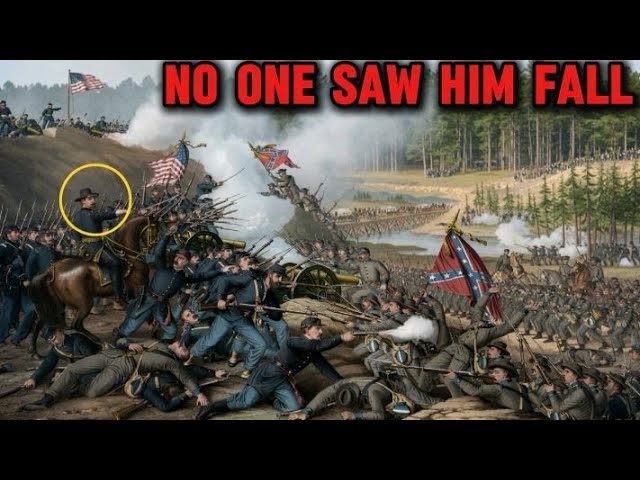
Nobody on the Union side saw what happened next. When the Army of the Cumberland finally reformed its shattered lines on the heights of Snodgrass Hill, General William Haines Lytle was not among them. He was not among the officers who stumbled into Chattanooga that night with the routed columns. He was not in any field hospital.
He was not among the prisoners the Confederates would eventually exchange. His own brigade, the men who had served under him through a year of hard campaigning across Tennessee and Kentucky, could not tell anyone where he had gone or what had become of him. He had ridden into the chaos of the Confederate breakthrough at Chickamauga and simply ceased to exist, from the Union Army’s perspective. The Confederates knew where he was.
They had found him in the smoke and the debris, lying among the dead of his brigade in a field he had tried to hold. They recognized who he was. And what they did next was something so far removed from the ordinary conduct of Civil War combat that it became one of the strangest and most affecting episodes the battle ever produced. They sent him back.
But for those terrible hours at Chickamauga, a general of the United States Army had vanished without explanation. His own side had no account of him. His fate was a genuine mystery to the men who served under him, to the officers above him, and to the country that had been reading his poetry for the better part of a decade. William Haines Lytle was not by any conventional measure the kind of man the Civil War was supposed to produce through the necessities of military emergency.
The officers who rose to brigade and division command in the war’s first two years came mostly from West Point, from state militia traditions, or from the rougher culture of frontier soldiering that the pre-war army had cultivated across three decades of Indian campaigns and border conflicts. Lytle came from none of those worlds. He was a Cincinnati lawyer, the son of a congressman, a man who had read Greek and Latin at an age when most of his contemporaries were still struggling through basic schoolroom arithmetic. He had served briefly in the Mexican War as a young officer, come home without distinction, returned to Cincinnati and the law, built a legal practice, and then turned quietly, without any public announcement, to writing poetry.
The poem that established his reputation was published in 1858, five years before anyone in America had heard of Chickamauga Creek. He called it Anthony and Cleopatra. It was a dramatic monologue written from the perspective of Mark Antony in his final moments: a dying soldier addressing the woman he loved, composing himself for death with a kind of resigned, elegant dignity. The poem treated death in battle not as a catastrophe to be mourned but as completion, the natural endpoint of a life spent committed to something larger than individual survival.
It became one of the most reprinted poems in American magazines in the years before the war. Schoolchildren memorized passages from it. Newspapers reached for it whenever a prominent public figure died in circumstances that seemed to require that particular quality of dignified sorrow. The lines were famous enough that when Lytle himself lay dying at Chickamauga, Confederate officers standing over his body were reported to have quoted them.
He had written his own eulogy five years before he needed one. When the war came in 1861, Lytle raised a regiment in Ohio and went south with it. He was wounded at Carnifex Ferry in western Virginia badly enough to require months of recovery before returning to field command. He was wounded again at the Battle of Perryville in Kentucky in October 1862, shot through the hip during the Confederate assault on the Union left.
He was captured when the position collapsed around him and held as a prisoner for several months before being exchanged. By the summer of 1863, he had been wounded twice, captured once, and promoted to command a brigade in the Army of the Cumberland: three regiments from Ohio, Illinois, and Indiana that had been in continuous hard service through the campaigns of the previous year. He was thirty-six years old. The men of his brigade left accounts that describe a commander attentive to the human texture of military life in ways senior officers rarely were.
He visited the sick in the regimental hospitals. He wrote letters home for men who could not write. He had a habit of riding along his picket lines at dusk and talking with sentinels, not as formal inspection rounds, but as genuine conversation about where the men were from and what they had left behind. He remembered things men had told him weeks earlier and asked about them.
He was respected with an authenticity that units reserve for officers who have proved something real under fire. The Battle of Chickamauga began on September 18, 1863, in dense second-growth forest along the west bank of Chickamauga Creek in northwestern Georgia. The strategic context was this. The Army of the Cumberland under William Rosecrans had been maneuvering through the mountain passes south of Chattanooga, threatening to cut the Confederate Army of Tennessee off from its supply line to Atlanta.
Braxton Bragg, commanding the Confederate force, had retreated from Chattanooga in early September under pressure from this maneuvering and spent the following weeks receiving reinforcements from across the Confederacy. The most significant was James Longstreet’s corps, transferred by rail from the Virginia theater in a logistical feat that covered nearly nine hundred miles in under two weeks. Rosecrans had not fully accounted for this reinforcement in his operational planning. When Bragg chose to strike along Chickamauga Creek, the Union Army was more dispersed than its commanders fully understood.
The forest was the defining condition of Chickamauga. It was not the open-field fighting of Gettysburg, where observers on elevated ground could follow the movements of entire divisions across miles of farmland. At Chickamauga, brigades lost contact with the units beside them within minutes of engaging. Regiments fought without knowing what was happening fifty yards to their left or right.
Commanders sent messengers into the timber and sometimes received no response because the messenger had been killed before reaching his destination. The battle generated a particular kind of operational chaos specific to that ground. The fighting through September 18 and into the afternoon of September 19 was brutal and produced no clear result. Bragg drove repeatedly at the Union left, trying to cut Rosecrans off from the road to Chattanooga, and Rosecrans responded by stripping troops from his right to reinforce the threatened flank, stretching his line until it covered more ground than his available force could comfortably hold.
By the morning of September 20, the Union position had gaps that had been patched with units already weakened by the previous day’s fighting. Longstreet’s assault struck one of those gaps at approximately eleven in the morning, and the consequences were almost instantaneous. The immediate mechanical cause was a communication failure in the Union command. A division was ordered to shift its position based on an erroneous staff officer’s report, and a section of the line was uncovered when in fact it was not.
The shifting of that division opened a gap of roughly a quarter mile in the Union line at the precise moment Longstreet sent eight brigades forward in a deep column formation designed to break through a single point. The Confederate column drove straight through the gap before the Union command structure could react. Three divisions on the Union right ceased to exist as organized fighting units in less than an hour. Men who had been standing in a formed battle line one moment were running north through the forest, throwing down rifles and equipment and knapsacks as they went.
Corps commanders Alexander McCook and Thomas Crittenden were swept up in the rout and unable to arrest it. Rosecrans himself, arriving at the position where his right wing had been and finding Confederate infantry there instead, concluded the battle was lost and rode for Chattanooga. He was wrong. George Thomas was holding Snodgrass Hill two miles away with the remnants of enough divisions to prevent complete catastrophe.
Thomas’s stand through that afternoon, fighting off repeated Confederate assaults with ammunition running low, became the act that saved the Army of the Cumberland from total destruction and earned him the nickname the Rock of Chickamauga. But in the hours of the collapse, before Thomas’s position was understood as the anchor of anything coherent, the Army of the Cumberland’s right wing had no directing general and no functioning plan. The men who survived the rout scattered north toward Chattanooga in a state contemporaries described with considerable consistency as resembling complete dissolution. The road to Chattanooga was choked with men who had abandoned their weapons, officers who had lost their commands, and horses running loose through the timber without riders.
McCook and Crittenden both faced courts of inquiry when the army finally had time to reckon with what had happened. The record does not establish with precision who found Lytle first or under what exact circumstances. What it does establish clearly is that Confederate officers recognized him by his uniform and rank insignia and that they treated his body with a deliberate care that stood in sharp contrast to the ordinary handling of fallen enemy soldiers on a contested battlefield. His sword was recovered and kept apart from the debris of the field.
His personal correspondence and effects were gathered. He was laid out with a formality that communicated something specific. Several Confederate accounts report that the officers who found him quoted lines from his Antony poem over his body, the passages about a soldier meeting his end without complaint in the cause he had chosen. Whether this is precisely accurate, or whether it accumulated in retellings by men who could not resist the symmetry, nobody can determine with confidence from this distance.
But the Civil War record contains enough of these strange convergences that dismissing this one requires more certainty than the surviving evidence actually provides. His body was sent back to Union lines under a flag of truce, accompanied by his sword and personal correspondence. This was not standard practice. The deliberate formal return of a dead enemy officer’s remains and possessions carried specific meaning in the military culture of 1863.
It was the Confederate Army communicating, in the vocabulary available to it, that this particular man had earned something the ordinary politics of the war could not erase. When news of Lytle’s death reached the North, it registered with an intensity disproportionate to his rank. Dozens of colonels and brigadiers had died at Chickamauga; most were mourned briefly and absorbed into the broader casualty accounting of the battle. Lytle was different because the public already had a way of understanding him.
He was the man who had written the Antony poem. His death arrived with its own interpretive frame already constructed. Newspapers ran the poem alongside the casualty notice, and readers who had memorized those lines about meeting death without flinching now read them about a man who had just done exactly that. The emotional effect was unlike the ordinary weight of battlefield loss.
It was something closer to watching a thing complete itself. The Army of the Cumberland had no time to dwell on any of it. Grant arrived to take overall command. Sherman’s army marched across Tennessee to break the siege of Chattanooga.
The campaign of late 1863 consumed everyone who survived Chickamauga. Lytle’s death was absorbed into the larger crisis and the larger recovery from it. But the gap in the record has never been filled. Those ten or fifteen minutes between the moment he rode forward and the moment Confederate soldiers found him lying in the field remain unaccounted for by any Union survivor.
No one who was there left a description establishing how many times he was hit, whether he was alive when he fell from his horse, whether the end came quickly or not. He disappeared into Chickamauga’s smoke the way thousands of other men disappeared on that morning, except that the smoke surrounding his disappearance carries the additional weight of everything he had written before the war and everything the Confederates chose to say about finding him. William Haines Lytle was buried in Cincinnati. At his death, he was thirty-six.
A man who had been wounded three times, captured once, and had led men through two years of western theater campaigns that produced some of the hardest sustained fighting the war generated. His poem outlasted him by decades. For a generation of American schoolchildren in the late nineteenth century, his name appeared in literary anthologies beside writers who had never been within a thousand miles of a battlefield. The soldier had become a poet before the war.
The poet went back to being a soldier when the war demanded it. Both versions of the man converged at Chickamauga in September 1863, in a field his brigade could not hold, in minutes that none of the men who survived them could afterward clearly describe. Lytle died in the collapse rather than the resistance, and military history has always preferred the resistance. But what his story preserves is something exact about what Chickamauga actually was.
It was the closest any major Union army came to complete battlefield destruction during the entire war. It produced one of the most decisive Confederate tactical victories of the conflict. And somewhere inside it, a Cincinnati lawyer who had written poems about dying without complaint rode forward into a Confederate surge that had already consumed the men beside him, because that was what his position required of him. The officers who found him thought enough of what he had done to send him home.
That gesture is as close as the record comes to a final accounting of who William Haines Lytle was and what those last minutes cost and meant.