On the black volcanic sands of Iwo Jima, the flamethrower operator was the most hunted man on the battlefield. By the time the Marines finished taking the island in the spring of 1945, the men who carried those weapons had suffered a casualty rate above ninety percent. Of the roughly 335 flamethrower operators who served there, only 18 came back alive. Most died before they ever fired a shot.
Those who survived rarely spoke of it again. Iwo Jima was not a typical island. Barely eight square miles of jagged volcanic rock, it steamed with sulfur and offered no trees, no rivers, and no shelter. But its location made it priceless to the United States.
Sitting halfway between the Marianas and the Japanese mainland, it lay directly beneath the flight path of B-29 Superfortress bombers raiding Japan. If America held the island, it would gain an emergency landing site and a fighter base to escort the bombers. If it failed, the island would become a graveyard. The Japanese command saw the invasion coming months in advance.
General Tadamichi Kuribayashi, unlike many of his superiors, understood that Japan could not win the war. He intended instead to make the Americans pay so heavily for the island that Washington might reconsider an invasion of Japan itself. Rather than rely on banzai charges, he ordered his men to carve the island into a fortress. They dug more than eleven miles of tunnels through the volcanic core.
Command bunkers, mortar nests, machine gun pillboxes, and supply stations were buried deep beneath the mountain, reinforced with steel and concrete, and hidden so well that aerial reconnaissance could not find them. His strategy was simple: delay, ambush, and sacrifice. There would be no suicidal charges. Just silence, traps, and death from below.
On the morning of February 19, 1945, the United States unleashed one of the heaviest pre-invasion bombardments of the Pacific War. Naval guns pounded the island for days while bombers dropped tons of explosives. But most of the Japanese garrison was not in the trenches. They were deep underground, untouched and waiting.
The landing craft came in and dropped thousands of Marines onto the black shore. The beach was unlike Normandy. The sand was volcanic ash, fine and sticky, swallowing boots, jamming tank treads, and slowing every movement to a crawl. There was no cover at all.
For over an hour, the beach was eerily quiet. Some Marines thought the bombardment had worked. Then, with the beach full of men and equipment, the Japanese opened fire from hidden positions. Pre-sighted artillery exploded in the surf.
Machine guns raked the sand. Mortars dropped among the landing craft. Within minutes, the beach became a killing field. The Japanese had deliberately let the Americans land, get comfortable, and then cut off their escape.
They were not trying to hold the shoreline. They were trying to bleed the invasion force dry. The deeper the Marines pushed inland, the stranger and deadlier the fight became. There were no front lines.
A position could be cleared, and then the Japanese would reappear from tunnels behind it. The pillboxes were reinforced to survive direct hits from tanks and naval guns. Their entrances were hidden behind rocks, and their gunports were positioned to cover one another. A Marine charging one would be cut down by another he had never seen.
Almost all of the pillboxes were connected underground, so destroying one did not remove the threat. The Marines were fighting ghosts beneath their feet. Grenades and satchel charges only worked if a man could get close enough, and getting close meant crossing open ground under machine gun fire. Even when a Marine reached the pillbox, the zigzag interiors often absorbed the blast, sparing the defenders.
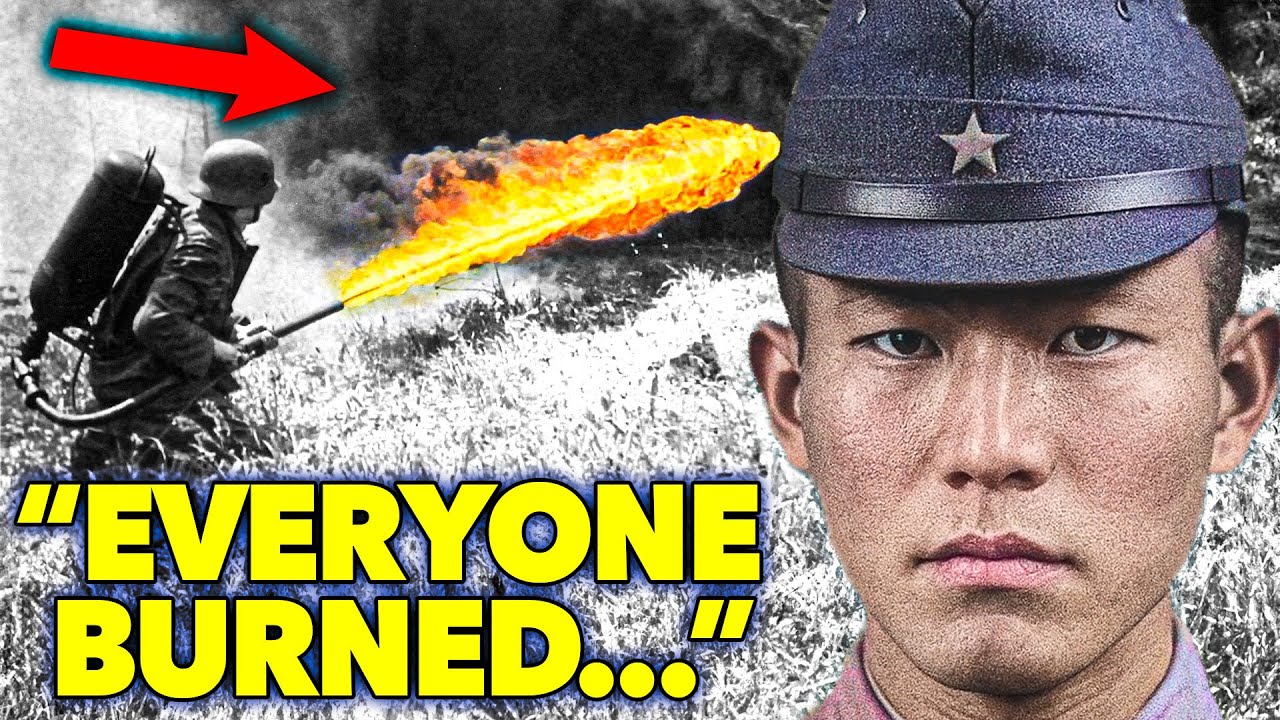
It was a war of inches, and it was tearing the divisions apart. Then someone brought up an old, nearly forgotten weapon: the flamethrower. The M2 flamethrower was a brutal machine. Fully loaded, it weighed about seventy pounds, with two fuel tanks and a central nitrogen propellant tank strapped across the operator’s back.
The fuel was a thickened mixture of gasoline and diesel that stuck to anything it touched and kept burning. When the operator pulled the trigger, the nozzle unleashed a roaring stream of flame up to thirty yards for just ten seconds total. Ten seconds. That was the difference between life and death.
Once the tanks ran dry, the operator became the most exposed man on the battlefield. The Japanese knew this. They called the flame operators demons and issued direct orders to eliminate them at any cost. They were ambushed, shot on sight, and sometimes captured.
One Marine recalled watching a fellow flamethrower charge a cave, aim his weapon, and have it misfire. Before he could retreat, two Japanese soldiers grabbed him and pulled him into the darkness. For two days, Marines nearby heard his screams. Then they stopped.
There was no rescue. That was why flamethrower men often begged their squadmates to shoot them if they were ever captured. Even those who survived carried a crushing moral weight. The flamethrower created an inferno over one thousand degrees Fahrenheit.
Inside caves and pillboxes, it vaporized the air and consumed all oxygen in seconds. One operator described clearing a pillbox with fire, then climbing inside after the smoke cleared. What he saw made him vomit. He sat outside in silence for an hour before his commanding officer ordered him back into action.
Many operators refused to use the weapon again. Some begged for reassignment. Others threw up before missions. Decades later, many confessed they had never told their families what they had done.
The answer to the carnage was not more men. It was more metal. When casualty rates for flamethrower operators passed ninety percent, commanders made a chilling but effective decision. They put the flame inside a tank.
The result was the M4A3R3 Sherman, a standard medium tank modified to replace its main gun with a flamethrower. It became known as the Flame Sherman. Where the backpack M2 could shoot thirty yards, the tank had a range of nearly one hundred yards. Where the Marine had ten seconds of fire, the tank carried three hundred gallons of fuel.
And it had armor. But the armor was not invincible. The volcanic ash bogged down the treads and made the tanks easy targets. The Japanese knew that taking out a flame Sherman could turn the tide of a battle, so every one of them became a priority target the moment it opened fire.
Suicide charges, hidden mines, and explosive traps were all aimed at them. Yet the crews went forward, coordinating with infantry who provided cover fire. The tanks rolled up to tunnel entrances and bunkers and unleashed torrents of fire so intense they melted steel and glass. Entire enemy positions surrendered at the sight of them.
Without those tanks, the island might never have been taken. For one Marine, Hershel “Woody” Williams, the flamethrower would become the stuff of legend. On February 23, 1945, the same day the American flag was raised over Mount Suribachi, Williams, a quiet Marine from West Virginia, was handed what many called a suicide mission: destroy a series of pillboxes that had pinned down his entire company. Several Marines had already been killed trying.
No one wanted the job. Williams said yes. With four Marines assigned to cover him, two of whom would die within minutes, Williams crawled across the volcanic ash under withering machine gun fire, a flamethrower strapped to his back. He found a narrow slit near the air vent of the first pillbox, shoved the nozzle in, and pulled the trigger.
Fire tore through the bunker, followed by screams, then silence. He did not pause. He moved to the next pillbox, then the next. Between assaults, he sprinted back to the rear line to grab another loaded flamethrower.
By the end of his run, he had cleared seven enemy positions single-handedly. When one Japanese soldier charged him with a bayonet, Williams turned, fired a jet of flame, and stopped the attack. When the dust settled, the Americans advanced because of him. Williams was awarded the Medal of Honor, becoming the only flamethrower operator in World War II to receive that distinction.
But he never thought of himself as a hero. He lived until 2022, passing away at the age of ninety-eight. In interviews, he admitted he could not remember much of the actual battle, likely a defense mechanism. What he did remember were the faces of the Marines who did not come back.
“I’ve never considered myself a hero,” he often said. “The heroes are the ones who never came home. ”
His humility masked a deep torment. Even decades later, Williams wrestled with the moral weight of what he had done.
His weapon did not just kill. It incinerated. It erased. And it left scars on both sides.
Flamethrower operators from the Pacific War rarely spoke of their role. Many refused to tell their families. Veterans groups reported disproportionately high rates of alcoholism, depression, and suicide among former flame troops. They had not just taken lives.
They had extinguished them in ways that felt unnatural. The military retired the flamethrower in the 1970s. Officially, it was outdated. Unofficially, it was too brutal to justify anymore.
In 1980, the United Nations Convention on Certain Conventional Weapons listed incendiary weapons as subject to restriction. While flamethrowers were not outright banned, their deployment in civilian areas or against populations became strictly regulated. Modern militaries began distancing themselves from their use. Iwo Jima was captured.
The flag went up. The war in the Pacific moved closer to Japan. But for the men who carried fire on their backs, the victory came at a cost that history rarely talks about.
Some weapons leave wounds that never heal, and some men carry burdens that no metal can ever lift.