Imperial Germany entered the First World War as the dominant industrial and military power on the European continent. By 1914 it produced more steel than Britain and France combined, led the world in chemistry and electrical engineering, and fielded a professional army directed by a general staff widely considered the finest of its age. It went to war with allies that formed a coherent strategic bloc controlling territory from the North Sea to the borders of Mesopotamia, and it financed its war effort through domestic borrowing and a recognizable system of credit, debt, and production that could be measured and planned. When Adolf Hitler came to power in January 1933, Germany was prostrate.
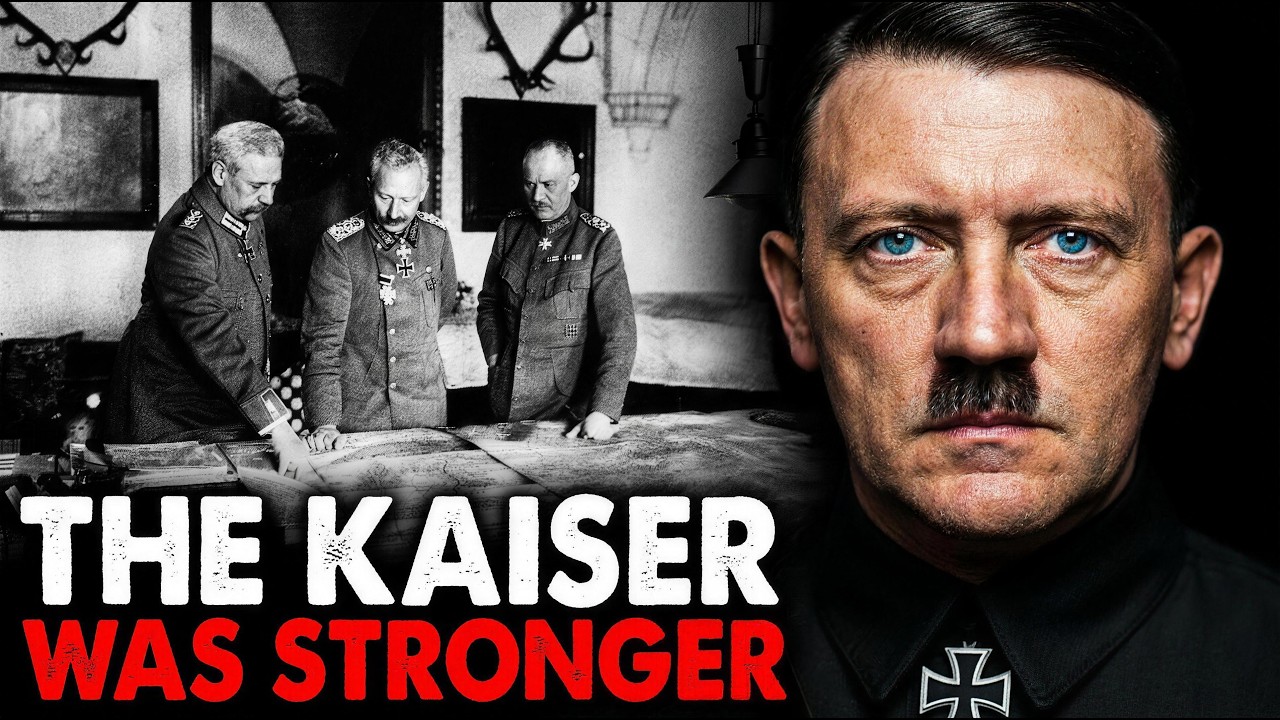
Hyperinflation had destroyed the savings of a generation, the Depression had pushed unemployment toward thirty percent, and the Treaty of Versailles had stripped the country of territory, military capacity, and standing. Within six years Hitler rebuilt Germany into a force capable of overrunning Poland, France, the Low Countries, Yugoslavia, and Greece in rapid succession. That achievement concealed fundamental weaknesses that the earlier imperial state never suffered to anything like the same degree, and the comparison between the two Germanys reveals how deep those weaknesses ran. The economics of the two wars could hardly have been more different.
Wilhelmine Germany went to war in 1914 with a rational financial foundation. The mark remained broadly stable through the first two years of the war, and industrial mobilization accelerated dramatically under the Hindenburg Program from 1916 onward, reorganizing the economy for war production on a centrally planned basis. Hitler’s rearmament, by contrast, was financed through a barely concealed fraud. The economist Hjalmar Schacht invented financial instruments called Mefo bills, promissory notes issued through a shell company, guaranteed by the government but kept off the books to disguise the true scale of rearmament.
By 1939 Germany had accumulated vast hidden debt, its foreign exchange reserves were barely sufficient to sustain imports for a few weeks, and it depended on foreign sources for oil, rubber, and iron ore with no realistic plan for a prolonged conflict. Schacht himself resigned as Reichsbank president in January 1939 because he believed the financial position was dangerously unsustainable. He was right. The industrial organization of the Nazi state was a bureaucratic catastrophe.
The Third Reich was not the efficient totalitarian machine it appeared to be from outside. It was a chaos of competing fiefdoms, overlapping jurisdictions, and personal rivalries. Göring’s Four-Year Plan competed with the Economics Ministry, the SS ran its own slave-labor enterprises, and the army, navy, and air force maintained separate procurement systems that duplicated effort on a massive scale. Hitler intervened constantly and erratically in economic decisions, favoring personal cronies and making choices based on ideology rather than calculation.
Britain, with a smaller population and a similar industrial base, outproduced Germany in aircraft for most of the war until Albert Speer’s reforms took effect in 1943. Germany refused to mobilize women for war work on ideological grounds, clinging to the doctrine of Kinder, Küche, Kirche, and instead turned to forced labor, importing millions of workers from occupied territories who produced far less than free labor under humane conditions. Imperial Germany’s military thinking was the product of a coherent strategic tradition. The general staff had refined its approach since the days of Moltke the Elder, developing Auftragstaktik, a command philosophy that delegated decision-making to the lowest practical level and trusted junior officers to use their initiative.
This produced an army of remarkable tactical flexibility. The infiltration tactics developed by officers like Oskar von Hutier in the final years of the First World War were a genuine revolution in military thought. The Wehrmacht inherited many of the best features of that tradition, and the Blitzkrieg victories of 1939 and 1940 were direct descendants of those infiltration methods adapted for tanks and aircraft. But the Wehrmacht operated under a political commander-in-chief who progressively strangled the qualities that made it effective.
Hitler dismissed, overruled, and replaced virtually every senior officer who gave him unwelcome advice. He took personal command of the army in December 1941 after the failure before Moscow, and by the final year of the war he was making decisions at divisional level from his bunker in Berlin, ordering units to hold positions that no longer existed. Imperial Germany’s supreme commanders were professionals who made decisions on the basis of military analysis. Hitler’s approach was the opposite.
His belief that willpower could overcome any material disadvantage led directly to some of the worst decisions of the war. He insisted on holding Stalingrad when a breakout might have saved over three hundred thousand men. He refused to build a strategic reserve for the expected Allied invasion of Western Europe, preferring to hold troops forward where Allied air power could destroy them. His insistence on declaring cities to be fortresses to be held to the last resulted in needless destruction and pointless deaths.
The war aims of the two states were fundamentally different in character. Imperial Germany fought for security on its eastern border, colonial revision, freedom of the seas, and recognition as a great power, objectives that in principle could have been achieved through negotiation. Hitler’s aims as set out in Mein Kampf called not merely for territorial revision but for the racial reorganization of Eastern Europe, the partial extermination, enslavement, and expulsion of Slavic peoples, and the complete elimination of the Jewish population of Europe. These were not aims that could be achieved through negotiated settlement, and they guaranteed that Germany’s opponents would fight to the last rather than accept any terms that left the Nazi regime in power.
The alliance structures of the two wars also favored the imperial period. Austria-Hungary with its fifty million people was a genuine strategic partner that coordinated military operations with Germany on shared fronts. The Ottoman Empire controlled strategically vital territory and defeated the Allies at Gallipoli. Bulgaria completed a contiguous bloc stretching from the North Sea to Mesopotamia.
Hitler’s allies were almost grotesquely inadequate. Italy had to be rescued in North Africa and Greece and collapsed in 1943, forcing Germany to occupy its own ally’s territory. Japan fought an entirely separate war in the Pacific and never cooperated with Germany on any significant military endeavor, while its attack on the United States brought American industrial power into the war without providing Germany any corresponding benefit. The Nazi technological programs offer the starkest illustration of the difference.
Germany had jet aircraft ready for deployment a year before Britain and America, but Hitler insisted the Me 262 be converted into a bomber, delaying its service and reducing its performance. The V-2 missile was the first operational ballistic missile, but it was essentially useless, killing far fewer people than died building it. Germany’s persecution of Jewish scientists had deprived it of some of its most brilliant physicists, who contributed their expertise to the Manhattan Project instead. Imperial Germany’s chemical and optical industries, by contrast, solved the strategic problem of nitrogen fixation for explosives through the Haber-Bosch process and provided its artillery and naval gunners with consistent accuracy advantages.
The political structures of the two states were the most fundamental point of comparison. Imperial Germany was a functioning constitutional monarchy with a professional civil service, an independent judiciary, and a freely elected parliament. The Nazi state was built not around institutional competence but around personal loyalty to a single leader. Hitler’s governing style, described by his biographer Ian Kershaw as working towards the Führer, meant that every agency competed for his favor, producing permanent institutional conflict and decisions of catastrophic quality.
The subject of this competition was the opposite of what military effectiveness requires. The intelligence failure of Nazi Germany was of a different order from anything Imperial Germany experienced. Hitler’s planners catastrophically underestimated Soviet industrial capacity and the determination of the Soviet population, and they never factored in the ability of the United States to supply the Soviet Union through Lend-Lease. More damaging still, British and American codebreakers at Bletchley Park broke the German Enigma codes, providing the Allies with access to a large proportion of German military communications throughout the war.
Germany never suspected the codes had been broken. The human cost of German state action in the Second World War has no parallel in the first. The Holocaust, the systematic murder of approximately six million Jewish people of Europe, was planned and organized by the German state with the same administrative thoroughness it brought to railway timetabling. It was carried out alongside the murder of hundreds of thousands of Roma, the killing of over three million Soviet prisoners of war in the first year of the war, and the murder of the handicapped.
Imperial Germany committed atrocities in Belgium, conducted unrestricted submarine warfare, and exploited occupied territories brutally, but it did not operate extermination camps. It did not implement a program for the biological elimination of entire peoples. When faced with the prospect of defeat, the two states behaved in ways that revealed their fundamental characters. Imperial Germany negotiated an armistice through legitimate diplomatic channels, handed power from the military to a civilian government, and preserved the basic institutional continuity of the German state.
The country recovered during the 1920s, reached agreements with its former enemies, and rejoined the international community. Nazi Germany fought to the absolute limit and beyond, sacrificing hundreds of thousands of its own people in a final defense of a system whose leaders had given up hope. Hitler died by suicide on April 30, 1945, having issued the Nero Decree ordering the destruction of Germany’s remaining infrastructure rather than allow it to fall to the Allies. Germany in 1945 was not merely defeated; it was destroyed, divided among four occupying powers, its institutions dismantled, its cities in ruins.
The comparison between the two Germanys demonstrates a fundamental truth about the relationship between political systems and military power. Rational military power requires honest information, professional institutions, and war aims that are at least in principle achievable. Imperial Germany satisfied many of these requirements and came genuinely close to winning its war. Nazi Germany satisfied essentially none of them.
The Wehrmacht fought with extraordinary skill and imposed disproportionate losses on its enemies until the very end, but tactical brilliance cannot compensate for strategic incoherence, economic miscalculation, and ideological madness at the level of political leadership. By every measure that truly matters, Hitler’s Germany was not the fulfillment of German military power but its catastrophic perversion.