On July 16, 1945, 28 men walked down to a landing craft on Guam, every one of them with his face turned away from the camera. The Navy photographer who took the picture was not permitted to show them. A sensor blocked out their faces before the print went to the wire services, and the caption that traveled with the photo explained why the boat was there at all. The 28 were Japanese doctors and medical corpsmen, prisoners of war captured by the Marines on Guam the summer before and held there ever since.
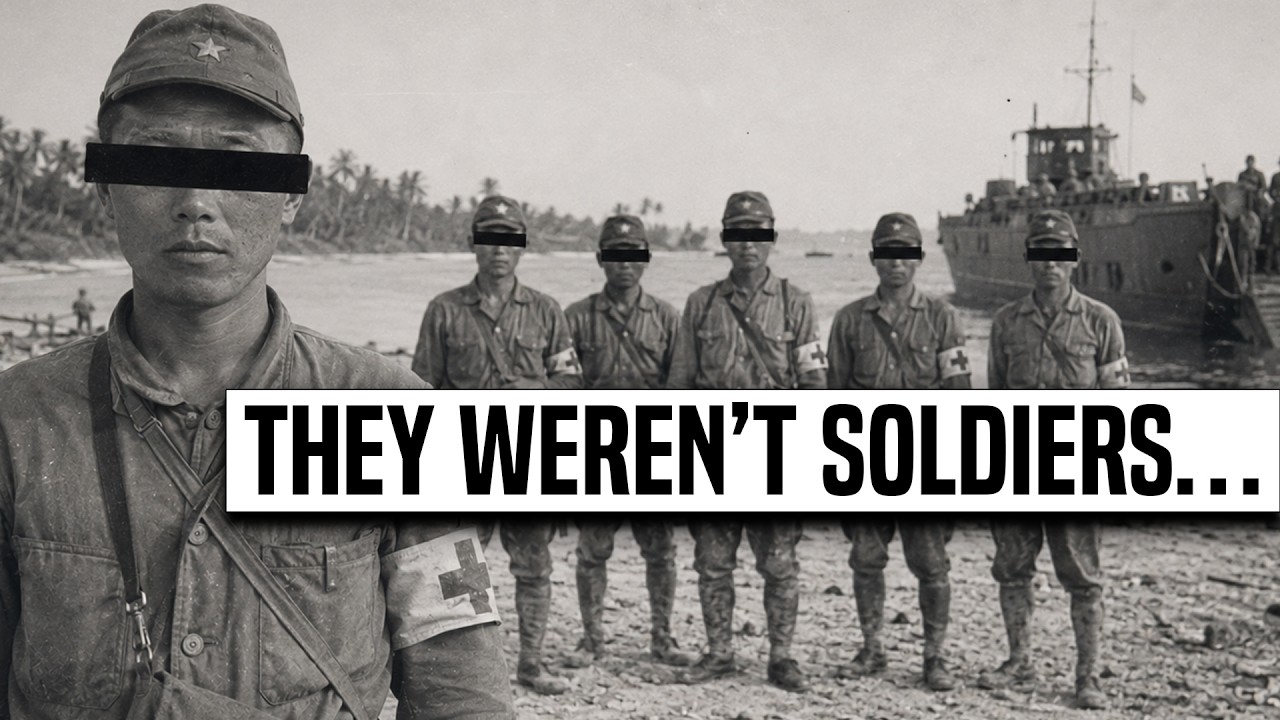
They had volunteered. The boat was carrying them to Okinawa to work for American Navy doctors. That caption is nearly the whole surviving file on those men. It gives their number, their trade, the date, and the detail that they raised their hands for the job.
It carries no names at all, and the faces are gone. What the file does supply is a question. Somebody in the American medical organization on Okinawa had gone hunting for enemy physicians in a prison compound 600 miles to the south, and had gone to the trouble of shipping them in. Somebody had decided he needed them.
The reason sits in a set of figures the 10th Army was keeping through that spring. The plan for the invasion gave the Civil Affairs Organization charge of whatever population came out of the caves. By the end of April, the number of Okinawans in American hands was 126,876. The bitter fighting slowed the intake through May.
Then the Japanese line broke. The South emptied and the total went on climbing until the fighting stopped. Detachments built to run a camp of 10,000 people were running camps of twice that size. The Army’s history of the campaign lists what ran short in those camps as the summer went on, and the list is brief and specific: cooks, military police, and hospital corpsmen.
That is the answer to the boat. The American Medical Service on Okinawa had been handed a civilian population the size of a mid-sized American city, most of it hungry, much of it carrying lice and fleas after weeks underground, and it did not have the hands. So it went to Guam and asked the enemy’s doctors whether they wanted work. Under the division of labor agreed before the landing, the Army held responsibility for all medical stores across the operation, and the Navy held responsibility for military government, which made Okinawan civilians a Navy problem—and those 28 men a Navy answer to it.
To understand what they were walking into, it helps to follow one hurt man through the machine they were joining. The machine had a fixed shape, and every part of it did one job. A man hit on the Okinawa line was collected and carried back in a jeep ambulance, a weasel, or a weapons carrier. The first stop was a battalion aid station situated 200 to 400 yards behind the front, where the bleeding was stopped and the splints went on.
From there he moved by ambulance to a collecting company. That link mattered more than its name suggests, because it was the first installation in the chain equipped to give whole blood. Refrigeration had changed what was possible. Ice boxes let whole blood go forward to regimental and even battalion level, an echelon or two nearer the front than in any earlier campaign.
The forecast for Okinawa was one pint of blood for every casualty. Two years before, in 1943, the working figure had been one pint for every three. After the collecting company came the division clearing station with a portable surgical hospital attached, and then a field hospital 4,000 to 6,000 yards behind the line. The portable surgical hospital is worth pausing on, because it was an Army invention and the Navy did not have one.
Four physicians and about 30 men in all. It existed to put a surgeon within reach of a casualty who would not survive the ride to the rear. The Army did not have enough of them even for its own divisions, so some regiments went without. The Marine divisions of the III Amphibious Corps had none attached at all, which meant that on paper they entered the largest amphibious operation of the Pacific War with no forward surgical capability whatever.
The 1st and 6th Marine Divisions solved it by scavenging. They acquired leftover trailers and amphibious tractors, fitted them out with operating-room equipment, and improvised the staff to run them. Everything downstream ran at fixed strength. Each Marine infantry battalion on Okinawa held 40 hospital corpsmen, two of them with every rifle platoon, and each combat unit trained its own litter bearers and spread them through the rifle companies.
The corpsman with the platoon opened the chain, and everything behind him depended on what he did in the first moments. Colonel Frederick Westervelt, the 10th Army Surgeon, wrote the plan that built all of this through the autumn of 1944 in Hawaii. He had come from Admiral Nimitz’s staff and understood both the Army and Navy sides of the business. It was an awkward plan to write.
The Fifth Fleet staff sat at Ulithi, far out in the Carolines, while fighting continued in the Philippines. The III Amphibious Corps was scattered across the Marianas and the Palaus. Nobody was in the same place as anybody else. Medical intelligence on Okinawa was thin to the point of comedy.
The planners appeared to have had a single solid item about the island’s health hazards—that it contained poisonous snakes—and it turned out not to have any. Westervelt forecast 30,000 casualties. He asked for 8,000 hospital beds so that men could be held on the island, healed, and returned to their units rather than shipped back to the Marianas. He was given 4,500.
The chain broke twice under weather. When the heavy rains came on May 20, the main roads washed out and evacuation from the divisions south of the Naha-to-Yonabaru line stopped altogether. Casualties began going out by landing ship from Machinato on May 31 and from Yonabaru two days after that. In the Marine sector, the reef and enemy fire ruled out a sea route.
Artillery spotting aircraft started putting down on a stretch of concrete highway north of the town and flying casualties up the coast to Chayan. By the end of June the spotter planes had taken out 1,232 men. For two days at the end of May, nothing left Okinawa at all, because the airfields were unusable and no hospital ship was on hand. At the end of April there were six field hospitals and one Marine evacuation hospital working.
By June 22, when Okinawa was declared secure, the beds available for battle casualties had crept up to 3,929. That shortage governed everything else. It is why the American Medical Service spent the whole campaign shipping men off the island who should have stayed on it, and why about 80 percent of all battle casualties had gone by June 30, half by air and half by sea. It cost the 10th Army trained infantry it could not replace.
Now hold that picture of a service running short of beds, and look at what the beds had been ordered against. Two months before Okinawa, the same planning organization had done the same work for Iwo Jima, and the Navy’s own official medical history sets out what went into it. The planners worked out how many of the attacking force would be killed, how many would go back to duty on the island, and how many would be shipped out. Then they added a category.
The history states it without emphasis: “Taking into consideration civilian casualties and enemy injured to whom the Americans were likely to be required to furnish medical care. ”
Plans were drawn up covering evacuation policy, the number of beds and ships required for hospitalization, and the volume of supplies to be ordered. Enemy injured sat inside the bed count and inside the stores order, written down in Hawaii by men who had never seen the island months before a single American set foot on it. The Okinawa plan carried the same shape.
The Navy’s medical history lists what the Okinawa planning provided for, and the first item on that list is the care of the sick and injured, with medical care for the civilian population named inside the same clause. Nobody bolted it on when the caves started emptying. It stood at the head of the list, not the end of it, in a document finished before the fleet sailed. This changes the story of what happened at the aid stations, and it changes it in an unromantic direction.
When Japanese casualties were carried in on Okinawa, the corpsmen handling them were not reaching a moral decision in the mud. They were executing a calculation that had been made for them in an office by men who had costed it in beds, in litters, in plasma, and in ship space. There was a column for them, and they were working inside it. What they did was close to boring, and the boringness is the point.
The man went into the same chain in the same order. Bleeding stopped, splint applied, tag written and tied to him with the treatment already given entered on it. Back to a collecting company for blood if he needed blood. Forward to a clearing station where a portable surgical hospital was working.
If he was carrying a suspected penetrating injury to the abdomen, he got a stomach tube passed, because a stomach tube was passed in every such case. If he was in shock, he went into a shock tent pitched right beside the operating tents, where the staff worked out how much blood he had lost with a copper sulfate test and decided how soon he needed the table. If the surgery went well and the rain held off, he left the island in the same hospital shipping and the same aircraft as the men who had shot him. A guard went with him, and that was the whole of the difference.
There is a version of this story in which it becomes an account of American mercy, and the file does not support it, because the Americans had every reason and every excuse to stop—and they can be shown to have had them. On April 28, 1945, a kamikaze hit the hospital ship Comfort amidships. It went into an operating room before it exploded. It killed patients on the table and killed the Army surgical personnel who had been put aboard to help the Navy staff cope with the load.
The Navy’s medical history gives the toll as 29 dead and 33 injured. Other official studies total that day’s losses differently and put the combined figure for the two ships struck higher than the Navy’s own history does. What is not in dispute is the second ship. The transport Pinkney was hit amidships the same day after she had already put her troops ashore, losing 22 men dead, 11 injured, and 19 missing.
Both ships were marked. Both were operating under a convention which held that the markings meant something. Two other hospital ships, the Relief and the Solace, had already been attacked earlier that month without damage. After April 28, the American hospital ships off Okinawa stopped showing lights at night and began relying on darkness instead—a quiet way of saying that the Geneva Convention had stopped functioning as protection, and everybody involved knew it.
Ashore was no better. The 1st Marine Division alone took 478 casualties among its hospital corps personnel in the southern fighting: 49 dead, 226 injured, 17 hurt in accidents, 186 sick. Corpsmen in the Pacific had already learned to strip off the Red Cross brassard and carry a pistol, because the insignia gave them no cover and in places seemed to draw attention. The men running the aid stations were being killed at a rate their own service found alarming, under markings that had failed twice in one afternoon offshore.
The handling of Japanese casualties did not change. It did not change because it had never been sentiment to begin with. It was a line in a document. It had beds costed against it, and the men in the tents carried it out the way they carried out everything else in that plan.
There is a version of this story in which that becomes an account of American mercy and the file does not support it because the Americans had every reason and every excuse to stop and they can be shown to have had them. The far side of the island was running its own hospital service at the same moment, staffed by men with the same training and the same instincts, working under a different instruction. The Japanese 32nd Army had its field hospital at Hābāru, a few miles inland. It began life in an elementary-school building.
When the pre-invasion bombardment destroyed the school and much of the stores with it, the hospital moved into a system of about 30 tunnels dug into the hills nearby. No red crosses went over the entrances, and nothing about the tunnels had been designed for surgery. They ran about five feet nine inches high and about as wide. Student nurses aged 15 to 19, pulled out of two Okinawan girls’ schools the previous November and given a short course, carried the work the shortage of trained staff left uncovered.
As casualties arrived, the internal-medicine departments were turned into second and third surgical departments, which meant a doctor whose professional background was pediatrics was now operating. That was a medical service doing its job with almost nothing. The men in those tunnels were trained surgeons working with the stores that had survived the bombardment, and what defeated them was not a shortage of skill. When the 32nd Army pulled back south on May 25, the hospital went with it.
The staff and the patients who could walk left carrying whatever stores remained. The patients who could not walk were told that transport was coming for them, and were given milk containing potassium cyanide by the staff who stayed behind, in order to prevent their capture. That sentence is the whole of what needs saying about it. The professional distance between the two services was not a distance of ability.
Both had trained surgeons, orderlies, and stretcher parties. Both had run out of almost everything by the last week of May, and both were working under bombardment with casualties arriving faster than their tables could take them. The distance lay in the order each service had been given about a man who could no longer be carried—and the American order was the one that had been costed in advance, in beds, by planners in Hawaii, for the other side’s injured as well as their own. That is where the 28 men on that landing craft come back into it.
By the middle of July, the fighting on Okinawa had ended and the medical problem had not. There were almost 200,000 Okinawan civilians in American hands. Okinawa had been short of physicians before the battle and was desperate for them after it. Of the 21 Okinawan doctors drafted into the war effort, six were still in the Ryukyus when it ended.
Around a third of the island’s civilian population had been killed or hurt. Military government was providing food, water, clothing, shelter, sanitation, and medical care to a population that had lost its own doctors, its own hospitals, and most of its own buildings, with corpsmen it did not have enough of. Two hospitals served as civilian clinics when it first began, at Genoza and Ishikawa, then two more at Itoman and Nago. Most Okinawans met American medicine for the first time as a dusting of insecticide powder against lice and fleas, applied by an Army medic at a camp entrance.
That is a thin and unglamorous way to begin a medical relationship. For a population that had spent June living underground, it was also close to the most useful thing that could have been done to them in an afternoon. Into that went 28 Japanese doctors and medical corpsmen who had been taken prisoner on Guam 11 months earlier. Nobody wrote down what they thought they were doing.
The censored photograph and its caption are what survive, and a caption is not testimony. Whether they volunteered out of professional reflex, out of boredom in a compound, out of a wish to help Okinawans in particular, or out of some private reckoning about how the war was going to end, the file does not say and may never have said. What can be established is the transaction. The American Navy was short of doctors.
The doctors it wanted were behind wire, and when it asked, some of them said yes. Two other items about the American effort on Okinawa belong in the file, and neither has anything to do with any of this. The 1st Marine Division’s medical officers had found in earlier campaigns that brandy was useful against combat fatigue, shock, and exposure, and they tried to obtain enough of it for Okinawa. The requisitions came back disapproved by higher authority, and they landed without any.
The III Corps medical battalion took a discarded radar trailer and, with help from a CB detachment, turned it into a mobile operating room. It came ashore on Blue Beach 2 on the second day, worked alongside the shore-party medical section, then rejoined its parent unit and ran for the rest of the campaign. The amphibious tractors the Marines converted turned out to be worth more than anyone expected. One was ambushed, and the armor kept the surgical team and the equipment intact.
But the real value was duller than armor. A tractor could be blacked out end to end, which meant a surgeon could take a patient into a room with working lights at once, instead of working under a flashlight beneath a tarpaulin during the rains at the end of May. It also gave him a dry, clean deck to stand on rather than ankle-deep mud. Colonel Robertson, the orthopedic consultant who went ashore on April 5 and served with the XXIV Corps for the following month, thought the outstanding unit he saw was the clearing company of the 7th Medical Battalion.
It was the one division clearing company in the corps with early X-ray facilities. It also had the only barber, the only hot shower, and the only laundry Robertson saw during his entire time on Okinawa. Robertson had gone ashore at Leyte the previous October with a collecting company and had been hit in the left thigh by a shell fragment four days later. When his unit set up in a church at Dulag, it split into a military section for emergency surgery and a civilian section for definitive care, and the surgical team worked through the night on both.
He came out of that campaign with 18 formal recommendations covering splinting, surgical teams, air evacuation, blackout tents, and the training of medical officers. The ninth of them argued that civil-affairs units should be established early enough to take over the medical care of civilians outright, so that the fighting units would be free of the burden. Nobody acted on it in time for Okinawa, which is why the camps were short of corpsmen in July, which is why the Navy went to Guam. At the end of the 18 recommendations, Robertson added one line that has nothing to do with the other 18.
He wrote that he had brought back “a renewed love and admiration for the combat soldier. ” And then he wrote the qualifier: “regardless of his color, flag, or religion. ”
The word “flag” is doing a specific job there, and it is impossible to prove what he intended by it. It sits in an official Army medical history at the end of a list of technical recommendations, written by a man who had watched American and enemy casualties come through the same tents on two islands.
It might be a broad humane sentiment about soldiers in general. It might be what it appears to be. Robertson never expanded on it, and nobody asked him to. That brings the whole thing to where it actually ends: a filing problem.
The medical reporting out of the Okinawa campaign is very good indeed. Beds are counted, as are the pints of blood distributed and the share that went forward by air, the operations performed in the field hospitals, the casualties evacuated by ship and aircraft, the 3,000 to 4,000 combat-fatigue cases, the proportion returned to duty within 10 days, and the died-of-injuries rate of 3. 4 percent against a war-wide figure of 4. 5.
Colonel Robertson’s report and Colonel Flick’s consultant notes go all the way down to the shortage of reducing valves for oxygen cylinders and the borrowing of replacements from ships in the harbor. The reporting is careful, granular, and honest about its own failures. Nowhere in any of it is there a line for the other patients. Some 7,400 Japanese were taken prisoner on Okinawa by the end of June; Admiral Nimitz’s headquarters gives a figure of 9,948 by the 27th.
A proportion of them arrived on a stretcher. Somebody carried each of those men, tagged him, typed him for blood if he needed it, laid him on a table, and afterwards wrote up the case in the ordinary way, because the paperwork requirement did not change either. Those pages went into unit files, and no total was ever compiled, because no total was ever requested. It was not impossible to ask.
In the China-Burma-India theater, the 20th General Hospital had admitted just over 50,000 patients by August 1, 1945, and its own accounting states how many were American, how many were British, and that 325 were Japanese prisoners of war. That hospital knew its enemy figure and published it. The Okinawa organization could have arrived at the same figure and did not, because the men doing the adding were counting what the 10th Army needed in order to fight the next island: beds, blood, ships, and the speed at which it could clear its own casualties off a beach. The enemy patients sat inside those numbers already.
They had been budgeted for at the planning stage and handled as part of the load, so there was no reason to break them out and no requirement to. They surface once, and not as people. The Army’s medical history of the Middle Pacific notes that the arrival of Japanese and Korean prisoners of war in 1945 brought the theater’s laboratories diseases they had not been dealing with, and it lists them: filiariasis, peraganimiasis, infestation with clonorchis sinensis. That is the trace.
Enemy patients enter the official medical account of the Pacific Ocean areas as an expansion of the parasite list, in a sentence about laboratory workload filed under the difficulties of 1945. The organization that had thought about this hard enough in 1944 to put it in a bed order never wrote about it afterwards as an achievement. No campaign history sets it apart. No consultant’s report reflects on it.
The corpsmen who did it were not asked about it then or later, and from the inside there would not have been much to say, because it did not look like anything. It looked like the next man on the litter. That is what the 28 faces were blacked out of.
A photograph taken on July 16, a landing craft off Guam, a caption written by somebody at the Office of War Information, and a Navy short enough of doctors to go find some behind its own wire.