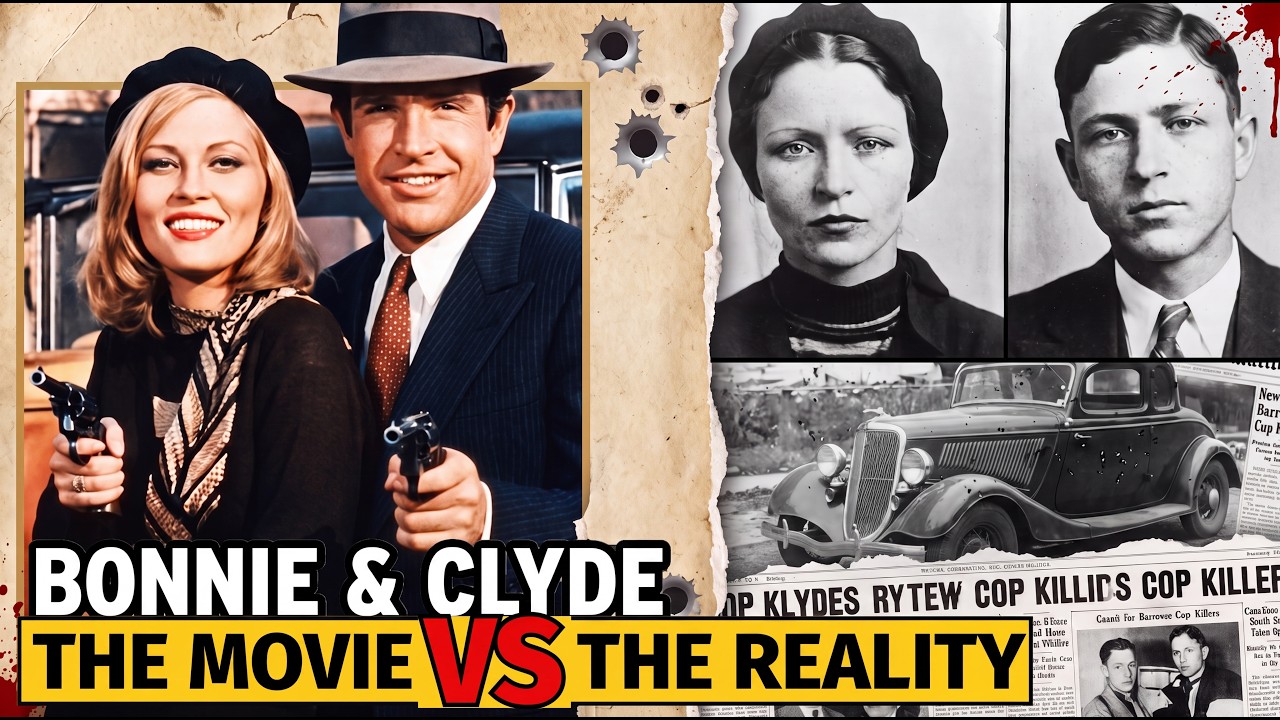
The 1967 film *Bonnie and Clyde* is often remembered as a stylish, romanticized portrait of two young lovers on the run. It turned two criminals into cultural icons and made stars out of Warren Beatty and Faye Dunaway. But according to biographer Jeff Guinn, the film’s accuracy is around five percent. That means nearly everything the public believes about Bonnie Parker and Clyde Barrow is wrong.
The real story is darker, more brutal, and far bloodier than anything Hollywood wanted to show.
Start with something simple: their height. The film cast Dunaway at 170 centimeters and Beatty at 188 centimeters. They looked tall, glamorous, and impossible to miss. The real Bonnie was 150 centimeters tall, and Clyde stood at 163 centimeters. At the time, the average woman was about 157 centimeters, and the average man was about 173 centimeters. The couple was short, and that was the least of the distortions.
The film presents Clyde as a gentle young man pushed into crime by the Great Depression. The system failed him, so he picked up a gun. It is a good story. It is also false. Clyde was already working in chicken farming at age 13 in 1922, seven years before the Depression reached Texas. Crime was a family business. Of seven siblings, five ended up as convicted criminals. The Depression changed nothing for Clyde. His fate was sealed long before the banks collapsed.
In 1930, Clyde was sent to the Eastham prison farm in Texas, one of the harshest places in the state. He arrived young and innocent-looking, which made him a target for the worst inmates. A prisoner named Big Ed Crowder singled him out and beat him repeatedly. One day, Clyde crushed Crowder’s skull with a lead pipe. It was his first planned murder. Another inmate serving a life sentence took the blame. Eastham was not finished with him, though. To escape hard labor and daily beatings, Clyde asked a friend to cut off two of his toes. Self-mutilation was so common that prison officials knew exactly what they were seeing. A friend later said Clyde entered as a schoolboy and came out as a rattlesnake.
Clyde was released in February 1932. He reunited with Bonnie, whom he already knew, and the two began a crime spree that lasted about 21 months and left roughly 13 people dead. Nine of them were lawmen. This was the era of the public enemy, from 1931 to 1935, when figures like John Dillinger dominated headlines. Dillinger himself dismissed Bonnie and Clyde as arrogant thugs who gave bank robbery a bad name.
That leads to the subject of bank robbery. The film made them look like professional bank robbers. They were not. Author Nat Hendley said they never robbed a bank at all. Instead, they targeted easy places: small grocery stores and gas stations in tiny towns, the very places where working people shopped. Their biggest haul was about $1,500. They were not stealing from the rich. They were stealing from the poor.
The gang was not a fixed group either. Clyde’s brother Buck Barrow and his wife Blanche were involved until Buck was killed and Blanche was captured. Blanche later wrote a memoir. There were also rotating young recruits like W.D. Jones and Raymond Hamilton. Hamilton had been in Eastham, like Clyde, but his recklessness scared even Clyde.
The film portrays their violence as reluctant self-defense, as if every shot was forced. Witnesses tell a different story. On Christmas Day 1932, one day after 16-year-old W.D. Jones joined them, Clyde and Jones shot and killed Doyle Johnson, a married man, while he was on top of his car in Temple, Texas. Eleven days later, Clyde killed Tarrant County deputy Malcolm Davis during a police ambush that was never meant for them. In April 1933, during a shootout in Joplin, Missouri, the Barrow brothers and Jones killed two more officers: Detective Harry McGinnis and Constable J.W. Harpman. Hollywood left all of that out.
In June 1933, Clyde was driving 70 miles per hour on a rural Texas road and missed a warning sign about a bridge under construction because he could not read well. The car flipped into a ravine, and battery acid poured onto Bonnie’s right leg, eating flesh down to the bone in places. She spent the last year of her life barely able to walk. Clyde carried her half the time because she could not run. The 1967 film never showed her limp, not once. Both of them limped, Clyde from his missing toes and Bonnie from the burn. They were not athletic outlaws. They were two disabled, desperate people dragging themselves across the country.
The worst incident happened on Easter Sunday, April 1, 1934. Two young Texas highway patrolmen, H.D. Murphy and Edward Wheeler, stopped on their motorcycles outside Grapevine, Texas, thinking a driver needed help. They dismounted and were both killed. A farmer who witnessed the shooting claimed Bonnie laughed while firing at Murphy’s bouncing head. His account was later disputed, but the officers were dead, and there was nothing hesitant about the crime.
The film also invents a major character arc for Texas Ranger Frank Hamer. It shows him as a pompous, bitter man who is captured and humiliated by the gang, then hunts them out of spite. None of that happened. Hamer never saw Bonnie and Clyde until the moment he shot them. The first time he saw them, he opened fire. He was a respected expert when he began the pursuit on February 10, 1934, and spent 102 days tracking them. His widow later sued the filmmakers for defamation and won. The 2019 Netflix film *The Highwaymen*, starring Kevin Costner as Hamer, tried to correct the record and is widely considered closer to the truth.

What ended the chase was not police brilliance. It was betrayal. A new recruit named Henry Methvin had a father who made a secret deal with the law. The father gave Hamer’s team the information they needed, leading to the ambush.
On May 23, 1934, around 9:15 a.m., Bonnie and Clyde stopped for breakfast on a rural road near Gibsland, Louisiana. Hamer was there with six men, including Ted Hinton, a Dallas deputy who had known Bonnie before things went bad. The officers opened fire with roughly 130 to 160 rounds. The first shot hit Barrow in the head. The autopsy counted 17 head wounds and 26 body wounds, including one bullet that broke Clyde’s spine in half. Some researchers believe the total number of holes exceeded 50.
What happened after the shooting shows exactly how the public felt about them. A crowd gathered around the death car and turned savage. People collected spent shells from the road. They tore locks of Bonnie’s hair and pieces of her dress. Someone even tried to cut off Clyde’s trigger finger. When officers finally searched the car, they found an arsenal: shotguns, stolen rifles, a large number of pistols, a huge amount of ammunition, and 15 different license plates from across the country.
Their funerals were like circuses. Bonnie’s drew 20,000 people. Clyde’s drew about 15,000. Even in death, they could not be together. Bonnie’s mother refused to allow it. She said Bonnie had been married to Clyde in life, and she would not be married to him after death. Bonnie never divorced her first husband and was still wearing his wedding ring when she died. A plot of land next to Clyde’s grave remains empty, still waiting for her.
The 1967 film turned Bonnie and Clyde into saints, rebels against a corrupt system. The honest version reveals them as thugs. They were not Robin Hood figures. No one who robs bankrupt grocers is a romantic rebel. What the country actually had was a pair of violent criminals who stole from working people, killed at least 13 human beings, and terrorized towns across the American heartland. The real story of Bonnie and Clyde was never a love story. It is a lesson about what happens when legend grows larger than the truth.