In February 1908, the man who killed Billy the Kid climbed down from his buggy on a lonely road outside Las Cruces, New Mexico. Pat Garrett stepped into the brush to relieve himself. A single bullet entered the back of his head, and he fell into the dirt, dead.
The story of Garrett’s death sounds a lot like the story he built his career on. In July 1881, Garrett claimed he shot Billy the Kid in a dark bedroom at Fort Sumner. The official record says the outlaw died at 21 years old. But for over a century, questions have lingered about both deaths.
Wayne Brazel confessed to killing Garrett and was acquitted. Almost no one in southern New Mexico believed he acted alone. The official suspect list has included land disputes, old enemies, a corrupt rancher named Oliver Lee, and a rising politician named Albert Fall, who later became the first U.S. cabinet member imprisoned for the Teapot Dome scandal.
A hired killer named Jim Miller was also on the list. Every theory points to powerful men who wanted Garrett quiet. But one name is missing from that list. One man had a motive larger than any landowner or politician. One man had spent 27 years living under another name because Pat Garrett let him walk away from Fort Sumner alive.
That man was Billy the Kid.
The killing at Pete Maxwell’s house has always had a problem. There was no autopsy. The most famous outlaw in America was shot dead at midnight, and no doctor ever examined the corpse. Every other notable outlaw of that era was photographed in death. Jesse James was photographed on a board. The Daltons were photographed in a row. For Billy the Kid, there is no death photograph.
The body went into the ground before sunrise the following morning. The coroner’s inquest was conducted within hours by jurors loyal to Garrett. Garrett’s two deputies that night had never met Billy the Kid in life. They could not identify him in a dark room. The only man who claimed to know the face of the outlaw was Garrett himself, and he was the shooter.
Garrett became the author of the official account the following year. A book ghostwritten by Ash Upson served as the foundation for every later biography of Billy the Kid for the next eight decades. One man held every pin in the room.
Garrett gained a great deal from the killing. The territorial reward was $500. Citizens raised an additional $7,000 in donations. A year later, the legislature granted him another $500 after Garrett bought drinks for the legislators who voted on it. In 1881 currency, the total equals more than a quarter of a million dollars today.
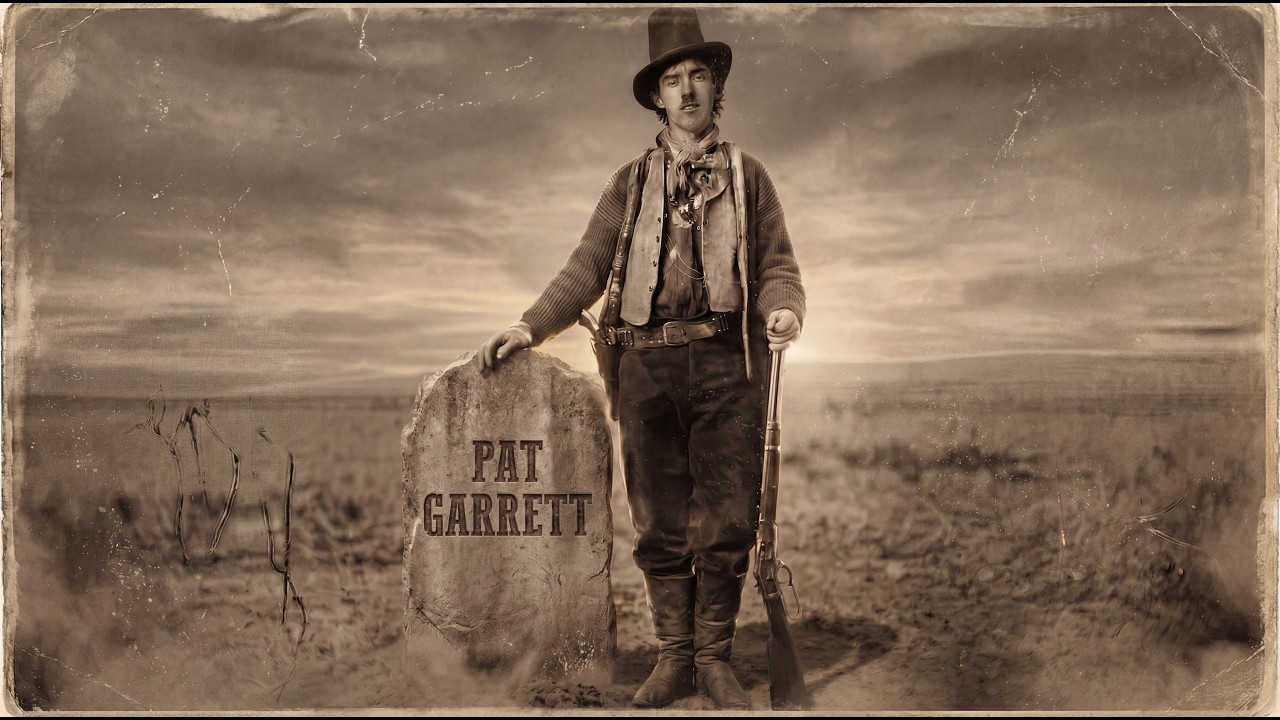
None of the payers ever asked to exhume the body. The reward was paid for the story, not for the corpse. Garrett became famous. He toured and gave interviews. He was appointed sheriff of Dona Ana County and served as a captain in the Texas Rangers. President Theodore Roosevelt personally appointed him collector of customs in El Paso.
Billy the Kid was the only person ever convicted of a crime arising from the Lincoln County War. The war started when rancher John Tunstall was murdered in February 1878 by a sheriff’s posse working for a rival faction. Tunstall had been a mentor to Billy. His murder was the spark.
Billy rode for the Regulators, a group formed to avenge Tunstall. Dozens of men died in the war. Everyone but Billy walked free. The men who ran the Santa Fe Ring needed Billy gone before he could testify. Governor Lew Wallace had broken his pardon promise. Billy spent his last year alive writing letters to Wallace, who stopped answering.
Whether the silence came through a real bullet or a staged one made no difference to the men paying for it. In 2003, the sheriffs of Lincoln County and DeBaca County filed a petition to exhume the grave in Fort Sumner. They also asked to test the grave of Billy’s mother in Silver City for DNA matching. The state of New Mexico blocked the petition. It remains blocked today.
If Billy the Kid walked out of Fort Sumner alive, where did he go? The most developed survival account comes from an old man in Hico, Texas, who went by the name Brushy Bill Roberts. In 1948, a probate investigator named William Morrison tracked him down. Roberts claimed he was Billy the Kid.
Roberts said Garrett shot a different man that night, a drifter named Billy Barlow. He said he fled to Mexico and lived among the Yaqui people. He returned to the American Southwest under aliases. He worked on the Wild West show circuit and rode with Pancho Villa during the Mexican Revolution. He married four times and grew old.
Historians have never accepted the claim. Official records show Roberts was born in 1879, which would have made him two years old when Billy supposedly died. But the geography of the survival narrative places its subject in a specific corridor for 27 years: northern Mexico, the Texas border country, southern New Mexico, and small Texas towns.
Pat Garrett spent those same 27 years in the same corridor. He moved to Texas and ran unsuccessfully for the state senate. He served briefly as a Texas Ranger. He ranched in Roswell from 1882 to 1896. He moved to Uvalde, Texas. He served as sheriff of Dona Ana County from 1896 to 1902. From 1902 to 1906, he was collector of customs in El Paso.
The towns he lived in trace the same line where the survival story takes place. Roswell and Uvalde sit along it. Las Cruces and El Paso sit along it. The line runs 600 miles through Texas and New Mexico along the Mexican border. If Billy the Kid was alive, the two men were never very far apart.

There is no documented meeting between them. There could not be. The entire arrangement, if it existed, depended on the absence of a record. A photograph or a letter would have collapsed the whole deal. The silence between them is not evidence that nothing happened. The silence is the precondition of everything that did.
Then came Garrett’s final years. He lost the customs job in 1906. President Roosevelt told him there would be no reappointment. Garrett returned to his ranch outside Las Cruces. He was drinking heavily and drowning in debt. He leased part of his ranch to a cowboy named Wayne Brazel. Two years later, Brazel would put a bullet in his head.
A broke, drunk, desperate Pat Garrett was a problem for every man who knew what he knew. Albert Fall wanted Garrett quiet. Oliver Lee wanted Garrett quiet. The pastoral circle wanted Garrett quiet. But none of them needed Garrett dead the way one other man did. None of them would lose everything if Garrett, drunk in a Las Cruces saloon, finally told the truth about Fort Sumner.
On the morning of February 29, 1908, Pat Garrett climbed into a buggy with two men. Carl Adamson was driving. Wayne Brazel rode in the back. The three were headed into Las Cruces to settle a dispute about the lease. About four miles from town, the buggy stopped. Garrett got down to relieve himself.
A bullet entered the back of his head. He fell forward into the dirt. A second bullet struck him in the stomach as he lay there. The most famous lawman in the American Southwest was dead at 57 years old.
Wayne Brazel confessed within hours. He said Garrett had drawn on him first. There was no deep autopsy and no thorough forensic examination of the scene. Brazel went to trial in 1909 and was acquitted in less than a day on grounds of self-defense. No one else was ever charged.
Almost no one believed Brazel acted alone. The bullet entered the back of Garrett’s head, a difficult angle for a man defending himself face to face. The driver, Carl Adamson, was a known associate of the El Paso underworld. He was also the brother-in-law of a notorious contract killer named Jim Miller.
Miller had at least a dozen killings to his name. Multiple witnesses placed him in the area that day. He would be lynched by a vigilante mob in Oklahoma the following year for a different paid murder. Before he was hanged, he allegedly confessed to the killing of Pat Garrett.
Historians have long believed the architects of the murder met in a hotel room in El Paso in the fall of 1907. The men in that room included W. W. Cox, a powerful rancher whose property bordered Garrett’s. Oliver Lee was there. Albert Jennings Fall was there. Print Rhodes was there. Jim Miller was there as well.

That is the official suspect list. It has been the official suspect list for over 100 years. It is built on land disputes, political ambition, and old grudges. It explains why Garrett was inconvenient to powerful men. But it does not explain the angle of the shot. It does not explain the certainty of Brazel’s confession.
It also does not explain the man who is missing from it. Cox wanted Garrett’s water rights, but he was still on his ranch whether Garrett lived or died. Lee carried a grudge, but he had already been acquitted for the Fountain murders. Fall was a politician on the rise. None of them faced ruin. None of them faced the gallows.
One man’s entire existence depended on Garrett’s silence. The moment Garrett opened his mouth about the night of July 14, 1881, that man would lose his name, his family, his freedom, and his life. He had 27 years invested in remaining dead. That man was officially in the ground at Fort Sumner, which made him a perfect suspect.
A man who is officially dead can arrange the murder of the only person who can prove he is alive. He does it quietly and through another man. He never appears in the room himself. He never signs his name. He puts money where it needs to go, and then he disappears back into the corridor.
Wayne Brazel did not need to know who paid him. Carl Adamson did not need to know. Jim Miller did not need to know. The El Paso meeting may have happened exactly as historians describe it. None of those men would have needed to know that a portion of the money came from somewhere outside the room.
If Billy the Kid was alive, he had the strongest motive of any man alive to make sure Pat Garrett never spoke. The men on the official suspect list stood to lose money and reputation. The man not on the list stood to lose his life.
The documented record cannot prove this happened because the documented record cannot prove Billy survived. Those two questions are tied to the same grave in Fort Sumner. If that grave holds a body that is not Billy the Kid, the official story of 1881 collapses. The entire suspect list for the 1908 murder would have to be rewritten.
In 2003, two New Mexico sheriffs petitioned the state to exhume the grave for DNA testing. The state refused. The state still refuses. The reason given involves the integrity of historic grave sites. What it actually accomplishes is keeping every question about both deaths permanently unanswered.
Back in 1881, Pat Garrett held the pen. He wrote the official account of Billy the Kid’s death. He chose the witnesses and selected the inquest jury. For 27 years, his version of that night was the only version that mattered.
Then on a Las Cruces road in February 1908, the pen passed to someone else. Garrett fell into the dirt with a bullet in the back of his head. The official story of his death was written almost immediately by the man who benefited from it. Wayne Brazel acted alone. Self-defense. Case closed.
The state of New Mexico has held that story for over a century. It has held the story of Fort Sumner for even longer. Both stories require a body that has never been examined. Both stories require a witness who is no longer alive to testify. Both stories serve the same purpose: to protect the people who held the pen.
If Billy the Kid lived, then he held the pen at the end. He outlasted the sheriff and the ring and every man who could prove he was still alive. The first draft of history is always written by whoever survives to write it. At Fort Sumner, that was Garrett. At Las Cruces, it was someone else.