Most gunfights in the real West lasted under ten seconds. Men bled out in the dirt before anyone around them understood what had happened. The movies gave those moments music and slow motion. The reality was fast, confused, and ugly.
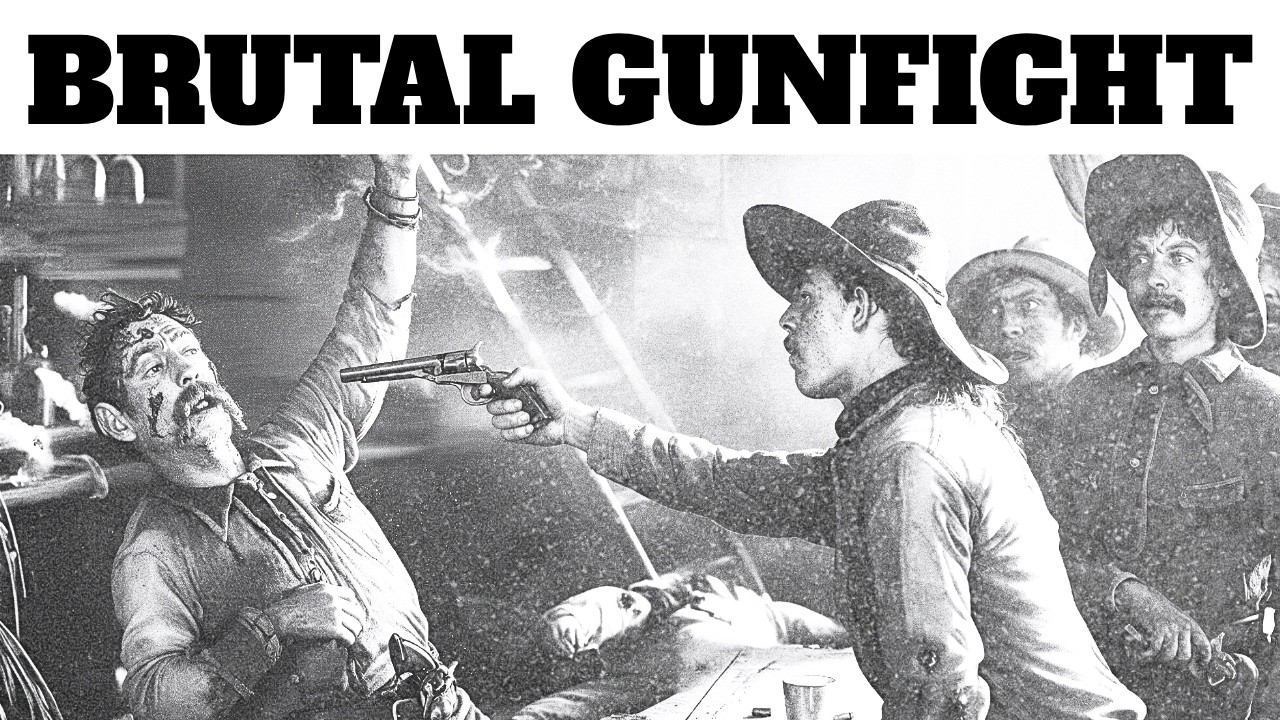
Some of these fights are famous by name but not by what actually occurred. Most are forgotten, and there is usually a reason for that. The closest thing the real West ever produced to a proper quick-draw duel happened in Springfield, Missouri, in 1865. Wild Bill Hickok and Davis Tutt had been gambling partners who fell out over a woman and a gold pocket watch.
Tutt claimed Hickok owed him a debt and took the watch as collateral. Hickok told him publicly not to wear it in the square. Tutt wore it the next day. On a July afternoon, with the whole town watching, they met seventy-five yards apart on the town square.
Both men drew and fired once. Tutt missed. Hickok steadied his pistol across his forearm and put a round through Tutt’s chest. Tutt staggered, said, “Boys, I am killed,” walked six more paces, and dropped face-first in the street.
Hickok was arrested, tried for manslaughter, and acquitted in ten minutes. A Harper’s Magazine article turned a frontier card player into a national figure overnight, and the myth of the Western showdown was born. It was the exception, not the rule. Nearly everything else that followed was uglier, closer, and far less romantic.
Fort Worth, Texas, 1887. Jim Courtright was a former city marshal who had reinvented himself as a protection racketeer, shaking down saloon owners in Hell’s Half-Acre. Luke Short did not pay. Short owned the White Elephant Saloon, had killed men before, and did not respond well to threats.
The two stepped onto the sidewalk on a February evening. Witnesses said Courtright reached for his pistol first, but his thumb caught on the hammer, and the cylinder would not rotate. In that half-second of mechanical failure, Short drew and fired five rounds into him before he hit the boardwalk. The fight was over in the time it takes to exhale.
Short walked back inside and resumed his evening. He was never charged. The protection racket ended that night, not by law, but by a faster hand. El Paso, Texas, 1894.
Bass Outlaw had been a Texas Ranger until the drinking got ahead of him and the Rangers let him go. On an April night, drunk in Tilly Howard’s sporting house, he fired a shot inside the building. Ranger Joe McKid came through the door to intervene. Outlaw shot him through the head, then put another round through his back as he fell.
Constable John Selman, nearby on the street, came around the corner and shot Outlaw through the chest. Outlaw fired back even as he fell, hitting Selman above the right knee, a wound Selman carried for the rest of his life. McKid was dead on the floor. Outlaw died the next morning asking for water.
Selman limped out of the alley and never walked right again. Three lawmen, one dead, one dying, one crippled for good, all of it over nothing that mattered, in under sixty seconds in a red-light district on a weeknight. In 1887, Commodore Perry Owens, newly elected sheriff of Apache County, Arizona Territory, rode alone to the Blevens house in Holbrook to serve an arrest warrant for horse theft. He did not bring a deputy.
Andy Blevens refused to surrender. In under sixty seconds, Owens shot Andy through the door frame. His brother John came at Owens with a pistol and was shot down in the doorway. A family friend named Moe Roberts fired from a side window and was killed through the window.
A teenage boy, Sam Houston Blevins, ran out with a pistol and was shot in the chest. Four men down, one sheriff standing in the street with a rifle he had not needed to reload. The territorial newspapers called it heroism. The Blevins family called it a massacre.
Owens served out his term, never ran for office again, and never talked publicly about that day. Sam Bass rode into Round Rock, Texas, in July 1878 to rob the Williamson County Bank. He did not know that one of his own gang, Jim Murphy, had been feeding information to the Texas Rangers for weeks. Rangers were positioned in and around town when Deputy Sheriff A.
W. Grimes spotted a bulge under the coat of one of the outlaws and moved to check for weapons. Seaborn Barnes shot Grimes dead on the spot, blowing the trap open before it was ready. Rangers and armed townspeople opened fire in the street.
Barnes was killed in the first volley. Bass took a round through the hand and a second that tore through his kidney. He managed to mount his horse and ride out of town, slumped over the saddle. A search party found him the next day under a live oak tree north of Round Rock.
When the rangers asked him to name his accomplices, he said it was against his profession to blow on his pals. He died on his twenty-seventh birthday. His grave became one of the most visited in Texas. Jim Murphy, the informer, died less than a year later from poison, and Round Rock never answered whether he took it himself or someone settled the debt for him.
John Wesley Hardin was by most counts the deadliest individual gunfighter the West produced. He killed his first man at fifteen, killed a man for snoring too loudly, killed black men during Reconstruction for reasons amounting to racial hatred and the knowledge that no Texas court would convict him. He was not a folk hero. By 1895, he had served fifteen years in prison, studied law behind bars, passed the examination, and set up a practice in El Paso that produced more barroom arguments than legal briefs.
He had made an enemy of Constable John Selman, the same Selman wounded in the Bass Outlaw fight the year before. On the night of August 19th, 1895, Hardin was standing at the dice table inside the Acme Saloon. Selman walked in behind him and put a bullet through the back of his head. Hardin collapsed face-first onto the bar.
Selman claimed Hardin had seen him in the mirror and was reaching for his gun. Nobody confirmed that story. Selman was charged but never convicted, and was himself shot and killed less than a year later in an alley four blocks from the Acme. Dallas Stoudenmire had been city marshal of El Paso for exactly three days in 1881 when a dispute over missing cattle boiled over into an inquest at the courthouse.
When shooting erupted, Stoudenmire came running with both pistols drawn. His first shot killed an innocent bystander crossing the street. His second and third killed two actual combatants. A fourth man, a county constable who had served as translator, had already been shot and was dying in front of the courthouse.
Four men were dead within five seconds. Stoudenmire survived two ambush attempts, developed a serious drinking problem, and made enemies of nearly every faction in the city. On September 18th, 1882, he got into an argument with the Manning brothers. The fight went to the ground.
James Manning shot Stoudenmire behind the ear at close range, and then one of the brothers beat his body with his own pistol in the street. The man El Paso hired to bring order died exactly the way the men he was supposed to control did, face down in front of a saloon over a grudge. In 1884, nineteen-year-old Elfego Baca arrested a drunk Texas cowboy named Charlie McCarty who had ridden his horse into a saloon in Frisco, New Mexico Territory, and started shooting at the feet of local villagers for sport. The local Anglo cattlemen, roughly eighty of them, surrounded the crude jacal where Baca had taken shelter and demanded he release their man.
Baca refused. For thirty-six hours, the cowboys fired an estimated four thousand rounds into the building. They tried fire and dynamite. Baca stayed inside and kept shooting back.
The wooden floor sagged below ground level from the sustained impact, putting him below the direct line of fire. He reportedly ate his meals sitting on the sunken floor while bullets punched through the walls above his head. When the shooting stopped, Baca walked out alive and untouched. Four attackers were dead.
Baca was tried twice for murder and acquitted both times. He went on to become a lawyer, a county clerk, and a deputy U. S. marshal, and died of natural causes in 1945 at the age of eighty.
The Lincoln County War had already produced enough killing to make New Mexico Territory ungovernable by the spring of 1878. The Regulators, a loosely organized posse that included Billy the Kid, rode to Blazer’s Mill looking for enemies of the Tunstall and McSween faction. They found Andrew Roberts, a small rancher called Buckshot because his body still carried pellets from an old shotgun wound that had left one arm partially disabled. Roberts had a warrant on him from the Murphy-Dolan side, issued as a weapon of faction, not an instrument of justice.
He refused to surrender, saying he would rather die than be taken by the men who killed Tunstall. Roberts took a round through the midsection, a wound that would have put most men down permanently. He dragged himself onto the porch of the Blazer house, found a Springfield single-shot rifle, pulled a mattress in front of himself as a barricade, and kept fighting from a prone position. From there, bleeding to death, he put a single round through the skull of Dick Brewer, the leader of the Regulators, at roughly fifty yards.
Brewer was killed instantly. Roberts died the next day in agony. They were buried a few yards apart, two men who had no personal quarrel with each other, both killed by a war that had turned every legal warrant into a death sentence. The Mason County Hoo Doo War in Texas in 1875 had no single dramatic shootout.
It was a long, bleeding sequence of ambushes, lynchings, jailbreaks, and murders stretching over most of a year. German immigrant farming families and Anglo cattlemen clashed over stock theft, with each side accusing the other of rustling. A rancher named Tim Williamson was arrested on suspicion of theft. On the road to the county seat, a mob stopped the deputy, who stepped aside without resistance and let them shoot Williamson dead.
After that, the county fractured beyond repair. Scott Cooley, a former Texas Ranger and close friend of Williamson, tracked down that deputy, shot him dead, and scalped him in the street in broad daylight. The county sheriff was ambushed and killed. A mob broke into the jail and murdered three prisoners in their cells.
The killing went back and forth through the summer and fall with night raids, roadside ambushes, and reprisal executions that blurred any remaining line between law and murder. Nobody of consequence was ever prosecuted. The German and Anglo communities did not fully reconcile for a generation. Newton, Kansas, 1871, was a railroad town raw and new.
In August, night watchman Mike McCluskey shot a Texan named William Bailey in a dispute connected to a local election. The Texans did not let it pass. Two weeks later, McCluskey was drinking in Tuttle’s Dance Hall on a Saturday night when a group of Texas cowboys led by Hugh Anderson walked in and sat down at his table as if to make peace. Without warning, Anderson pulled a pistol and shot him.
The room exploded. In the next ten to fifteen seconds, every armed man in a narrow, crowded, dimly lit hall started firing at whoever was closest. Muzzle flash and powder smoke filled the room so thick that men shot at shapes, not faces. When it stopped, five men were dead or dying, most of them bystanders.
One man was killed while still sitting in his chair. McCluskey died of his wounds within hours. Anderson was hit but escaped that night and was never brought back. The bodies were dragged out the front door, and the dance hall reopened the same week.
It was the deadliest gunfight in any Kansas cow town, and it lasted about as long as it takes to strike a match and watch it burn down. The Dalton gang tried something no outlaw gang had ever pulled off in 1892: robbing two banks at the same time in the same town in broad daylight. They chose Coffeyville, Kansas, where half the citizens recognized them on sight because the Daltons had grown up just outside town. On the morning of October 5th, five gang members walked in wearing obviously fake beards.
Inside the Condon Bank, a teller told them the vault was on a time lock. It was a lie, and that lie cost the gang their lives. While the Daltons were inside, citizens armed themselves with rifles and shotguns from Isham Brothers hardware store and took positions around the square. When the gang emerged, they walked into a crossfire from every direction.
Grat Dalton was killed in an alley. Bill Power was shot off his feet. Dick Broadwell made it into the saddle and rode half a mile before falling dead into the road. Bob Dalton, the leader, went down with a rifle round through his chest.
Four townspeople were also killed, including the city marshal. Emmett Dalton, the youngest brother, was hit twenty-three times and somehow did not die. He served fourteen years in prison, was pardoned, moved to Los Angeles, and spent the rest of his life lecturing about why crime does not pay. The alley where the gang was cut down is still called Death Alley.
The James-Younger Gang rode north to rob the First National Bank of Northfield, Minnesota, in 1876, and chose the wrong town. Northfield was settled by Scandinavians and New Englanders who had fought in the Civil War, men who kept their service revolvers oiled and loaded and knew how to use them under pressure. Inside the bank, acting cashier Joseph Heywood refused to open the vault, lying that it was on a time lock. He knew what would happen, and he chose to protect the depositors’ money with his life.
One of the gang shot him through the head. Outside on Division Street, citizens were already shooting from doorways and upper windows. A medical student grabbed a carbine and shot Clell Miller dead off his horse. Bill Stiles was killed near the bank entrance.
The surviving gang members fled south, all of them bleeding. What followed was one of the largest manhunts in American history. Jesse and Frank James split from their comrades and escaped west. The three Younger brothers were found two weeks later in the Watonwan River bottoms, shot eleven times, soaked through, starving, and too weak to raise their weapons.
Cole Younger survived all his wounds, served twenty-five years in Stillwater Prison, and was paroled in 1901. The Northfield bank still stands, with bullet holes preserved under glass. The most famous gunfight in American history did not happen at the O. K.
Corral. It happened in a narrow vacant lot on Fremont Street in Tombstone in 1881, barely fifteen feet across. It was not a showdown between noble lawmen and blackhearted villains. Virgil Earp, the town marshal, brought his brothers Wyatt and Morgan and a dentist turned gambler named John Henry Holliday to disarm cowboys carrying weapons inside town limits.
The cowboys, Tom and Frank McLaury and Billy and Ike Clanton, were gathered in the lot. In the next thirty seconds, three men were dead, two Earps were wounded, and 145 years of argument began. Billy Clanton, gutshot and dying, propped himself against a wall and kept pulling the trigger until his revolver clicked empty. He was nineteen.
The subsequent hearing lasted a month, and the judge ruled the shooting justified, but Tombstone was split down the middle. The real violence had only just started. After the O. K.
Corral, the cowboy faction struck back. On March 18th, 1882, Morgan Earp was playing billiards when a bullet came through the glass panel of a back door and struck him in the spine. Three months earlier, Virgil Earp had been ambushed and permanently crippled by shotgun blasts. Two of the three brothers who had walked down Fremont Street were dead or maimed.
Wyatt decided he was done with courts and legal process. He assembled a small posse, including Holliday, and rode out on what became known as the Vendetta Ride. At Iron Springs, they stumbled into a camp of cowboy faction men led by Curly Bill Brocius. According to Wyatt, he dismounted, walked toward the camp with a shotgun, and fired both barrels into Brocius at close range while bullets tore through his coat and shot the heel off his boot.
Whether every detail holds up is debated, but the core fact is not: Curly Bill Brocius was dead. Over the following weeks, the Vendetta Ride killed between four and six more men. Warrants were issued for Wyatt’s arrest. He ignored them, left the territory, and never came back.
He died in bed in 1929 at the age of eighty, in a rented bungalow in Los Angeles. In 1893, thirteen deputy United States marshals rode into Ingalls, Oklahoma Territory, to arrest members of the Doolin-Dalton gang. The gang had been using the town as a base for months. They spent money in its restaurants and saloons, had relationships with women in town.
They were neighbors. When the marshals arrived in covered wagons, the gang was scattered across town. Deputy Dick Speed was killed by a shot from an upper window. Deputy Tom Hueston was shot from his horse in the open.
Deputy Lafe Shadley was gutshot and died in the street. A local boy was hit in the crossfire. A woman watching from a window was wounded by a stray round. The residents of Ingalls did not assist the marshals.
Some accounts say civilians actively helped the outlaws saddle their horses and escape. Three deputies were dead, and none of the gang was captured that day. Federal posses returned again and again until every last member of the gang was dead or locked in a cell. In 1877, a detachment of Texas State Police rode into Lampasas to arrest members of the Horrell family.
When the officers walked into Jerry Scott’s Saloon, the shooting started before anyone finished a sentence. Captain Thomas Williams and three of his men were killed. What followed was not a single gunfight but a year-long cycle of ambush, murder, and retaliation between the Horrell and Higgins families. Both were prominent ranching clans with deep roots in the community.
Both claimed legal authority for their violence and had enough friends in local government to obtain warrants whenever they needed one. At least ten men died. A Texas Ranger captain eventually brokered a written truce, signed at the courthouse in front of witnesses. The document still exists in county records.
Neither side honored it completely. Men associated with both families continued to die in ambushes for years afterward. In July 1881, a party of American smugglers and cattle thieves, almost certainly including members of the Clanton ranching operation, set up an ambush in Skeleton Canyon for a Mexican silver pack train heading north out of Sonora. The trail was narrow, hemmed in by rock walls.
The Americans waited in the boulders and opened fire without warning. Between fifteen and nineteen Mexican muleteers and guards were killed. The silver was divided among the attackers. No law enforcement agency on either side of the border investigated.
Two weeks later, Mexican irregulars crossed the border to settle the dead. At Guadalupe Canyon, they hit a cattle camp run by Clanton associates at dawn. Old Man Clanton was killed along with several others, their bodies stripped, mirroring exactly what had been done to the muleteers. Again, no investigation on either side.
There was no law that reached into that canyon country. What happened on either side of the border stayed there. For five days in July 1878, the small town of Lincoln, New Mexico Territory, became a war zone. The Regulators, loyal to the murdered English rancher John Tunstall and his attorney Alexander McSween, barricaded themselves in buildings on one side of the single main street.
The Murphy-Dolan faction occupied the buildings opposite. U. S. Army soldiers from Fort Stanton were positioned at the edge of town, with a Gatling gun and a howitzer.
For five days, men fired at each other across a distance you could cross at a walk in thirty seconds. Billy the Kid was inside the McSween house with roughly a dozen fighters. On the final night, the Murphy-Dolan faction set the house on fire. As each room became untenable, the men inside retreated deeper, firing from windows until the heat drove them back.
When there was no room left and the roof began to collapse, they had to choose between burning alive and running into the open. Alexander McSween walked out the back door into the firelight with his hands raised. He was shot to death before he reached the yard. Billy the Kid ran out the same door seconds later, sprinting low through the firelight, and vanished into the darkness beyond the river.
The soldiers watched and did not intervene until the next morning. Whether that delay was incompetence or a calculated decision to let the Regulators be destroyed depends on which historian you read. The Regulators were broken. The House won.
McSween’s wife stood on the hillside and watched her house burn with her husband inside it. She later said she could hear the piano burning. The deadliest feud in the history of the American West is the one almost nobody talks about. There is no statue, no reenactment, no visitor center.
The Graham and Tewksbury families, joined by hired men, allies, and drifters who picked sides for pay or grudges they barely understood, waged a ten-year war in the mountain country of central Arizona. The Grahams were cattlemen. The Tewksburys brought sheep into the basin, which in open-range cattle country was treated as an act of war. The terrain was steep, forested, and perfect for ambushes.
The first confirmed killing came in 1887, when a Navajo sheepherder was found shot to death in the hills. His name was not widely recorded. His death was not investigated. In September of that year, John Tewksbury and William Jacobs were shot and killed outside the Tewksbury ranch.
The Graham side kept firing, pinning the family inside. The bodies lay in the open yard, and hogs rooted at the remains in full view of the house. Mary Ann Tewksbury could not bear it. She walked out into the line of fire carrying a shovel and dug a shallow grave for her husband while bullets struck the dirt around her.
She was not hit. Even in a war this savage, there were certain lines. At least thirty men died over the course of the war. Some historians place the number closer to fifty.
The Grahams were hunted down one by one until almost none remained. Tom Graham, the last surviving adult male of his family, moved to Tempe to start a new life. On August 2nd, 1892, he was shot in the back while driving a load of grain down a public road in broad daylight. Two men connected to the Tewksbury faction were charged.
One was acquitted. The other was convicted, then won a new trial, and the charges were dropped when witnesses refused to testify a second time. Nobody else was ever held accountable for any of it. What ended the war was not justice, not forgiveness, not a treaty.
It was arithmetic. One side ran out of men. Twenty gunfights spanning thirty years and a dozen territories. The fastest lasted five seconds.
The longest lasted ten years. The men in them were lawmen, outlaws, ranchers, drunks, brothers, strangers, and sometimes all of those at once. Not one of them died the way the movies show it. Two men walk into a dance hall in Newton.
Five men ride into Coffeyville. A boy climbs out of a courthouse in Lincoln. A woman walks into a field with a shovel in Pleasant Valley. The West was not won.
It was survived. And not by everyone.