On February 3, 1889, Belle Starr was riding alone along a muddy road in Indian Territory, less than a mile from her home at Younger’s Bend. As she turned a bend near a creek crossing, a shotgun blast struck her in the back and threw her from the saddle. She tried to push herself up from the mud. A second blast hit her in the face and neck.
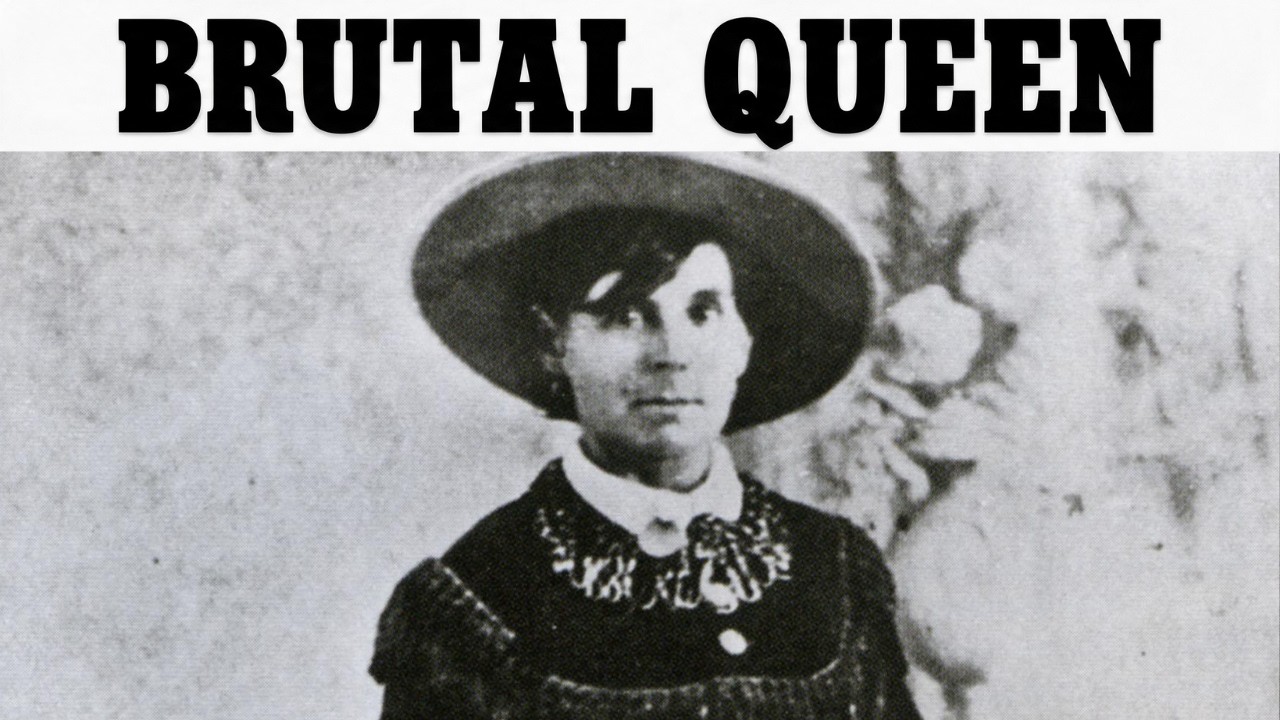
A farmer named Milo Hoy heard the shots and ran to the road, finding her face down and still breathing. Her horse galloped home with blood on the saddle. When the riderless horse reached the cabin, Belle’s daughter Pearl knew what had happened and ran down the trail. Belle Starr died in her daughter’s arms without naming her killer.
She was two days short of her forty-first birthday. No one was ever convicted. The woman who died on that road was born Myra Maybelle Shirley on February 5, 1848, on a farm near Carthage, Missouri. Her father, John Shirley, was a prosperous farmer and innkeeper known locally as Judge.
Her mother, Elizabeth Pennington, was related to the Hatfield side of the Hatfield-McCoy feud. The family was wealthy by Jasper County standards, farming wheat and corn and raising horses and hogs. Belle attended the Carthage Female Academy, a private school her father had helped found, studying Greek, Latin, Hebrew, classical grammar, and piano. She was an accomplished pianist before she was fifteen.
Her real education came from her older brother, Bud Shirley, who taught her to ride and shoot. She became a crack shot with a pistol and an expert horsewoman before the Civil War reached Missouri and destroyed everything. Missouri was a border state, and the fighting there was not between armies in formation. It was guerrilla war, neighbor against neighbor.
Bud rode with Confederate irregulars and became a scout for William Clarke Quantrill, whose raiders burned and killed across the Missouri-Kansas border. In June 1864, Union troops killed Bud. That same year, Union forces burned Carthage. John Shirley had no town left and no eldest son.
He moved the surviving family to Scyene, Texas, east of Dallas, and started over. Belle was sixteen years old, with a classical education, a dead brother, and no home to return to. In Scyene, John Shirley’s farm became a way station. Former Confederate guerrillas who had ridden with Quantrill needed places to disappear.
Cole Younger, Jesse James, Frank James, and the Younger brothers used the Shirley home as a hideout, and Belle grew up in their company. In 1866 she married Jim Reed, a former guerrilla she had known since Carthage who had ridden alongside her brother. They had two children: a daughter, Rosie Lee, called Pearl, born in 1868, and a son, James Edwin, called Eddie, born in 1871 in California, where the Reeds had fled because Reed was wanted for murder in Arkansas. Jim Reed could not stay still and could not stay legal.
He drifted between the Younger Gang, the James Gang, and the Starr clan, a Cherokee family in Indian Territory notorious for whiskey running, cattle rustling, and horse theft. Belle operated a livery stable in Dallas where she reportedly sold horses Reed stole. In August 1874, Jim Reed was shot and killed by a deputy sheriff in Paris, Texas. Belle was twenty-six, a widow with two small children and a name already attached to men the law was hunting.
She left the children with relatives, drifted west into Indian Territory, and stopped using the name Myra. From that point forward, she was Belle. The man who took her in was Tom Starr. Tom was Cherokee, six feet five inches tall and massively built, with a reputation that ran ahead of him.
His father, James Starr, had been a Cherokee leader who signed the Treaty of New Echota in 1835, the treaty that surrendered Cherokee lands in the East and led to forced removal on the Trail of Tears. That treaty split the Cherokee Nation in two, and the faction loyal to Chief John Ross considered the Starrs traitors. The feud turned into civil war. In November 1845, thirty-two armed men from the Ross faction attacked the Starr homestead and murdered James Starr and his son Buck.
Tom watched his father die and escaped into the woods, swearing to avenge every man responsible. By the time the Cherokee factions negotiated peace in 1846, Tom Starr had reportedly killed more than twenty of them. His own nation declared him an outlaw and put a price on his head. Tom Starr settled in the southern Cherokee Nation and built a ranching operation on the Canadian River.
He ran whiskey, harbored fugitives, and was feared by tribal police and federal marshals alike. According to one account, he wore a necklace of dried earlobes taken from men he had killed. Whether that detail was true or embellished by frontier legend, the fear it represented was real. Jim Reed had known Tom Starr through years of running stolen cattle together.
After Reed’s death, Belle followed that connection. Tom took her in. Under Cherokee law, a white person could only reside in the nation through marriage to a Cherokee citizen. Tom Starr happened to have a son of about the right age.
On June 5, 1880, Belle married Sam Starr in a Cherokee ceremony. She was thirty-two; legal records listed her age as twenty-seven. Sam was twenty-three. They settled on communal tribal land along a bend in the Canadian River, about seventy miles southwest of Fort Smith, Arkansas.
Belle named the place Younger’s Bend after the Younger brothers who had sheltered there so many times. Belle did not rob stagecoaches or hold up banks. What she did was harder to prosecute and harder to stop. She organized.
She planned. She fenced stolen horses and cattle for every rustler and bootlegger working the Canadian River country. When her associates were captured, she bribed lawmen. When bribery failed, she hired the best lawyers in Fort Smith.
She became the operational center of Younger’s Bend, not the one who stole the horses but the one who moved them, sold them, and got the men who stole them out of custody. Jesse James himself reportedly hid at Younger’s Bend on trips between Texas and Missouri. The cabin on the river became the safest place in the territory for a man who needed to disappear. The system meant to stop all of this sat seventy miles to the east in Fort Smith, Arkansas.
Indian Territory in the 1880s had no local courts with jurisdiction over non-Indians. Every federal criminal case, every horse theft charge, every whiskey running indictment went to the Western District of Arkansas. That court belonged to Judge Isaac C. Parker, known as the Hanging Judge.
Parker held court six days a week, with sessions often running ten hours. His jurisdiction covered 74,000 square miles where federal marshals were the only law, and the nearest courtroom was days of hard travel away. Deputy United States Marshals like Bass Reeves, himself a former slave and one of the most effective lawmen in American history, rode into the territory to serve warrants. The court could take land, liberty, or life, and for most of its existence there was no appeal.
Belle understood this better than almost anyone in the territory. She studied how the court worked, where it was weak, and who could be bought or outmaneuvered inside it. In 1882, Belle and Sam were charged with the larceny of two horses. The arrest warrant was served by Deputy United States Marshal Bass Reeves.
On March 8, 1883, a jury in Parker’s courtroom found them both guilty. Parker sentenced Belle to two terms of six months each and Sam to twelve months, to be served at the House of Correction in Detroit, Michigan. It was a surprisingly lenient sentence from a judge who had sent men to the gallows for less. Belle was transported to Detroit by railroad prison car, the only woman among nineteen convicts.
In Detroit she was a model prisoner, teaching music and French to the warden’s children. She and Sam were released after nine months for good behavior. The conviction did not break Belle Starr. It educated her.
She returned to Younger’s Bend and told a reporter from the Fort Smith Elevator newspaper, “I regard myself as a woman who has seen much of life. ” Then she went back to work. Belle stood trial at Fort Smith twice more in 1886. In the first case she was accused of participating in farm robberies near Younger’s Bend.
Two witnesses identified her, but the evidence was insufficient and she was discharged. Three months later she was charged with horse theft after mistakenly selling a stolen horse to a friend. She was acquitted again. She hired the best lawyers Fort Smith had and knew Parker’s procedures well enough to use them against him.
When her son Eddie was arrested for horse theft, Belle’s lawyers went over Parker’s head and contacted President Grover Cleveland. Cleveland overturned Parker’s seven-year sentence with a full presidential pardon. Belle Starr was not just evading the law anymore. She was beating it inside its own courthouse, in front of the one judge in the territory who had made it his personal mission to bring her down.
While Belle was outmaneuvering Parker, Sam Starr was running out of time. In the fall of 1886, Cherokee tribal police ambushed him, shot his horse from under him, and wounded him badly. Sam escaped and fled to his brother’s home. Belle found him there, treated his wounds, and convinced him to surrender to federal authorities rather than face the tribal council.
Sam turned himself in to United States Deputy Marshals in October 1886. Trial was set for February 1887. Sam never made it to court. On December 17, 1886, Belle and Sam attended a Christmas party at a friend’s house near Whitefield in the Cherokee Nation.
At the party, Sam ran into Franklin West, a United States Deputy Indian Marshal and Sam’s own cousin. The two men had a history. They drew on each other, and both were killed. Belle’s husband was dead.
Under Cherokee law, her claim to Younger’s Bend now depended entirely on her status as the wife of a Cherokee citizen. If she could not prove that connection, she could lose the land. Her response was immediate. She married Jim July, also called Jim July Starr, an adopted son of old Tom Starr, a member of the Creek tribe and roughly fifteen years younger than Belle.
Cherokee authorities told her she could keep the land as long as she remained married to a tribal citizen. The marriage was a legal instrument. Now came February 1889 and the road where this story began. Jim July was indicted for horse theft and had to ride to Fort Smith to surrender.
Belle accompanied him about a dozen miles before they argued. She told him she would not pay his bail and would not hire his lawyers. Jim July rode on toward Fort Smith. Belle turned her horse around and headed back toward Younger’s Bend alone.
On Saturday, February 2, she stopped at a neighbor’s house. Among the visitors was Edgar A. Watson, a tenant farmer who had rented land from Belle in 1888. He had paid cash in advance and moved in with his wife.
Belle later learned that Watson was a fugitive wanted for murder in Florida. The Cherokee Tribal Council had warned her that harboring more fugitives would cost her the land. She confronted Watson and threatened to reveal his whereabouts to Florida authorities. Watson moved to another nearby farm but did not leave the area.
When Belle walked into the neighbor’s house that Saturday, Watson was standing in the yard with a double-barrel shotgun. He left immediately, walking in the direction Belle would ride the next day. Sunday afternoon, February 3, Belle stopped at another neighbor’s home and stayed talking with the women there until about three o’clock, wanting a pone of sour cornbread from Mrs. Barnes.
When she finally mounted her horse and rode toward home, the road passed close to Watson’s new farm. She turned a bend near a creek. The shotgun blast hit her in the back. She was knocked from the saddle.
She tried to rise. The second blast took her in the face and shoulder. She fell face down in the mud. Milo Hoy found her still alive but unable to speak.
Her horse galloped toward the cabin at Younger’s Bend, and Pearl saw it and ran. Belle Starr died in her daughter’s arms. Her neighbors carried her body back to the cabin wrapped in quilts. The women of the community prepared her for burial, anointing her body with turpentine and oil of cinnamon and dressing her in her favorite black velvet gown.
A rough pine coffin was made from local boards and lined with black shrouding trimmed in white lace. She was buried in her own front yard at Younger’s Bend without a preacher and without a prayer. Jim July reached Fort Smith and found a telegram waiting with the news. He rode back immediately.
Boot tracks were found at the ambush site leading toward Watson’s cabin. Jim July placed Watson under citizen’s arrest and escorted him on a two-day ride to Fort Smith. Watson sat in jail for two months. Jim July came to court and offered no evidence.
Judge Parker did not believe the case was strong enough to hold, and Watson was released. He was the only person ever formally charged with Belle Starr’s murder. But he was not the only suspect. Eddie Reed, Belle’s eighteen-year-old son, had been beaten by his mother with a bullwhip just weeks before the killing for mistreating her horse, and their relationship had been hostile for years.
Jim July himself had quarreled with Belle the day before and had reason to want control of Younger’s Bend without her. A neighbor named Jim Middleton had his own grudges. The historical record has never settled the question. Nobody saw the shooter.
Nobody was convicted. The murder of Belle Starr is officially unsolved to this day. Edgar Watson went back to Florida after his release and settled deep in the Ten Thousand Islands in the remote Everglades on forty acres along the Chatham River. He grew sugarcane and sold syrup in Fort Myers and Key West.
He hired transient workers, people with no connections and no one to ask questions about them. Over the years, those workers developed a pattern of disappearing around payday. Bodies washed up in local waterways. The small community of Chokoloskee grew terrified and reported Watson to authorities.
Nothing happened. In October 1910, a mob of armed townspeople confronted Watson at Smallwood’s Landing and shot him dead. He was never tried for any of the Everglades killings. The man most likely to have killed Belle Starr died the same way she did: shot without warning by people who had decided the law was never going to do its job.
Eddie Reed was convicted of horse theft and receiving stolen property in July 1889, just five months after his mother’s murder, and was sentenced to prison in Columbus, Ohio. After his release he became a deputy at Fort Smith. He was killed in a saloon in Claremore, Oklahoma, in 1896. He was twenty-five years old.
Pearl Starr, born Rosie Lee Reed, was twenty-one when her mother died. After Belle’s murder and Eddie’s conviction, Pearl had no money, no land, and no family left standing. She became a prostitute in Van Buren, Arkansas, to raise funds for her brother’s legal defense and eventually assembled a legal team that secured a presidential pardon for Eddie in 1893. Then she moved to Fort Smith and opened her own bordello on the Row, the waterfront strip of gambling halls, saloons, and brothels.
She advertised the place with a bright red star surrounded by lighted pearls, using her dead mother’s name as a brand. Business prospered, and Pearl bought additional properties and invested in saloons. She was forced out of Fort Smith when anti-prostitution ordinances were enforced in 1916. She moved to Douglas, Arizona, married a German musician named Arthur Irby, and died in 1925 at the age of fifty-six, buried under the name Rosa Reed.
Isaac Parker continued on the bench at Fort Smith until 1896. He sentenced 160 people to death during his twenty-one years in the territory and died in office, exhausted by a caseload that gave him jurisdiction over 74,000 square miles with almost no resources to govern it. Belle Starr’s only documented conviction was for stealing two horses. The dime novels published after her death said she robbed stagecoaches, led outlaw armies, and terrorized the plains.
The record says something different: she organized a network of horse thieves and bootleggers, bribed and outmaneuvered federal marshals, hired better lawyers than the government could afford, and used the legal system more skillfully than most of the men who tried to prosecute her. The legend is more exciting. The record is more interesting. Younger’s Bend still sits near the Canadian River in eastern Oklahoma.
In 2010, a Tulsa orthopedic surgeon bought the property. The original tombstone had been chipped apart by souvenir hunters over 120 years. He rebuilt it from historic photographs and moved an 1850s cabin from Missouri to the site, reconstructing a version of the Starr home. The trail to the grave is open, and visitors leave coins and flowers on the brick tomb.
The epitaph was commissioned by Pearl, paid for with money earned at her bordello on the Row in Fort Smith. It reads: “Shed not for her the bitter tear, nor give the heart to vain regret. ’Tis but the casket that lies here, the gem that filled it sparkles. ” The murder remains officially unsolved.
The mother is buried in the front yard of a cabin on the Canadian River. The daughter is buried in Arizona under a stone that says Rosa Reed. Neither one rests under the name the world remembers.