In 2012, Ethel Kennedy sat before a camera held by her daughter and refused to answer. Rory Kennedy had made her name documenting difficult subjects—addiction, Abu Ghraib, Appalachian poverty—and she knew how to make people talk. But when she asked her mother about the night of June 1968, the night Robert Kennedy was shot, Ethel, then eighty-four, said she did not want to go into it. Not with a speech, not with tears.
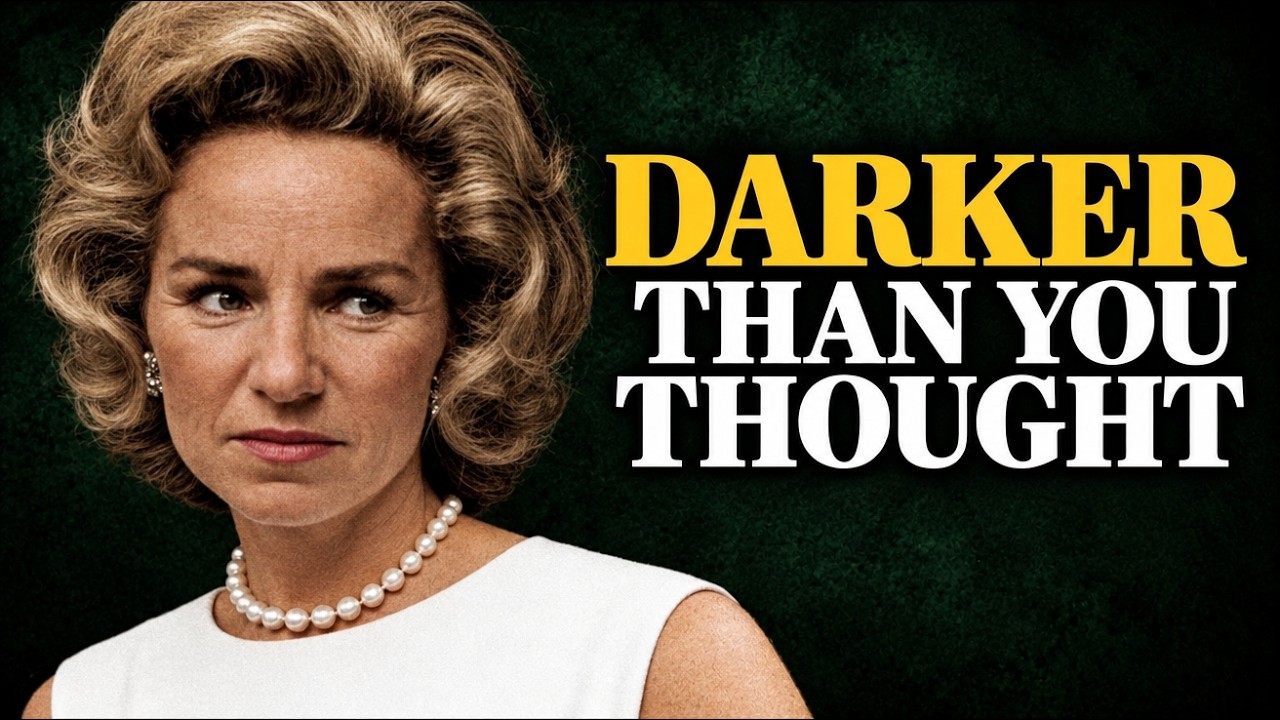
She closed the door politely while the camera kept rolling, and her daughter left the scene in the final cut. This was the only Kennedy documentary made by a Kennedy about a Kennedy, with full family cooperation, home movies no one outside the house had ever seen, and siblings on camera. And inside that work, the central figure drew a red line and the filmmaker, her daughter, respected it on screen. This was not a woman losing control of her story.
This was a woman proving she still had it. People always wanted the bad stories—the firings, the unpaid bills, the guests pushed into the pool, the staff given twenty minutes to pack. All of it was documented. But those stories were a sideshow.
The real story was about power, and it ran opposite to what one might assume. Robert Kennedy married a woman who outranked him in social standing but had less money. In 1950, the Skakel fortune was newer, noisier, and in some ways more liquid than anything Bobby personally controlled. His father controlled the trust fund and its terms.
Her father had built his company from nothing. By the end of her life, the situation had completely inverted. She lived on Kennedy land in a Kennedy house with institutional Kennedy support, while the wealth she was born into evaporated largely in her brother’s hands. The heiress had become a dependent.
And as the money faded, her grip tightened on the thing that replaced it: the narrative. For fifty-six years, she was the widow of a man the country had canonized, and she was the gatekeeper. The refusal in 2012 was not weakness. It was inventory management.
To understand how she became so skilled at that, one had to return to the house where she grew up. Everything people later called cruelty was behavior learned there. The place was called Rumble Side on Lake Avenue in Greenwich, Connecticut—about thirty rooms. The Skakels bought it in 1935.
By then, George Skakel Sr. had done the thing America pretends to love and secretly trusts: he made himself, fast. From a clerk in the Midwest to founder of Great Lakes Carbon, supplying coke and carbon products to the steel and aluminum industries. During the war years, the company printed money.
He had not gone to Harvard. He had not married into wealth. He built it himself. Ann Brannack Skakel ran the house in the strict Catholic manner—priests at dinner, Mass as schedule, charity by check as duty.
There were seven children: George Jr. , Jim, Rushton, Georgeann, Pat, Ethel, and Ann. The household was loud, competitive, violent, with pranks bordering on injury, cars driven too fast on Lake Avenue, guns everywhere, and private planes. Much of what was repeated about the Skakels came from Jerry Oppenheimer’s 1994 book, which the family never cooperated with and hated; it should be treated as hostile and unauthorized rather than settled fact.
But the outline was not controversial, because the Skakels themselves told versions of it for decades, and the plane and car accidents were in public records. This was a family that moved fast and assumed the world would absorb the impact. There was a large staff—cooks, maids, gardeners, drivers. Ethel grew up with people whose job was to fix what she broke, clean what she spilled, and never be mentioned.
That was not psychological theory; it was a household structure, and it produced a specific operating assumption in the child: someone is always taking care of it, and consequences are something that happens to other families. Keep that idea. It explains the pool, the bills, and forty years of McLean, Virginia suppliers telling journalists they never got paid. She was the sixth child, and in such a house, the sixth child either disappears or becomes loud.
Ethel became loud. Family nicknames, athleticism, insistence—it was all an attempt to claim space in a crowded room, and she was very good at it. She could make herself the most interesting person at the table. That was a real skill, the one that later made her the most popular Kennedy wife, and the most underestimated.
She attended Manhattanville College of the Sacred Heart, where Catholic families of a certain income sent daughters they wanted educated without complications. Rose Kennedy had studied there. So had the Kennedy daughters. Ethel’s roommate was Jean Kennedy.
That was the hinge, not an accident but an institutional meeting. By the mid-1940s, Bobby, Jean’s brother, was around. In his twenties, the seventh of nine children, the youngest in a family where being youngest was a real problem for your prospects. He was shy in ways the other Kennedys were not, religious in ways they were not, thin, serious, trying hard.
For a while, he dated Pat Skakel, Ethel’s older sister, not Ethel. In the winter of 1945, Bobby went on a ski trip to Mont Tremblant in Quebec with the Skakel sisters, accompanying Pat. He came home having noticed Ethel. The family never hid this story.
It was told at weddings and in interviews. Look at it again: a woman in her twenties watches her older sister bring her roommate’s brother into the house, evaluates him, and then goes and wins him. Over several years, not one weekend. Because it did not happen immediately.
There was a long period when nothing happened, and a period when Ethel seriously considered entering a convent. She talked about taking vows; people who knew her at Manhattanville believed she meant it, and a close religious teacher encouraged the idea. But she did not go. She wrote her thesis, graduated in 1949, and married Robert Kennedy the following summer.
No one can tell you what was inside her during those years. But the two choices she was weighing deserve consideration, because they are less different than they appear. A convent is a total institution with permanent vows, strict hierarchy, obedience, no way out, a life organized entirely around a figure you will never personally possess. That, as it happened, also applied to marrying into the Kennedy family.
She chose the option that involved children. Here is what each of them actually got. Bobby got money that was not his father’s. That mattered more than people realized.
Joseph Kennedy’s trusts gave his children security and gave Joseph Kennedy permanent leverage over them all. A wife with independent Skakel wealth loosened that grip a little. He also got something most of his brothers’ girlfriends lacked: a fierce, uncomplicated, unashamed Catholicism from a family with money but without social polish, meaning she would never outshine him socially and would never compete. Jack married a woman who matched him in intelligence and outmatched him in taste, and spent her marriage one step outside the family.
Bobby married a woman who wanted to enter the family deeply. Ethel got the name. Her father could have bought Greenwich. But he could not buy what the Kennedys had been building since the 1920s—the ambassador, Harvard, London, the church, the political future.
The Skakels had the money and the crashed planes. The Kennedys had the project. The romance was real. The letters, the devotion, the fact that she organized her entire existence around him—none of it was an act.
She was in love with him. The deal was also real. Both things were true at once, and the family never liked hearing the second one said aloud. What she could not have known in 1950 was which of those two fortunes would survive.
She brought the money and got the name. Within twenty years, the money was fading and the name was everything. And the name belonged to a man who would die at forty-two. After his death in June 1968, Ethel Kennedy built her life around that name for the next fifty-six years.
She never remarried. The polite answer was Catholicism; her faith was absolute. The honest answer involved something less flattering and more interesting: the widow was the strongest position Ethel Kennedy ever held. Before June 5, 1968, she was one of several Kennedy wives—the loud one with many children.
Afterward, she was the widow of a martyr, guardian of eleven children carrying the most valuable name in American public life, and the only person on earth who could say what Robert Kennedy would have wanted. She did not plan it. But she recognized the value of that position the moment she held it, and she never let it go. She founded the Robert F.
Kennedy Memorial in 1968, within months. She chose the causes: farm workers, prison reform, housing, Native American education, civil rights litigation. She staffed it with young people and gave them room. The RFK Book Award began in 1980.
The Human Rights Award began in 1984, given to activists in places where prison was a natural career consequence. She made the trips herself and appeared where there were no cameras. She was arrested in 1988 outside the South African embassy in Washington protesting apartheid—something a fifty-nine-year-old mother of eleven did not have to do. The foundation still exists.
She built it, and it outlasted the house, the fortune, and most of her children. The troubles came from the children in that house, because the method that carried her through 1955, 1966, and 1968—channeling grief through the church, suppressing it, moving forward—was a method she expected everyone under her roof to follow. David was eleven, alone in a Los Angeles hotel room watching his father on television when the shooting happened. What the children needed was someone to sit with them and talk about it.
What they got was a mother who found that conversation almost unbearable, a revolving staff, and a name that guaranteed no one outside treated them as normal. Within five years, the consequences appeared in public. In August 1973, Joseph Kennedy, twenty-one, drove a Jeep carrying six passengers on Nantucket; it flipped. David was thrown out and suffered a fractured vertebra.
A nineteen-year-old passenger, Pam Kelley, was permanently paralyzed. Joe was fined for reckless driving; the family settled with the Kelleys and covered medical costs. The family handled it the way it handled everything: financially, privately, file closed. David was given painkillers, and the addiction that followed lasted a decade.
He was beaten and robbed in a Harlem drug den in 1979. He went in and out of treatment and Hickory Hill, with long periods when he was simply not welcome. Ethel’s response to her children’s addiction was anger, not acceptance. She could not treat it as illness; she treated it as a failure of will.
On April 25, 1984, David Kennedy was found dead in a Palm Beach hotel room. The medical examiner found a combination of cocaine and other drugs. The family was there for Easter. Ethel did not go to Palm Beach.
Family members handled arrangements. At the funeral she was composed, and in the years after she reportedly refused to discuss David at all. The surviving children learned the rule: you were a Kennedy in that house, or you were a problem, and there was no third category. Meanwhile, the money was shrinking.
Great Lakes Carbon had been the engine of everything, and after George Jr. died in a 1966 plane crash, the Skakel brothers ran it without him through restructurings and partial sales in the 1970s and 1980s; family control faded. Precise dollar figures were private, but the trajectory was indisputable. By the 1980s, Ethel’s Skakel share no longer covered running Hickory Hill, and the cost was enormous—six acres, horses, staff, a house operating as a public institution for a famous family.
So she did what she had to do: she turned to the Kennedy family. Robert Kennedy had died nearly broke, most of what he owned sitting inside the family trust structure his father built. Ethel’s income flowed through that structure, managed by the family office in New York. For decades, the woman who had entered the family with more liquid wealth than her husband personally possessed had to ask her in-laws’ office for money, and reports during the 1980s and 1990s described friction over her spending, the state of Hickory Hill, and the family’s willingness to keep financing it.
Local businesses in McLean stopped extending her credit. She was not changed. She was doing exactly what Rumble Side taught her in 1938: someone is always taking care of it. The difference was that the someone was now the family office, and it kept a ledger.
If you wanted access to Robert Kennedy in the fifty years after Arlington—his letters, his home movies, his friends, his children, his widow, or family blessing to write about him—you passed through Hickory Hill, and Ethel decided. Arthur Schlesinger got cooperation; his 1978 book remains the approved biography. Evan Thomas, writing in 2000, got significant access. Those were authorized works.
Jerry Oppenheimer’s 1994 book about Ethel was unauthorized and hostile, built largely on interviews with aggrieved former staff and estranged relatives; much of the worst material about her comes from it, and it should be read as a hostile account from interested sources, not documentary record. Part of it may be true, but none of it should be repeated as settled fact. This distinction mattered, and it was exactly the distinction Ethel spent her life enforcing—through controlling access. Friendly writers got the home movies.
The others got nothing. She controlled the photographs, the annual pilgrimages, the Hyannisport summers where invitation was a form of citizenship. She controlled how the anniversaries were commemorated. She controlled the foundation’s framing of her husband’s image.
That is why the public memory of Robert Kennedy is largely the 1968 version—Delano, the Indianapolis speech, the wave of hope—not the 1957 version, the McCarthy committee counsel who surveilled Martin Luther King as attorney general. That editing was not dishonest exactly. It was selective and relentless, and it worked. In 1975, a fifteen-year-old girl named Martha Moxley was beaten to death with a golf club in Greenwich, across the street from the Skakel house.
The case went unsolved for over two decades. In 2000, Michael Skakel, Ethel’s nephew, was charged; in 2002, convicted of murder. The Kennedy family reaction split. Robert Kennedy Jr.
became the most public defender, writing lengthy pieces asserting innocence and eventually a 2016 book; the conviction was overturned in 2018 and the state declined to retry in 2020. Ethel said almost nothing. For twenty years, through the arrest, trial, conviction, appeal, and reversal, in a case involving her nephew, in her hometown, on the street where she grew up, the most quoted widow in America refused to be quoted. Compare that to her son.
Bobby Jr. spent years and a book on it; his mother spent nothing. She understood something he did not: the Skakel name had become a liability to the Kennedy name, and the right move was distance, and distance meant silence. Silence was always her preferred tool.
She used it again in December 1997, when her son Michael died skiing into a tree in Aspen during a family football game. He was thirty-nine. Six months earlier, the Boston Globe had reported allegations of involvement with a teenage babysitter, beginning when she was fourteen. A grand jury investigated; no charges were filed, and the young woman and her family refused to cooperate.
Ethel had lost a second son. The press wanted comment on the babysitter story, the investigation, the family’s conduct. She gave them a funeral and nothing else. She buried four of her eleven children: David in 1984, Michael in 1997, Kathleen in 2011 from an illness at sixty, and her granddaughter Saoirse in 2019 at twenty-two, a death that brought the word overdose into every obituary, about which the family said almost nothing.
In 2003, Hickory Hill went on the market at $25 million. Six acres in McLean, ten minutes from Georgetown, a house where a sitting attorney general had run a political salon and planned a presidential campaign around the pool. In her calculation, it was a national landmark with a garden. The market disagreed.
The house had been used hard for forty-six years by eleven children and a rotating collection of animals, and the physical condition did not justify the price. There were offers and retreats. In 2005 a buyer contracted, but the deal collapsed over inspections. She finally sold in 2009 for about $8.
25 million—a third of the asking price, after six years on the market. Understand what that sale meant. Hickory Hill was the only major asset she ever personally controlled, not a trust, not an allowance, but a deed. She bought it in 1957 from her sister-in-law, who could not bear to live there after losing a child, and turned it into the most famous private house in Washington.
When she gave it up at eighty-one, she accepted a third of what she believed it was worth and moved to Cape Cod, to Hyannisport, to the compound—to Kennedy land, in a Kennedy house, inside the arrangement her father-in-law built in the 1920s. The heiress from Greenwich ended as a resident of someone else’s family estate. And here is the thing no one writing the sad version of that story understood: it did not diminish her, not visibly, not for a moment. She ran Hyannisport the way she ran McLean.
She decided who came, who stayed, who got the good room. The person who lost the money and the house but still controlled the guest list had lost less than one might think. In 2012, the documentary appeared, the logical next step. Rory had the credentials and the access, and no one else alive had both.
The film was affectionate, skillfully made, full of footage that exists nowhere else—Bobby with the children on the lawn, the house at its peak of noise, Ethel in her thirties looking as though she had never been tired in her life. Her surviving children sit on couches and discuss their father and mother. And it ends as a film with many obvious gaps. Those gaps are the point.
David barely appears. Michael’s final year is not seriously discussed. The babysitter investigation is absent. The financial side is absent.
The Skakel case is absent. And when Rory asks her mother about the night her father was shot, Ethel refuses, and the film respects that refusal, and that is where it ends. A daughter makes a two-hour authorized documentary about her mother, the mother sets the boundary on camera, and the daughter films herself accepting it. That is not a failure of journalism.
That is the exhibit itself. You are watching the actual mechanism of Kennedy family memory management across fifty years happening in real time, at a kitchen table, between two women who loved each other. In 2014, she received the Presidential Medal of Freedom from Barack Obama, who cited the foundation and the human rights work—the right honor, because that work was real and her own. She was in her mid-eighties then, widowed for forty-six years.
She had outlived the Skakel fortune. She had outlived the house. She had outlived Jackie, who died in 1994; Joan outlived her but had long since retreated. She outlived Teddy, the last brother, who died in 2009, the same year she sold Hickory Hill.
But she did not outlive the thing she was guarding, and in her final years, that thing tore apart before her eyes. In 2024, her son Robert Jr. , who had spent years defending his Skakel cousin, ran for president as an independent, lost momentum, and in August endorsed Donald Trump. Five of his siblings had already called his campaign dangerous to the country.
After the endorsement, Kerry Kennedy wrote publicly that her brother’s decision was a betrayal of the values their father died for. Read that sentence again. The family dispute was over who owned the true meaning of Robert Kennedy—the dispute Ethel had adjudicated alone and successfully since 1968. She was ninety-six and had suffered a stroke.
No reliable public account exists of what she thought about any of it. That absence itself was a kind of final consistency. She gave the press nothing about Michael in 1997, nothing about the Moxley case for twenty years, nothing about David, nothing about this. She died on October 10, 2024, at ninety-six.
The announcement came from Joe. She was buried at Arlington beside Bobby, fifty-six years after that light went out. Fifty-six years. He had been dead longer than she had lived when she married him, and she spent every one of those years as his widow—officially, professionally, completely.
What was that marriage, then? It lasted eighteen years. It produced eleven children. By every record, it was a marriage of real love—the letters, the campaign plane, the way she organized her entire existence around his.
No one who looks at the evidence can call it false. It was also a deal made by a twenty-two-year-old woman fully aware of what her family had and lacked. George Skakel could buy Greenwich. But he could not buy his daughter a place in the only Irish Catholic family in America with a plan.
She brought money to a man whose own money came with his father’s restrictions, and she took the name. Then history did something no one could have arranged: it killed him at the height of his fame, before the country, while she was in the same room. The deal she made in 1950 produced results she never would have negotiated and never would have chosen. This is the part that is difficult to state cleanly.
Ethel Kennedy’s power began the night her husband’s ended. Everything she became—the institution, the arrests outside the South African embassy, the awards, the role as gatekeeper, the fact that she could exclude a writer from Washington with a phone call forty years after her husband’s death—all of it rested on the floor of that hotel kitchen. She did not want it. She used it completely.
Both are true, and neither erases the other. She never wrote her memoirs. Think about that, in a family that produced dozens. The woman who could spend eight hours on a funeral train shaking hands was not shy.
Back at the 2012 kitchen table, camera rolling, her daughter asking about June 1968—the easy reading is the one the film invites: an elderly woman too wounded to relive the worst night of her life, protected by a loving daughter. That reading is persuasive because it is partially true and because it flatters everyone in the room. Here is the other reading. By 2012, the Skakel money was gone.
Hickory Hill belonged to someone else. Four of her children were in the ground. The family office in New York had been signing the checks for decades. Almost nothing legal and solely hers remained.
Except the thing she said no to. She learned in that thirty-room house on Lake Avenue that someone is always taking care of it. She learned on October 3, 1955, that the only safe place for catastrophe is behind a closed door. And she spent the next seventy years discovering that what she refused to say was the one asset no one could audit, subpoena, inherit, or sell at a third of the asking price.
She took June 5, 1968, with her to Arlington.