The morning of April 2, 1855, began like any other on a dusty road north of Brownsville, Texas. The sun was just rising over the mesquite trees. A group of men were driving a herd of horses west toward California, kicking up a thick brown haze in the early light.
One of those men was 47 years old. His name was Nelson Lee. Within minutes, nearly everyone riding with him would be dead. Only three would survive the first hour. Lee was one of them.
He would spend the next three years being sold like livestock among Comanche warriors on the southern plains. The story told about what happened to him is not the story that actually unfolded. There is a version of Nelson Lee that America wanted, and there is another version that survived.
One version was published in 1859 to sell books. The other may never have been told at all.
Three years. That is 1,095 days of captivity. Birthdays come and go while you live in a dwelling you will never call home. Winter, then summer, then winter, then summer, then winter. In every season, you watch men die around you and wonder if you are next.
How did one man survive while his companions fell dead on that road? The Texas State Historical Association states that only four men survived the first hour. Lee was one of them. The reason he remained alive was not courage. It was not luck. It was something in his pocket worth no more than one dollar.
What that object was, and what it did to the men who found it, is the strangest part of this entire story.
But there is a second question, and it is worse than the first. The book Nelson Lee published four years later, the book that made him famous and shaped an entire generation's image of the Comanche people, contains a warning in its opening pages. A warning written by the editors themselves. A warning that what you are about to read may not have happened in the literal sense at all.
Nelson Lee was born in 1807, when Thomas Jefferson was president. By 1855, he had lived two lives on the frontier. Years as a Texas Ranger. Years herding cattle. Years watching men make the same mistake he was about to make.
That spring, he agreed to help drive a herd of horses from Brownsville to California. The appeal of that route was powerful. It was 1855, and the country was still caught up in the aftermath of the Gold Rush. Horses in California were worth several times what they were worth in Texas. Every man on that trail was there because the calculations at the end of the road were tempting.
Lee understood the risks. He went anyway.
The trail out of Brownsville turned north and west toward land the United States Army did not control. It passed through the edges of Comancheria, the Comanche empire that stretched from the Arkansas River down into northern Mexico. You did not simply pass through Comancheria. You entered with their permission and left with their permission.
The Comanche controlled the movement, speed, and survival of anyone foolish enough to cross their land.
There is an irony at the heart of Lee's story. Nelson Lee, the famous frontier author, could not write. Not fluently. Not for publication. Everything published under his name after his captivity had to come through someone else's pen.
The men who attacked the horse caravan the next morning were not just shadows in war paint. They were Comanche horsemen from the last full generation of Comanche power. Their world was collapsing beneath their feet. Anglo-American settlers, Mexican ranchers, disease, and the disappearance of the buffalo were pressing in from every direction.
The attack on a group of white men driving horses through their land was not a crime in their eyes. It was defense. It was economics. It was survival.
Some of the warriors in that raid were likely teenagers. Some had children waiting for them in camps a hundred miles north. History will not record their names, but they were human beings and they were there.
On the morning of April 2, they were watching the road.
The surviving accounts indicate several men were driving the herd. The exact number is difficult to determine because the primary source is Lee's dictated narrative, and that source has known problems. But the shape of the group is clear enough. A small party of men, insufficiently protected in the land they were crossing, betting that speed and distance would save them.
The horses would have raised dust for a mile behind them. The sound of hooves on hard ground is not subtle. Anyone within five miles who wanted to know they were coming would know. The herd was a magnet, a slow-moving beacon through the brush.
South Texas in April is not the barren desert people imagine. It is a mix of thorny brush, mesquite, and open vistas cut by the low greenery of the chaparral. A man on horseback could disappear completely in it at 200 yards. Ambushes here did not need a canyon. They only needed patience.
The Comanche in 1855 were the finest light cavalry on the North American continent. This is not exaggeration. Any historian of the plains will tell you the same. They had spent 150 years, from the moment horses arrived in their world, transforming into a mounted force capable of outriding, outshooting, and outmaneuvering every army sent against them.
In 1855, that equation had not yet changed. A small group of white men driving horses through open country against a Comanche raiding party was not a fair fight. It was arithmetic.
There is no photograph of Nelson Lee. Think about that. He arrived in New York City in November 1858 as one of the most famous captivity survivors of that decade. He dictated a book that became a bestseller. He left behind not one confirmed image of his face.
The man is, at best, a voice. And even that voice, as you will learn, was not entirely his own.
It is late summer 1858. Nelson Lee is in a Comanche camp somewhere on the southern plains. He is extremely thin. He has been sold three times. At this point in the story, he belongs to a warrior the narrative calls Rolling Thunder.
He has been thinking for months about one question. The question is not whether he will escape. It is whether escape is even a word that applies to him anymore.
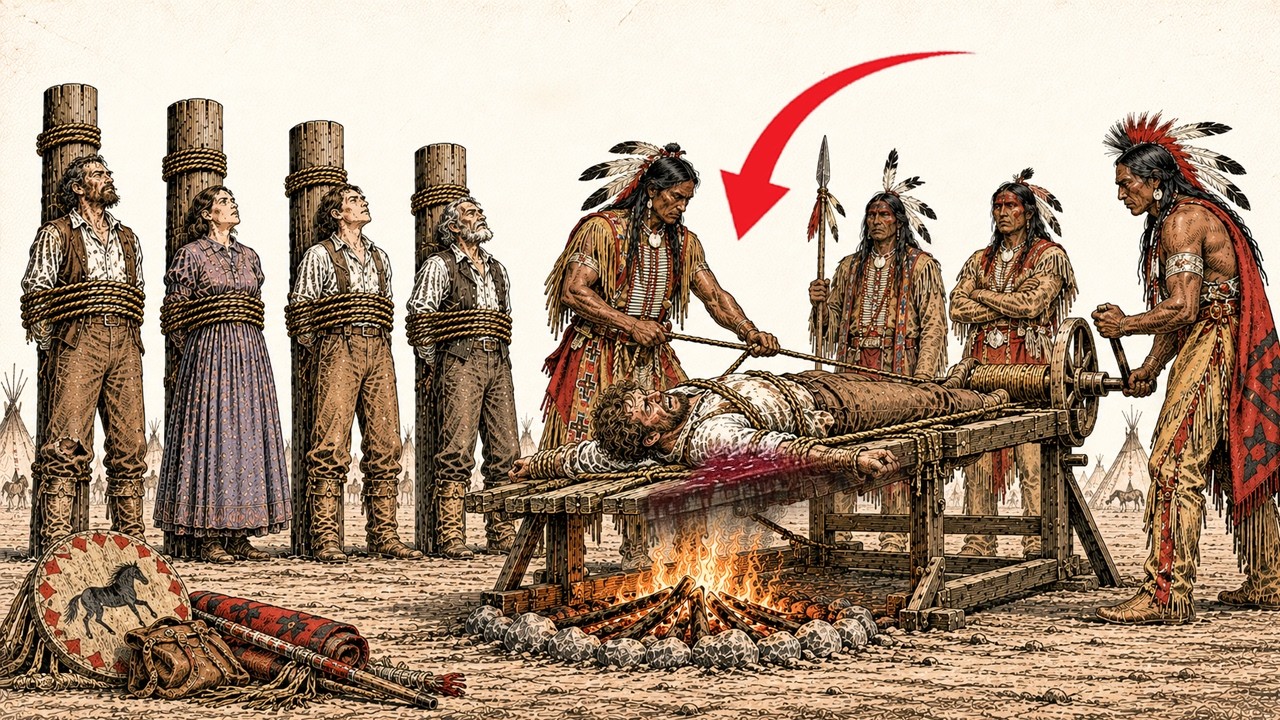
He is a 49-year-old man in the middle of a continent. No horse. No water. No map that would help him. No idea whether the nearest white settlement is 100 miles away or 400. If he leaves the camp, he will almost certainly die alone in land that will not even give up his bones. If he stays, he will die inside the lodge of a man who purchased him.
In that moment, on that particular night, he makes his decision. Lying awake, listening to the sounds of the camp around him, breathing in the smell of fires dying to embers, the shape of a decision forms in his chest. A decision he cannot take back once he starts moving.
Whether it happened on one dramatic night or over weeks of slow surrender to the idea, we do not know. The dictated narrative smooths these edges to make a story. The fact of that moment is not in dispute on one point only. At some point, this man chose the desert over the lodge.
He chose the near-certain death he could walk toward himself over the certain death waiting for him if he stayed. This is not a battle scene. This is not a heroic charge. This is a man in the dark deciding to stand up. It is the most important thing he ever did.
He does not know it yet, but if he gets out alive, he will walk into a room in New York City three months later to sit before editors working for a publishing house called Baker Taylor. What those two editors do with his words will become almost as important to Nelson Lee's story as anything the Comanche did to him.
But first, he has to survive the road.
Back to April 2, 1855. Back to the road outside Brownsville. Present tense, it is morning. Dust is rising. The sun has just cleared the mesquite, throwing long shadows across the hard ground. The horses move in their scattered mass, stirring that slow brown haze. The men ride on the edges, holding the herd together, their eyes wandering through the brush.
Somewhere in the thorn trees, Comanche riders are already in position. The group on the road does not know it yet. They will not know anything for another sixty seconds.
Then the attack begins.
The first shots come out of the brush. The horses panic and scatter. The men who fall in the first moments never get up. The men who try to fight are killed for trying. The men who try to flee are chased down and killed for fleeing. It is fast, brutal, and entirely one-sided.
By the end of the first minutes, most of the group lies dead in the dirt. Only four remain alive. Nelson Lee is one of them.
The problem, when trying to reconstruct what happened in the following minutes, is that everything we know comes from a single source. A book published four years later. In its opening pages, the editors wrote that it was recorded as it fell from the lips of Nelson Lee, day by day. Not accurately in his own words, for he is not an educated man though an intelligent one, but his history is related substantially as he related it.
That is the warning card placed by the editors themselves. Substantially. Not accurately. Keep that word "substantially" in mind, because it will matter greatly at the end of this.
Here is what we do not know. We do not know the names of the Comanche men who attacked that group. We do not know their band. We do not know how many there were. Later summaries of Lee's story give names to his captors, but whether those were their real names, or translated names for the book, or a mixture of everything, no independent record has ever confirmed.
The men who changed Nelson Lee's life more than any other men on earth are, in the historical record, faces without documentation.
Now we come to the moment that changes the course of the story. It turns on something that seems almost absurd. Nelson Lee, crouching or standing among his captors in whatever posture follows a battle, reaches into his clothing and pulls out a pocket watch. He holds it out to them. He does something with it. He winds it. He opens it. He makes it tick. He makes it chime.
The men who just killed his friends stop.
This is the story as later told. In every summary and reprint of Lee's narrative, this is the pivotal moment. The watch, that small mechanical thing that ticks, is the reason he was not killed on the road with the others. It fascinated the men who captured him. It made him someone worth keeping.
Not quite a prisoner. Not quite a slave in the way we use that word. Property. Valuable in a strange way because he owned something that made a strange sound.
The watch was not worth one dollar on the streets of New York. A man's life was bought and sold over a piece of brass and glass, with a spring inside that a watchmaker could have replaced in an afternoon. The distance between what a thing is and what it can mean is the distance Nelson Lee's life fell into that morning. It is the reason he was still breathing at sunset.
The survivors were taken north with the raiders. The land they crossed was harsh. The pace was relentless. The endurance the Comanche demanded from captives just to keep up was astonishing. Lee was a 47-year-old horseman pushed across the country at the pace of riders for days on end. He was not fed like the men who captured him. He did not sleep like them.
He was watched constantly because the watch, the thing that saved him, was now the thing that tied him to whichever man currently owned him.
Later catalog descriptions of Lee's narrative promoted it shamelessly as a tale of Indian life as it is on the war path and in the camp. That phrase, on the war path and in the camp, deserves a pause because it was the selling point. This is what the book was selling to readers in 1859 who were hungry for exactly this kind of story.
From the moment Lee opened his mouth in that editor's office in New York, the narrative was already being shaped for what the market wanted to hear.
By the end of the journey, Nelson Lee no longer belonged to the men who captured him. He had been given, or traded, or sold, the accounts vary, to a warrior whose name is translated in the narrative as Big Wolf. His first life of three within the Comanche world was about to begin.
What follows is the part of Nelson Lee's story that made his book sell. Three years. 1,095 days spent in a world he could not name. Sold and resold among warriors whose language he did not speak. Kept alive by an object none of them fully understood.
Everything in the record from this point forward comes from his lips, filtered through his editors, directed at his readers, and treated as such. The following is what Nelson Lee said happened. Whether it happened exactly that way is a question the final part of this story will answer.

Big Wolf is introduced as his first owner. In the narrative, he is the man who seized Lee and the watch after the raid. A warrior of standing. His control over Lee is total. His reasons for keeping him alive are tied entirely to the object in Lee's pocket.
Lee's role in the camp was menial. Exhausting. The watch was a ceremonial object, brought out for display, wound in front of visitors, its chime shown off to men who came from other camps specifically to hear it. Lee was reduced to being the keeper of the watch. His identity faded in the eyes of the men around him to become merely the sound that object made.
To stay alive because of a machine. To know that if the machine broke, you broke with it. To wind it every day with hands growing weaker in a camp where you are already the least important thing there.
The editors of the 1859 book promoted Lee's story as a window into a world their readers could not otherwise see. They called it a look at "the Comanche as they are." This framing claims a documentary authority the book cannot actually deliver, because everything in those pages passed through the memory of a captive, three years of trauma, and two New York editors before it reached the reader.
Every "as they are" in the book is actually "as he remembered them" and "as we chose to write that down."
At some point during his captivity, the narrative does not say how long it lasted, Nelson Lee ceased to belong to Big Wolf and became the property of a warrior called Spotted Leopard. The transition happened through trade, or gift, or the fluctuations of internal Comanche politics. The surviving text is not precise, and it is our only witness.
What matters is the pattern. Nelson Lee was no longer a man. He was an object attached to another object, and both could change owners.
The 47-year-old man who left Brownsville was now 48, then 49. His body was not what it had been. The frontier toughness that carried him into this country was fading under malnutrition, exposure, and a life that offered no rest.
Later summaries and new edition covers describe the book's content as torture and singular escape. That is the language of the genre. Because that is what captivity narratives were in 1859. A literary genre. It had conventions. It had expected rhythms. Readers bought these books expecting torture and a miraculous escape. Publishers delivered what readers expected.
In the three years Nelson Lee was held, the United States held two presidential elections. Buchanan replaced Pierce. The country he left was moving toward a civil war he did not know was coming. Newspapers were being printed in cities he could not name from where he stood. And Lee was somewhere on the southern plains, winding a watch every morning to prove he was still worth the food needed to keep him alive.
The middle years are the long, grinding heart of the captivity. The camp moves. Lee moves with it. He learns fragments of the language, enough to understand what is said about him sometimes, not enough to argue. He watches men come and go. He watches other captives, because he was not the only one, though his narrative focuses mostly on himself, arrive and disappear. Killed, ransomed, absorbed, or gone in ways he never learns.
There is a particular kind of endurance captivity requires, and it is not the endurance of battle. Battle is minutes. Captivity is years. It is not about the ability to fight. It is about the ability to not lose yourself when everything around you tells you daily that you no longer exist.
From the other side, from the perspective of the men who owned him, Nelson Lee was certainly not the center of anyone's world but his own. He was a curiosity. A story told to visitors. The men who held him had wives, children, relatives, disputes, hunting trips, deaths, weddings, and wars that had nothing at all to do with the old white man in the corner of the lodge.
To reduce the Comanche side of this story to merely being Nelson Lee's captors is to commit the same error as the 1859 book. It reduces an entire people to their relationship with one white man's ordeal.
The editorial note in the 1859 edition stated again that the book was recorded as it fell from the lips of Nelson Lee, day by day. Day by day. That means the editors sat with Lee across multiple sessions over an unknown period and shaped what he said into a book. Each night, one of those editors went home. Each morning, one of them came back. Between sessions, decisions were made. Decisions about pacing, drama, which parts of Lee's raw account deserved to be in the book, and which did not.
Decisions Lee himself, unable to write, had no real control over.
By the time he was sold for the last time, Nelson Lee had spent nearly three years in Comanche country. He was fifty years old. He belonged, in the language of the narrative, to a warrior named Rolling Thunder. And he was about to make the decision that would end everything.
Here is what Nelson Lee did not know as he lay awake in Rolling Thunder's camp planning his escape. He did not know that his own book, not yet written, would become within a few decades of his death one of the most debated captivity stories in American literature. He did not know that some scholars would eventually question whether the entire story was at best heavily embellished, and at worst largely fabricated.
He was, at that moment, a real man planning a real escape from real captivity. But the story he would tell about it, when he told it, would be received by historical narrative as less solid than the ground he was about to run across.
The escape. He goes at night. He goes alone. He takes almost nothing. The narrative later dramatizes this moment, and how could it not. Later summaries emphasize what they call his singular escape. Language that already smells of literature.
What can be said with reasonable confidence is that a man in his condition, in that country, in that season, set out toward the horizon. And that the attempt should not have succeeded. And yet it somehow did.
The country was brutal. The days without water were brutal. The way a human body, pushed to that edge, keeps moving with nothing but a refusal to stop is remarkable. There comes a moment when he can no longer tell whether he is walking or dreaming that he is walking.
He finally reaches the settled fringes of the American Southwest. The narrative brings him to El Paso in a condition the TSHA summary describes in two words: great suffering and extreme hunger. That is the dry description. The reality behind those words is a man who emerged from three years with a body that could barely stand.
Everything from this point in Lee's story forward is fundamentally different from everything that came before. Once he reached white settlements, there were witnesses. There were records. There were people who saw him, fed him, spoke to him. Before El Paso, there was only his word. After El Paso, there were documents.
That divide between the years no one else can testify to, and the moment he returns to the documented world, is the precise fault line on which any serious reading of Nelson Lee must rest.
He arrives in El Paso in the fall of 1858. He emerges from the desert into the fringes of the settled world, and the world has to stop and look at him. Look at his feet. Just his feet. Whatever remained of the shoes he left camp with had disintegrated by the time he reached the settlements. His feet were the feet of a man who had walked out of his own life. Cracked, bleeding, wrapped in whatever cloth he could tear from his clothes.
A doctor in El Paso, had one examined him, would have known immediately that he was looking at something men rarely survive. There is a particular look to the body of a starvation survivor that no one who has seen it once ever forgets. Nelson Lee in El Paso in November 1858 looked like that.

His recovery was slow. He ate carefully because a starving man cannot eat freely without killing himself. He rested. He began telling his story to those around him in fragments. Word spread. A man came out of Comancheria. A man who survived three years. A man who wanted to go east.
He sailed from the Gulf and arrived in New York City on November 10, 1858.
New York in November 1858 was a city already tilting toward a war it would not survive intact. Lincoln was two years from the presidency. The city was full of publishers who understood better than most what sold. A man walks into that city and says he was held by the Comanche for three years. Publishers do not need to be told twice.
Within days, he was sitting across from editors at Baker Taylor, and they were asking him to tell them everything from the beginning.
Here the story shifts entirely. Nelson Lee sits in a room in New York. He is 51 years old. Only weeks have passed since he left the Comanche world. In front of him sits at least one editor, perhaps two, with pen and paper, and Lee begins to talk.
He talks day after day, in the editors' later phrase. Not in one session. Not in one week. Across multiple sessions, spanning enough time to form a book. In every session, another person is writing down what he says. In every session, another person is deciding what to keep and what to cut. In every session, the man being interviewed is a trauma survivor whose memory carried the weight of three years of captivity and whose body had only recently recovered enough to speak fluently.
And that watch. The watch that saved his life on the road. The watch that made him worth keeping. The watch that became the central character of his captivity. It is now the centerpiece of the book being written around it. In the narrative that emerges, the watch is not just an object. It is the reason for everything. It is what turned killing into capture.
Whether it was truly the centerpiece, or whether it became so because it made a great story, is a question the records cannot fully answer.
Now the full account. Three years and some months of captivity until freedom. 1,095 days at minimum. Three owners, if the narrative is to be trusted. Big Wolf. Spotted Leopard. Rolling Thunder. Most of the horse caravan he was leading to California died on the road outside Brownsville. The other three people who survived the first hour, whose fates the narrative did not follow with any interest, and who largely vanish from the records afterward, are gone.
Nelson Lee walked out of Comanche territory a man in his fifties. He had entered it at 47. The three years between those two numbers are the three years of the book. They are also the three years in which he remains the only surviving witness on his side of the story.
But the escape was not the end of Nelson Lee's story. The end of Nelson Lee's story happened in that editor's office in New York. And that is where the sickening truth about his captivity lies.
Three Years Among the Comanches was published in 1859, one year after Lee arrived in New York. It sold. It sold well. It fed a market of American readers who desperately wanted to know what the Comanche world looked like from the inside, and who were not at the same time interested in the accuracy of what they were reading.
The book gave them Big Wolf. It gave them Spotted Leopard. It gave them Rolling Thunder. It gave them torture, captivity, and a miraculous escape. It gave them everything they had come to expect from the genre.
And in the opening pages, in a note most readers ignored, the editors had revealed the truth about what they had made.
He could not write.
Read that again. The man whose name is on the cover of one of the most famous Comanche captivity narratives in American history could not write. Every word in that book passed through someone else's hand before it reached the page.
Here is the note. The precise editorial admission that sits at the front of the 1859 edition. This narrative was taken down as it fell from the lips of Nelson Lee, day by day, not accurately in his own words, as he is not an educated man though an intelligent one, but his history is related substantially as he related it.
Read that carefully. Not accurately in his own words. Substantially as he related it. This is not a book. This is a book about a man, written by other men, based on what the man was able to say out loud in a room across several sessions, then shaped by editors to fit what the market wanted.
The publishers of 1859 were not hiding this. They put it in the opening pages. But no one read the opening pages. They read about the torture. They read about the escape.
And that is why, for over a century and a half, scholars have argued about how much of Nelson Lee's account represents his actual experience during his three years among the Comanche, and how much is editorial drama. And what percentage, if any, was completely fabricated.
Some readings treat the book as a largely honest account that was heavily revised. Other readings treat it as closer to a hoax dressed in the clothes of a memoir. The honest answer is that the records cannot settle the matter definitively. The only man who could died over 140 years ago.
This is the second question from the beginning. The question of whether the book that made him famous was actually true. And the answer is that the New York editor himself stated in the opening pages that it was not. Not accurately. Not literally. Not word for word.
The book is a shadow of a man's testimony, shaped by strangers, sold to an audience that wanted a specific story. That is the sickening truth of Nelson Lee's captivity. Not what the Comanche did to him on the plains. What New York did to him in a publisher's office.
Back to the road outside Brownsville. April 2, 1855. Dust is rising. Horses are moving. A 47-year-old man rides at the edge of his doomed party. In about two minutes, everyone around him will be dead except three.
You now know what saved him. A pocket watch worth less than a dollar. You now know what happened in the next three years. Or you know what he said happened, after being revised by editors and shaped into a book.
Nelson Lee's story is not actually one story. It is two. There is what happened on the plains, which we can only see partially. And there is what happened in that office in New York, which is why we can only see it partially.
The sickening truth about Nelson Lee's captivity is that the record we have of it was never fully his to tell. His tongue spoke it. Other men wrote it down. The public bought it. What we call his history is what survived that process.