Johanna Elisabeth came into the world with a pedigree that opened doors across northern Europe, but the doors led into rooms that were far grander than her own. Born into the old German house of Holstein-Gottorp, she grew up in the household of her godmother, where she was raised alongside the three daughters of Duke Augustus William. That childhood placed her inside one of the most lavish courts in northern Germany, a world of sumptuous banquets, royal hunts, and ornate theatrical performances. She tasted that life early, and she wanted more of it.
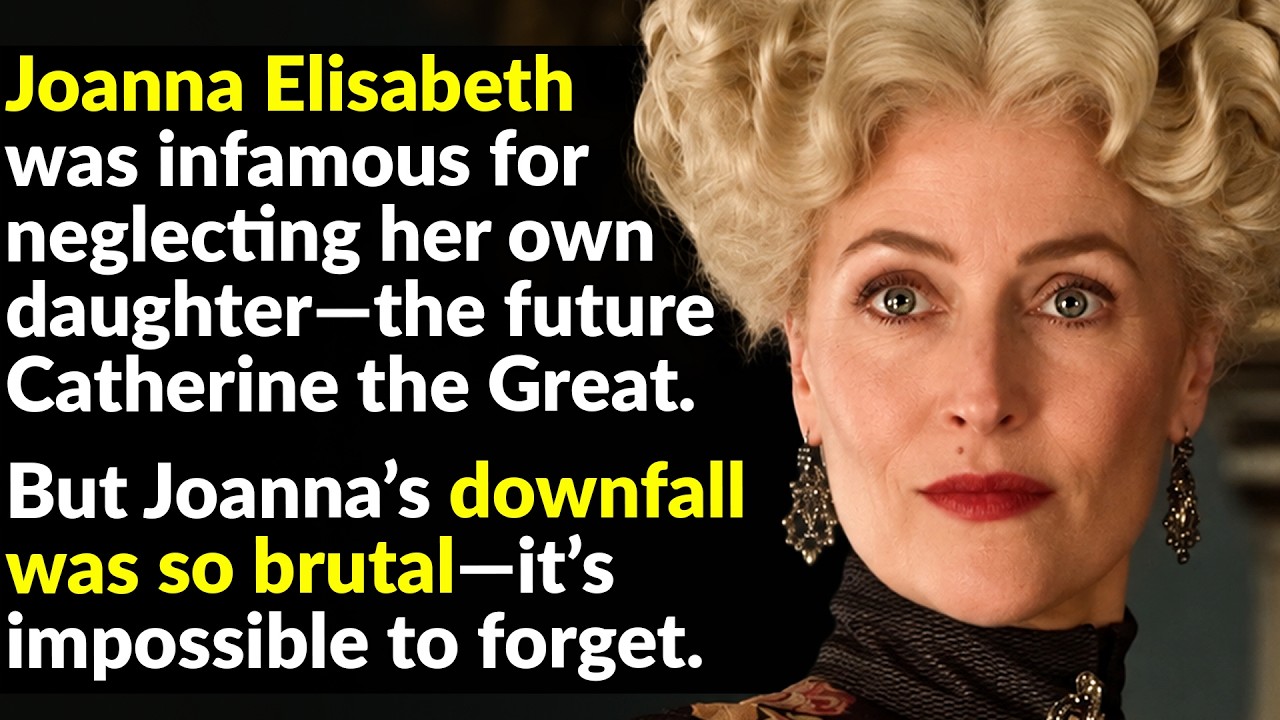
She wanted wealth and status and a place among the great families of Europe. Reality disappointed her. In November 1727, at the age of fifteen, she was married to Christian Augustus, a minor German prince who was thirty-six and twice her age. He was a general in the Prussian army under Frederick William I and the heir to the small principality of Anhalt-Zerbst, but the titles did not translate into money.
The couple settled in the provincial town of Stettin in Pomerania, far from the glittering courts of her youth. Their marriage soured quickly. Christian was serious and quiet; Johanna was social and restless. Worse, his modest salary could barely afford a small house suitable for a junior officer’s family.
For a woman who had grown up amid royal splendor, the decline was humiliating. In January 1729, her husband was appointed commandant of Stettin, and the family moved into the castle in the center of town. Even that could not satisfy her for long. Months later, in April, Johanna nearly died in childbirth.
The delivery was long and dangerous, and though she had access to the best eighteenth-century medicine available, she spent the next nineteen weeks confined to bed recovering. When it was over, she learned that her first child was a girl. The girl, who would one day become Catherine the Great, was to her mother only a disappointment. A daughter brought her no closer to the wealth and prestige she craved.
Johanna handed the infant to nurses and governesses without a second thought, already convinced that the child who might raise the family’s fortunes would have to be a son. She kept trying. After Sophie, she gave birth to three more children: William Christian Frederick in November 1730, Frederick Augustus in August 1734, and Auguste Charlotte Christine in November 1736. Of the four, William was her favorite.
Meanwhile, young Sophie, the eldest, slowly understood that being firstborn did not mean being loved. According to her own memoirs, she later wrote that her mother bore her a deep anger and, for reasons she could not explain, seemed to care little for her. The neglect was painful enough, but Johanna’s ambition always outweighed her affection for her children. That attitude shifted when Johanna realized her ignored daughter could become a valuable asset.
From the age of eight, Sophie accompanied her mother on visits across the European courts while Johanna scouted for potential husbands. In 1739, she found an especially promising match. Johanna visited her brother Adolf Frederick, who served as guardian to an eleven-year-old orphan named Charles Peter Ulrich. The boy was the Duke of Holstein-Gottorp and the only surviving grandson of Peter the Great, the former Emperor of Russia.
Johanna saw her ticket to history. The timing proved perfect. In 1741, Grand Duchess Elizabeth Petrovna seized the Russian throne as Empress. Johanna immediately sent a letter of congratulations, accompanied by a portrait of her late sister, Grand Duchess Anna Petrovna.
The gesture worked; Elizabeth responded with a valuable portrait of her own. Johanna pressed her advantage and sent a portrait of her daughter Sophie, the very child she had once dismissed as ordinary and even ugly. Sophie was not classically pretty, but her bright blue eyes and intelligent, expressive face caught attention. It was that face that impressed Empress Elizabeth, who became enchanted by the girl’s beauty.
Before Johanna could celebrate her success, tragedy struck. William, her beloved son, had been sickly since birth, and years of seeking treatments had not cured his rickets. On August 27, 1742, he died at the age of twelve. Johanna, who rarely showed emotion toward any of her children except him, was described as prostrate with grief.
But the mourning was brief. A few months later, she was pregnant again, and in December 1742 she gave birth to her fifth and final child, another daughter. She saw the birth as an opportunity. She asked Empress Elizabeth for permission to name the baby after her, and the Empress agreed, even serving as the child’s godmother.
The flattery worked. In 1742, Elizabeth brought Charles Peter Ulrich to Saint Petersburg and adopted him as her heir. Overnight, the orphan Johanna had once eyed for her daughter became one of the most important young men in Europe. Around the same time, the Empress also named Johanna’s brother Adolf Frederick heir to the Swedish throne.
A family that had been relatively obscure was suddenly connected to two future thrones. In November of that year, Christian Augustus inherited the principality of Anhalt-Zerbst alongside his brother, and the family packed up from remote Stettin and moved to the more fashionable city of Zerbst. On New Year’s Day 1744, a letter arrived that changed everything. It came from the grand marshal of Grand Duke Peter’s court.
The message was direct: by order of the Empress, Johanna and her eldest daughter were to come to Russia as soon as possible. Hours later, a second envelope arrived, this one from King Frederick II of Prussia. The timing was no accident. Frederick told Johanna he believed a marriage between Grand Duke Peter and Sophie could be arranged.
Johanna suddenly found herself caught between the two most powerful courts in Europe, preparing to play a dangerous game. On January 10, 1744, Johanna, Christian, and Sophie traveled to Berlin to meet Frederick in person. The King wanted more than a wedding. He secretly asked Johanna to act as a Prussian agent in Saint Petersburg.
According to the sources, she accepted the request with enthusiasm. To avoid suspicion, she traveled under the false identity of Countess von Reinbeck. But the reality of espionage was less glamorous than she had imagined. The journey to Russia was grueling, and by the time she reached Moscow, she was just in time for the celebrations of Grand Duke Peter’s birthday.
The court was magnificent, but her joy faded quickly. Shortly after arriving, she learned that her youngest daughter, Elizabeth, the child named after the Empress herself, had died suddenly. Things continued to deteriorate. Sophie fell ill, and when the doctors wanted to perform a bloodletting, Johanna refused.
The Empress took the refusal as a personal insult, separated Johanna from her daughter, and attended to Sophie herself. It was the first crack in Johanna’s relationship with the Russian court. Meanwhile, she was still pursuing her own secret mission, working to undermine Vice-Chancellor Bestuzhev. The double game grew more dangerous, and Bestuzhev was already ahead of her.
He intercepted her incriminating letters to the Prussian and French ambassadors, along with her correspondence with the Prussian and French courts, and presented everything to Empress Elizabeth. It was the worst possible outcome. Johanna’s espionage was exposed, and her secret dealings were laid bare before the very woman she had spent years desperately trying to please. The punishment was absolute humiliation.
The Empress, furious, ordered Johanna Elizabeth permanently banished from Russia. But there was one problem: Sophie’s engagement to Peter was already arranged, and the wedding was too politically important to cancel. To avoid a public scandal, Elizabeth allowed Johanna to remain in Russia until her daughter’s wedding. Immediately afterward, she would be forced to leave and would be forbidden from ever returning.
By then, the damage was done. Even Johanna’s relationship with her future son-in-law had deteriorated, leaving her without allies at court. With her betrayal exposed, she had only one task left: getting Sophie to the altar. That wish was fulfilled on August 21, 1745, when the young couple married.
The wedding celebrations lasted ten days, with lavish banquets, masquerades, fireworks, and theatrical performances designed to display the immense wealth and power of the Romanov court. For Johanna, on the edge of exile, the wedding was a bittersweet climax to a lifetime of social ambition, proof that her family had finally reached the top. Yet true to her word, the Empress expelled her immediately after the ceremonies. Johanna was forced to leave Russia without even being allowed a formal private farewell with her daughter, who now bore the title Grand Duchess Catherine Alexeievna.
The two never saw each other again. In a final act of vengeance, Johanna was handed an open official letter from Elizabeth to deliver directly to Frederick the Great, demanding that the King recall his expelled ambassador at once. Making Johanna the bearer of the consequences of her failed conspiracy was the ultimate degradation. Two years after returning to Russia in disgrace, Johanna lost her husband.
Christian died in March 1747, and their son Frederick inherited his father’s title, becoming the new Prince of Anhalt-Zerbst. The boy was still too young to rule, so Johanna took on the regency herself. For the first time in her life, she was actually in charge, and she wasted no time using her new authority. During her regency, she built a grand new palace at Dornburg, intended to be magnificent enough to host her brother, the King of Sweden, and her now-famous daughter, the Grand Duchess of Russia.
Neither of them ever bothered to come. Her time at the top did not last. In 1752, her son came of age, and the regency ended. After five years of holding power, she was forced to step aside for her son.
But what followed was unlike any humiliation she had faced before. In 1758, the Seven Years’ War caught up with her. Prussia, the very kingdom whose secrets she had carried as a spy, marched into Anhalt-Zerbst and seized it. Johanna and her son had nowhere to go.
In a panic, they fled to Paris and settled in exile. Johanna Elizabeth never returned home. She died in Paris in May 1760 at the age of forty-seven, still living in exile and still separated from her famous daughter. Her son Frederick never returned to Zerbst either.
The greatest irony of Johanna’s life was one she never lived to see. Had she survived just two more years, she would have witnessed her most remarkable achievement. In 1762, the very child she had neglected and handed over to governesses became Empress and autocrat of all Russia under the name Catherine II, known to history as Catherine the Great. She ruled for thirty-four years without her mother’s knowledge.
Catherine transformed Russia into a great European power, expanding its borders, securing vital ports, and modernizing its economy. A devoted enthusiast of the Enlightenment, she encouraged education, supported the arts, and corresponded with some of the greatest thinkers in Europe. The small child her mother had treated as a political bargaining chip became an empress who reshaped an empire and left her mark on history.