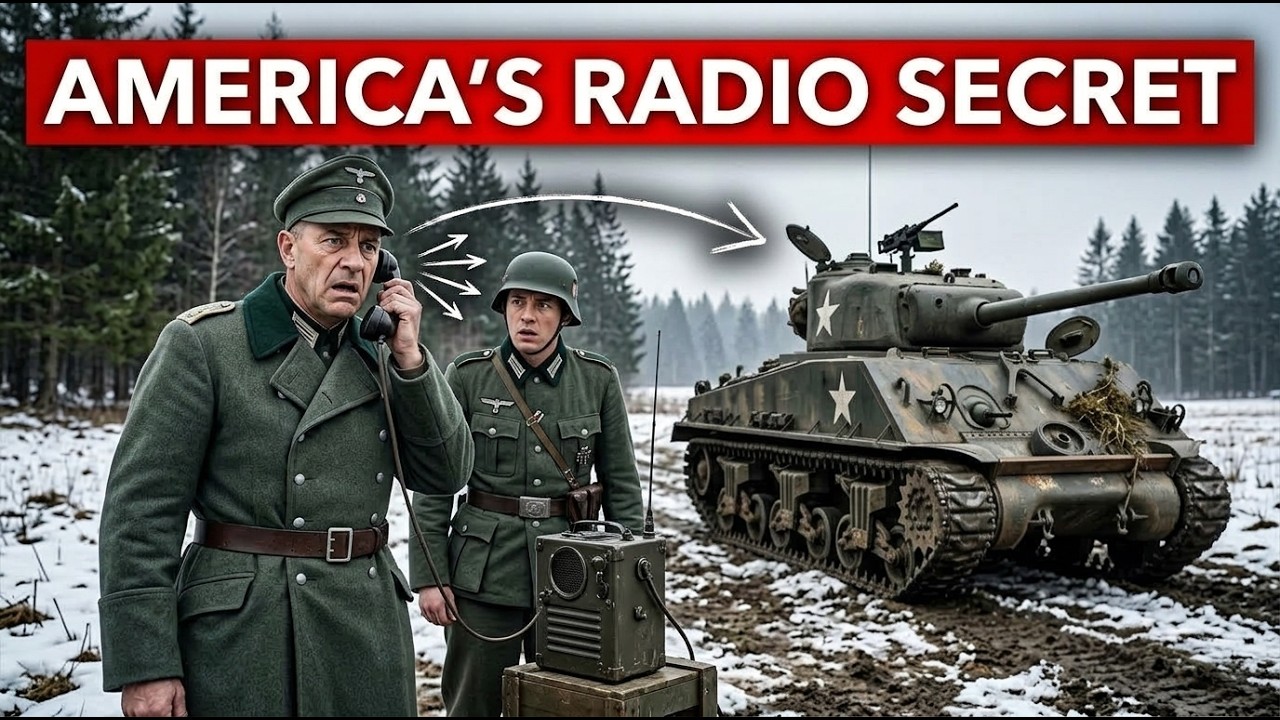
In October 1944, a German signals officer stood on a burned-out Sherman tank in a scrap yard outside Aachen. The tank had been destroyed three days earlier. Using a crowbar, he pried open the rear of the turret where the Americans kept their radio equipment.
He removed the radio boxes in about 20 minutes. Two olive-drab units, one transmitter and one receiver, sat bolted together on a shock-absorbing base. Cables ran forward to the commander’s seat and to every crew station inside the tank.
He carried the units into a barn and placed them on a workbench. Then he did something he had been ordered to do, and would have done anyway out of professional curiosity. He counted the buttons.
There were 10 of them. Ten push buttons in a single row across the face of the unit. Each button was numbered and roughly the size of a thumbnail. The officer understood immediately what the ten buttons meant.
They meant ten pre-set channels. They meant an American tank commander, wearing gloves, inside a moving vehicle under fire, with the loader screaming in his ear and the engine roaring behind him, could change frequency with a press of his thumb. No dial to turn. No fine-tuning. No holding the signal steady while the tank lurched over a berm.
He wrote his report that night. Dozens of similar reports survived from German signals officers on the Western Front in the last 18 months of the war. They described the hardware, the frequency range, the output power, the crystal control, the quality of manufacture.
German technical intelligence was excellent. They took the sets apart correctly. They understood every component in front of them. But none of those reports could explain what frontline troops kept complaining about, because the complaint from the front was not about the box itself.
The complaint was about what happened when a German gun crew fired on one American tank at the edge of a forest. You did not fight one Sherman. You fired at one Sherman, and within 30 seconds every American vehicle within two kilometers was shooting back at you, plus artillery you could not see. Sometimes aircraft as well.
The German officer watching through his binoculars could not figure out who gave the order, because there was no time for anyone to give an order.
They had the radio. They had it on the workbench in the barn near Aachen. But it did not tell them what they needed to know. The thing they were trying to understand was not a radio. It was a decision made in an American laboratory 11 years earlier, a decision the entire commercial radio industry in the United States had tried hard to bury.
The Germans invented tank radio. That part is often skipped, and skipping it makes the story absurd. The idea that an armored formation could hold together by voice instead of flags, messengers, and a plan agreed upon the night before, was a German idea championed by German officers in the early 1930s, when the world’s armies still treated the tank as a mobile fortress walking beside infantry.
Heinz Guderian was a signals officer before he became a tank officer. That detail matters more than anything else about him. He came to armor from communications and understood before almost anyone else that the limiting factor of mechanized power was not the speed of the tank. It was the speed at which a commander could change his mind and deliver that change to his vehicles.
So the German Panzer arm was built with radio first. By 1940, German tanks carried the Fu 5, a 10-watt set operating on shortwave, with a voice range of a few kilometers and a longer range using Morse code. Command tanks carried heavier equipment. Signal procedures were drilled relentlessly. German radio discipline, brevity, standard phrasing, and cleanliness of call signs were the best in Europe, and they worked exactly as advertised.
In France in 1940, French tanks were individually superior in several respects. The Char B1 bis was better armored than anything the Germans fielded. The French had more tanks in the theater. They lost partly because a French tank company commander who wanted to redirect his unit often had to go to it in person, while the German company commander pressed a switch and talked.
So when a German signals officer stood in a barn outside Aachen holding an American radio, he was not a man facing a new idea. He was a man from the country that invented the idea, looking at someone else’s version of it, and trying to figure out why his own version had stopped being enough.
The first part of the answer is not about hardware at all. It is a physical problem the German set could not escape, while the American set was designed to bypass it.
The Fu 5 was an AM radio. Information traveled in the strength of the wave. That is a fine way to run a radio in a quiet room. It is a bad way to run a radio inside a steel box containing a large unshielded gasoline engine, a power generation system, and a crew wearing headsets moving across a battlefield where hundreds of other engines and dozens of other stations are operating on nearby frequencies.
Every spark plug firing behind your back adds noise to your signal, because noise is a fluctuation in amplitude, and amplitude is exactly what your receiver is listening to. German crews dealt with this the way everyone did. Shielding, suppression, discipline, fine-tuning, repeating yourself, then drift, because a tuned circuit heats up, the frequency changes, and someone has to re-tune. In a tank under enemy fire, the person busy re-tuning is the person not fighting.
The Americans made a different bet. They had made it before any of this mattered to anyone.
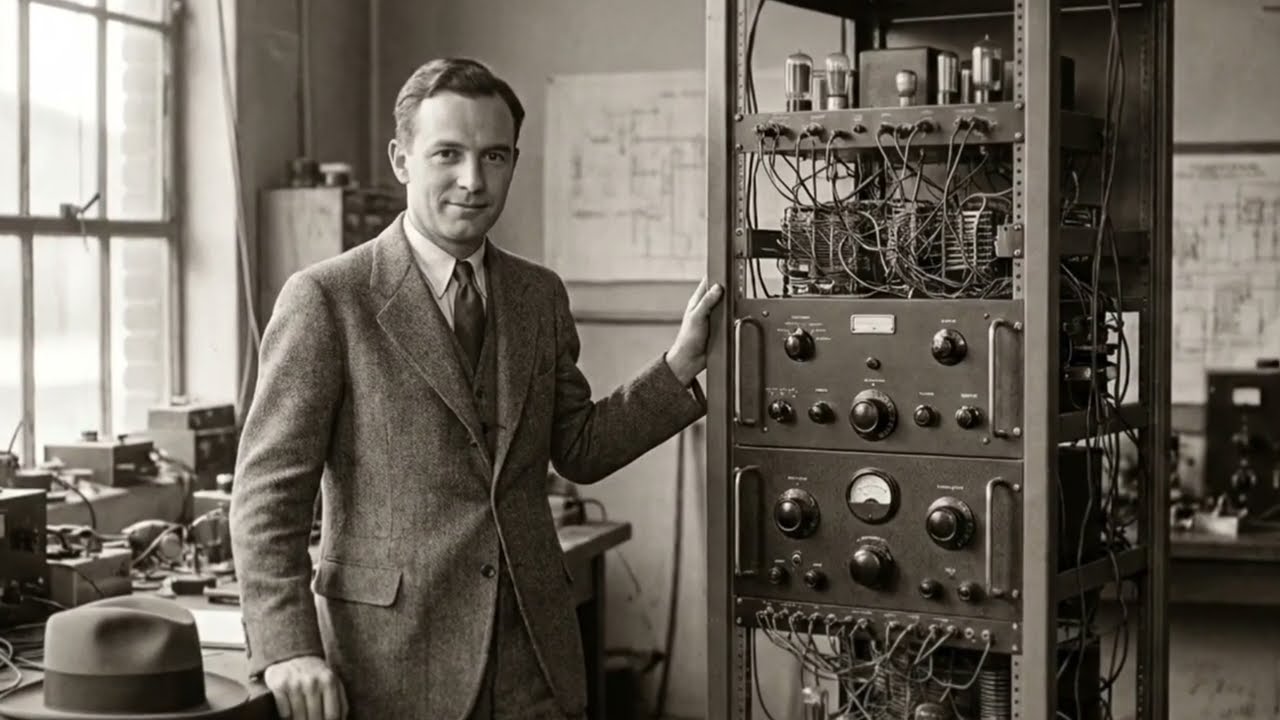
In 1933, an American engineer named Edwin Howard Armstrong demonstrated a method of radio broadcasting that encoded the signal not in the strength of the wave but in small changes in its frequency. Frequency modulation. FM.
Armstrong was not a fringe figure. He had already given the world the regenerative circuit and the superheterodyne receiver, the internal design of every radio receiver built since. He was one of the most important radio engineers in history. The American commercial broadcasting industry, which had invested enormous capital in the AM system, did not want FM to exist.
What followed was a long, bitter commercial and legal fight that consumed the rest of Armstrong’s life. It has nothing to do with tanks, except for one aspect. While industry fought it, the U.S. Army Signal Corps was running secret tests. The officers running those tests found something broadcasters did not want to hear.
FM had a unique property. AM did not. In the laboratory it looked like a scientific curiosity. On the battlefield it was decisive. It is called the capture effect.
An FM receiver receiving two signals on the same frequency does not mix them together into garbled sound. It locks onto the stronger signal and suppresses the weaker one almost entirely. Noise, ignition crackle, atmospheric interference, the electrical noise of a moving vehicle, all of these are amplitude noise. A receiver that relies on frequency instead of amplitude is almost deaf to them.
Translated out of engineering language, this means the American tank commander heard a clean voice. Not a voice buried under static. Not a voice he had to strain to hear or ask to repeat. A voice in his headset as clear at the far end of the net as at the near end, with the engine at full power and the gun firing.
The Signal Corps pushed that bet further than any other army on earth. Armor sets, the SCR 508 and its relatives, were FM, crystal-controlled, operating in the 20 to 28 megahertz range, with those ten pre-set buttons so that changing the net was a thumb movement instead of a procedure.
Crystal control matters as much as FM. A crystal-controlled set does not drift off its frequency. You set it in the morning and it stays exactly where you left it that night. Every other set in the battalion stays exactly where they left it. A tank that had been out of communication for six hours rejoined the net with the press of a button.
Then there was the small decision in the procurement document that was not small at all. Every tank had a transmitter. Not the platoon leader. Not the company commander. Every tank. The soldier driving the fifth tank in a five-tank platoon could send a contact report to the company net himself, in his own voice, in real time, without asking anyone’s permission.
The German gun crew at the edge of the treeline fires at one Sherman according to German assumptions. Logical assumptions. Doctrinally sound assumptions. The assumptions that broke France.
What happens next is a sequence. The tank that is hit reports it. The report reaches the platoon leader. The platoon leader assesses and passes it to the company. The company commander decides. The decision comes back down. Somewhere in that chain, artillery is requested and that request travels through a communications channel with its own procedures and its own delay. Call it a few minutes.
In a well-trained unit with an experienced commander, German officers trained on this carried a number in their heads about how long a competent enemy needed to respond. Everything they did, shoot and scoot, dispersal plans, withdrawal positions, retreat timing, was built around that number.
What actually happened was this. The tank that was fired on sent its report. Every other tank in the company heard it at the same moment, in the original voice, without relay, without summarization, without delay from a man deciding whether it was worth passing on. The platoon on the flank did not wait for an order because the platoon on the flank had heard the contact report directly and was already watching the same situation develop on the same net.
Two tanks started moving before anyone above them said a word. The company commander could reach the artillery without leaving his own net.
This is the element the Germans consistently underestimated, because in their system it did not exist in the same form. American armor, infantry, and artillery could talk to each other. The forward observer with the field artillery battalion. The infantry battalion command net. The tank company. These were not sealed compartments with liaison officers standing between them as translators. Equipment was shared. Nets were tied together. An artillery observer rode inside a tank. A tank commander could get fire support because the man granting that support was on a radio he could reach with his thumb.
Then there is the smallest and most revealing piece of equipment in this entire story. It did not come out of a laboratory. It came out of a maintenance tent.
By the middle of the Normandy campaign, American tank and infantry units faced a deadly, specific problem. Tanks and infantry fighting in the same field could not talk to each other. The riflemen who could see the machine gun position had no way to tell the tank 15 meters away except to climb onto the vehicle under fire and bang on the hull with a rifle butt.
So units in the field began mounting a standard field telephone, the EE8, a box with a handset, the same phone used to connect a command post, inside an ammunition box welded to the rear plate of the tank and wired into the intercom system. An infantryman walked behind the tank in its cover, picked up the handset, and spoke directly to the tank commander’s headset.
Nobody designed it. Crews and ordnance men improvised it because they were tired of watching men die on the rear deck. It worked so well it spread across the theater and became standard production.
That is the entire American communications story in one detail. The system leaked downward. A sergeant with an extra field phone and a welding torch could add capability to a 30-ton vehicle, and nobody arrested him for it. They copied him.
The men who welded a phone box to the back of a Sherman because their infantry kept dying on the hull appear nowhere by name.
Now the harder half of the assessment, because the easy version of this story, that the Americans had good radios and the Germans had bad radios, is wrong. The German officers who wrote those workshop reports knew it was false.
German radio engineering was superb. German signal procedures were, if anything, more disciplined than American ones. In one way, they were more disciplined than they should have been. German transmissions were so regular, so precisely phrased, so faithfully encrypted on the same machines day after day, that they became the raw material for Allied codebreaking efforts that read a vast amount of German traffic for years.
What happened to German communications by 1944 was not an engineering failure. It was that everything that engineering depended on had been drained away.
Start with vehicles. A radio net requires vehicles carrying radios, and by autumn 1944 German formations in the West were being assembled from scattered remnants. A regiment might have one battalion of veterans with a trained signals section, and another raised last month from air force and navy personnel with no armor signals training and no compatible equipment.
Then crystals, tubes, batteries, copper, trained operators. Each one of those was a supply line. By late 1944, every German supply line in the West was being cut by day and bombed by night.
Then there is the silence discipline dilemma. German units in the West operated under increasingly strict radio restrictions because they had correctly learned that transmission brought direction-finding, artillery, and aircraft. A unit that cannot safely transmit is a unit whose beautiful radio doctrine has become theory. The set was in the vehicle, but it could not be used.
On the other side of the line, the Americans broadcast constantly on tactical nets at enormous volume all day, because they had also calculated, correctly, that the tactical advantage of talking outweighed anything the Germans could do about it in the time available.
That is the disparity. Not simply radio versus no radio. A system that could still afford to use its radios versus a system that no longer could.
There is another layer, the one the officer with the crowbar could not see because it was not inside the tank. The American tactical FM radio was an integrated family. The armor set in the turret. The SCR 300 backpack that gave an infantry company commander a voice. The small SCR 536 handset that a platoon leader carried in his fist.
These were built as interconnected infrastructure, produced in numbers that are difficult for the mind to absorb. Tens of thousands of backpack sets. More than a hundred thousand handheld sets. Enough for a rifle platoon leader in an ordinary infantry division to have a radio, with enough spare parts behind him that if his set failed, he was handed another one.
A German platoon leader in most formations in 1944 relied on his voice and a runner to pass orders.
So when the Germans wondered how every American tank answered at once, they were asking a question about a single vehicle. The answer was an integrated structure. Radios in turrets. Radios on infantry backs. Radios in artillery fire direction centers. Light aircraft overhead. A phone box welded to the rear plate. And the industrial capacity to put all of it in the hands of ordinary men and replace it the week it broke.
The verdict is not that American radios were better than German ones. In many measurable respects, they were. The decision to use FM was one of the most far-sighted technical bets any army made in the twentieth century. But that is not the conclusion.
The conclusion is that the two armies had different theories about what a radio was for.
In German theory, the radio was a command tool. It existed so that the commander’s intent could reach his subordinates faster than a runner could carry it. That is a good theory. It is the theory that broke France. Under it, you invest in the commander’s set. You drill procedures relentlessly. You keep the net pure by keeping traffic minimal and hierarchical.
In the American arrangement, which nobody wrote down as doctrine, which grew because the equipment was there and the men used it, the radio was not a command tool. It was shared awareness. It existed so that everyone on the net knew what everyone else knew at the same moment, without waiting for the information to be processed at a higher level first.
Under German theory, the fifth tank in the platoon does not need to transmit, because the fifth tank does not make decisions. In the American arrangement, the fifth tank transmits, and every vehicle in hearing range changes direction based on what it just heard. The officer, who nominally commands, finds his unit has already executed half the correct maneuver by the time he opens his mouth.
That is exactly what the German gun crew at the edge of the forest was watching. That is what their doctrine gave them no vocabulary to describe. They fired at one tank. An entire company answered, because that company that morning was not a hierarchy. It was a network, and every station on it heard the shot.
The signals officer in the barn near Aachen had the hardware in front of him and could not find the answer in it, because the answer was not inside the box. The box was only a display. The answer was that the United States had made enough boxes to put one in every vehicle, one on an infantryman’s back, and one in a wooden case bolted to a rear plate by a sergeant whose name was never recorded, and then trusted the men carrying them to speak without permission.
You cannot capture that with a crowbar. You can only capture the radio.
The officer in the barn is a composite figure. The salvage yards were real. The captured sets were real. The German technical reports on American armor radio were real. And the phenomenon the German front line kept describing, that firing at one American vehicle drew a response from an entire formation in under a minute, is documented from Normandy to the Rhine.
Edwin Armstrong, who gave the U.S. Army the physics that made this possible, spent his final years in litigation over patents granted to him that he could not defend. He died in 1954. He never commanded anything. He never sat in a tank. Every clear voice in every American headset in Europe was his voice.