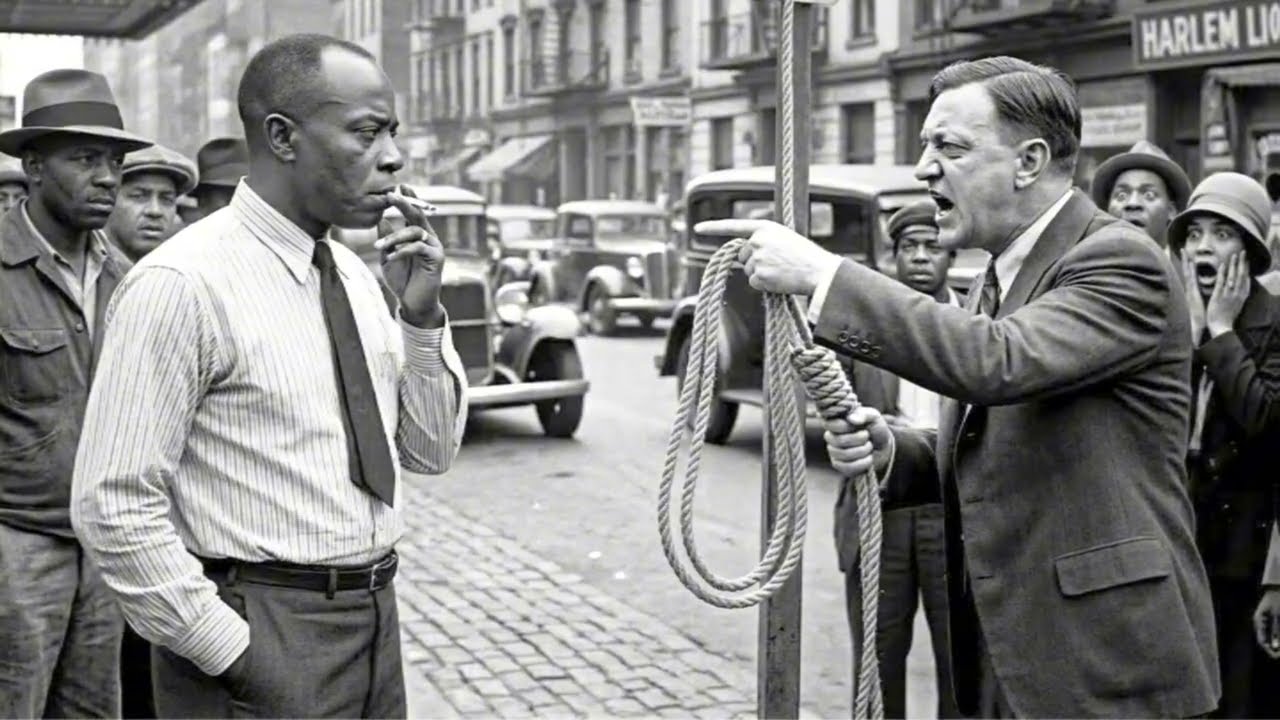
In the fall of 1931, a rope appeared on a lamp post in Harlem before the city woke. It was thick, deliberate, and knotted with patience. Tied to it was a folded piece of paper bearing two things: a name and a date. Ellsworth Johnson. November 14th, 1931.
The name belonged to Bumpy Johnson, the man who controlled Harlem’s numbers operation. The date was three weeks away. The rope was a promise, and the promise was death.
The crowd that gathered that morning understood the message instantly. This was not a warning. Warnings imply that behavior can still be changed. This was an announcement. Whoever placed it wanted witnesses. A police officer on his morning beat read the paper and kept walking without touching a thing.
Monroe, a friend who ran the barber shop two doors down, took the paper upstairs to Bumpy’s apartment. He found him at the kitchen table with a cup of coffee and a book. Bumpy listened without moving. When Monroe finished, he turned a page and took a sip of coffee.
"The man who hangs the rope first," he said, "is usually the man who dies first."
Monroe stared at him. "Bumpy, that's Dutch Schultz."
"I know who it is. He doesn't bluff. You know he doesn't bluff."
"I know that, too."
By midmorning, the news had moved through Harlem the way only street-level information moves. By noon, it had reached every barbershop and church basement. By mid-afternoon, it had settled over 125th Street like a second weather system. People walked faster. They watched doorways and corners. The membrane between ordinary life and catastrophe had suddenly become visible.
Bumpy’s lieutenants came to his apartment before the day was out. Calvin, the eldest and broadest, sat across the table and offered the obvious solution. "We move you tonight. Philadelphia, Baltimore. You disappear for six months, let the temperature drop."
Bumpy’s voice was quiet but had an edge that stopped Calvin mid-sentence. "From the position of a man who ran. The moment I leave Harlem, Dutch Schultz walks in. Not in a week. That same night. Everything here becomes his. You're asking me to save my life by surrendering every reason my life has ever meant anything."
The room absorbed this in silence. There was no counter argument because there was none to offer.
Dutch Schultz had built his empire through genuine brilliance and a willingness to act decisively. But there was a third element in his character. His mind worked at a speed most people could not match. And then, without warning, the calculation would dissolve into the need to dominate, to punish, to prove a point.
Harlem was both things at once. A rational business objective and an emotional compulsion. The numbers game threading through those streets represented revenue Dutch wanted. But Harlem was also the one significant territory where his reach had not yet arrived. Bumpy Johnson had not gone out of his way to challenge Dutch. He had simply continued to operate as though Dutch’s expansion did not automatically require his submission.
For a man like Dutch Schultz, that quiet, unbothered independence was more provoking than any open insult.
Four days after the rope appeared, a message arrived through an intermediary. Dutch Schultz wanted a meeting. A warehouse on the West Side, after dark. Bumpy brought four men. He wore his best suit. He walked through the entrance with the pace of a man arriving for an appointment he himself had scheduled.
Dutch stood near the center of the room beside a folding table with an unopened bottle of whiskey. His eyes moved constantly. When Bumpy walked in, Dutch’s eyes found him and held there.
"You're a smart man. Everybody says so. I respect smart men. But smart men know when a thing is over. I'm giving you the chance to step back with dignity. With money. With your future intact somewhere else."
He paused, and his voice dropped. "48 hours. Hand over Harlem, or I personally make sure that rope outside your building gets the use it was hung for."
Thirty armed men stood in that warehouse, waiting for the fear to arrive on Bumpy Johnson’s face. It did not arrive.
Bumpy straightened a small shift in posture that somehow reorganized the spatial dynamics of the entire room. He fastened the top button of his jacket with slow, complete attention. Then he looked at Dutch Schultz with a long, settled, direct look. Then he smiled, cold and precise as a blade.
"Dutch," he said, and his voice reached every corner of the room. "You just made the biggest mistake of your life. And you don't even know what it is yet."
He turned and walked toward the door. His four men fell in behind him. Not one of the 30 armed men in that room moved. Not one hand reached for anything. Not one voice called after him.
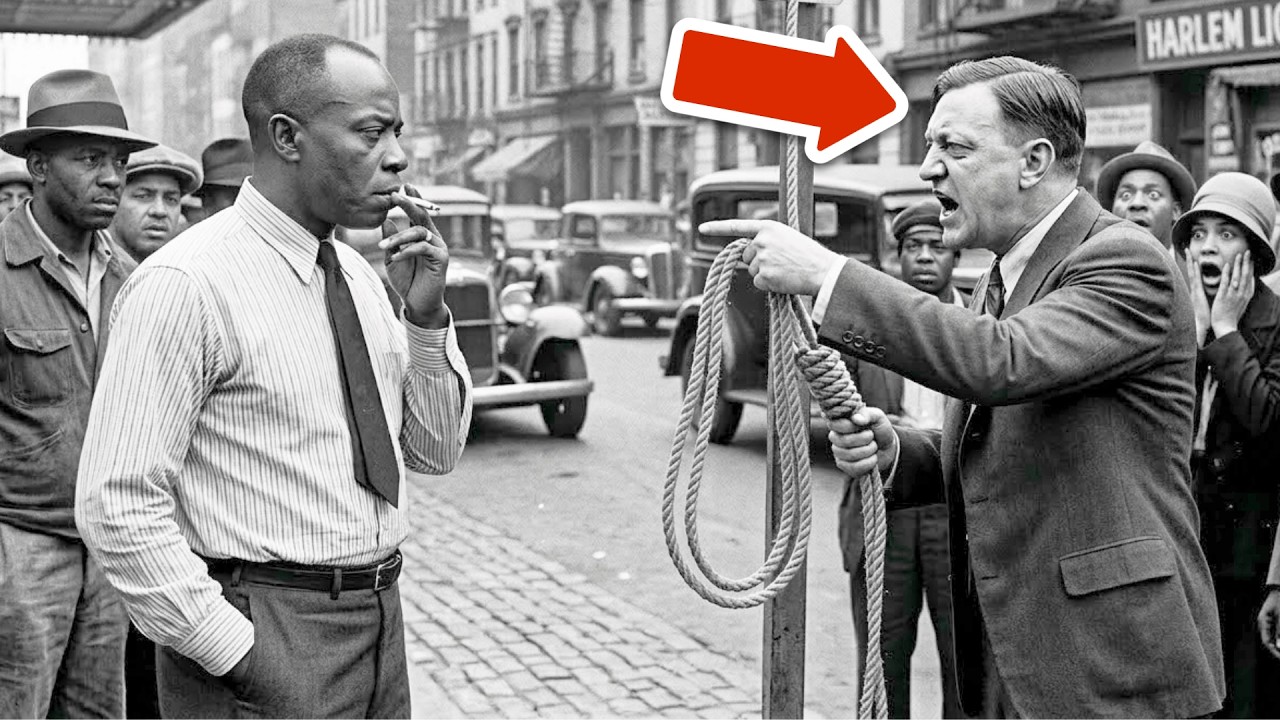
Dutch Schultz stood beside his unopened bottle of whiskey and watched Ellsworth Johnson walk out of his warehouse on his own feet. He did not give an order. No one who was in that room ever fully agreed on why.
The pressure began the following morning. Dutch Schultz did not believe in the slow application of force when rapid overwhelming force was available. Within 48 hours, his operation had deployed across Harlem with the systematic efficiency of a military campaign. Number runners were intercepted. Small gambling operations were visited by men who explained that their arrangements were now void. Shopkeepers received visits from a different kind of visitor.
Within two weeks, Bumpy Johnson had lost nearly 40% of his daily revenue. Runners who had worked for him for years were making quiet departures. The money that funded everything was drying up.
Every night during those two weeks, Bumpy Johnson sat at his kitchen table and read. Calvin came by on the fourth night and found him halfway through a book on military strategy.
"We're losing ground every day. You understand that?"
"I understand that completely."
"Then what are we doing?"
"We are letting Dutch Schultz believe he is winning. A man who believes he is winning stops looking for the trap. And I need Dutch to stop looking."
The first move had begun six weeks earlier, before the rope, before the warehouse. Bumpy had understood that Dutch’s attention was turning toward Harlem long before Dutch made it official. And he had used that lead time quietly and to maximum effect.
Lucky Luciano was in the autumn of 1931 the most structurally significant figure in New York’s organized criminal landscape. He understood that sustainable power required stable arrangements. He was precisely the kind of man who could be approached with a business proposition rather than a plea.
Bumpy requested the meeting through three intermediaries. The meeting took place in a restaurant in Lower Manhattan. A private room. Two men and a meal and a conversation that lasted three hours.
Bumpy did not come asking for protection. He came with numbers. Actual figures. The revenue potential of a stable Harlem operation under a cooperative arrangement versus the revenue lost to all parties under continued instability. He came with an analysis of what Dutch Schultz’s unchecked expansion meant for the broader equilibrium of the city’s underground economy.
And he came with a proposal that offered Luciano something genuinely valuable. A reliable, independently managed partner in Harlem who would maintain order, generate consistent revenue, and require nothing except the weight of his implicit endorsement.
Luciano listened, asked six questions, received six direct and well-prepared answers, and said yes.
The effect on Dutch Schultz was immediate and disorienting. Luciano had not declared open opposition. But his position was communicated through the architecture of small signals that men in this world read with the fluency of a native language. Certain conversations that did not happen. Certain resources that became quietly unavailable.
Dutch Schultz had for the first time in years encountered a ceiling. He did not take it well. But he could not act against it directly. So he refocused his pressure on Harlem. Harder than before.
While Dutch refocused, Bumpy opened a second front, and this one operated entirely in public.
The black press in Harlem in 1931 was not a minor institution. Papers like the Amsterdam News reached tens of thousands of readers. Bumpy had relationships in these rooms, built over years of quiet and consistent support. He now used those relationships to ensure that the story already present was told in its full context.
The story of Dutch Schultz’s campaign against Harlem’s independent operators was framed not as a gangland territorial dispute, but as something it also genuinely was. An external power structure attempting to absorb an economic system that black residents had built for themselves without outside help.
Reverend Thomas, whose congregation on 126th Street was one of the largest in the neighborhood, delivered a Sunday sermon that did not name Dutch Schultz but described with considerable eloquence the pattern of what was happening. The way livelihoods were being dismantled by forces arriving from outside with no investment in what they were destroying.
Community leaders who had maintained careful public neutrality found themselves, when the question became one of neighborhood survival versus outside predation, rather less neutral than they had previously been. City Council members began receiving questions they then felt compelled to ask of the police department and the District Attorney’s office.
Dutch Schultz found his name in newspapers in a way he had not previously experienced. Not as the subject of criminal investigation, which he was experienced with navigating, but as a social villain. A figure in a story about community harm. The political temperature around his Harlem operation began rising in a way that was genuinely inconvenient.
He responded by making his move earlier than planned. The intelligence that reached Bumpy was specific. Dutch had identified a location where Bumpy was believed to meet with his remaining operators on Thursday evenings. A back room in a building on 127th Street. Dutch was sending a team on the coming Thursday.

Thursday evening. The room on 127th Street was empty. It had been empty since Tuesday when Bumpy had quietly moved his meeting location without explanation.
What happened next unfolded with a precision that suggested choreography. Dutch’s team arrived at the building, entered the back room, and found nothing. What they also found within minutes was a significant police presence that had materialized in the surrounding blocks with the timing of people who had been told exactly where to be and exactly when.
Three of Dutch’s men were taken into custody. The others scattered. The operation designed as a show of overwhelming force had instead become a public embarrassment at the worst possible time.
When the news reached Dutch Schultz, the stillness that preceded his response was, according to those present, more frightening than the response itself. He stood in his office for a long moment, not moving. Then he picked up his coat, walked out of the building, and delivered what became one of the most public declarations of personal intent anyone in his organization could remember.
Standing on a street corner in the Bronx, in front of a gathering of associates and bystanders, Dutch Schultz said, in a voice that required no amplification, "I will hang Bumpy Johnson before Christmas. I give you my word."
He meant it. Everyone who heard him understood that he meant it. The rope, which had been a symbolic gesture at the beginning of this story, was now something else. It was now a commitment made in front of witnesses. And Dutch Schultz had built his entire reputation on the principle that commitments made in front of witnesses were kept.
A second rope was acquired. A specific night was selected. The preparation was not symbolic this time.
Then Lucky Luciano withdrew. The message arrived through the same channels the original arrangement had been communicated through. The Commission, the governing body of organized crime families that Luciano himself had helped to establish, had determined that the current situation in Harlem represented an unnecessary escalation. Luciano was stepping back. The arrangement was suspended. He wished Bumpy well in the sense that powerful men wish people well when they are removing their support. Sincerely, briefly, and with finality.
Bumpy received this information alone in his apartment late on a Wednesday evening. For the first time since the rope had appeared, the path forward was not clear. The financial pressure was severe. The political momentum moved too slowly for a rope with a date attached to it. The alliance that had provided the only structural counterweight had just dissolved.
By morning, two more of his people had sent word that they were stepping away. He was, by any reasonable assessment, alone.
What no one knew, not Calvin, not Monroe, not the men who had left, not Dutch Schultz, not Lucky Luciano, was that six months earlier, long before any of the current crisis had taken visible shape, Bumpy Johnson had begun spending time with a man named Edward Conroy.
Conroy was not a neighborhood figure. He was an accountant. Specifically, he was the senior accountant for Dutch Schultz’s financial operation. The man who maintained the books, reconciled the numbers, and tracked the flow of money through the layered and deliberately obscured channels that kept Dutch’s income from being legible to anyone with a legal interest in making it so.
He was, in the architecture of Dutch’s empire, the person who knew everything about how the money actually worked. Which made him, in Bumpy’s quiet and patient assessment, the most valuable person in that empire.
Bumpy had not approached Conroy with money or threats. He had approached him with time and attention. He had learned that Conroy was a man who had spent years being very good at a job that made him invisible. Working in the service of people who used his competence without acknowledging his existence. Carrying the weight of knowledge that was both enormous and completely isolating.
Over six months of occasional meetings, a meal here, a conversation there, nothing rushed, nothing pressured, Bumpy had become something that very few people in Conroy’s world had ever been. Someone who listened to him as though what he said mattered.
On the night that Dutch Schultz led his men to Bumpy’s apartment and found it empty, Bumpy Johnson was seated at a small table in a room in Lower Manhattan, across from Edward Conroy, with a pot of tea between them and a stack of documents beside it.
The documents Conroy placed on the table that night represented the complete financial architecture of Dutch Schultz’s operation. The real numbers. The real channels. The real names. The real flows of money that connected Dutch’s street-level empire to the legitimate businesses and financial instruments that laundered it into respectability.
By early morning, those documents were in the hands of the federal prosecutor’s office.
Dutch Schultz arrived home that night to an empty apartment and a city that was, though he did not yet know it, already irrevocably changed. The rope he had prepared was still coiled in the back of a car. The date he had selected was still on the calendar. The promise he had made in front of witnesses was still, technically, outstanding.
But the ground beneath the entire structure of his power had just shifted in a way that no rope and no date and no number of armed men could address. Because it had shifted in the place where he was most vulnerable and least defended. In the records. In the numbers. In the paper trail that a quiet and invisible man had spent six months deciding to hand to the people who knew exactly what to do with it.
The documents reached the federal prosecutor’s office on a Thursday morning. By Friday, the architecture of Dutch Schultz’s financial empire had begun its collapse. Not with a single dramatic implosion, but with a quiet accelerating sequence of failures, each one triggering the next.
Bank accounts were frozen within days. Business fronts that had operated for years under the cover of legitimacy were suddenly exposed. Associates who had believed their own arrangements safely removed found themselves named in documents they had not known existed.
The allies Dutch had cultivated over years of careful relationship building began their departures with a speed that would have been impressive under any other circumstances. Some sent word through intermediaries. Some simply stopped returning messages. Some, calculating with the cold arithmetic of self-preservation, took the additional step of making themselves visibly cooperative with the very investigation that was dismantling him.
The organization that had seemed, as recently as a month earlier, to be on the verge of absorbing the last significant independent operation in its path was now consuming itself.
Dutch Schultz spent the weeks following the document transfer in a state that those around him described as increasingly difficult to read. The strategic intelligence that had always been the engine of his operation was still present. But the emotional volatility that had always run alongside that intelligence was now operating without the moderating influence of confidence. And confidence had been the one thing that had always, until now, been in reliable supply.
He was brilliant and he was cornered, which is the most dangerous combination in the human character and also, ultimately, the most self-destructive one. He made moves that were bold without being strategic. He made demands of people who were no longer in a position to meet them. He issued threats that had no enforcement mechanism behind them.
The world he had built settled his account in the way that world always settles accounts. Not through courts or legal processes, but through its own internal logic. Its own understanding of when a figure has ceased to be an asset and become a liability too costly to carry.
The rope that Dutch Schultz had prepared for Bumpy Johnson was never used for the purpose it was intended. The date on the paper, November 14th, 1931, passed without ceremony. Dutch was too consumed by the accelerating unwinding of everything he had built to attend to promises made in a more confident season.
And then, not long after, the world he had made found its own resolution to the problem of Dutch Schultz in the manner and by the mechanisms of that world. With a finality that no legal proceeding could have delivered as completely. The man who had walked into rooms and rearranged them by the force of his will ceased to be a factor in any room at all.
The empire dissolved. The name remained. The way the names of cautionary figures always remain. Not as legacy, but as lesson.
The morning Bumpy Johnson walked back down 125th Street, the neighborhood received him the way it had always received him. Not with ceremony, but with recognition. A nod from the man behind the counter at the corner store. A wave from a woman leaning out of a second-floor window. Two teenage boys who stopped their conversation and stood a little straighter as he passed.
Near the lamp post where the rope had hung six weeks earlier, an older man named Clarence was waiting. He had been a fixture of that block for 30 years. He was holding the rope, coiled neatly, someone having taken it down from the lamp post and passed it through a chain of hands until it reached someone who understood what should happen to it next.
Clarence held it out without speaking. Bumpy took it. He stood there for a moment, holding the rope in both hands, looking at it with an expression that the people nearby who remembered that moment would later struggle to describe precisely. Not contempt. Not satisfaction. Not relief exactly. But something that contained elements of all three and resolved into something quieter than any of them.
Then he walked to the trash can at the corner and dropped it in. He did not watch it fall. He was already turning back toward the street, already moving forward in the manner of a man who does not need to watch the past disappear because he has already finished with it.
Monroe found him that evening at the kitchen table. The same position. The same cup of coffee. A different book. Monroe sat down across from him, and for a while neither man said anything.
Finally, Monroe said, "How does it feel?"
Bumpy considered the question with the seriousness it deserved. "Like a Tuesday," he said.
And then, because Monroe’s expression invited something more, "I never wanted a war, Monroe. I wanted to be left alone to do what I do in the place I do it for the people it serves. Dutch made it a war. That was his choice and his mistake. When it was over, it was over. There's nothing to celebrate in the fact that a man destroyed himself."
In the years that followed, the story of the rope on the lamp post and the man who had not run from it became part of the neighborhood’s own telling of itself. Not as a gangster story. Not as a tale of criminal victory over criminal defeat. But as something closer to a parable about what intelligence looks like when it is operating under genuine pressure.
An elderly man named Robert, who had been 19 years old in the autumn of 1931, and who had been standing on 125th Street the morning Monroe read the paper aloud beneath the lamp post, was interviewed by a community historian decades later and asked what he remembered most clearly about that period.
He thought for a long moment before answering.
"Dutch Schultz had everything," he said finally. "He had the money and the men and the connections and the will to use all of it. He had everything a man in that world needed to have."
He paused.
"Except one thing. He didn't have the heart of the people. You can take a lot of things from people by force. You can take their money and their territory and their sense of safety. But you cannot take the thing that makes them choose one man over another when it matters most. Dutch never understood that. Bumpy always did. That's the whole story. Really. Everything else is just details."
The rope that Dutch Schultz had tied to a lamp post on 125th Street was intended to be the ending of a story about one man’s refusal to submit to power. It became instead the opening of a story about what happens when genuine intelligence meets brute force and refuses to be hurried, refuses to be frightened, refuses to be anything other than exactly what it is.
Dutch had written Bumpy’s name on a piece of paper with a date beside it, certain that he was writing a conclusion. What he was actually doing was handing his opponent the first page of a very different story. One in which the rope, the date, the warehouse, the 30 armed men, and the empire behind them all became instruments not of Bumpy’s ending but of Dutch Schultz’s own unraveling.
The rope is long gone. The lamp post is still there. And if you walk down 125th Street today, and you know what to look for, you can still feel something in the air of that block. The particular quality of a place where something important happened. Where a man stood his ground, not with force, but with intelligence. And where the outcome proved, once again, that the most powerful weapon any human being can carry is the one that cannot be seen, cannot be taken, and never, under any circumstances, runs out.