At Prince Philip’s funeral in April 2021, only 30 people were permitted inside St. George’s Chapel at Windsor Castle. COVID restrictions had reduced the service to the barest minimum. The pews sat almost entirely empty. Cameras captured a lone Queen Elizabeth sitting apart from her family, masked and quietly devastated.
Among those 30 mourners, seated with the family and dressed in black, was a woman who was not a relative. Her name was Penelope Knatchbull, Countess Mountbatten of Burma, known to everyone as Penny. She was given one of the 30 seats at the funeral, above dozens of Philip’s own grandchildren, above friends of decades, above politicians and dignitaries who had known him their entire careers. The palace offered no explanation.
That silence, in many ways, is the whole story of Prince Philip. A man who spent 73 years at the side of the most photographed woman in the world, whose every public moment was documented and archived, and yet about whose private life an enormous and deliberate silence was maintained.
To understand the double life, you first have to understand the official life. Philip was born in 1921 as Prince Philip of Greece and Denmark. The title sounded grand, but his circumstances were chaotic. His family was exiled from Greece when he was 18 months old. He was shuttled between relatives across Europe. His mother, Princess Alice of Battenberg, suffered a serious breakdown and was institutionalized when Philip was a child. His father, Prince Andrew of Greece, retreated to a life of pleasure on the French Riviera, largely abandoning his family.
Philip was, in the most literal sense, a royal without a kingdom, without a stable home, and without reliable parents. He was raised by relatives and educated at Gordonstoun School in Scotland, a place that prized physical toughness. He found his footing in the Royal Navy, where he served with genuine distinction during World War II.
By all accounts, the young Philip was brilliant, magnetic, and restless. He was dashingly handsome. He was witty in a way that could shade into cruel. He had an energy and an impatience that made him difficult to contain.
When he married Princess Elizabeth in 1947, he gave something up that few people fully acknowledged at the time. His career. His independence. His name. He surrendered his royal Greek surname and took the Anglicized Mountbatten, only to find even that was stripped from him when the Queen’s advisers insisted the dynasty remain Windsor. He once said bitterly that he was the only man in the country not allowed to give his name to his children.
He could not walk anywhere without a police escort. He could not make a significant decision without palace approval. He was expected to walk two steps behind his wife at all times in public for the rest of his life.
One of George VI’s advisers noted before the royal marriage that Philip was unlikely to be faithful. It was not a condemnation. It was an observation about who Philip was and, implicitly, about the deal that was being struck.
To give himself an outlet, Philip co-founded one of the most exclusive and least discussed gentlemen’s gatherings in post-war London. It was called the Thursday Club. The club met weekly for lunch at Wheeler’s fish restaurant in Soho. The membership was carefully assembled. Journalists, artists, actors, minor aristocrats, naval officers. Men who were witty, well-connected, and, crucially, discreet.
The meetings were rowdy, ribald, and entirely off the record. Among the Thursday Club’s members was a man who would later become a central figure in the most explosive political scandal of the 20th century. A society osteopath and amateur portraitist named Stephen Ward.
Ward was the ultimate social fixer of his era. He moved between the aristocracy and the demimonde, between politics and pleasure. He had a talent for collecting interesting people and introducing them to other interesting people. He also kept a studio and hosted gatherings at the studio of Polish-British artist Feliks Topolski, whose famous studio on the South Bank became a gathering point for London’s artistic and aristocratic worlds.
One journalist reported that Topolski was gregarious and famous for ripe gossip. But when asked about Prince Philip specifically, Topolski said only, “I can’t discuss Prince Philip.” That single sentence was remarkable. A man famous for gossip, who would talk about almost anyone, refusing entirely to discuss one person.
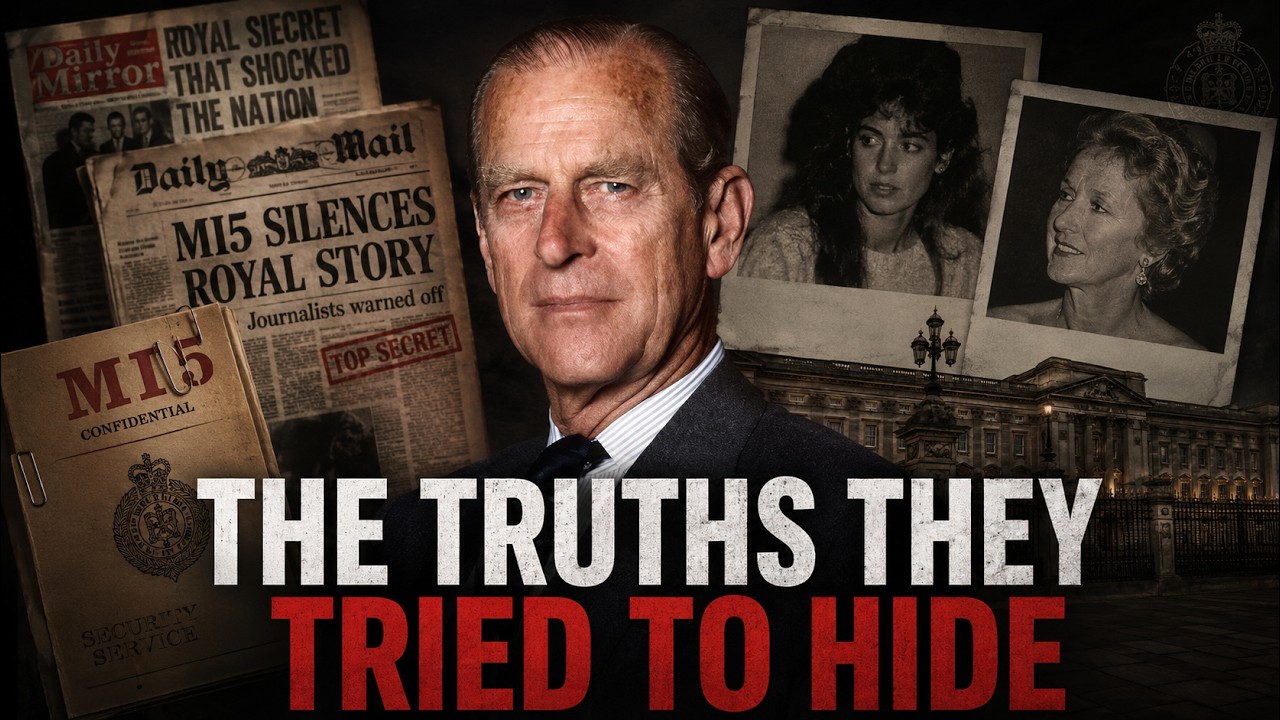
When a journalist later investigated this refusal, a man identifying himself as working for MI5 contacted him and requested a meeting specifically to find out what Topolski had shared about Prince Philip. The British security services were monitoring what Philip’s name was attached to and actively intervening to contain it.
In 1963, Britain was rocked by the Profumo affair. The scandal involved government minister John Profumo, a 19-year-old model named Christine Keeler, and a Soviet naval attaché who was simultaneously her lover and, it emerged, a spy. The security implications were terrifying to the establishment. Keeler had been sleeping with both a senior British minister and a Soviet intelligence officer at the same time.
Stephen Ward, the man who had introduced Keeler to Profumo, was at the center of everything. And Stephen Ward was connected to Prince Philip through the Thursday Club and through London’s overlapping social circuits.
The Ward case prompted the Daily Mirror to run a headline reading “Prince Philip and the Profumo scandal,” in which it dismissed what it called the foul rumor that the prince had been involved, without specifying what the rumor actually was. This is a classic establishment maneuver. You don’t suppress a rumor by naming and denying it. You suppress it by keeping it vague, so that people don’t even know what they should be looking for.
FBI Director J. Edgar Hoover sent a cable to the American Embassy in London in June 1963, revealing that an American businessman had told the FBI there was a rumor that Prince Philip was involved with Christine Keeler and Mandy Rice-Davies. The Americans were hearing Philip’s name in connection with this scandal.
After Ward’s death, he committed suicide by overdose before the jury in his trial had delivered its verdict. His portrait sketches were sold. The collection included portraits of Prince Philip and Princess Margaret. The purchase was made by a man who refused to give his name and paid with a bank draft. The anonymous buyer spirited the images away, and they have never been publicly exhibited since.
Over Philip’s 73-year marriage, a series of women were linked to him by biographers, journalists, and royal insiders. Philip denied affairs throughout his lifetime. The palace never confirmed any romantic involvement beyond his marriage, and several of the women named have themselves denied any impropriety. That needs to be stated plainly.
That said, the pattern of names, the persistence of the accounts, and the seriousness of some of the biographers involved make it impossible to dismiss the subject entirely. Philip was linked, over the course of his life, to a Greek cabaret singer, several actresses, three peeresses of the realm, a famous television personality, a renowned female novelist, the Queen’s own cousin Princess Alexandra, and others.
One of the most consistently cited names is Hélène Cordet, a Greek cabaret singer and television personality who had known Philip since childhood. They had grown up together in Europe’s displaced royal circles. The suggestion that their friendship became something more was persistent enough that Cordet herself was required to deny it publicly on multiple occasions. Her son, Max Boisot, was the subject of paternity speculation for decades. Both denied any connection to Philip.
Another name that appeared frequently in the early years was Pat Kirkwood, a celebrated West End star of the 1940s. Philip and Kirkwood allegedly met on several occasions, and the rumors attached to those meetings were stubborn enough that Kirkwood spent decades attempting to get Philip and the palace to publicly deny them. He never obliged, reportedly saying, “Short of starting libel proceedings, there is absolutely nothing to be done.” Kirkwood died in 1997, still frustrated by the cloud that had followed her career.
Biographer Sarah Bradford, who wrote the definitive biography of Queen Elizabeth II, was direct about her conclusions. “The Duke of Edinburgh has had affairs, full-blown affairs and more than one,” she wrote. “He has affairs and the Queen accepts it. I think she thinks that’s how men are.” She went further. “He’s never been one for chasing actresses. His interest is quite different. The women he goes for are always younger than him, usually beautiful and highly aristocratic.”
Andrew Lownie made a claim in his 2025 biography of Prince Andrew and Sarah Ferguson that generated the most immediate shock and the most vigorous denials. Lownie alleges that Prince Philip had an affair with Susan Barrantes, the mother of Sarah Ferguson, who would later become his daughter-in-law.
Lownie presents the affair as fact. He places the beginning of the relationship in 1966, a full 20 years before Sarah Ferguson married Prince Andrew. The book opens its account of the 1986 wedding with the line that the father of the groom and mother of the bride, lovers 20 years earlier, sat in the third carriage waving.

Lownie is specific about his sources. He cites his wife Angela, who grew up near the Fergusons in Ascot and heard the story firsthand from someone with direct knowledge of the royal social circles of that era. There is also a supporting voice from an unexpected direction. In his 1994 memoir, The Galloping Major, Susan’s first husband, Ronald Ferguson, Philip’s friend and polo associate, wrote, “Prince Philip usually made a beeline for the prettiest girl on the dance floor. He certainly found Susie’s company much more enticing than mine.”
When Lownie appeared on GB News to discuss the claim, conservative commentator Jacob Rees-Mogg dismissed it as just gossip. Lownie’s response was measured but firm. He had interviewed over 300 people for the book and stood by his sources.
The claim has extraordinary implications if true. It would mean that when Philip sat at his son’s wedding, he was not simply the proud father of the groom. He was a man looking at the mother of the bride, a woman he had been intimate with two decades earlier.
According to Lownie’s reporting, Prince Philip had Sarah Ferguson followed and her communication wiretapped during her marriage to Prince Andrew. Whether this was paternal protectiveness toward his son, institutional management of a problem Duchess, or something more complicated and personal, is a question the historical record cannot yet fully answer.
Then there is Penny. Penelope Knatchbull, now Countess Mountbatten of Burma, is the woman who has generated perhaps the most sustained and serious speculation about Philip’s private life. Her connection to him lasted longest, ran deepest, and ended only with his death.
Penny was born Penelope Eastwood in 1953, the daughter of the founder of the Angus Steakhouse restaurant chain. She met Prince Philip when she was around 20 years old and Philip was in his 50s. She later married Norton Knatchbull, the grandson of Lord Mountbatten, Philip’s beloved uncle and mentor who was killed by an IRA bomb in 1979.
The shared grief of Lord Mountbatten’s murder is often cited as one of the foundations of Philip and Penny’s closeness. Their relationship was built around horses and carriage driving, a passion Philip maintained into his 90s. They were photographed together regularly at equestrian events. She accompanied him and sometimes the Queen to the Royal Windsor Horse Show over many years.
There has never been any doubt that Philip and Penny were close friends, and rumors of an affair long dogged them despite the 30-year age gap. The nature of that closeness was publicly debated when The Crown season 5 depicted their relationship in romantic terms. Dickie Arbiter, who served as the Queen’s press secretary for 12 years, called the portrayal cruel rubbish. Other royal insiders insisted their relationship was deep but platonic.
But consider the evidence again. Penny was one of only 30 mourners invited to Prince Philip’s private funeral in April 2021. That funeral was so restricted by COVID rules that many of Philip’s own grandchildren were not present. His children were there, his closest personal staff, and Penny. The palace made no comment then and has made none since.
What we can say with certainty is this. Whatever the precise nature of their relationship, it was important enough to Philip and accepted enough by the Queen that she was considered family in the most private and painful of moments.
Here is the question that Andrew Lownie and others keep returning to. If these stories existed, if journalists knew about them, if foreign intelligence services were tracking them, if biographers were documenting them, why did none of it reach the British public for so long?
The answer is a story of deliberate, coordinated suppression. Start with the press. Fleet Street editors in the post-war decades operated under a set of informal but very real constraints regarding the royal family. Critical royal coverage was considered unpatriotic. Editors who pushed against those constraints found themselves subject to pressure, calls from palace officials, withdrawal of access, suggestions from proprietors that the story wasn’t worth the trouble.
No law prevented newspapers from writing about Philip’s alleged affairs. But the combination of libel risk, the social networks that connected Fleet Street to the establishment, and the cultural assumption that the royals required a particular kind of deference created an effective if informal wall of silence.
As one journalist who investigated Philip’s activities in the 1960s noted, when his team was making inquiries about Philip’s connection to Feliks Topolski’s studio, somebody knew about those inquiries within hours. He received a visit from men identifying themselves as MI5 agents who were specifically interested in what Topolski had said about Philip.
The pattern repeated itself across decades. Whenever a thread led toward Philip’s private life, something intervened. A legal threat. A quiet phone call. A withdrawal of cooperation that made the story impossible to stand up to the standards required for publication.
There was also a more structural reason why Philip’s stories were suppressed. As Andrew Lownie has explained in multiple interviews, attacking Philip was understood in palace circles and in Fleet Street editorial offices as an attack on the Queen herself. Elizabeth II’s entire identity was built around her marriage. She was not merely a monarch, she was publicly and persistently a wife. To suggest that Philip was not faithful, that the partnership was not what it appeared, would be to undermine the Queen. And that the establishment had decided was simply not permissible.
The result was a conspiracy of silence that lasted, largely intact, for over 70 years. Stories were known. Photographs existed. Sources could be named. And yet, within Britain, the silence held.
It is only now, with Philip dead, the Queen dead, a new reign begun, and a new generation of royal biographers less constrained by the old differences, that the full shape of the hidden story is beginning to emerge.
Before drawing any conclusions, a note of important caveat. Much of what has been discussed here is alleged, claimed, strongly suggested by people with serious credentials and solid sources, but not confirmed by documents, not admitted by the parties, not established beyond reasonable doubt.
Prince Philip denied affairs throughout his lifetime. He was, by many accounts, a man of considerable honor in other respects, a devoted father in his own complicated way, a genuinely hard-working public servant, a man of intellectual curiosity and physical courage. The full complexity of any human life resists the neat narrative of simply good or simply bad.
What Andrew Lownie and others are doing, and what history demands, is not a condemnation of Philip, but a reckoning with a system. A system that decided some people were too important, too central, too symbolically necessary to be subjected to the same scrutiny as everyone else. A system that bent the press, involved the intelligence services, and relied on the social solidarity of an elite to keep certain truths from the public that the monarchy was supposed to serve.
Lownie himself has said about the upcoming Philip biography, “People might be ready to hear some of the stories about his private life. People expect more transparency from the monarchy now.”
That expectation of transparency is new. It is a product of the years of scandal, of Diana’s Panorama interview, of the Andrew Epstein catastrophe, of Harry and Meghan’s departures and declarations. The wall of silence that protected Philip for seven decades has been structurally weakened.
What we know now is this. There was a double life. There were people who knew. There were institutions that intervened. And for decades, the British public was told a version of their most famous marriage that was, at best, incomplete.
The story of Prince Philip’s private life is, ultimately, the story of how power protects itself. How institutions decide which truths are permissible and which are not. How the people at the center of national life, the people who are supposed to be most accountable, are often in practice the least so.
Andrew Lownie’s Philip biography is still years from completion. When it arrives, it may be the most consequential royal biography of the modern era.