The morning of May 19, 1836, began in thick silence over the cornfields of Fort Parker, Texas. A thin mist hung low, the sun not yet above the horizon, and the ordinary sounds of the small community filled the air. Nine-year-old Cynthia Anne Parker stood near her mother, holding a container, unaware that her life was about to be torn in two. Fort Parker was not truly a fortress.
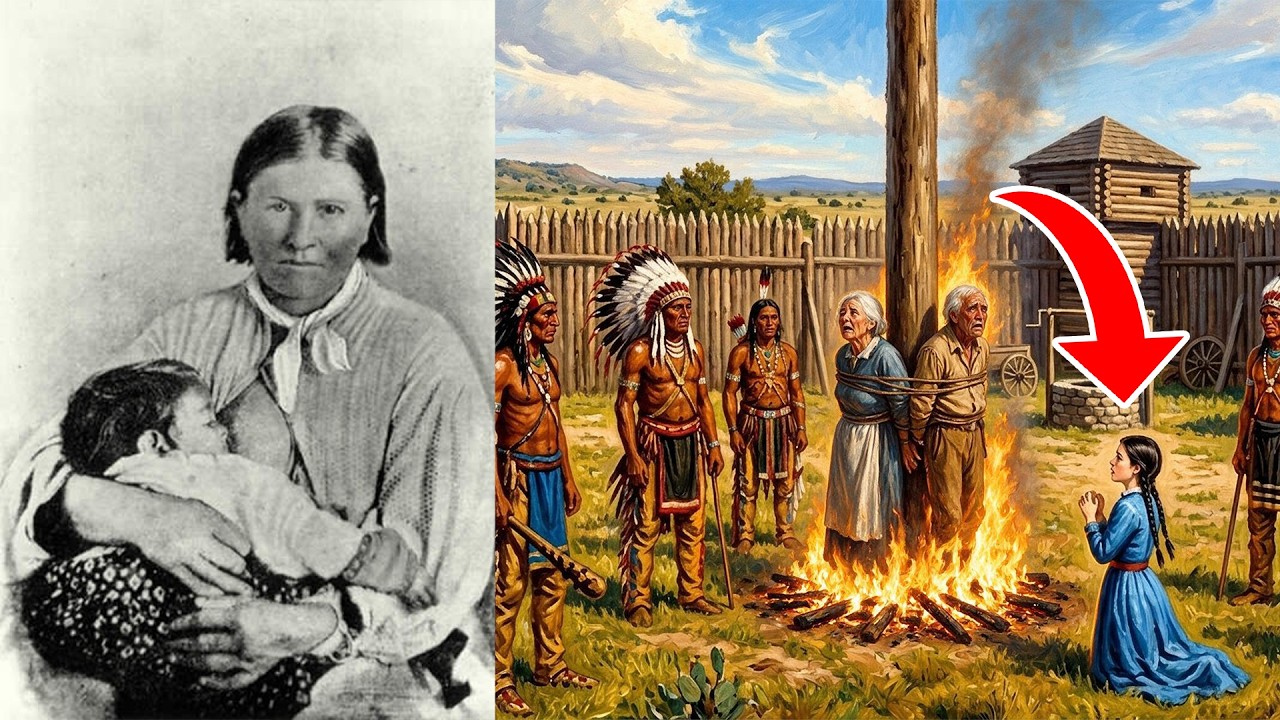
It was a handful of family homes enclosed by thick log walls, a community founded by her grandfather, Elder John Parker. The gates were open that morning because no one expected a threat. Then dust appeared on the horizon. Far away at first, then closer, a cloud rising into the sky.
The colors became distinct. Red-painted faces, feathers, the glint of metal at the tips of lances, the pounding of hooves. A group of roughly six hundred Comanche, Kiowa, and allied warriors approached under a white flag, a sign of peace, or so it was assumed. Her grandfather, Benjamin Parker, walked out to meet them in good faith.
He was cut down by a lance. Within seconds, the community collapsed. Her father, John Parker, tried to gather her into his arms and was killed. Grandparents fell.
Women were wounded. Some fled into the wheat fields. The raid lasted only minutes. Then the warriors took captives.
Cynthia Anne was thrown onto the back of a horse. Her young cousin John Richard, her aunt Rachel Plummer, Rachel’s small son, and another woman, Elizabeth Kellogg, were taken as well. The horses broke into a gallop, and she left behind the world she knew. In popular memory, this story is usually told as a simple tale of an innocent girl kidnapped by savages and eventually rescued.
The truth was more complex. In 1836, the Texas frontier was the meeting point of two expanding worlds. Anglo settlers pushed westward onto lands the Comanche Empire had controlled for centuries. For the Comanche, raiding and the capture of women and children was a long tradition tied to their survival, a way to compensate for population losses from epidemics and war.
For the settlers, it was savagery. But the settlers had seized the same lands with the same ruthlessness. The violence was not one-sided. Only the memory of it was written one-sided, and the dead of Fort Parker were memorialized as victims of a barbarism that needed to be civilized.
The fates of those taken differed. Rachel Plummer endured months of labor and beatings, came close to death twice, and was ransomed after eighteen months. She died shortly after her return at only twenty-one. Elizabeth Kellogg was sold, traded, and eventually recovered.
John Richard was adopted into Comanche society, became a warrior, and for years refused to return. Cynthia Anne’s path was different. In Comanche society, captive children, especially the very young, were not usually kept as slaves but adopted into the tribe. This was partly survival strategy, but for a child it was a chance at life.
She was adopted by a Comanche family. The first months were brutally foreign. The language, the food, the smells of the tipi, the cold nights, and the absence of any familiar face. But the brain of a nine-year-old adapts to survive.
She learned the language, then dreamed in it. She learned horses, leatherwork, beading, the rhythms of the bison hunt, and how to read the wind and the earth. Years passed. By the 1840s, when white traders and officials found her and tried to ransom her, she refused to go.
On one occasion she refused to show herself at all. Another woman spoke on her behalf, saying she wished to stay. She had been given a choice, and she chose her new family and her new life. This was not the story the frontier narrative wanted.
She grew into a young woman and took the name Nadua, meaning something like one who belongs to someone, a beloved person. She married Peta Nocona, a distinguished warrior and chief of the Nokoni band. Sources testify that this marriage was a genuine bond, unusual for a warrior of his status, who could have taken more than one wife, but took only her. They had three children.
Her first son received the most famous Comanche name in history, Quanah, meaning fragrant or blowing wind. Then another son, Pecos, and a daughter, Topsana, Prairie Flower. She had built a complete life. A home, a community, love, and children.
For twenty-four years she belonged fully to the Comanche world. The memory of Cynthia Anne Parker had become a distant echo. In December 1860, that life was destroyed. The Comanche had been weakened by dwindling bison herds, disease, and the relentless pressure of settlers.
Her camp along the Pease River was small, mostly women, children, and the elderly, because most of the warriors were away. In the early morning fog, Texas Rangers under Colonel Lawrence Sullivan Ross, reinforced with army soldiers, attacked. The so-called Battle of Pease River was less a battle than a raid on an undefended camp, the mirror of Fort Parker, with the roles reversed. Gunfire, screams, horses bolting.
She grabbed her baby Topsana and tried to flee, but was caught. A soldier noticed her blue eyes in a sun-tanned face. She was identified as a white woman. In that moment, Nadua ceased to exist, and Cynthia Anne Parker was forcibly resurrected by others who never asked what she wanted.
Peta Nocona is believed to have been killed in the attack, though some historians argue he died later. Her sons Quanah and Pecos were not in the camp that day, or escaped, and she would never see them again. When she was taken to her relatives, to the home of her uncle Isaac Parker, she barely spoke English. She refused to wear white clothing, refused to eat western-style food, and repeatedly tried to escape, desperate to return to the Comanche lands and her children.
Once, when caught attempting to mount a horse and flee, she was never allowed to ride again. The newspapers celebrated her return as a triumphant rescue. The legislature granted her a pension and a piece of land. Journalists arrived to examine the woman who had lived among the savages.
The only question anyone asked was how much she had suffered. When she tried to say she had been loved, that she had a family, no one believed her. She was surrounded by people who thought she had been saved and mourned the sons she had lost. Her daughter Topsana was her only comfort.
But in 1863 or 1864, influenza or pneumonia took the little girl. Cynthia Anne had lost her first family at nine, her second family at thirty-three, and now her last remaining child. In the period that followed, testimonies describe her refusing food, cutting herself in the mourning tradition of the Comanche people, and sitting for hours looking toward the prairie horizon, waiting for her sons to return. The white Texans found this barbaric.
For her, it was the only language her grief had. She was moved between relatives’ homes, but never took root anywhere. In 1870 or 1871, she died of pneumonia or influenza, though many believed the true cause was grief, starvation, the exhaustion of the will to live. She was forty-three or forty-four years old, a woman suspended between two worlds, never fully belonging to either.
The strangest turn of the story came after her death. Her son Quanah grew up in Comanche territory, became a warrior, and rose to become the last great war chief of the Comanche people. He led the resistance in the Red River War of 1874-75, standing tall on his horse amid enemy bullets at Adobe Walls. But the bison herds had been slaughtered, the Comanche source of survival destroyed, and defeat was inevitable.
After surrendering, Quanah underwent a remarkable transformation. He adapted to reservation life, formed partnerships with white businessmen, negotiated with railroad companies, and became a spokesman for his people. He took the surname Parker, from his mother’s family. He never forgot her.
He repeatedly wrote to white officials searching for her, followed leads, and years later found her grave and had her remains moved to Oklahoma, to his own land, beside her family. When he died in 1911, he was buried beside her. Mother and son, fifty years after the raid that tore them apart, were finally together again. Cynthia Anne Parker’s story is not simply a tale of savagery and salvation.
It is the story of how fragile identity is, how it can be constructed, and how cruelly it can be taken away. She lost one identity at age nine and built a new, deep, real one. At thirty-three, that identity was stripped from her in the name of rescue. Both peoples took each other’s children, women, and lands.
The dead at Fort Parker were real. The Comanche women and elders killed at the Pease River were real too. Each side remembers its own pain and prefers to forget the other’s. And Cynthia Anne Parker stands exactly at the point where those two memories intersect.
A woman between two worlds, never fully allowed to simply be herself. For whites, a rescued victim. For the Comanche, a lost mother. For historians, a frontier legend.
For no one, simply herself.