She told anyone who would listen in the summer of 1968 that if they were killing Kennedys, her children were targets. The widow who had watched her husband’s head explode in a Dallas motorcade and then buried her brother-in-law after a hotel kitchen shooting in Los Angeles said she wanted out of the country. Four months later she married Aristotle Onassis, and America decided it understood her perfectly. The grieving icon of Camelot had sold herself for Greek shipping money and a private island.
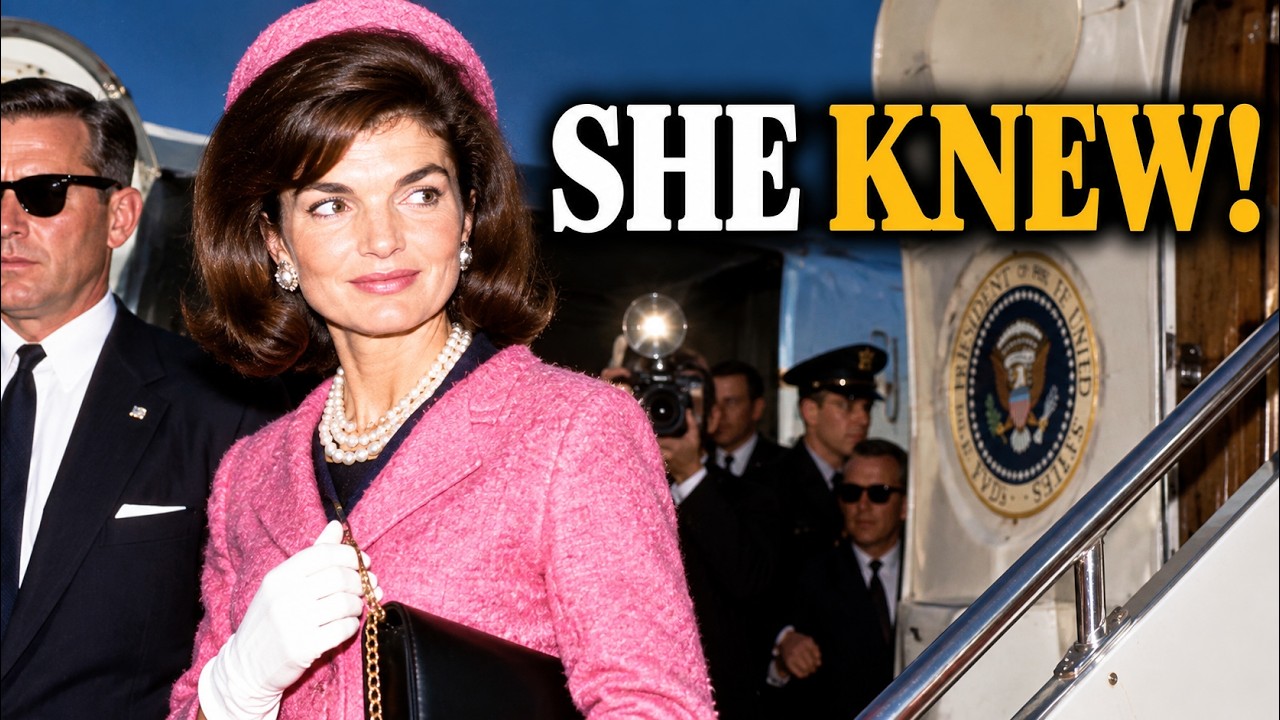
The press turned on her with a fury that shocked even veteran observers. Publications once devoted to her image labeled her a traitor to a sacred memory. Within a week, the woman who had been the most admired figure in the nation became its most public disappointment. That interpretation missed almost everything.
The documents tell a different story, one that begins more than a decade before Dallas. Jacqueline Lee Bouvier was born in July 1929 in Southampton, New York. Her father, John Vernou Bouvier III, a Wall Street broker known as Black Jack, was an alcoholic and a serial womanizer whose money repeatedly evaporated. Her mother divorced him in 1940 and married Hugh D.
Auchincloss, a stepfather connected to the Standard Oil family. That detail mattered more than it usually receives credit for. Jackie grew up inside genuine wealth, but as a stepchild. She lived in the Auchincloss mansions at Hammersmith Farm in Newport and Merrywood in Virginia.
Neither house belonged to her family, and the money in them was not her family’s money. She understood how wealthy institutions worked from the inside, and she knew that her place within them existed only by permission of others. She was educated at Vassar, the Sorbonne, and George Washington University. She spoke fluent French, good Spanish, and passable Italian.
In 1951 she won the Prix de Paris contest for Vogue magazine, and the prize was a job at the journal, which her mother talked her out of accepting. Instead, she became a reporter for the Washington Times-Herald, roaming the city with a camera, asking strangers questions and publishing their answers. She knew how journalism worked from the inside. She knew exactly how a story spread and how a quote landed.
She married John Fitzgerald Kennedy in September 1953 at St. Mary’s Church in Newport. She was 24. He was 36, a senator from a family that operated as a political machine run by its patriarch.
The marriage was difficult from an early stage. Kennedy’s infidelity was not contested then and has not been since. She had a miscarriage in 1955. In August 1956 she delivered a stillborn daughter while her husband was on a yacht in the Mediterranean and did not return immediately.
Caroline arrived in 1957, John in 1960, and in August 1963 their son Patrick was born prematurely at Otis Air Force Base. He lived 39 hours and died of respiratory distress, three months before Dallas. No account of November 1963 treats her as a woman entering that motorcade with an intact life. She had buried an infant in August.
On November 22, 1963, she was beside him in the open limousine. What happened to his head occurred roughly two feet from her. She climbed onto the trunk of the vehicle. Then she refused to change her dress.
She wore the pink suit for the rest of that day, through the flight back to Washington, through Lyndon Johnson’s oath on Air Force One, arriving at Andrews Air Force Base still blood-soaked. She was offered clean clothing repeatedly, and she refused. She said she wanted them to see what they had done. Shock is passive.
This was a deliberate decision about how an event would be recorded. Over the following three days she made a series of similar decisions. She had the Library of Congress research Abraham Lincoln’s funeral and modeled the ceremony on it. She ordered the riderless horse and requested the eternal flame at Arlington herself.
She walked behind the coffin from the White House to St. Matthew’s Cathedral, accompanied by heads of state, against the advice of a Secret Service still handling an unsolved assassination. She staged the most influential political ceremony of the twentieth century. A week after the funeral she summoned journalist Theodore H.
White to Hyannis Port in the rain for an interview with Life magazine. She told him her husband had loved the musical Camelot and played its record at night. She steered him toward an image of a brief, shining moment. White later admitted to doubts, and his editors questioned the frame, but he published it because she wanted it published.
In one week, a widow of eight days had created the myth that governed American understanding of that presidency for sixty years. Then came the loss of control that changed everything. In 1964 the Kennedy family authorized writer William Manchester to produce the official account of the assassination. Jackie gave him roughly ten hours of recorded interviews in which she spoke with extraordinary candor about the murder, her marriage, and its aftermath.
The agreement gave the family approval over the final text. Manchester submitted his manuscript in 1966. The family wanted changes. His portrait of Lyndon Johnson angered Robert Kennedy, and the intimate material she had shared she now wanted removed.
Manchester and his publisher refused. In December 1966 she filed suit. The American press turned against her for the first time since Dallas, portraying the widow as a censor wielding money and lawyers against a writer she herself had chosen. The suit settled in early 1967.
Some passages were removed. The book was published and sold massively. For three years she had controlled the narrative completely. Then a writer she selected, operating entirely within American law and journalism, took her recorded voice describing the worst day of her life and published what he wanted from it, and the courts of the United States did not stop him.
She never gave another substantive interview about the assassination for the rest of her life. The third factor was Robert Kennedy. After Dallas he was her protector, managing her affairs and defending her interests inside the family. On June 5, 1968, he was shot in the kitchen passageway of the Ambassador Hotel in Los Angeles moments after winning the California primary.
He died the next day. She flew to the funeral, rode the train from New York to Washington past two million people lining the tracks, and then said what she said about her children. The assessment was not paranoia. Her husband had been assassinated in 1963.
Her brother-in-law in 1968. Martin Luther King had been killed two months earlier, Malcolm X in 1965. Her children were ten and seven, the most photographed in America. The woman who concluded in June 1968 that American public life had become lethal to her family was reading the newspapers, correctly.
In October 1968 she married Onassis on his private island of Scorpios in the Ionian Sea. He was 62, she was 39. Her lawyers negotiated a prenuptial agreement that provided her with an annual allowance and a fixed settlement upon his death, deliberately kept away from the shipping assets. Most accounts cite the agreement as evidence that the marriage was a business transaction.
It was. But the agreement reveals her priorities precisely. She did not secure a share of one of the world’s great fortunes. She secured income, protection for her children, and above all a change in jurisdiction.
She became the wife of a Greek citizen whose entire commercial empire was structured to resist any government’s reach, including that of the United States. He was a survivor of the burning of Smyrna in 1922, a refugee who had watched his family killed in a civilization’s collapse and responded by building a life no state could touch. She had watched her country kill her husband and her brother-in-law and reached the same conclusion. They understood each other.
The American reaction was ferocious. Within a week she went from the most admired woman in America to a figure of public contempt. The specific content of the anger deserves attention: she had stopped performing the role of the widow. The country had assigned her that role in November 1963, and she had played it so brilliantly that the public began to believe the performance was her identity.
The marriage itself was not happy. They lived largely apart. Onassis resumed his relationship with Maria Callas. In January 1973 his son Alexander died in a plane crash at 24, and Onassis never recovered.
He died in Paris in March 1975. His daughter Christina waged a legal fight over the estate, and in 1977 Jackie settled for roughly 26 million dollars in exchange for a full release. At 47, for the first time in her life, she had capital that belonged entirely to her. She took a job as a consulting editor at Viking Press and later at Doubleday, where she worked for the rest of her life, acquiring and editing more than a hundred books.
Colleagues described her as a serious professional who did the work herself. She campaigned to save Grand Central Terminal, and the case reached the Supreme Court in 1978. The station still stands. She died of non-Hodgkin lymphoma on May 19, 1994, at her Fifth Avenue apartment.
She was buried at Arlington National Cemetery beside John Kennedy under the eternal flame she had requested in 1963, under the name Kennedy. Not on Scorpios, not beside Onassis. In the summer of 1968 a 39-year-old woman who had been widowed twice, whose own recorded testimony about the worst day of her life had been published over her legal objection, and who knew a federal agency held damaging files on her marriage concluded that the United States was not a safe place to raise her children. She found the one living man whose wealth had been structured to remain beyond the reach of governments and signed an agreement with him.
America called it betrayal for a quarter century. The country that watched her husband’s head destroyed in an open car, then watched her walk behind a coffin with the world’s leaders, could not understand why she wanted to get her children out. She told them why, clearly, in 1968.
They were too busy mourning the fact that the widow had stopped standing at the grave.