Edward VIII carried the grandest titles the British monarchy could bestow: King of Great Britain and Ireland, King of the British Dominions beyond the Seas, Emperor of India. He held them for just 326 days. The popular story paints his reign as a fairy tale, a king who gave up a throne for love. That version collapses quickly under scrutiny.
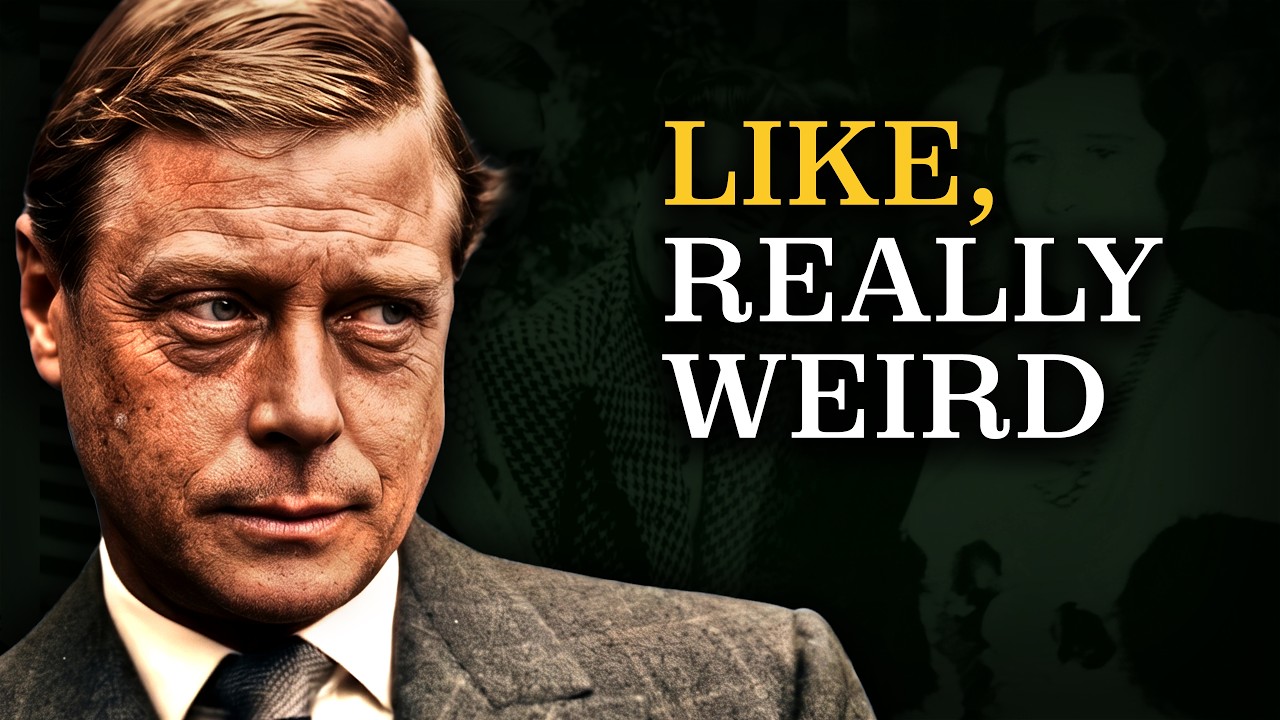
His letters, his relationships, and his documented political sympathies tell a far more unsettling story than any romance. His father, George V, saw it coming with chilling precision. In 1935, a year before his death, the old king told Prime Minister Stanley Baldwin that after his passing, the boy would destroy himself within twelve months. No one laughed.
The prediction came from a father who had watched his eldest son for four decades and understood that the charm and the recklessness could not be separated. Edward was born on June 23, 1894, at White Lodge in Richmond Park, the eldest son of the Duke and Duchess of York, later King George V and Queen Mary. From his first breath, he carried the weight of the crown. His childhood lacked warmth.
George V ran his household like a warship, discipline first, affection nowhere. Queen Mary loved her children from a formal distance, as Edwardian aristocratic standards required. Edward craved affection and acceptance from parents entirely incapable of providing either. This detail matters because his adult behavior, the desperate, almost childlike attachment to domineering women, mirrored that childhood wound exactly.
Private tutors isolated him before he entered the Osborne naval college in 1907 at thirteen. Two years later, he moved to the Royal Naval College at Dartmouth. He never fit in. In 1914, he joined the Grenadier Guards and desperately wanted to fight at the front, not in a ceremonial sense but with genuine urgency.
Secretary of State for War Lord Kitchener refused his requests repeatedly, reasoning that if the heir to the throne were captured or killed on a French battlefield, the propaganda disaster for Britain would be immense. Edward remained behind the lines, close enough to see and smell the horror, but barred from joining it, a spectator to slaughter he yearned to enter, forbidden by the very status he would later renounce. His years as Prince of Wales were nonetheless a phenomenon. After his investiture at Caernarvon Castle in 1911, he spent the next two decades becoming the most photographed man alive, a walking public relations campaign for an empire that desperately needed one.
He toured Canada, India, and Australia, talking to ordinary people naturally, remembering names, apparently enjoying the crowds. The press and public adored him, transforming him into a symbol of a monarchy moving toward modernity, a prince for the jazz age. Behind the charm, serious concerns grew. His private secretary Alan Lascelles documented emotional immaturity so profound it bordered on arrested development.
Edward threw tantrums when opposed, sulked when contradicted, and stubbornly refused to engage with constitutional responsibilities. Stanley Baldwin shared these fears in private. The men closest to the machinery of government believed the future King of England was fundamentally unfit for the job. The very qualities that charmed the public, spontaneity, easy laughter, willingness to break protocol, looked entirely different from behind the curtain.
To the public, he seemed modern. To officials who dealt with him daily, he seemed reckless. His relationships with women followed a fixed and troubling pattern. He pursued married women almost exclusively, with total emotional dependency, obsessive devotion, and a childlike need for maternal approval, then cut them off suddenly and cruelly when a new obsession appeared.
Margaret Alibert, known as Maggi Miller, was a French prostitute he met in Paris in 1917. Their affair ended in 1918, but he wrote indiscreet letters that became a problem when she shot and killed her husband in 1923. The jury acquitted her, though some biographers allege royal intervention behind the scenes. Freda Dudley Ward represented the saddest chapter.
They met in early 1918 during a Zeppelin raid and she remained his primary mistress for sixteen years, from 1918 to 1934, while married to a Liberal MP. He ended it with remarkable cruelty. In 1934, fully consumed by Wallis Simpson, Edward simply instructed the Buckingham Palace telephone operator to refuse all calls from Fredda. Sixteen years of intimacy collapsed at the hands of a switchboard operator following orders.
One day she could reach him. The next day, silence. No explanation was ever given. Between Freda and Wallis came Thelma Furness, who hosted him often at her country estate and performed the most consequential act of social courtesy in 1931 when she introduced Edward to Wallis Simpson.
Her own relationship with Edward collapsed in early 1934 when she returned from an American trip to find Wallis had completely replaced her in her absence. Bessie Wallis Warfield was born June 19, 1896, in Blue Ridge Summit, Pennsylvania. She married a U. S.
Navy pilot in 1916, divorced in 1927, then married Ernest Simpson, a British-American shipping executive, in 1928. By the early 1930s, the Simpsons lived in London, moving in circles at a comfortable distance from royal life. She met Edward on January 10, 1931, at Thelma Furness’s home. By early 1934, with Thelma abroad, the relationship intensified into something all-consuming.
Edward depended entirely on Wallis’s approval, showered her with money and jewelry, and displayed devotion so intense that even sympathetic observers found it troubling. The objections to her as queen were structural and constitutional. As king, Edward would serve as Supreme Governor of the Church of England, which at the time strictly forbade the remarriage of divorcees whose former spouses were still living. Since both of Wallis’s former husbands were alive, a king marrying a twice-divorced woman would head a church that officially condemned his own marriage.
Baldwin and the government flatly refused to accept Wallis as queen consort. Australia, South Africa, and Canada declared they would not accept a divorced woman as queen. The Irish Free State treated the crisis as an opportunity to accelerate its constitutional independence. MI5 investigated Wallis, examining claims of an affair with German Ambassador Joachim von Ribbentrop and possible state secrets, but found no conclusive evidence for either allegation.
George V died on January 20, 1936. Edward ascended as Edward VIII. On October 27, 1936, Wallis Simpson obtained a preliminary decree of divorce from Ernest Simpson in Ipswich court. On November 16, Edward summoned Baldwin to Buckingham Palace and announced he intended to marry her, and if the government, church, and dominions would not accept her as queen, he was prepared to abdicate.
A week later, he proposed a morganatic marriage, keeping the crown while Wallis became his wife but not queen, their children excluded from succession. On December 2, the dominions rejected the proposal. His options narrowed to two: give up Wallis, or give up the throne. For months, the British press had maintained an implicit agreement of silence on the king’s relationship while American and European papers printed the story for weeks.
That silence shattered on December 3, 1936, when a vague sermon by the Bishop of Bradford gave provincial newspapers enough cover to begin publishing what everyone in London political circles already knew. Within hours, the national press followed. The crisis went public. On December 10, 1936, at Fort Belvedere, his beloved country retreat in Surrey, Edward signed the instrument of abdication.
A strikingly ordinary document of a few paragraphs, a signature, witnessed by his three brothers. It took minutes. Parliament passed the Declaration of Abdication Act the next day, formalizing what the stroke of a pen had accomplished. That evening, December 11, Edward sat before a microphone at Windsor Castle and delivered a radio address that would become one of the most quoted speeches of the twentieth century, written with help from Winston Churchill.
Its centerpiece sentence landed like a hammer: he found it impossible to discharge his duties as king without the help and support of the woman he loved. Two days later, the Archbishop of Canterbury, Cosmo Gordon Lang, delivered his own broadcast, condemning with full moral authority a man who had abandoned sacred duty for what Lang considered base personal indulgence. Edward was created Duke of Windsor. In May 1937, George VI issued letters patent granting the duke the title of Royal Highness but explicitly denying it to Wallis and any future children, a deliberate, personal, permanent exclusion that festered for decades.
Edward married Wallis on June 3, 1937, at Château de Candé in France, at a property borrowed from a sympathetic friend. No member of the British royal family attended. In October 1937, Edward did something historians still debate. He toured Nazi Germany against the explicit wishes of the British government, meeting Adolf Hitler at the Berghof.
The former king appeared in photographs giving the full Nazi salute. The damage was irreparable. During the war, while in Spain and Portugal, Edward expressed defeatist and pro-fascist sentiments recorded by intelligence agencies on both sides. German diplomatic telegrams revealed Operation Willi, a Nazi plot to kidnap the duke and possibly install him as a puppet king over a conquered Britain.
Winston Churchill solved the immediate problem by appointing Edward Governor of the Bahamas in 1940, a de facto exile that kept him warm, distant, and constitutionally irrelevant for the duration of the war. After the war, the couple settled in Neuilly-sur-Seine, a wealthy Paris suburb, living out their remaining decades in a strange state of voluntary exile. Free in theory to return to Britain, unwelcome in practice. Active socially, politically neutralized.
Biographers have never agreed on how to judge him. Frances Donaldson called him a disaster avoided. Philip Ziegler depicted a man cursed with extraordinary charisma and total self-absorption. Andrew Lownie documented what he described as extensive evidence of behavior amounting to treason during the war years.
Edward died of throat cancer on May 28, 1972, in Paris, aged seventy-seven. His body returned to England for burial in the royal burial grounds at Frogmore, Windsor, the same Windsor where he had sat before a microphone thirty-six years earlier to tell the world he could not rule without the woman he loved. His father had predicted he would destroy himself in twelve months.
He managed it in eleven.