In the spring of 1944, the Allied command in Italy faced a situation that military academies would never dare put on an exam. A general watched his subordinate ignore a direct order. He watched an entire enemy army slip through a gap that should have been closed. And he did absolutely nothing.
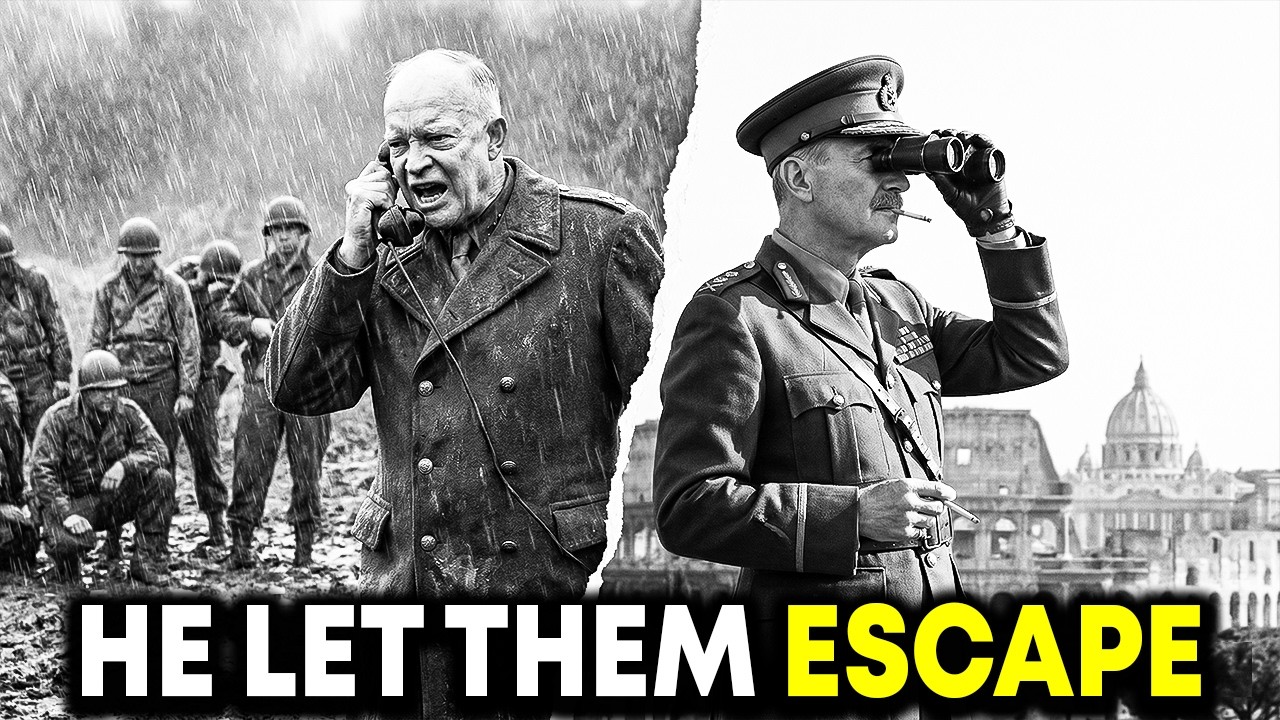
In most organizations, there is a word for that kind of behavior. In the Allied command structure in Italy, they called it leadership. The Italian campaign remains one of the most misunderstood chapters of the Second World War. Not because the facts are hidden, and not because the records were lost, but because the truth of what happened there is uncomfortable.
And it had nothing to do with the enemy. The Germans fought well in Italy, brilliantly at times, but they did not win. They were not supposed to. What prolonged the campaign by months and cost thousands of lives that did not need to be spent was a failure that happened not at the front line but in the command tent, around maps and telephones, among men who knew exactly what needed to be done and chose, every time, the easier path.
By the summer of 1943, the Allies had crossed the Mediterranean and landed on the shores of Sicily. The fall of Mussolini followed weeks later. Italy, the soft underbelly of Europe as it had been promised, was open. On paper, the plan was elegant.
Push north. Draw German divisions away from France. Open a second front that would force Hitler to spread his resources thin. Keep the pressure relentless until the whole southern flank of the Reich began to buckle.
But Italy is not a map. It is a spine of mountains and narrow valleys, flooded rivers, and ancient hilltop towns turned into natural fortresses. Every mile north came at a price. Leading this effort was a coalition of allied armies—British, American, Canadian, New Zealander, Polish, French—all operating under a chain of command that looked clean on an organizational chart and was in practice something else entirely.
At the top of the Allied command structure in the Mediterranean sat General Dwight D. Eisenhower. He was methodical, direct, fiercely committed to making coalition warfare actually work. He understood that for an alliance to function, egos had to be managed.
But he also understood that vagueness at the command level had consequences measured in lives. Directly beneath him, overseeing the ground campaign in Italy, was British General Harold Alexander. Charming, well-liked, a natural diplomat in uniform, Alexander was a man whose style of leadership was so hands-off that his subordinates sometimes wondered whether he was leading them at all. Eisenhower and Alexander were not enemies.
They were, in many ways, genuinely fond of each other. But the way they understood command could not have been more different. Eisenhower believed in issuing clear objectives and holding his generals accountable when those objectives were not met. He was not a man who enjoyed confrontation, but he was willing to have the hard conversation when the mission required it.
Alexander believed in something closer to guidance. He would suggest, he would indicate, he would leave room for his army commanders to find their own ways toward the goal. In a different war on a different continent, this might have been called strategic flexibility. In Italy, in the winter and spring of 1944, it became something more dangerous.
Because one of Alexander’s army commanders, American General Mark Clark, was a man who did not fill a vacuum with caution. He filled it with ambition. In January of 1944, Allied planners executed one of the boldest strokes of the Italian campaign: an amphibious landing at Anzio, a small port town just thirty miles south of Rome. The idea was audacious.
Land behind the German defensive line, cut their supply routes, and threaten the capital itself. The first hours were almost miraculous. Allied troops came ashore against minimal resistance. The road to Rome lay open.
German commanders caught flat-footed scrambled to respond. And then nothing. The Allied commander on the beachhead, General John Lucas, halted. He consolidated.
He built defenses instead of exploiting the breakthrough. He was a cautious man by nature, and caution at Anzio in those first critical days handed the Germans exactly the time they needed to seal the beachhead off. Within weeks, what had been an opportunity became a siege. Allied soldiers dug into the mud of the Anzio perimeter while German forces poured in from every direction.
The breakout that was supposed to unlock Rome had become its own kind of trap. Where was the pressure from above? Where was Alexander insisting that the momentum be maintained, that the opportunity not be wasted? He watched.
He waited. He expressed concern through the proper channels and hoped his commanders would find their footing. They did not. While Anzio festered, the main Allied force further south was battering itself against what the Germans called the Winter Line, a layered system of fortifications anchored on the heights around the town of Monte Cassino.
A Benedictine monastery, ancient and imposing, looked down over the only viable road north. Three major Allied assaults failed, each one costly, each one stopped short by terrain and by a German defender who understood the ground better than anyone. The campaign was not lost, but it had lost its momentum, its shape, and increasingly its coherence. Different national armies were being assigned different sectors with different objectives, and the overarching coordination that should have knitted them together was at best intermittent.
Eisenhower by this point had been reassigned. He was needed in England to plan the great invasion of France. The Italian theater and all its complications now fell fully to Alexander and to his army commanders. And one of those commanders was already planning something that had almost nothing to do with the strategy he had been given.
By late May of 1944, the pieces finally aligned. The Anzio beachhead broke out at last. The Winter Line cracked. The German forces, stretched, exhausted, finally outmaneuvered, began to pull back.
Alexander’s plan, Operation Diadem, was clear in intent. The breakout from Anzio was to drive northeast, cutting the primary German withdrawal route, Highway 6. The German 10th Army retreating from the south would be caught between the anvil of the advancing Allied line and the hammer of the Anzio force. It was, in military terms, a potential encirclement, the kind of move that ends campaigns.
Mark Clark had a different idea. Clark turned his forces west toward Rome. Rome was not a military objective of particular strategic importance at that moment. But it was a city, a symbol, and it was the kind of symbol that made careers, that filled front pages, that placed a general’s name in the history books.
Clark drove for Rome. The German 10th Army, the force that was supposed to be cut off, simply walked north along the roads that had been left open. Divisions that should have been destroyed or captured instead escaped into northern Italy, where they would fight for another year. Alexander knew what was happening.
His staff knew. The orders were unambiguous. And he did not stop it. He did not pick up the telephone and demand compliance.
He did not relieve Clark of command. He did not make the call that every instinct in his military training told him had to be made. He allowed the moment to pass. Rome fell to Allied forces on June 4th, 1944.
Mark Clark entered the city in triumph. Photographs were taken. History, or at least a version of it, was made. Two days later, the world’s attention shifted entirely to a beach in Normandy.
The Italian campaign, which had consumed so much—so many lives, so much material, so much time—was buried beneath the weight of the larger story. But the German 10th Army that escaped the Anzio trap kept fighting. The Italian campaign, which some planners had believed might be concluded by the end of 1944, dragged on until the very final days of the war in Europe. Every week of that prolonged struggle had a cost measured in the most concrete terms possible.
Could one decisive order from Harold Alexander have changed that? Could the campaign have ended months earlier if Clark had been forced to execute the plan as written? These are questions that historians have argued ever since, and the arguments seven decades later remain unresolved. Not because the evidence is unclear, but because the nature of command is genuinely complicated.
Because the line between flexibility and abdication is not always easy to see in the moment. The Italian campaign is not remembered the way Normandy is remembered. It does not have the same mythology, the same monuments, the same grip on the popular imagination. It was a campaign of grinding miles and cold nights and objectives that seemed always just beyond reach.
But it was also a campaign that illuminated something essential about the nature of military leadership. Command requires clarity. Coalition requires trust. But trust extended without accountability is not generosity.
It is a transfer of responsibility to people who may not share your goals, or who may simply be unwilling to sacrifice their own ambitions for the mission. Harold Alexander was by most accounts a genuinely admirable man. Eisenhower respected him. His soldiers liked him.
He was not a villain in this story. But the Italian campaign did not need a villain. It needed a commander. And that, in the end, is the most sobering lesson of all: the worst outcomes in history are not always the result of malice.
Sometimes they are the result of a good man who simply could not bring himself to give a hard order—and a mission that paid the price.