Marjorie Merriweather Post was born in Springfield, Illinois, in the spring of 1887. She was the only child of Charles Post, a restless and gifted man who had failed at selling farm machinery, rifles, sewing machines, and bicycle parts. The year his daughter was born, the family moved to Texas, chasing the next chance after the last one had collapsed.
Charles Post’s mind was fragile. Historians count seven nervous collapses across his life. One of the worst brought the family to Battle Creek, Michigan, where the Kellogg brothers ran a famous sanitarium promising cures for the nervous and the sleepless. Marjorie was four years old when her mother carried her along on that journey.
The Kellogg cure did little for Charles Post. By the family’s account, it was faith that steadied him, a Christian Science healer doing what doctors could not. That faith passed to his daughter and stayed with her to the end of her life.
Out of his search for something to settle his own stomach, Charles Post began roasting grain into a warm brown drink he sold as a coffee substitute. He incorporated his company on the first day of 1895. Within a few years, he added a hard baked cereal he named Grape Nuts and then the toasted flakes of corn that would carry the family name into every kitchen in the nation.
Charles Post’s real genius was salesmanship. He spent more than a million dollars a year telling the nation his cereals would cure its ailments. The country believed him and bought Grape Nuts. Within roughly ten years, the company was worth something near $10 million.
Marjorie was ten years old when she began sitting in on board meetings of the company. She worked in the plant, pasting labels onto jars and folding boxes in the barn where the first work was done. Her father gave her stock when she was still a girl, shares said to be worth millions by the time she was sixteen.
He gave her a way of standing in the world. If she were ever cast ashore on a desert island, her father once said, she would set about organizing the grains of sand. She told that line often in her grand years because it was true and because it had come from him.
In the autumn of 1904, when Marjorie was 17, Charles Post divorced her mother Ella and within weeks married his young secretary. It was the first time Marjorie learned a lesson she would spend the rest of her life relearning: that money does not hold a marriage together.
Her mother died a few years later quietly in her sleep. Her father would not last a great deal longer.
On a spring day in 1914, in a house in Santa Barbara, Charles Post put a gun to himself and died. He was 59 years old. He had been ill for months with a pain in his stomach that nothing could name or ease. The man who built a fortune selling cereals advertised as cures for gut ailments was broken by a stomach illness at the last.
Marjorie was 27 years old. She was his only child, the heir he had trained with his own hands. She never spoke openly about what that loss did to her. She took the pain and did with it precisely what her father had trained her to do with everything else. She put it in its place and went to work.
The fortune that came down on her was enormous, around $20 million, a sum worth many hundreds of millions in a later century. It made her at 27 one of the wealthiest women in the United States and quite possibly the wealthiest of them all.
The money did not come cleanly. Charles Post had divided control of the company between his daughter and his second wife. Marjorie disputed it. In the end, the two women settled without a courtroom. Ila surrendered her shares in exchange for a payment of $6 million.
At 27, Marjorie held all of it. The company was already selling close to $20 million of cereal every year. Under her ownership it would grow into a fortune valued near a quarter of a billion dollars.
Here is the strange defining fact of her whole life. She owned the company. She did not run it. For a very long time she was not even permitted to sit at the table where it was run. The reason was as simple as a wall. She was a woman.
This was the America of 1914. A woman might own a great corporation outright and still be judged unfit to take a seat on its board. Her husband held her seat. When that marriage ended, a trusted friend was installed to hold it for her. She would spend 22 years like this, the sole owner who was not allowed to be the director.
She had already married years before the fortune fell on her. His name was Edward Close, a handsome young lawyer from an old and proper Connecticut family. They wed in the winter of 1905 when Marjorie was 18. Two daughters came quickly, Adelaide in 1908 and Eleanor the year after.
Edward Close was a conventional man. He liked the settled rhythms of Greenwich society. Charles Post reached an unsentimental verdict that Edward Close had no real appetite for leading the company and never would.
Then came the war. When the United States entered the fighting in 1917, Close went into the army and served overseas as an officer. In his absence, Marjorie unfolded. She poured her fortune into the war effort at a scale that astonished everyone around her.
She paid for and equipped an entire military hospital in France, a vast facility that grew to hold thousands of beds. When the first ship carrying her supplies was accidentally sunk in New York Harbor, she simply sent the whole shipment again on the next vessel out. France would later make her a commander of the Legion of Honor.
In the autumn of 1917, she joined a delegation of women who went to the White House to press the president on the question of the vote. In New York, moving among artists and financiers while her husband soldiered overseas, she found a life so much larger than Greenwich.
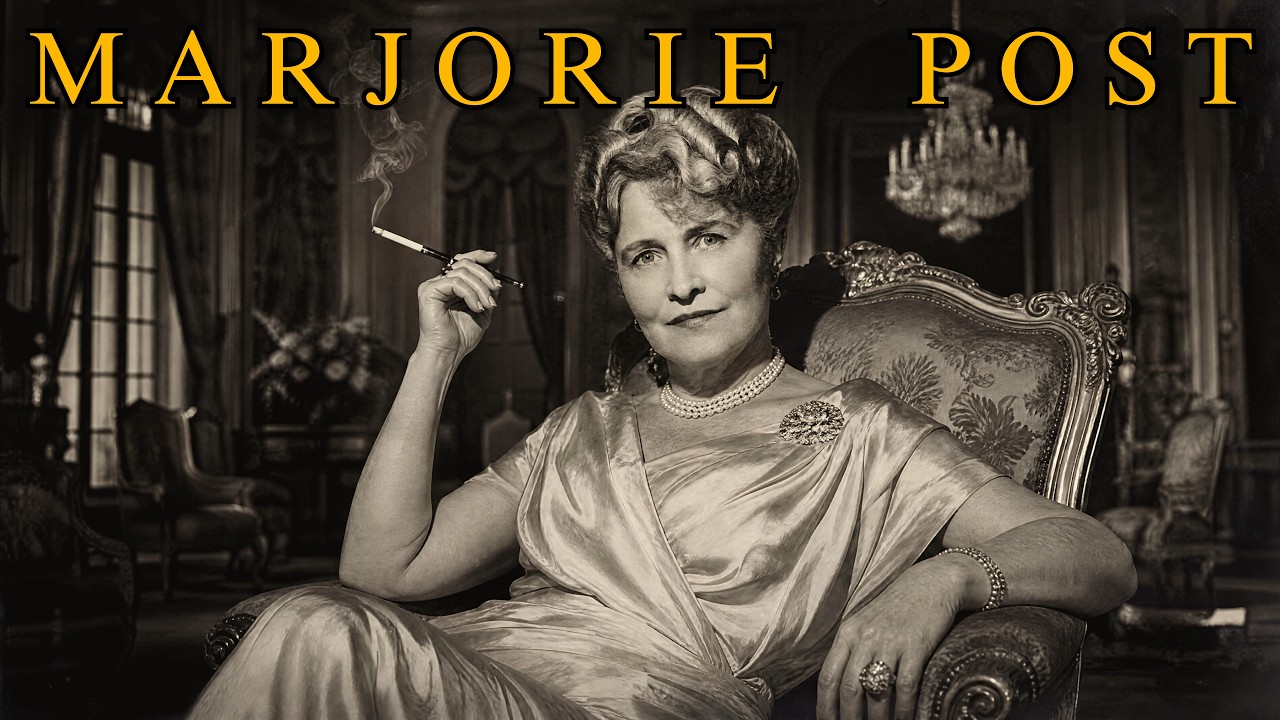
When Edward Close came home, he found a woman transformed. There was no scandal, no betrayal. They divorced in 1919. Marjorie kept the daughters and walked out of that marriage as a woman who had chosen to leave.
The second husband was at last something close to a match. His name was Edward Hutton, and everyone in America knew the name because it hung over one of the great brokerage houses of Wall Street. When he married Marjorie in the summer of 1920, he took hold of the company with both hands.
Together they built an empire. Hutton took the Postum Company public, and they set out on a decade-long campaign of acquisition. Jell-O came in. The Maxwell House coffee business came in. Baker’s chocolate, Log Cabin syrup, Calumet baking powder. Brand after brand until the modest cereal company had become something the country had never seen.
In 1929 they gave the giant its new name. The Postum Company became the General Foods Corporation, the largest food company in the United States. Marjorie Post owned the controlling share of the whole of it.
The single most important acquisition in that campaign was her own doing. Marjorie was cruising off the coast of New England when the cook served up a goose that had been frozen, then thawed, then roasted. She was struck by how fresh it tasted. She asked where it had come from.
The answer led her to a man named Clarence Birdseye, an inventor who had learned a way of freezing food so fast that it kept its texture and flavor. Marjorie understood at once what she was looking at. She was looking at the future of how an entire nation would eat.
Her husband could not see it. Hutton resisted the idea for years. Marjorie kept pushing. At last, in 1929, General Foods bought the Birdseye business for a sum around $22 million. It remade the American kitchen, and it proved her right for the rest of the century.
There was a new daughter in these years, Nadenia, born in 1923. She would one day shed the family name for the stage and become the actress Dina Merrill.
And there was, rising out of the sand in Florida, the thing that would define her forever. She told Edward Hutton she wanted to build a modest little place by the sea. What rose instead would have 118 rooms.
It took the better part of four years to build, from the early 1920s to its completion in 1927. It consumed a sum reported near $7 million in the money of the day. Six hundred workers labored on the house. It rose to 118 rooms with 58 bedrooms and 33 bathrooms, crowned by a tower 75 feet high.
Marjorie sent to Italy for boatloads of pale stone, three whole shiploads of Doria limestone. She stripped an old Spanish castle in Cuba of its treasures and had them shipped north. Some 20,000 roof tiles and 2,000 blocks of black and white marble for the floors. There was gold leaf across the ceilings and fixtures of gold in the bathrooms.
She named it Mar-a-Lago, Spanish for “sea to lake,” for the ribbon of Palm Beach it commanded from the Atlantic Ocean to Lake Worth. Even Edward Hutton marveled at what his wife had conjured out of the sand. She had said she was going to build a little cottage by the sea, he would tell people. Look what we got.
Mar-a-Lago was only the grandest jewel in a whole crown of houses. There was Camp Topridge in the Adirondack Mountains, a rustic empire of nearly 70 buildings where every guest cabin came with its own dedicated butler. There would in time be a triplex apartment in New York of 54 rooms, said to be the largest apartment in the whole city.
And there was the yacht. At the start of the 1930s, she built a four-masted bark more than 300 feet long. When it was launched, it was the largest private sailing yacht in the entire world. She took a course in marine engineering so she could understand her own vessel from the keel up.
The trouble was Edward Hutton, and the trouble was other women. The charming financier turned out to be a serial adulterer. By the middle of the 1930s, his affairs had grown impossible to ignore. The one that finally broke the marriage was close to home. Hutton had taken up with a member of the household staff, a maid who lived and worked under Marjorie’s own roof.
To win a divorce, a wife needed grounds. In practice, the only reliable ground was hard proof of adultery. And so Marjorie, betrayed inside her own home, set about gathering that proof herself.
She laid little bells that would sound if a door was opened in the night. She stretched fine threads of silk across doorways that would break silently if someone passed through. She dusted talcum powder across the floors so that footprints would show in the morning.
The mistress of Mar-a-Lago crept through her own palace at night, laying traps for her own husband, because it was the only way the law of the age would ever let her be free of him.
She got her proof. The marriage ended in 1935. Her biographer records that the divorce from Hutton was a blow to Marjorie’s pride from which she never fully recovered. Of all four husbands, Hutton was the one who came closest to being her genuine equal.
The end of the marriage meant the end of Hutton’s grip on her boardroom. In the spring of 1936, a woman who had owned one of the largest companies in America for 22 years finally sat down at its board table. The date was the 9th of April. Marjorie Post, newly divorced, joined the board of directors of the General Foods Corporation.
She was 49 years old. She had owned the company since she was 27. It had taken her 22 years and the collapse of a marriage to win a seat at a table she had owned outright the entire time.

She proved a working director in earnest. She held her place through boom and depression and war. She would keep that seat for the rest of her active life, more than 20 years, until she stepped back near the end of the 1950s.
Weeks after one marriage ended, she began another. The new husband was Joseph Davies, a prominent Washington lawyer. They married at the very end of 1935, only weeks after her divorce, and honeymooned aboard the great sailing ship.
President Roosevelt made Davies the American ambassador to the Soviet Union. So it was that in the late 1930s, Marjorie Post came to be living in Moscow, presiding over the ambassador’s residence at Spaso House and staging dinners of a splendor that must have seemed to arrive from another planet.
She set her tables with French and Russian porcelain and banked them high with orchids flown in from abroad. She was privately appalled by the police state she was living inside, even as her husband went on to write a book that defended the dictator and excused his show trials.
What she carried home from Moscow was a collection. The Soviet regime, desperate for hard foreign currency, was selling off the confiscated treasures of the old Russia. Marjorie bought steadily, shrewdly, at prices that would never come again.
She bought icons and chalices and porcelain. She bought the delicate works of the great imperial jeweler Carl Fabergé. She carried out of Russia the beginnings of what would become the largest collection of Russian imperial art anywhere in the world outside Russia itself.
Among the things that passed into her keeping was one object that runs through the rest of this story like a dark thread. It was the diamond nuptial crown of the last empress of all the Russias, the crown Alexandra had worn on the day she married the last of the Tsars. A frame set with more than 1,500 diamonds.
Alexandra had worn it to her wedding, and Alexandra had been shot to death in the cellar of a house with her husband and her children around her. Now her wedding crown was being sold for hard cash by the very men who had done the murdering.
Marjorie gathered nearly 90 pieces by Fabergé, two of the famous jeweled eggs, and the crown a murdered empress had worn on her wedding day. She assembled the whole of it with the collector’s genius that had run in her since she labeled jars in a Michigan barn.
The marriage to Davies carried its strains from the start. He was possessive and jealous. As the 1940s gave way to the 1950s, Davies grew old and sick and irritable. Marjorie discovered that she could not do the thing a certain kind of wife was expected to do. She could not settle in gently beside a declining man and nurse him toward his end.
She had watched her own father’s mind break again and again across her childhood. She had built an entire life on the refusal of frailty. Faced now with a husband who was becoming a diminished and difficult old man, she chose to leave him.
They divorced in 1955 after 20 years, the longest of her four marriages. When she left Joseph Davies, she settled property upon him, gave him one of their Washington estates as she went out the door.
At 71 years old, three times divorced, the richest woman in America fell in love once more. She wired her granddaughter that she was walking on fluffy pink clouds.
The man was Herbert May, a business executive from Pittsburgh, a patron of the opera and the ballet. He was the poorest of the four. Marjorie simply arranged the money to smooth the difference, setting up a trust to provide for him.
She married Herbert May in the summer of 1958. For a while, it was pure delight. When May, who loved to fly, introduced her to travel by private plane, she decided on the spot that she must have one of her own. She bought a turbo-propeller plane and named it the Merryweather.
She made Palm Beach fall in love with square dancing, hosting evening after evening of it in the great rooms of Mar-a-Lago. The Grand Dame of American wealth called the figures in a full skirt, dancing every single dance herself, even as her hearing began to slip away.
The people closest to her, including her own daughter Dina, had tried to tell her something about Herbert May before the wedding. They had suggested that May’s deepest attachments were not to women at all. She dismissed it out of hand.
A set of photographs arrived on her desk, and with them a demand for money. The photographs showed Herbert May at the pool at Mar-a-Lago in the company of young men, in poses that left nothing whatever to be misunderstood. A blackmailer had gotten hold of them and wanted to be paid to keep them quiet.
As the truth came out into the open, Marjorie learned that the people around her had known, or at the least strongly suspected, all along. Dina, astonished, asked her mother the obvious thing. “You mean you did not know?” And Marjorie, equally astonished from the other direction, answered that of course she had not known, and then turned the question straight back. You mean you did?
The marriage ended in 1964 after six years, the shortest of the four. When Herbert May fell seriously ill some years later, suffering a stroke, Marjorie quietly paid his medical bills and gave him a place to live out his days.
In her last years she went deaf. A butler stood at her shoulder to announce each guest by name so that the woman who had everything need never seem even for a single moment to have no one.
She still threw the great parties. She still called the square dances at Mar-a-Lago. She employed something close to 300 people across her houses, paid better than the going wage. Her butlers set the table with yardsticks, measuring the space between the plates and the silver.
She served her dinners on gilded plates that had once belonged to an emperor of Austria. At the head of the longest private table in Palm Beach sat a woman in her 70s, dressed as if for a state occasion, dining entirely alone.
There is a single exchange from these late years that lands the whole story in a handful of words. The chairman of her own great company looked at her one day and asked the question everyone who had ever watched her must have wanted to ask. Marjorie, he said, you could run General Motors. You could run United States Steel. You are the smartest woman I know. Why do you have so much trouble with husbands?
Marjorie shrugged. “I honestly do not know,” she said. “Ain’t it hell?”
She died in the autumn of 1973 at Hillwood, her house in Washington, 86 years old. Her will revealed the final ambition of a woman who had spent her whole life building things too large for any private person to hold.
She left Mar-a-Lago to the federal government to become the winter White House of the United States, a retreat for presidents. The government took it. And then the government discovered that a palace of 118 rooms is a devouring thing.
The cost of heating it and cooling it and securing it and staffing it was more than the government cared to bear. A few years after her death, the United States handed Mar-a-Lago back. An act of Congress returned the greatest private house in America to the foundation she had left behind, because the richest nation on earth had looked at the arithmetic and decided it was simply too expensive to own.
The palace went back to her foundation and then in 1985 it passed into the hands of a brash young developer from New York named Donald Trump for a sum that was a fraction of what it had cost her to build it.
One by one the houses she had ordered so perfectly slipped out of her family’s hands. Hillwood, her Washington estate, was the house she died in. She left it with a great endowment attached to the Smithsonian. The Smithsonian, weighing the cost against the size of the endowment, declined the gift as too expensive to keep.
But here, and only here, the story turned her way. Her foundation took Hillwood back and opened it to the public as a museum. It stands today holding the largest collection of Russian imperial art anywhere outside Russia. The Fabergé and the icons and the chalices and the diamond nuptial crown, all of it preserved and displayed and open to anyone who wishes to come and see it.
The great camp in the Adirondacks she left to the state of New York. The state found it too costly to run and put it up for auction. It sold in 1985 for around $911,000.
The grandest of her jewels went to the Smithsonian and remain there still, including a great diamond necklace once made for the wife of Napoleon and a pair of earrings said to have belonged to Marie Antoinette.
What survived best of everything she made had no walls at all, and it was the giving. There was the field hospital she equipped in the First World War. There was the great canteen she paid for through the worst years of the Depression, feeding something like a thousand hungry people every single day, served at a proper table rather than standing in a line out on the cold street.
There was the concert pavilion that still carries her family name and the more than a million dollars she gave to the National Symphony. There was the college built on the grounds of one of her old estates, named for her father.
Her daughters carried the name forward into the world. The youngest, Nadenia, became the actress Dina Merrill and made a public name entirely her own in the movies and on television.
In the center of a rose garden in Washington stands a stone urn of deep purple. Marjorie Merriweather Post was laid to rest at Hillwood, in the garden at its very heart. On the base of the monument, beneath her coat of arms, there is a motto set in Latin. Rendered into plain English, it says, “All my hope rests in myself.”
She could have chosen a line of scripture about love or the name of a husband or the name of a child. She chose instead a flat declaration of absolute self-reliance made by a woman who had married four separate times reaching for someone to lean upon and who had learned across four separate failures that in the end there was no one to lean upon but herself.
She had organized the grains of sand exactly as her father said she would. She had organized a small cereal company into the largest food empire in the nation. She had organized a palace of 118 rooms and a sailing ship and a mountain camp of 70 buildings and a household of 300 souls measured to the inch.
She had put everything in its place. The one thing that would never stay in its place, the one acquisition that slipped the catalog every single time, was a husband, a partner, an equal at the center of it all.
She kept the crown of a marriage that was never hers. She kept the palace and lost the people. And when the time came to choose the last words that would stand over her in the rose garden forever, she did not pretend, and she did not reach for comfort.
All my hope rests in myself. She had learned it the hard way in 118 rooms at the head of a table set for one.